世界模型

Search documents
李飞飞最新长文:AI很火,但方向可能偏了
创业邦· 2025-11-23 11:15
Core Viewpoint - The article discusses the limitations of current AI language models, emphasizing that while they are advanced in processing language, they lack true understanding of the physical world, which is essential for achieving genuine intelligence [5][6][7]. Group 1: Limitations of Current AI Models - Current AI language models, like ChatGPT and Google's Gemini, excel at predicting the next word based on statistical patterns but fail to understand basic physical concepts [6][7]. - The analogy of a scholar in a dark room illustrates that while these models can generate coherent text, they lack real-world experience and understanding [7][13]. - AI's reliance on language statistics rather than physical interactions leads to nonsensical outputs, highlighting the need for a deeper understanding of the world [8][13]. Group 2: The Concept of Spatial Intelligence - To advance AI, it is crucial to develop "spatial intelligence," which involves understanding and interacting with the physical world without relying solely on language [8][14]. - The article posits that true intelligence requires the ability to predict physical interactions and outcomes, akin to how humans learn through experience [14][15]. - Examples from child development and scientific discovery illustrate how spatial interactions lead to a deeper understanding of cause and effect [9][11]. Group 3: Future Directions for AI - The future of AI may shift from predicting the next word to predicting the next frame of the world, integrating physical laws and spatial reasoning [14][17]. - Developing a "world model" that incorporates spatial data and physical interactions could revolutionize AI capabilities, allowing for more accurate simulations and predictions [15][17]. - The article mentions ongoing efforts to extract spatial information from 2D videos to train AI models, indicating a significant area of research [17][18]. Group 4: Practical Applications and Opportunities - The emergence of AI with spatial intelligence could lead to practical applications in robotics, enhancing their ability to navigate and interact with real-world environments [20][21]. - Potential use cases include virtual scene generation for design, therapy, and educational purposes, showcasing the versatility of AI in various fields [21][22]. - The ability to convert imagination into tangible reality presents significant opportunities for innovation and entrepreneurship [22][23].


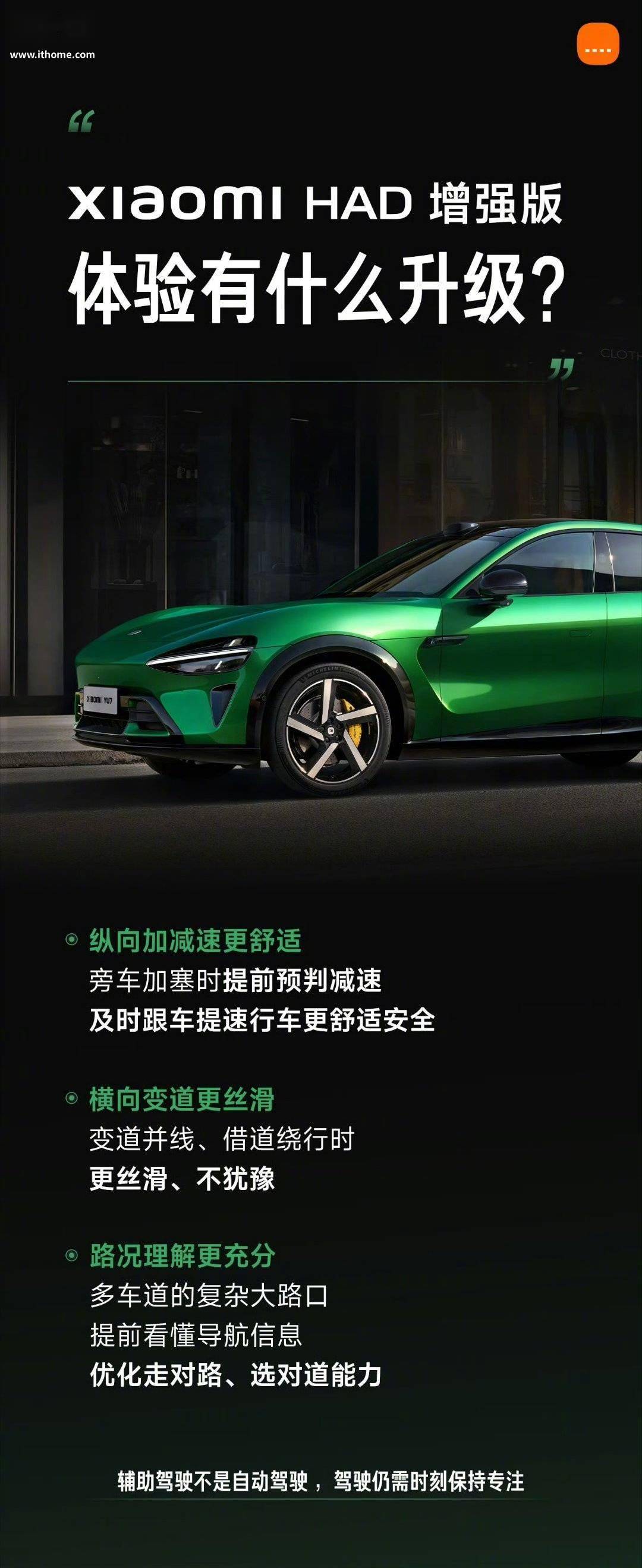
雷军 :辅助驾驶不是自动驾驶,驾驶时仍需时刻保持专注
Sou Hu Cai Jing· 2025-11-23 08:56
Core Insights - Xiaomi has upgraded its end-to-end assisted driving system, Xiaomi HAD Enhanced Version, focusing on comfort and safety during driving [1][4] - The system now features improved longitudinal acceleration and deceleration, allowing for better preemptive braking and acceleration when merging [1] - The lateral lane change experience has been enhanced for smoother transitions, making it more natural during lane changes and detours [1] - The road condition understanding capability has been improved, enabling better navigation in complex multi-lane intersections [1][4] Additional Details - Xiaomi emphasizes that assisted driving is not the same as autonomous driving, and drivers must remain attentive at all times [4] - The Xiaomi HAD Enhanced Version was officially launched at the 2025 Guangzhou Auto Show, incorporating reinforcement learning and world models into its system [4] - Upgrades include AEB (Automatic Emergency Braking) enhancements and the addition of emergency steering assistance [4]

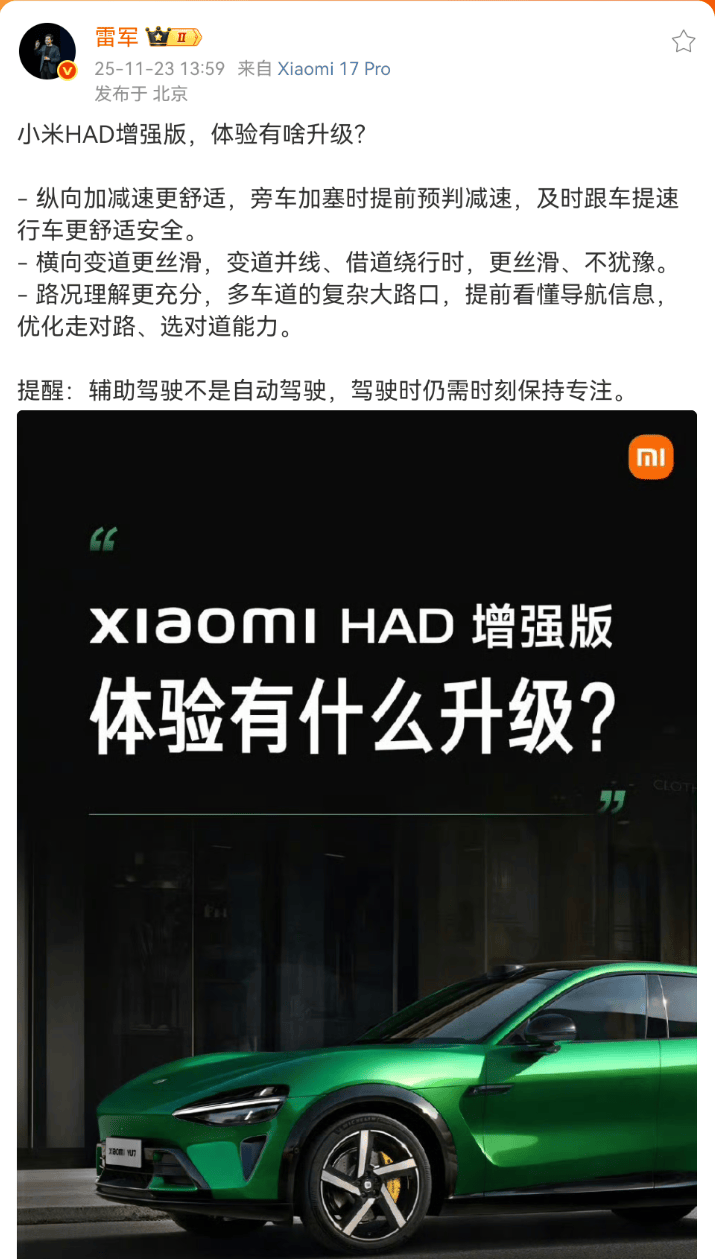
雷军提醒:辅助驾驶不是自动驾驶,驾驶时仍需时刻保持专注
Sou Hu Cai Jing· 2025-11-23 06:25
IT之家 11 月 23 日消息,小米创办人、董事长兼 CEO 雷军今日发文,总结了小米端到端辅助驾驶 HAD 增强版的升级点。 纵向加减速更舒适,旁车加塞时提前预判减速,及时跟车提速行车更舒适安全。 横向变道更丝滑,变道并线、借道绕行时,更丝滑、不犹豫。 路况理解更充分,多车道的复杂大路口,提前看懂导航信息,优化走对路、选对道能力。 雷军也再次提醒:辅助驾驶不是自动驾驶,驾驶时仍需时刻保持专注。 据IT之家此前报道,在 11 月 21 日 2025 广州车展开幕日当天,小米汽车端到端辅助驾驶"Xiaomi HAD 增强版"正式发布,其在 1000 万 Clips 版本的基础上 引入了「强化学习」与「世界模型」,同时 AEB 防碰撞辅助升级,并新增紧急转向辅助。 车道保持辅助 - 预警 车道保持辅助 - 纠偏 紧急车道保持 盲区监测预警 车门开启预警 变道辅助预警 其他安全能力 超速告警 红绿灯提醒 自适应防眩目矩阵3 辅助驾驶不是自动驾驶,驾驶仍需时刻保持 侧向安全能力 ...
小米加码“安全课”
Hua Er Jie Jian Wen· 2025-11-22 12:38
广州车展首日,雷军没有出现在小米汽车的发布会上。 作者 | 周智宇 编辑 | 张晓玲 站在台前的,是小米汽车副总裁李肖爽。除了技术迭新,李肖爽演讲的核心只有一个:安全。屏幕上, 是不加小字注释的三行大字——安全是前提,安全是基础,安全是一切。 营销味突然淡去,将安全牌打上牌桌。今年深陷舆论漩涡的小米,正在发生一些微妙的变化。 广州车展上,李肖爽没有谈论那些锦上添花的功能,重点展示的Xiaomi HAD增强版以及安全辅助功 能。 在智能驾驶的上半场,行业普遍采用"规则驱动"或基础的"数据驱动"。这就像是让司机死记硬背交规, 或者通过模仿记忆来开车。但这种模式很快遇到了天花板:面对极端稀缺的场景,由于缺少训练样本, 模型无法有效学习。 小米此次打出的"世界模型",本质上是构建了一个高保真的虚拟仿真引擎。在这个虚拟世界里,系统不 再依赖现实中必须发生的事故来学习,而是可以通过"日夜兼程"的模拟演练,在海量生成的场景中试错 ——"走对了加分、走错了扣分"。 这种从"模仿"到"认知"的范式转移,目的是试图通过算法的泛化能力,去覆盖那些长尾的风险场景,从 而降低系统性的行车风险。 此次小米HAD增强版AEB也全面升级,A ...
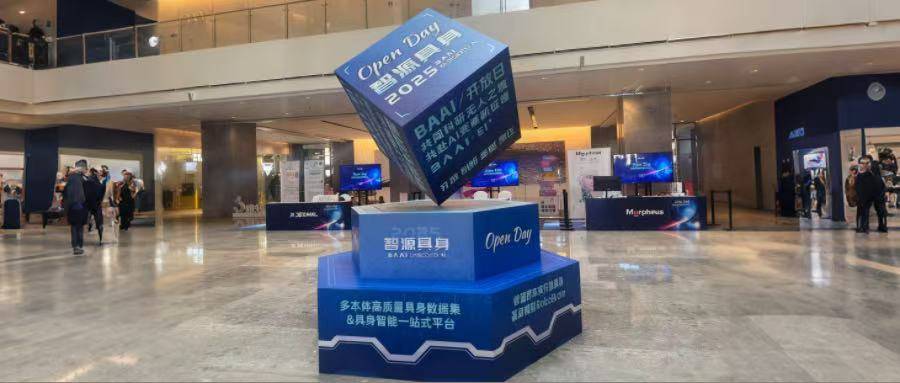
100亿都不够烧!机器人公司CEO们给出新判断:具身智能不能再照搬LLM
Sou Hu Cai Jing· 2025-11-22 02:41
Core Insights - The event highlighted the latest advancements in embodied intelligence by the Zhiyuan Research Institute, focusing on the importance of world models and the development of a comprehensive embodied brain system [2][3] Group 1: Zhiyuan's Full-Stack Layout - Zhiyuan introduced the native multimodal world model Emu3.5, which expanded training data from 15 years of video to 790 years and increased parameter size from 8 billion to 34 billion, enhancing video and image generation speed [5] - The institute is constructing a cross-heterogeneous ontology embodied intelligence system, including RoboBrain, RoboOS, and RoboBrain-0, deployed across various robotic forms for tasks ranging from navigation to complex interactions [5] Group 2: Key Elements of Embodied Intelligence - The role of world models in embodied intelligence was debated, with experts emphasizing the need for models that predict the next state based on the robot's form and goals, rather than merely generating videos [7][10] - There is a consensus that embodied intelligence should not follow the current language-first paradigm but rather adopt a structure centered on action and perception [10][12] - The importance of real data was highlighted, with discussions on the necessity of combining real, simulated, and video data for effective learning in robots [15][17] Group 3: Investment Priorities - When asked how to allocate 10 billion, experts prioritized talent acquisition, computational power, and data engines as key investment areas [19][21] - There were differing views on the importance of infrastructure versus model development, with some advocating for a focus on creating a comprehensive data engine for continuous digitalization [21][22] Group 4: Human-like Robots and Hardware Limitations - The debate on whether human-like robots represent the ultimate form of embodied intelligence concluded that neither models nor hardware define each other; rather, the specific application scenarios dictate the requirements [22][24] - Experts suggested that a layered structure for embodied intelligence should be adopted, where higher-level models can be reused across different robotic forms, but lower-level models must be tailored to specific hardware [23][24] Conclusion - The discussions at the event signaled a proactive search for solutions to achieve a closed-loop system in embodied intelligence, emphasizing the need for models, hardware, and scaling to evolve together [24]

小米HAD增强版辅助驾驶发布:引入强化学习与世界模型,AES紧急转向功能上车
Feng Huang Wang· 2025-11-21 02:33
Core Insights - Xiaomi Auto officially launched the Xiaomi HAD Enhanced Version at the Guangzhou Auto Show, showcasing advancements in smart driving technology and talent acquisition in the AI field [1] - The company plans to invest over 7 billion yuan in AI research and development by 2025, with a current team of 1,800 experts, including 108 PhDs [1] Technical Developments - The new Xiaomi HAD Enhanced Version is built on a foundation of 10 million clips and incorporates reinforcement learning algorithms and world models to enhance driving performance [1] - The world model technology allows the system to simulate various scenarios, including extreme weather and complex road conditions, transitioning from a "rule-driven" to a "learning-driven" approach [1] User Experience Enhancements - The updated version focuses on optimizing longitudinal and lateral control experiences, particularly in scenarios like lane merging, reducing unnecessary deceleration and hard braking [2] - Significant upgrades to active safety features include the introduction of the AES emergency steering assist function, which can automatically change lanes to avoid collisions at speeds between 80 km/h and 135 km/h [2] Safety Features Expansion - The forward AEB (Automatic Emergency Braking) range has been expanded to 1 km/h to 135 km/h, with new capabilities to recognize various obstacles [2] - The backward AEB covers reversing scenarios from 1 km/h to 30 km/h, with a focus on balancing sensitivity to ensure accurate stopping while minimizing false triggers [2] Software Updates - The driving updates will be included in the Xiaomi HyperOS 1.11.0 version, with rollout times varying by model due to review progress [2]
Nano Banana Pro 要上天
3 6 Ke· 2025-11-21 01:55
Core Insights - Google has recently launched several AI models, including Gemini 3, Antigravity, and Nano Banana Pro, which showcases advanced capabilities beyond simple image generation, indicating a move towards reasoning and understanding [1][26]. Model Testing - The Nano Banana Pro model was tested for its ability to generate realistic video conference scenarios featuring well-known figures from the tech industry, demonstrating a high level of detail and accuracy in character representation [2][5]. - The model successfully integrated a two-dimensional anime character into a three-dimensional video conference setting, maintaining the character's original style while ensuring a coherent visual experience [5][26]. Language and Menu Generation - Nano Banana Pro was tasked with creating menus in multiple languages, including English, Chinese, Japanese, and Russian, showing proficiency in layout and design but revealing limitations in generating coherent text beyond the prompt [10][11]. - The generated Chinese menu displayed accurate headings and categories, but specific dish names were less recognizable, indicating a gap in the model's text generation capabilities [10][11]. Cultural Understanding - The model demonstrated an understanding of Chinese cultural elements, such as palmistry and acupuncture, accurately depicting relevant imagery and concepts [13][18]. - However, it made errors in specific details, such as mislabeling lines in palmistry, highlighting areas for improvement in cultural accuracy [14][26]. Mathematical Problem Solving - Nano Banana Pro was evaluated on its ability to solve algebraic and geometric problems, with results aligning with expected answers, suggesting a foundational understanding of mathematical concepts [20][24]. - The model's performance indicates a shift from being merely a graphic tool to incorporating reasoning and understanding in its outputs, as it processes prompts with a degree of contextual awareness [26][27]. Future Implications - The advancements in Nano Banana Pro's capabilities suggest a potential evolution towards a "world model," where the AI not only generates images but also comprehends relationships and structures within a scene [26][27]. - This progression raises both excitement and caution, as the model approaches a level of understanding that could redefine its applications in various fields [27].


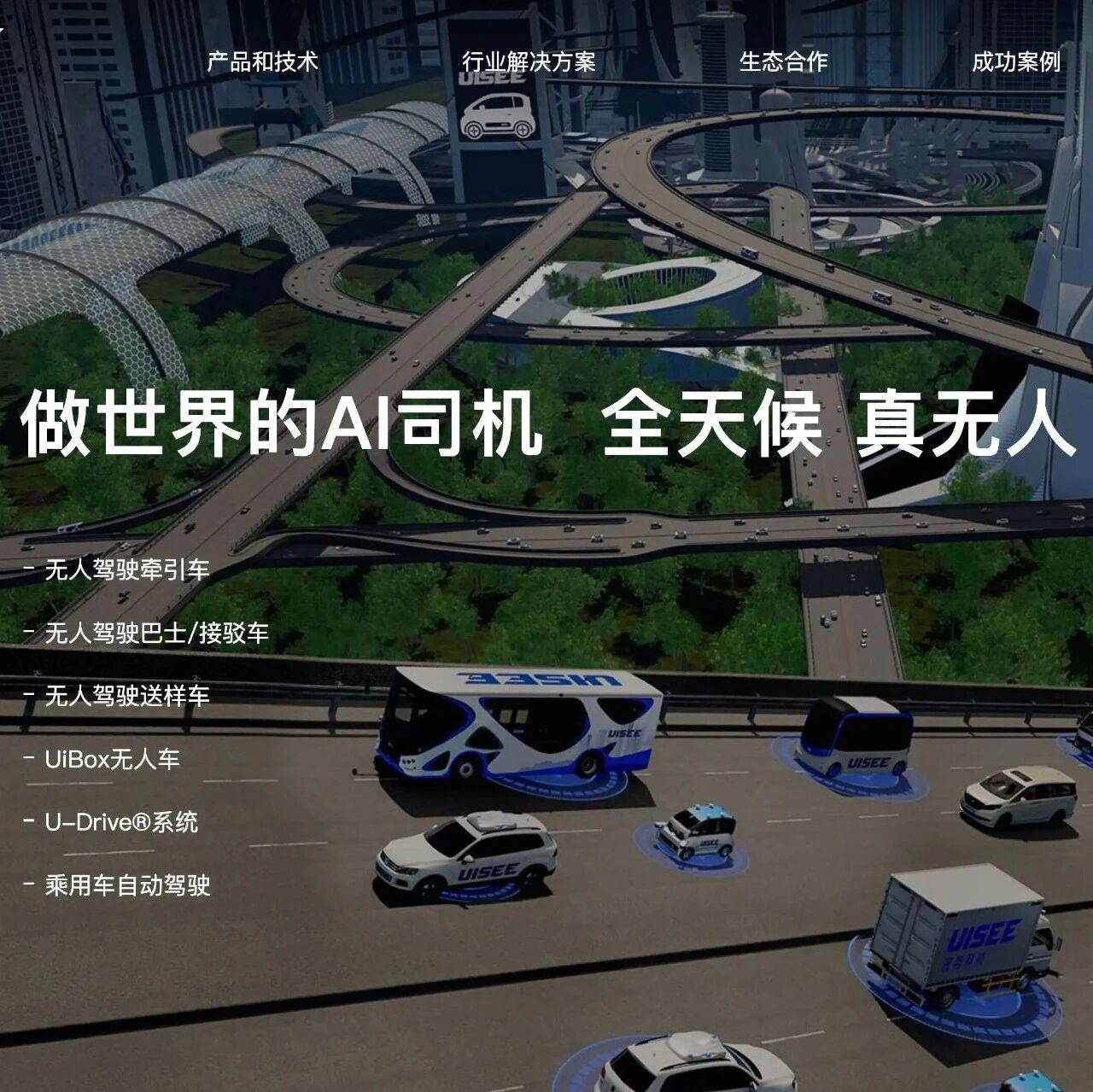
驭势科技 | 规划算法工程师招聘(可直推)
自动驾驶之心· 2025-11-21 00:04
Core Insights - The article discusses the advancements in autonomous driving technology, particularly focusing on the development and implementation of VLA (Vehicle-Language Architecture) by Xiaopeng Motors, highlighting its significance in the industry [14]. Group 1: Company Developments - Xiaopeng Motors has announced the launch of VLA 2.0, which represents a significant step in the evolution of autonomous driving technology, transitioning from perception-based systems to more integrated approaches [14]. - The article reflects on a year of research and development in VLA, indicating a shift in focus from traditional perception methods to VLA, which aims to enhance the vehicle's decision-making capabilities [14]. Group 2: Industry Trends - The article notes a growing trend in the industry towards end-to-end autonomous driving solutions, with VLA being positioned as a potential game-changer in how vehicles interact with their environment [14]. - There is a discussion on the competitive landscape, particularly the debate between world models and VLA routes, suggesting that the industry is at a crossroads in terms of technological direction [14]. Group 3: Research and Academic Contributions - The article mentions recent academic contributions, such as the paper from The Chinese University of Hong Kong (Shenzhen) and Didi, which proposes a new method for dynamic driving scene reconstruction, indicating ongoing research efforts in the field [14].
自动驾驶三大技术路线:端到端、VLA、世界模型
自动驾驶之心· 2025-11-21 00:04
Overview - The article discusses the ongoing technological competition in the autonomous driving industry, focusing on different approaches to solving corner cases and enhancing safety and efficiency in driving systems [1][3]. Technological Approaches - There is a debate between two main technological routes: single-vehicle intelligence (VLA) and intelligent networking (VLM) [1]. - Major companies like Waymo utilize VLM, which allows AI to handle environmental understanding and reasoning, while traditional modules maintain decision-making control for safety [1]. - Companies such as Tesla, Geely, and XPeng are exploring VLA, aiming for AI to learn all driving skills through extensive data training for end-to-end decision-making [1]. Sensor and Algorithm Developments - The article highlights the evolution of perception technologies, with BEV (Bird's Eye View) perception becoming mainstream by 2022, and OCC (Occupancy) perception gaining traction in 2023 [3][5]. - BEV integrates various sensor data into a unified spatial representation, facilitating better path planning and dynamic information fusion [8][14]. - OCC perception provides detailed occupancy data, clarifying the probability of space being occupied over time, which enhances dynamic interaction modeling [6][14]. Modular and End-to-End Systems - Prior to the advent of multimodal large models and end-to-end autonomous driving technologies, perception and prediction tasks were typically handled by separate modules [5]. - The article outlines a phased approach to modularization, where perception, prediction, decision-making, and control are distinct yet interconnected [4][31]. - End-to-end systems aim to streamline the process by allowing direct mapping from raw sensor inputs to actionable outputs, enhancing efficiency and reducing bottlenecks [20][25]. VLA and VLM Frameworks - VLA (Visual-Language-Action) and VLM (Visual-Language Model) frameworks are discussed, with VLA focusing on understanding complex scenes and making autonomous decisions based on visual and language inputs [32][39]. - The article emphasizes the importance of language models in enhancing the interpretability and safety of autonomous driving systems, allowing for better cross-scenario knowledge transfer and decision-making [57]. Future Directions - The competition between VLA and WA (World Action) architectures is highlighted, with WA emphasizing direct visual-to-action mapping without language mediation [55][56]. - The article suggests that the future of autonomous driving will involve integrating world models that understand physical laws and temporal dynamics, addressing the limitations of current language models [34][54].
36个月大逆转,他带着谷歌AI杀回来了,下一步世界模型
3 6 Ke· 2025-11-20 23:53
Core Insights - The competition in the AI model landscape is intensifying, with Google's Gemini 3 Pro recently surpassing Elon Musk's Grok 4.1 to claim the top spot in various rankings [1][3][7]. Group 1: Gemini 3's Capabilities and Impact - Gemini 3 is highlighted for its advanced reasoning, multimedia processing, and coding abilities, enhancing Google's existing products, particularly its lucrative search business [7][8]. - The introduction of AI Overviews has led to a 10% increase in search query volume, while visual search capabilities have surged by 70% due to Gemini's photo analysis [8]. - Gemini 3 is positioned as a foundational model for Google's product ecosystem, integrating AI into various services like Google Maps, Gmail, and cloud services [8][12]. Group 2: Competitive Landscape and Market Position - Google has made significant investments in AI, leading to breakthroughs that have allowed it to catch up with competitors like OpenAI, which initially disrupted its core search business [9][10]. - The monthly active users of Gemini applications have exceeded 650 million, indicating a strong user engagement compared to ChatGPT's 700-800 million weekly active users [12]. - Gemini 3 has outperformed OpenAI's GPT-5 in several benchmarks, particularly in reasoning and long-term planning, enhancing its practical capabilities [12]. Group 3: Future Directions and AGI Aspirations - Google aims to develop a comprehensive model that excels in various domains, which is seen as a crucial step towards achieving Artificial General Intelligence (AGI) [13][14]. - The company is focused on refining the Gemini model to improve its programming, reasoning, and mathematical capabilities, with future iterations expected to be more efficient and cost-effective [13][14]. - The timeline for achieving AGI is projected to be 5 to 10 years, with Gemini 3 serving as a pivotal platform for future advancements [14][15]. Group 4: Economic Viability and AI Bubble Concerns - Despite concerns about an AI bubble, Google is well-positioned due to its solid revenue streams and the strategic role of DeepMind in enhancing its AI capabilities [15][17]. - The integration of AI into existing Google services is already yielding tangible returns, enhancing the performance of search, YouTube, and cloud services [16][17].