产业结构升级

Search documents
西蓝集团党委书记、董事长姬秦安二〇二六年元旦致辞
Sou Hu Cai Jing· 2025-12-31 02:55
Group 1 - The company expresses gratitude to leaders, partners, and employees for their support and wishes everyone a prosperous new year [3][20] - The company reflects on the past year, highlighting its commitment to reform and innovation, which has led to improved service quality and operational efficiency [6][11] - The company aims to deepen its "contracting system" reform to foster an entrepreneurial spirit among employees, promoting higher quality and sustainable development [11][20] Group 2 - The company emphasizes the importance of collaboration and mutual benefit in achieving new milestones in the upcoming year [20] - The company acknowledges the challenges faced in the past year and the collective effort that has enabled it to meet its annual goals [6][11] - The company is committed to providing safe, stable, and high-quality gas services to society [6]

前11个月山东淄博货物贸易进出口总值破900亿元
Da Zhong Ri Bao· 2025-12-30 06:33
Core Insights - The total import and export value of Zibo from January to November reached 93.08 billion yuan, with exports valued at 58.26 billion yuan, showing a year-on-year growth of 0.1% [1] Group 1: Trade Performance - General trade remains dominant, accounting for 79.9% of the total foreign trade import and export value at 74.33 billion yuan [1] - Processing trade and bonded logistics experienced rapid growth, with imports and exports of 10.18 billion yuan and 8.55 billion yuan, respectively, increasing by 11.6% and 13.5% [1] Group 2: Business Activity - The number of foreign trade enterprises with import and export performance reached a record high of 3,360, an increase of over 210 compared to the same period last year [1] - Private enterprises accounted for over 3,200 of these, contributing 75.89 billion yuan, which is over 80% of Zibo's total import and export value [1] Group 3: Structural Upgrades - The transformation of new and old driving forces in foreign trade is accelerating, with continuous upgrades in industrial structure [1] - Exports of "new three samples" products reached 777 million yuan, growing by 98.9%, including lithium-ion batteries and electric vehicles, which grew by 9.9% and 111.4%, respectively [1] Group 4: Import Composition - Resource-based products dominate imports, with crude oil imports valued at 16.64 billion yuan, accounting for nearly 50% of total imports [2] - The demand for paper pulp remains strong, with imports reaching 3.75 billion yuan, an increase of 8.9%, making up 10% of total imports [2]
“十五五”规划开局关键蓄势期,关注中证A500ETF(159338)
Sou Hu Cai Jing· 2025-12-30 01:28
Group 1 - The core viewpoint of the articles indicates that the Chinese stock market, particularly the Shanghai Composite Index, is experiencing a strong upward momentum, with the offshore RMB strengthening against the USD, reaching a 15-month high at the 7.0 level, which is expected to enhance the attractiveness of Chinese assets to global capital [1] - It is anticipated that China's monetary and fiscal policies will remain accommodative through 2026, leading to a recovery in overall demand, while global fiscal expansion in the US, Europe, and Japan is expected to improve demand [1] - The CSI A500 index is highlighted for its balanced industry exposure and higher growth potential, making it a favorable option during the structural upgrade cycle, with an annualized return of 9.11% and a volatility of 21.41% since its base period, outperforming the CSI 300 in terms of total returns [2] Group 2 - The CSI A500 index's characteristics of industry balance and coverage of leading companies across various sectors provide investors with a defensive yet growth-oriented investment choice, particularly in volatile markets [2] - Investors are encouraged to pay attention to the CSI A500 ETF (159338), which offers a combination of safety and growth potential [2]
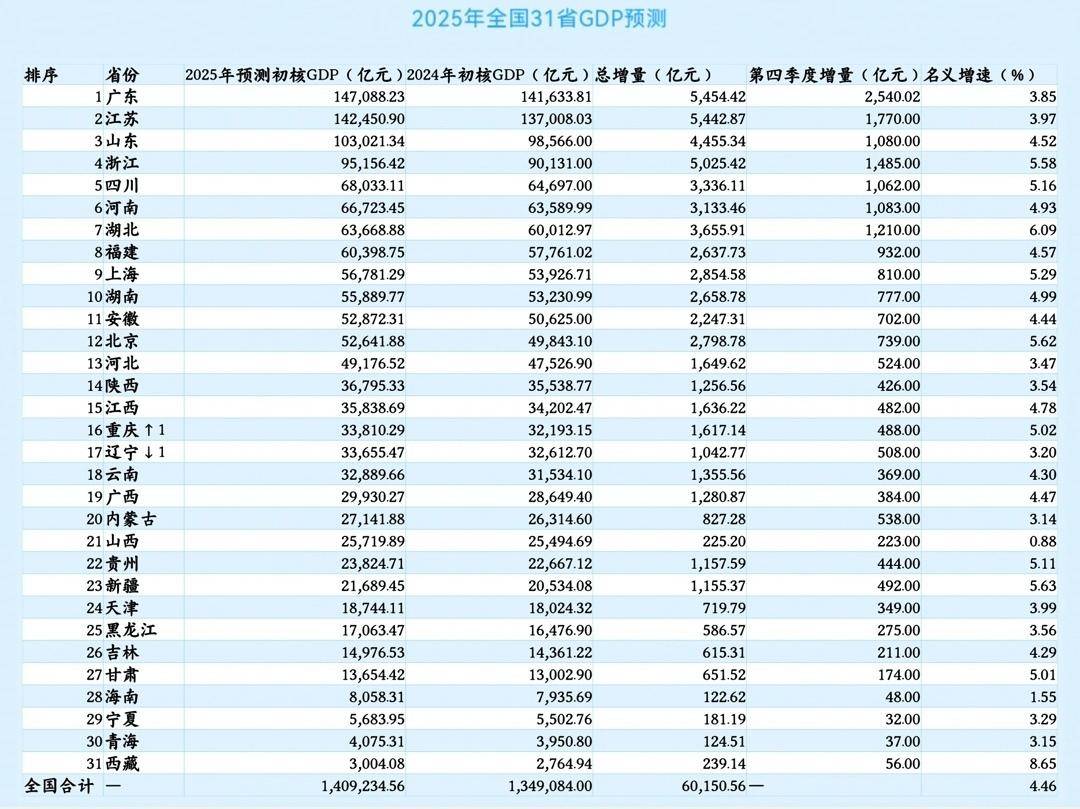
2025年中国31省GDP大预测:浙江远超四川,安徽近5.3万亿,吉林26
Sou Hu Cai Jing· 2025-12-27 16:42
Core Viewpoint - The economic landscape of China in 2025 is projected to show significant growth, with a total GDP reaching 1,409,234.56 billion yuan, marking an increase of 60,150.56 billion yuan from 2024, and a nominal growth rate of 4.46% [1] Provincial Economic Performance - Guangdong is expected to lead with a GDP of 147,088.23 billion yuan, followed closely by Jiangsu at 142,450.90 billion yuan, while Shandong surpasses the 10 trillion yuan mark with 103,021.34 billion yuan [3] - Zhejiang ranks fourth with a GDP of 95,156.42 billion yuan, showcasing a growth rate of 5.58%, driven by its coastal advantages and robust private sector [5] - Sichuan's GDP is projected at 68,033.11 billion yuan with a growth rate of 5.16%, highlighting the challenges posed by its larger population base [5] - Anhui's GDP is forecasted to reach 52,872.31 billion yuan, benefiting from the integration of the Yangtze River Delta region [6] Regional Highlights - Hubei emerges as a key player in central China with a GDP of 63,668.88 billion yuan and a growth rate of 6.09%, driven by strong fourth-quarter performance [7] - Xinjiang's growth rate is projected at 5.63%, reflecting the opportunities from the Belt and Road Initiative [7] - Tibet leads the nation with the highest growth rate of 8.65%, indicating vibrant development in border regions [7] - The overall economic structure shows coastal provinces dominating growth, while central and western regions like Hubei and Sichuan are making strides to close the gap [7]
政策精准调控防内卷,龙头提质增效赢先机 | 投研报告
Sou Hu Cai Jing· 2025-12-26 02:55
Core Viewpoint - The steel industry is experiencing a tightening supply trend, with a projected decrease in crude steel production and an increase in exports, indicating a shift towards quality and structural improvements in production policies [1][2]. Supply Side - As of November 2025, the cumulative crude steel production in China reached 890 million tons, a year-on-year decrease of 4.04%, with a reduction of 3.8 million tons compared to the same period in 2025 [1]. - The current round of regulatory policies emphasizes innovative capacity governance, focusing on quality and structure rather than merely eliminating ineffective capacity or controlling production levels [1]. Demand Side - By October 2025, China's cumulative steel exports amounted to approximately 110 million tons, an increase of 13.29 million tons year-on-year, with net steel exports accounting for about 13% of crude steel production, nearing the pre-reform high of 15% in 2015 [2]. - Although the demand for construction steel is still declining, the rate of decline is narrowing, indicating that demand is approaching its bottom [2]. - Manufacturing steel demand is expected to remain stable, driven by sectors such as automotive, home appliances, and shipbuilding, along with increased demand from new infrastructure projects like wind power and photovoltaics [2]. Cost Side - Global iron ore demand is expected to decline, with China's industrial structure upgrades leading to reduced steel demand, while growth in other emerging markets is insufficient to offset this decline [3]. - In the first half of 2025, supply looseness has put downward pressure on coking coal prices, with price movements primarily driven by supply adjustments rather than strong demand growth [3]. - The price of scrap steel is expected to remain stable with limited fluctuations, continuing to exert pressure on upstream and downstream profits [3]. Investment Recommendations - The combination of supply-side production controls and more proactive fiscal policies is likely to enhance sector valuations [4]. - Demand for construction steel is stabilizing, while manufacturing steel demand is showing positive trends, with exports shifting towards higher quality and indirect models [4]. - The elimination of outdated capacity is expected to increase the concentration of leading enterprises, with a necessary trend towards high-quality product development [4]. - Recommended companies include industry leaders with product structure advantages such as Baosteel (600019.SH), Nanjing Steel (600282.SH), and Hualing Steel (000932.SZ), as well as special steel companies with high barriers and added value like CITIC Special Steel (000708.SZ), Jiuli Special Materials (002318.SZ), and Yongjin Co., Ltd. (603995.SH) [4].


新版外商投资目录来了
Di Yi Cai Jing Zi Xun· 2025-12-25 06:38
Core Viewpoint - The release of the "Encouragement Directory for Foreign Investment (2025 Edition)" aims to attract and utilize foreign investment more effectively, focusing on advanced manufacturing, modern services, high-tech, and environmental protection sectors, as well as promoting investment in the central and northeastern regions of China [2][3]. Group 1: Changes in the Encouragement Directory - The new directory includes a total of 1,679 entries, with a net increase of 205 entries and 303 modifications compared to the 2022 version [3]. - The national directory has 619 entries, with 100 new additions and 131 modifications, while the regional directory has 1,060 entries, with 105 new additions and 172 modifications [3]. - The expansion of the directory signals a proactive approach to attract foreign investment amidst increasing global competition and protectionist measures from other countries [3][4]. Group 2: Focus Areas for Foreign Investment - The new directory encourages foreign investment in advanced manufacturing by adding or expanding entries related to end products, components, and raw materials to enhance the development of supply chains [4]. - It promotes investment in modern services, with new or expanded entries in business services, technical services, scientific research, and service consumption to foster high-quality development in the service sector [4]. - The directory also emphasizes investment in the central and northeastern regions of China, tailoring entries to local resources and industrial advantages, such as new projects in various provinces [4][5]. Group 3: Impacts on Industry Structure and Economic Growth - The revision of the directory is expected to support industrial structure upgrades and improve efficiency, responding to the rapid technological revolution and industrial transformation [5]. - It aims to attract global innovation factors and enhance international investment cooperation, benefiting both supply and demand sides of the economy [5][6]. - The directory continues to prioritize technology innovation as a key area for foreign investment, supporting advanced manufacturing and high-tech sectors to foster new productive forces [6]. Group 4: Future Directions and Implementation - The National Development and Reform Commission plans to strengthen guidance and coordination to ensure the effective implementation of the new policies [7]. - Efforts will be made to create a market-oriented, law-based, and international business environment to attract more multinational companies to invest in China [7]. - The government will expedite the launch of major foreign investment projects and address issues related to land use, environmental assessments, and energy consumption [7].

新版外商投资目录来了
第一财经· 2025-12-25 06:34
Core Viewpoint - The release of the "Encouraged Foreign Investment Industry Catalog (2025 Edition)" aims to attract and utilize foreign investment more effectively, focusing on advanced manufacturing, modern services, high-tech, and energy conservation sectors, as well as promoting investment in the central and northeastern regions of China [3][5]. Summary by Sections Changes in the Encouraged Catalog - The new catalog includes a total of 1,679 entries, with a net increase of 205 entries and 303 modifications compared to the 2022 version. The national encouraged foreign investment industry catalog has 619 entries, with 100 new entries and 131 modifications, while the regional catalog has 1,060 entries, with 105 new entries and 172 modifications [5][6]. Focus Areas for Foreign Investment - The new catalog encourages foreign investment in advanced manufacturing by adding or expanding entries related to terminal products, components, and raw materials to enhance the development level of the industrial and supply chains [6]. - It also promotes foreign investment in modern services, with new or expanded entries in business services, technical services, scientific research, and service consumption to foster high-quality development in the service sector [6]. - Additionally, the catalog encourages foreign investment in the central and northeastern regions of China, tailoring entries to local resource endowments and industrial advantages, such as new services in tourism, equipment manufacturing, and environmental governance [6][7]. Impacts on Industry Structure - The revision of the catalog is expected to support industrial structure upgrades and improve efficiency, responding to the increasing global competition for foreign investment and the challenges posed by protective measures in other countries [5][8]. - The catalog aims to attract global innovation factors and enhance international investment cooperation, addressing the evolving demands in healthcare and elder care services, thereby improving the well-being of the population and expanding domestic demand [9]. Future Directions - The National Development and Reform Commission plans to strengthen guidance and coordination to ensure the implementation of policy measures, creating a market-oriented, legal, and international business environment for foreign investment [10].

新版外商投资目录来了 哪些变化值得关注
Di Yi Cai Jing· 2025-12-25 06:27
Core Viewpoint - The release of the "Encouraged Foreign Investment Industry Catalog (2025 Edition)" aims to attract and utilize foreign investment more effectively, focusing on advanced manufacturing, modern services, high-tech, and environmental protection sectors, as well as promoting investment in the central and northeastern regions of China [1][2]. Group 1: Changes in the Encouraged Catalog - The new catalog includes a total of 1,679 entries, with a net increase of 205 entries and 303 modifications compared to the 2022 version [2]. - The national encouraged foreign investment industry catalog has 619 entries, with an increase of 100 entries and 131 modifications [2]. - The regional encouraged foreign investment industry catalog has 1,060 entries, with an increase of 105 entries and 172 modifications [2]. Group 2: Focus Areas for Investment - The new catalog encourages foreign investment in advanced manufacturing, with new or expanded entries related to end products, components, and raw materials to enhance the development of supply chains [3]. - It promotes foreign investment in modern services, adding entries related to business services, technical services, scientific research, and service consumption to foster high-quality development in the service sector [3]. - The catalog also emphasizes investment in the central and northeastern regions, tailoring entries to local resources and industrial advantages, such as new services in tourism, equipment manufacturing, and environmental management [3]. Group 3: Implications for Economic Development - The revision of the catalog signals a commitment to high-level opening-up and aims to assist in upgrading industrial structures and improving efficiency [2][4]. - It addresses the competitive landscape for attracting foreign investment amid rising protectionist measures in other countries, reinforcing China's openness to global investors [2][4]. - The catalog is designed to attract global innovation factors and enhance cooperation between domestic and foreign enterprises, thereby meeting the evolving demands in sectors like healthcare and consumer services [5]. Group 4: Future Directions - The National Development and Reform Commission plans to strengthen guidance and coordination to ensure the effective implementation of policies, creating a market-oriented, law-based, and international business environment for foreign investors [6]. - There will be efforts to expedite major foreign investment projects and resolve issues related to land use, environmental assessments, and energy consumption [6].
冲刺万亿GDP城市,这座地级市胜算大
2 1 Shi Ji Jing Ji Bao Dao· 2025-12-12 12:18
Core Insights - The expansion of the "trillion GDP club" is a significant highlight of regional economic development in China this year [1][4] - Wenzhou, Xuzhou, and Dalian are expected to join the club, with Wenzhou projected to surpass 1 trillion yuan in GDP this year [2][5][9] Group 1: Economic Performance of Cities - Wenzhou's GDP is expected to exceed 1 trillion yuan, with a growth rate of 6.3% projected for 2024, reaching 9,719 billion yuan [5] - Xuzhou's GDP for the first three quarters is 7,298.12 billion yuan, with a growth rate of 6.0% [15] - Dalian's GDP for the first three quarters is 7,248.2 billion yuan, with a growth rate of 6.0% [11] Group 2: Characteristics of the New Trillion GDP Cities - Among the three cities, two (Wenzhou and Xuzhou) are ordinary prefecture-level cities, indicating a trend of expansion beyond major cities [3][4] - The rise of these cities is expected to reshape China's economic landscape, with a focus on high-quality development and urban renewal [4][19] Group 3: Industrial and Economic Foundations - Wenzhou's economy is supported by a robust manufacturing base and a strong private sector, with 83% of its GDP generated by the private economy [6] - Dalian is focusing on high-quality development, with a strategic emphasis on modernizing its industrial structure and enhancing high-tech manufacturing [14][15] - Xuzhou, as a traditional industrial base, is also undergoing transformation to achieve its GDP goals by 2025 [16] Group 4: Future Trends and Implications - The trend of ordinary prefecture-level cities joining the trillion GDP club is expected to continue, with cities like Shaoxing, Yangzhou, Yancheng, and Jiaxing being potential candidates [17] - The focus will shift from mere GDP growth to the quality of growth, emphasizing structural optimization and the well-being of residents [20]

冲刺万亿GDP城市,这座地级市胜算大
21世纪经济报道· 2025-12-12 12:08
Core Viewpoint - The expansion of the "trillion GDP club" is a significant highlight of regional economic development in China this year, with cities like Wenzhou, Xuzhou, and Dalian expected to join the ranks of cities with a GDP exceeding one trillion yuan [1][3]. Group 1: Economic Progress of Target Cities - Wenzhou's GDP is projected to exceed one trillion yuan this year, with a first-quarter GDP of 240.37 billion yuan and a growth rate of 6.7% [2][4]. - Xuzhou's GDP for the first three quarters is 729.81 billion yuan, with a growth rate of 6.0%, aiming for a GDP of over one trillion yuan by 2025 [12][17]. - Dalian's GDP reached 724.82 billion yuan in the first three quarters, with a growth rate of 6.0%, and is also targeting the trillion GDP milestone [13][16]. Group 2: Characteristics of the Expansion - The expansion of the trillion GDP cities includes ordinary prefecture-level cities, indicating a trend where economic growth is not limited to major metropolitan areas [2][3]. - The cities in the trillion GDP club are expected to become central nodes for local development, fostering industrial and population agglomeration effects [3][19]. - The trend of ordinary cities joining the trillion GDP club reflects a broader pattern of regional economic development, with more cities expected to achieve this milestone in the coming years [20]. Group 3: Industrial and Economic Structure - Wenzhou's economy is supported by a robust manufacturing base and a strong private sector, with private enterprises contributing approximately 83% to the city's GDP [9]. - The city aims to establish a dual trillion industrial cluster system by 2025, focusing on both traditional and emerging industries [9][10]. - Dalian is focusing on high-tech manufacturing and has set a strategic plan to develop new industries, although it faces challenges in establishing core competitiveness [15][16]. Group 4: Future Prospects and Strategies - The future expansion of the trillion GDP club is expected to include cities with GDPs between 700 billion and 800 billion yuan, such as Shaoxing, Yangzhou, Yancheng, and Jiaxing [19]. - Cities like Shaoxing and Jiaxing are pursuing collaborative development with nearby major cities to enhance their economic prospects [19][20]. - The emphasis on quality over quantity in GDP growth is becoming increasingly important, with a focus on optimizing economic structure and improving residents' welfare [20].