代理式AI

Search documents
黄仁勋对谈杨元庆:30年老友立下新目标
Di Yi Cai Jing Zi Xun· 2026-01-03 15:05
Core Insights - The dialogue between NVIDIA CEO Jensen Huang and Lenovo CEO Yang Yuanqing highlights the long-standing partnership and future directions in AI and computing technologies [2][3] - Both companies anticipate significant growth opportunities in the AI sector, particularly through the development of hybrid AI systems [3][4] Group 1: Partnership and Growth - The collaboration between NVIDIA and Lenovo has evolved over 28 years, with business scale increasing fivefold in the last two years [2] - Lenovo's AI business growth is attributed to its global business layout and technological advantages in high-performance computing and water cooling technology [2] - Huang expressed confidence that the partnership could expand fivefold again in the next two years, driven by the widespread adoption of AI across industries [4] Group 2: Future Trends in AI - The next phase of AI development will feature two main trends: the integration of public cloud models with private customized models, and the application of hybrid enterprise intelligence across various industries [3] - Lenovo and NVIDIA are collaborating to create an enterprise-level AI system based on RTX Pro, which Huang described as a revolutionary server [3] - The anticipated launch of this product is expected to significantly impact sectors such as industrial, logistics, warehousing, and robotics [4]




黄仁勋对谈杨元庆:30年老友立下新目标
第一财经· 2026-01-03 14:58
Core Viewpoint - The dialogue between Huang Renxun, CEO of NVIDIA, and Yang Yuanqing, CEO of Lenovo, highlights their companies' collaborative vision for the future of computing and AI, emphasizing the significant growth potential in the AI sector, particularly through hybrid AI systems [3][4]. Group 1: AI Development Trends - The next phase of AI development will showcase two major trends: the integration of public cloud advanced models with private customized models, and the application of hybrid enterprise intelligence across various industries [5]. - Huang Renxun predicts that the collaboration between NVIDIA and Lenovo could expand fivefold in the next two years, driven by the increasing adoption of AI across all sectors and countries [6]. Group 2: Collaborative Innovations - NVIDIA and Lenovo are jointly developing an enterprise-level AI system based on RTX Pro, which is expected to be a revolutionary server aimed at scaling in the enterprise market [5]. - The upgraded system architecture by NVIDIA enhances token efficiency by 10 to 15 times, indicating a significant technological advancement that will benefit various fields such as industrial, logistics, and robotics [6].

黄仁勋对谈杨元庆:30年老友立下新目标,锚定混合AI
Di Yi Cai Jing· 2026-01-03 13:18
Core Insights - NVIDIA and Lenovo are collaborating to develop an enterprise-level AI system based on RTX Pro, aiming to enhance AI capabilities in various industries [4] - The partnership has seen a fivefold increase in business scale over the past two years, indicating strong growth potential [3] - Both companies foresee a shift from generative AI to agent-based AI, which will integrate public cloud models with customized private models [3][5] Group 1 - The collaboration between NVIDIA and Lenovo has reached a significant milestone after 28 years, with expectations to expand fivefold in the next two years [3][5] - The focus is on hybrid AI, which combines public and private models, requiring robust infrastructure that the joint enterprise-level AI system will provide [3] - The anticipated trends include the integration of hybrid enterprise intelligence across various sectors, such as high-performance computing and industrial intelligence [3] Group 2 - NVIDIA's CEO expressed excitement about launching a revolutionary server aimed at the enterprise market, with technical details to be revealed at an upcoming global innovation conference [4] - The upgrade of system architecture to rack-level computing has improved token efficiency by 10 to 15 times, showcasing significant technological advancement [5] - The collaboration is expected to unlock substantial application potential in industries like logistics, warehousing, and robotics [5]

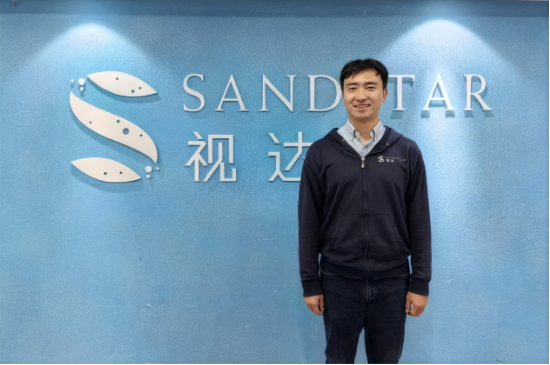
对话视达创始人:AI创业找不对场景,就会陷入“死亡螺旋”中
Xin Lang Cai Jing· 2025-12-22 07:20
Core Viewpoint - The current stage of AI development is identified as Agentic AI, which represents a significant evolution from previous stages, allowing AI to function as a colleague and partner rather than just a tool [2][15]. Group 1: AI Development Stages - Huang Renxun proposed four stages of AI development: Perception AI, Generative AI, Agentic AI, and Physical AI, with Agentic AI being the stage of true intelligence awakening [2][15]. - The transition from Perception AI to Agentic AI allows AI to independently complete tasks and provide results, significantly enhancing operational efficiency [3][16]. Group 2: AI in Retail - In the retail sector, AI can now manage 800 stores with the efficiency of one supervisor, reducing costs to less than 1/100 of previous levels [2][15]. - The cost of generating analysis reports using AI has decreased significantly, with the price for 1 million tokens being only a few cents to several yuan, allowing for broader management of retail stores [4][17]. Group 3: Business Growth and Strategy - The company has expanded its operations to 30 countries and regions since its inception in 2016, focusing on AI in retail, which was initially overlooked by many [6][19]. - The company is expected to achieve profitability this year, with substantial sales growth, indicating a successful business model [22][24]. Group 4: Market Insights and Challenges - The key to success in the retail AI sector lies in identifying the right market scenarios and maintaining a focus on valuable projects to avoid financial pitfalls [23][24]. - The company has established itself as a member of NVIDIA's partner network, leveraging NVIDIA's edge computing platform for its solutions [21][24].

告别「手搓Prompt」,前美团高管创业,要让物理世界直接成为AI提示词
机器之心· 2025-12-16 02:31
Core Viewpoint - The article discusses the emergence of Looki, an AI hardware aiming to enhance human-machine interaction by transforming real-world scenarios into contextual data, moving from passive responses to proactive engagement [1][2]. Group 1: Looki's Purpose and Technology - Looki aims to fill the gap in large models' "sensory intelligence" by converting real-time visual and auditory signals into contextual data, thus driving AI to think and serve users more effectively [4][28]. - The Looki L1 device, weighing only 30g, is designed to operate as a multi-modal perception system, capturing the physical world continuously and efficiently [6][8]. - The founders of Looki, with backgrounds in autonomous driving and smart hardware, leverage their expertise to adapt perception algorithms from driving to everyday life [9][10]. Group 2: Data Management and User Context - Looki employs a "data flywheel" approach to create a personalized context for users, transforming raw data into structured memories that the AI can efficiently access [12][15]. - The system addresses two major challenges in multi-modal models: understanding long-sequence data and managing context explosion, ensuring privacy and security in data handling [14]. Group 3: Transition to Proactive AI - The article highlights a shift from manual prompts to proactive AI, where enriched context allows for anticipatory actions by the AI, marking a transition from chatbots to agentic AI [17][18]. - Looki's capabilities include automatic video editing, identifying significant moments in users' lives, and providing insights based on accumulated data, thus evolving into a second brain for users [20][24][30]. Group 4: Future Vision - Looki envisions its hardware as a data interface that evolves beyond its current form, aiming to address the data hunger of the physical world and help users accumulate valuable personal data assets [29]. - The ultimate goal is for AI to possess a sense of presence, transforming it from a mere tool into an integral part of users' daily lives [30][31].

观察| 100万亿Tokens的:AI正在发生你看不见的巨变
未可知人工智能研究院· 2025-12-07 03:02
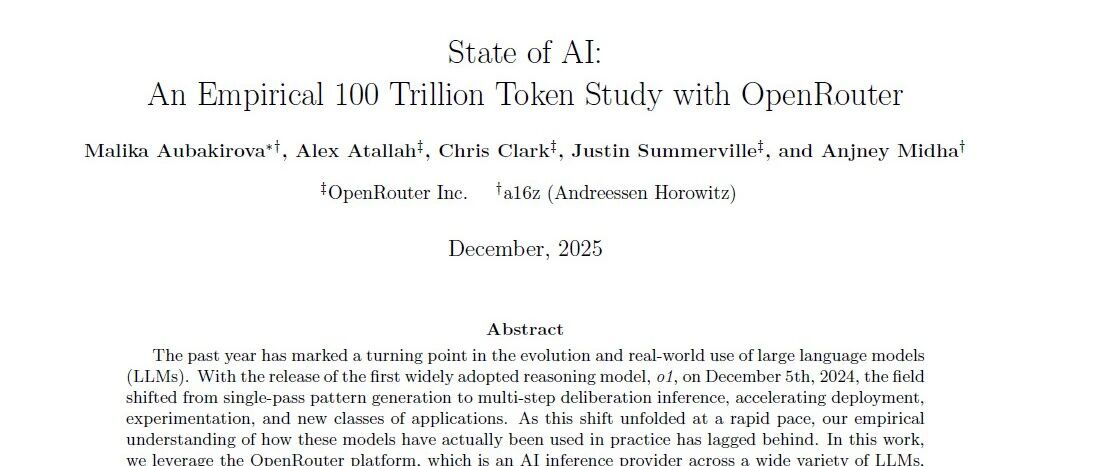
Core Insights - The report reveals that AI is undergoing a significant revolution, characterized by a shift from traditional models to reasoning models that can think and plan in multiple steps [3][11][12]. Group 1: OpenRouter and Its Importance - OpenRouter is likened to "Meituan" in the AI world, connecting over 500 million developers to more than 300 AI models, making its data highly credible [5][6]. - OpenRouter's daily token processing volume has surpassed 1 trillion, indicating a rapid growth from approximately 100 trillion tokens annually from early 2024 to mid-2025, marking a tenfold increase [8][6]. Group 2: Reasoning Revolution - The report identifies a "reasoning revolution," where AI models evolve from simple response machines to complex reasoning machines capable of multi-step thinking [11][12]. - The launch of OpenAI's o1 reasoning model (codename Strawberry) is a pivotal event, as it incorporates internal reasoning processes that enhance its problem-solving capabilities [18][19]. - Users are increasingly engaging in complex tasks, leading to longer prompts and more dialogue rounds, indicating a shift towards training AI for intricate tasks [20][21][23]. Group 3: Agentic AI - Agentic AI represents a transformation where AI can autonomously plan, execute, and verify tasks, moving from passive response to active engagement [27][30]. - The report highlights that agentic reasoning is the fastest-growing behavior on OpenRouter, indicating a shift in user expectations from simple answers to task completion [34][35]. Group 4: Rise of Open Source Models - Open source models, particularly from Chinese teams like DeepSeek R1 and Kimi K2, are rapidly gaining market share, challenging the dominance of closed-source models [44][47]. - DeepSeek R1 offers significant cost advantages, with a cost of $0.003 per 1K tokens compared to $0.03 for GPT-4, making it attractive for developers [52]. Group 5: Real-World AI Usage - The primary applications driving token usage are creative writing and programming, with AI becoming indispensable for developers [71][72]. - Users are not merely relying on AI for content generation but are engaging in co-creation, indicating a shift in the role of AI from a tool to a creative partner [77][78]. Group 6: Model Personality - Users' choices of AI models are influenced by the "personality" of the models, which affects user retention and engagement [88][95]. - The report suggests that models with unique personalities can outperform those with higher benchmark scores in terms of user loyalty [96][100]. Group 7: Implications for the Chinese AI Industry - The success of Chinese models like DeepSeek R1 and Kimi K2 in the global market indicates that they have competitive capabilities [109]. - The report emphasizes the importance of focusing on reasoning and agentic capabilities as key technological directions for the Chinese AI industry [115].
ChatGPT三周年,那个“对话模型”如何重构我们的世界
3 6 Ke· 2025-12-01 10:22
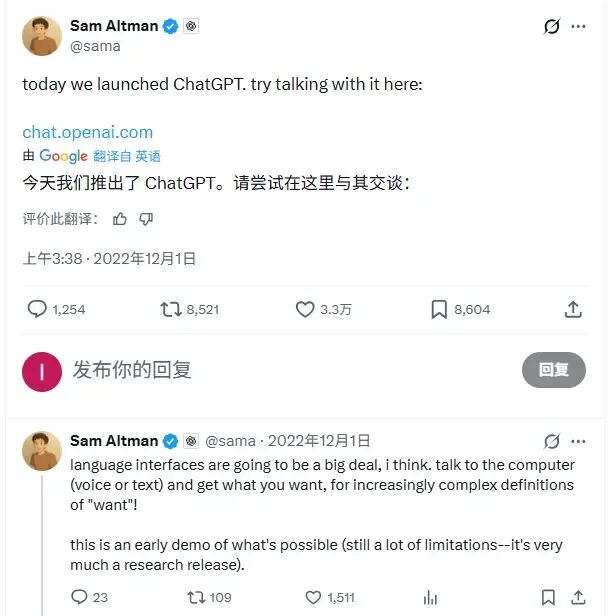
Core Insights - The launch of ChatGPT by OpenAI on November 30, 2022, marked the beginning of a transformative journey in AI, impacting various sectors including technology, business, education, and geopolitics [1] - The rapid user adoption of ChatGPT, reaching 1 million users within five days and 100 million in two months, highlights its unprecedented growth compared to other platforms like TikTok and Instagram [2] - The evolution of ChatGPT from a simple conversational model to a sophisticated platform with multimodal capabilities and real-time voice interaction signifies a major leap in AI technology [2][3] User Growth and Engagement - By the end of 2024, ChatGPT had 300 million weekly active users, growing to 800 million by November 2025, indicating a significant penetration into global markets [5][6] - The mobile revenue surpassed $2 billion in August 2025, with an average revenue per installation of $2.91, showcasing its commercial viability [6] Business Model and Strategy - ChatGPT's pricing strategy evolved from a free model to a tiered subscription model, including a $20/month Plus plan and a $200/month Pro plan, aiming to capture various market segments [6] - The platform's enterprise customer base exceeded 1 million by 2025, making it the fastest-growing business platform in history [6] Technological Advancements - The introduction of GPT-4 and GPT-5 brought significant enhancements, including the ability to perform complex tasks, manage calendars, and generate comprehensive applications [5][10] - The shift from interactive AI to agent-based AI indicates a transformation in how users interact with technology, moving towards more autonomous functionalities [5][10] Market Dynamics and Competition - The competitive landscape has shifted dramatically, with emerging players like DeepSeek challenging OpenAI, prompting a return to open-source models [10] - The stock prices of major tech companies, including Nvidia, have surged significantly, reflecting the capital market's enthusiasm for AI technologies [10] Ethical and Legal Challenges - The rapid growth of ChatGPT has raised concerns regarding safety, with incidents of inappropriate content generation and lawsuits related to mental health issues [8][9] - Ongoing legal battles over copyright infringement and the ethical implications of AI training data highlight the complexities of integrating AI into society [9] Future Outlook - As ChatGPT approaches its third anniversary, questions about its limits and the sustainability of its growth emerge, particularly regarding energy consumption and societal impacts [11][12] - The potential for AI to redefine personal health markets and other sectors indicates a continuous evolution of its applications, while also raising concerns about the implications for future generations [12][13]
英伟达电话会:黄仁勋反击“我们看到的和AI泡沫截然相反”,公司订单能见度达5000亿美元,Rubin明年下半年推出
Hua Er Jie Jian Wen· 2025-11-20 01:08
Core Viewpoint - NVIDIA's CEO Jensen Huang strongly refuted the "AI bubble" narrative, asserting that the company is at the center of three fundamental technological transformations that are driving sustained growth in AI technology [1][2][3]. Group 1: AI Transformations - The world is experiencing three major platform transformations: the shift from CPU to GPU accelerated computing, the transition from traditional machine learning to generative AI, and the rise of agentic AI [3][4][32]. - Huang emphasized that these transformations are foundational and necessary for future infrastructure growth, with NVIDIA's architecture capable of supporting all three transitions [4][35]. Group 2: Financial Performance and Guidance - NVIDIA reported a record revenue of $57 billion for Q3, a 62% year-over-year increase, with data center revenue reaching $51 billion, up 66% [15][28]. - The company provided a strong Q4 revenue guidance of $65 billion, significantly above market expectations, even without assuming any revenue from data center computing in China [11][28]. Group 3: Demand and Supply Dynamics - NVIDIA's CFO Colette Kress revealed a revenue visibility of $500 billion for the Blackwell and Rubin platforms from now until the end of 2026, indicating robust demand [5][9]. - The company acknowledged supply chain challenges, particularly in power and packaging, but emphasized that these issues are manageable [6][8]. Group 4: Strategic Partnerships and New Clients - NVIDIA announced a strategic partnership with AI model company Anthropic, marking its first adoption of NVIDIA's architecture with an initial compute commitment of up to 1 gigawatt [9][25]. - The company is also collaborating with OpenAI to build and deploy at least 10 gigawatts of AI data centers, indicating a significant scale-up in computational capabilities [11][24]. Group 5: Market Position and Competitive Edge - NVIDIA's unique architecture allows it to run all major AI models, positioning it as a leader in the AI infrastructure market [9][12]. - The company is focused on expanding its CUDA ecosystem through strategic investments in key AI companies, which are intended to deepen technical collaborations rather than merely boost short-term demand [10][25].
英伟达第三季度财报电话会全文(附PPT)
美股IPO· 2025-11-19 23:45
Core Viewpoint - NVIDIA's third-quarter financial results demonstrate significant growth driven by accelerated computing, AI models, and agentic applications, with a revenue forecast of $500 billion from Blackwell and Rubin platforms by the end of 2026 [3][22][41]. Financial Performance - NVIDIA reported third-quarter revenue of $57.0 billion, a 62% year-over-year increase, and a record sequential growth of $10 billion or 22% [3][14]. - Data center revenue reached a record $51.0 billion, up 66% year-over-year, driven by the strong demand for accelerated computing [3][22]. - The company expects fourth-quarter revenue to be around $65.0 billion, reflecting a 14% sequential growth [4][36]. Business Segments - The networking business generated $8.2 billion in revenue, marking a 162% year-over-year increase, establishing NVIDIA as the world's largest networking business [4][29]. - The gaming segment reported $4.3 billion in revenue, a 30% increase, supported by strong demand for Blackwell GPUs [33]. - Professional visualization revenue reached $760 million, up 56%, driven by the DGX Spark AI supercomputer [34]. Strategic Partnerships and Market Opportunities - NVIDIA is expanding its CUDA AI ecosystem through strategic partnerships with companies like OpenAI and Anthropic, aiming to support the next generation of AI data centers [4][31]. - The company has secured a three-year agreement with Saudi Arabia for 400,000 to 600,000 GPUs, indicating strong demand in international markets [3][43]. - The transition to physical AI represents a multi-trillion-dollar opportunity for NVIDIA, positioning it for future growth [4][32]. Product Development and Future Outlook - The Blackwell platform is gaining momentum, with significant shipments to major customers, while the Rubin platform is set to accelerate in the second half of 2026 [3][26]. - NVIDIA's architecture is designed to support all three major platform shifts: accelerated computing, generative AI, and agentic AI, which are expected to drive infrastructure growth [4][39]. - The company anticipates continued strong demand for AI infrastructure, with a projected annual build of $3 to $4 trillion [4][22].

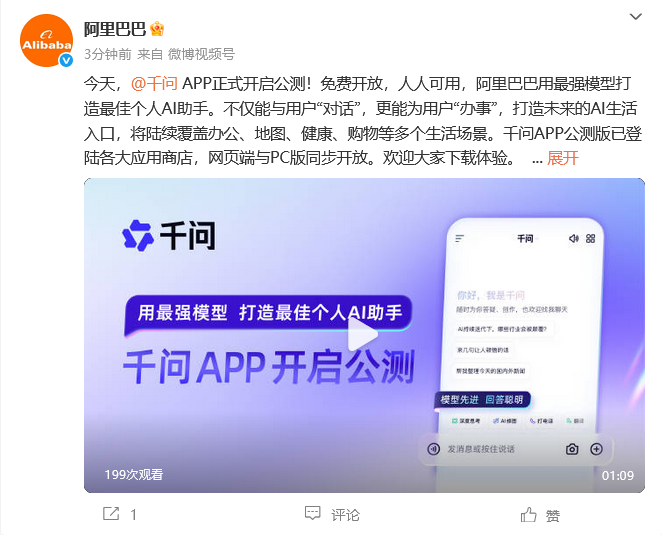
千问APP正式上线,阿里要打造AI超级入口
Hua Er Jie Jian Wen· 2025-11-17 05:14
Core Viewpoint - Alibaba has launched its AI application "Qwen" (formerly known as "Tongyi"), marking a significant move into the consumer AI market with a free, user-friendly model that aims to serve as a comprehensive AI assistant for various daily tasks [1][3][22]. Group 1: Product Launch and Features - The "Qwen" app is now available for public testing, featuring a simplified design and integrated functionalities such as image generation, AI photo editing, video calls, and real-time translation [1][20][17]. - The app is powered by the Qwen3-Max model, which is reported to outperform GPT-5 and is recognized as one of the top three models globally [13][15]. - The application aims to cover multiple life scenarios, including office tasks, navigation, health, and shopping, positioning itself as a one-stop AI life portal [1][17][22]. Group 2: Market Impact and Competition - Following the announcement of the "Qwen" app, the AI application sector saw significant stock price increases, with companies like Xunlei and Rongji Software reaching their daily trading limits [7]. - The launch reflects Alibaba's strategic shift from focusing on enterprise (B2B) clients to targeting consumers (B2C), competing with local rivals like ByteDance's "Doubao" and Tencent's "Yuanbao" [22][23]. - Despite the competitive landscape, analysts believe that the market is still in its early stages, with no existing AI application achieving over 100 million daily active users, suggesting potential for growth [23]. Group 3: Brand Strategy and User Experience - The rebranding from "Tongyi" to "Qwen" is a strategic move to unify Alibaba's AI branding, making it easier for users to understand the relationship between the app and its underlying technology [24]. - The app's launch faced initial challenges due to overwhelming user traffic, leading to service interruptions and congestion [25].