优化供给

Search documents
政治局会议5大信号:通稿短、增量多
GOLDEN SUN SECURITIES· 2025-12-08 12:28
证券研究报告 | 宏观研究 gszqdatemark 2025 12 08 年 月 日 宏观点评 通稿短、增量多—政治局会议 5 大信号 事件:12 月 8 日,政治局会议召开,分析研究 2026 年经济工作。 核心观点:12 月政治局会议历来是"吹风会",篇幅一般有限、没提到的 不代表不重要、不宜过分解读,即将召开的中央经济工作会议将作详细部 署。总体看,本次会议信息量不少,尤其是:1)较为少见的盘中发布通 稿,旨在提振信心、进一步凸显了稳股市的重要性;2)总定调偏积极、偏 扩张、偏刺激,包括实现"十五五"良好开局是硬要求,延续"四稳",延 续"更加积极有为的宏观政策",延续"更加积极的财政政策和适度宽松的 货币政策",首提"发挥存量政策和增量政策集成效应",首提"加大逆周 期和跨周期调节力度"等;3)大原则上,"扩大内需"与"优化供给"并 重,"做优增量"与"盘活存量"并重,延续"两大更好统筹"(国内经济 工作 VS 国际经贸斗争,发展 VS 安全);4)重点任务上,相比于"十五 五"规划建议稿,扩内需重回首位(突出内需主导),科技+产业次序仍靠 前(新动能从"加快培育"变为"加紧培育"),双碳移至民生前 ...
解读中央政治局会议:如何理解“扩大内需、优化供给,做优增量、盘活存量”?
Jing Ji Guan Cha Bao· 2025-12-08 12:00
Group 1 - The core viewpoint of the Central Political Bureau meeting emphasizes the need for proactive macroeconomic policies to enhance demand, optimize supply, and achieve a balanced economic structure, aiming for a good start to the 14th Five-Year Plan [1] - The meeting highlights the importance of expanding domestic demand and stimulating effective investment to address the persistent issue of insufficient effective demand in the Chinese economy [1][2] - The economic growth target for 2026 is projected to be between 4.5% and 5.0%, reflecting a slight downward adjustment from the previous year's target, while still maintaining a medium to high growth level [2] Group 2 - The meeting stresses the need for a more proactive fiscal policy and moderately loose monetary policy to support economic stability and growth, with an emphasis on integrating stock and incremental policies [2][3] - The fiscal deficit rate is suggested to increase to 4.5% to 5% in 2026, with a broad deficit scale exceeding 16 trillion yuan, to create incremental demand and adjust the economic structure [5] - The analysis indicates that approximately 7.4 trillion yuan in incremental fiscal funds will be needed to support the targeted 5% economic growth in 2026, with specific allocations for special bonds and local government debt [5][6]
解读中央政治局会议:如何理解“扩大内需、优化供给,做优增量、盘活存量”?
经济观察报· 2025-12-08 11:16
Core Viewpoint - The article emphasizes the need to address the persistent issue of insufficient effective demand in China's economy by expanding domestic demand, boosting consumption, and stimulating effective investment demand, while also optimizing and expanding effective supply through innovation to achieve structural balance in supply and demand [2][3]. Group 1: Economic Policy and Growth Targets - The Central Political Bureau meeting on December 8 discussed the economic work for 2026, proposing a more proactive macro policy to enhance the forward-looking, targeted, and coordinated nature of policies, aiming to maintain social stability and achieve a good start for the 14th Five-Year Plan [2][3]. - Analysts predict that the GDP growth target for 2026 will be set between 4.5% and 5.0%, a slight decrease from the 2025 target of around 5.0%, reflecting a focus on high-quality development and maintaining necessary policy space [3][4]. - The meeting highlighted the importance of achieving qualitative improvements and reasonable quantitative growth in the economy, with a focus on stabilizing employment, businesses, and market expectations [3][4]. Group 2: Fiscal Policy and Investment - The article suggests that the fiscal deficit rate for 2026 should be raised to 4.5% to 5%, with a broad deficit scale exceeding 16 trillion yuan, to support an estimated 7.4 trillion yuan in incremental fiscal funding needed for a 5% growth target [7]. - It is proposed that special bonds remain at 1.8 trillion yuan, with local special bond quotas slightly increasing to 5.1 trillion yuan to support infrastructure projects and debt clearance [7][8]. - The fiscal policy for 2026 is expected to reflect a "one flat three rises" approach, maintaining the fiscal deficit rate while increasing the scale of special bonds and quasi-fiscal policy tools [8]. Group 3: Economic Environment and Structural Adjustments - The article notes that China has transitioned from an incremental growth phase to one focused on existing stock, necessitating structural adjustments and the enhancement of technological innovation to achieve high-quality growth [3][4]. - The need for significant project investments in the early part of 2026 is emphasized, particularly in light of internal pressures such as aging and external challenges like geopolitical tensions and industrial chain restructuring [6].


划定“小目标”、实现“双提升” 轻工业发展“路线图”来了
Yang Shi Wang· 2025-09-19 03:50
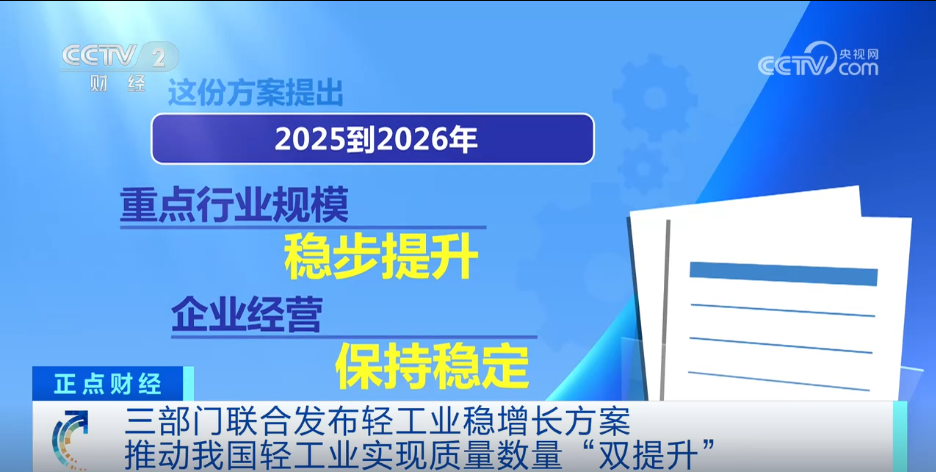
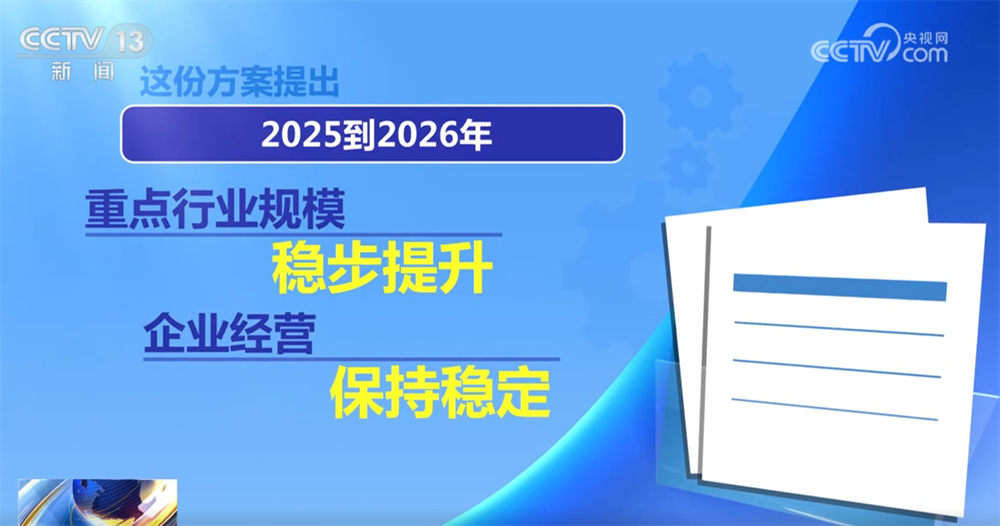
Core Viewpoint - The "Light Industry Stabilization and Growth Work Plan (2025-2026)" aims to provide a clear roadmap for the development of the light industry, focusing on stabilizing growth, promoting consumption, and improving livelihoods [1][4]. Group 1: Development Goals - The plan sets several key objectives for the light industry from 2025 to 2026, including steady growth in key sectors, stable business operations, rapid growth in emerging fields such as smart home products and elderly and infant goods, the launch of 300 upgraded innovative products, and the cultivation of 10 industry clusters with a scale exceeding 100 billion [4][6]. Group 2: Supply and Demand Strategy - The core strategy of the plan is to drive market vitality through a dual approach of "optimizing supply" and "expanding consumption" [7]. - The plan emphasizes the importance of light industry as a fundamental aspect of people's livelihoods, linking numerous enterprises and jobs to daily life [6]. Group 3: Supply Optimization Measures - Key measures for optimizing supply include accelerating product innovation through AI analysis of consumer needs, enhancing quality and safety by revising national standards, and building brand influence in sectors like home appliances and cosmetics [9][11]. - The plan aims to complete revisions of 10 mandatory national standards within two years and update 300 industry standards annually [9]. Group 4: Consumption Expansion Initiatives - The plan outlines initiatives to promote consumption, such as implementing trade-in policies for home appliances and promoting green and smart products suitable for the elderly and children [11]. - It also focuses on developing new categories like smart home appliances and health products, leveraging online platforms for supply-demand matching, and fostering new business models that integrate AI with consumption [11].
轻工业稳增长方案为“强供给、促消费、惠民生”提供行动指南 有何“新”亮点?
Yang Shi Wang· 2025-09-19 03:44
Core Viewpoint - The Ministry of Industry and Information Technology, the Ministry of Commerce, and the State Administration for Market Regulation jointly issued the "Light Industry Stabilization and Growth Work Plan (2025-2026)", outlining development goals and a roadmap for the light industry to stabilize growth, promote consumption, and benefit people's livelihoods [1] Group 1: Goals and Strategies - The plan aims for steady growth in key industries, stable business operations, rapid growth in emerging sectors like smart home products and elderly and infant goods, the launch of 300 upgraded innovative products, and the cultivation of 10 industry clusters each exceeding 100 billion yuan [1] - The five main tasks include strengthening supply, promoting consumption, stabilizing exports, optimizing ecology, and increasing momentum for "dual improvements" in quality and quantity within the light industry [4] Group 2: Supply Optimization - The plan includes measures such as accelerating product innovation through AI analysis of demand, enhancing quality and safety by revising national standards, and building brand influence by selecting brands for the "China Consumer Famous Products Array" [6][8] - Specific actions include implementing a replacement policy for home appliances and promoting green, smart products suitable for the elderly and children [8] Group 3: Consumption Expansion - The plan emphasizes increasing new categories around health, elderly care, and infant products, and developing new business models like "AI + consumption" to achieve quick responses and personalized customization [8][10] Group 4: Export Stability and Ecological Optimization - The plan supports leading companies in home appliances and furniture to accelerate global branding and enhance cooperation with regions like Southeast Asia and Africa through the Belt and Road Initiative [11] - It also aims to cultivate leading enterprises in sectors like home appliances and batteries, promote collaboration between large and small enterprises, and guide businesses to relocate to central and western regions [13] Group 5: Transformation and Upgrading - The plan focuses on digital transformation in industries like furniture and footwear, promoting green development through low-carbon technologies and recyclable materials, and pushing the industry towards high-end, intelligent, and green transformation [16] - The light industry's global export share exceeds 30%, maintaining a leading position worldwide, with an emphasis on optimizing trade structures and strengthening public services to consolidate advantages [17]
强化价格导向——《政府工作报告》解读【财通宏观•陈兴团队】
陈兴宏观研究· 2025-03-05 10:41
Core Viewpoints - The economic growth target for this year is set at around 5%, consistent with last year's target, but reflects a more conservative outlook due to increasingly complex external conditions [1][4] - The fiscal deficit is projected to increase to 4%, surpassing the previous threshold of 3%, indicating a stronger push for fiscal stimulus [2][6] - The focus on expanding domestic demand has been elevated as a primary task, with significant emphasis on promoting consumption through various measures [3][10] Economic Growth Targets - The government has set the economic growth target at approximately 5%, maintaining the same level as last year, but with a more cautious approach due to external challenges [1][4] - The consumer price index target has been adjusted to around 2%, down from 3%, reflecting a more realistic assessment while increasing its binding force [1][4] - The urgency to reduce energy consumption per unit of GDP has intensified, with a target reduction of 13.5% set in the 14th Five-Year Plan, impacting high-energy-consuming industries like steel and chemicals [1][4] Central Policy Adjustments - The fiscal budget deficit is set at 4%, with a planned scale of 5.66 trillion yuan, an increase of 1.6 trillion yuan from last year's budget [2][6] - Local government special bonds are projected to reach 4.4 trillion yuan, a 13% increase from last year, indicating a significant rise in fiscal capacity [2][6] - The monetary policy is characterized as "moderately loose," with potential for timely reductions in reserve requirements and interest rates [7] Key Focus Areas - Expanding domestic demand is prioritized, with a focus on enhancing consumption capabilities and promoting supply release [3][10] - The government plans to allocate 300 billion yuan in special bonds to support the consumption of new goods through trade-in programs, doubling last year's funding [3][10] - The report emphasizes a higher technological content in industrial policies, with specific support for sectors such as commercial aerospace, low-altitude economy, and artificial intelligence [11] Real Estate Regulation - The real estate regulation continues with a strategy of "controlling new supply and managing existing stock," aiming to revitalize the market [12][13] - The report suggests integrating eligible rural migrant workers into the housing security system, which could stimulate demand in the real estate market [13] Support for Childbirth - The introduction of childcare subsidies at the national level acknowledges the effectiveness of local policies and indicates potential increases in central financial support for childbirth [13]