关税收入

Search documents
特朗普赚大了,关税收入超3000亿美元?美联储降息格局再生变数!
Sou Hu Cai Jing· 2025-08-22 09:48
Core Points - The U.S. Treasury Secretary's claim of $300 billion in tariff revenue is misleading, as actual revenue has only reached $100 billion by July, requiring an unrealistic daily collection of $13 billion over the next five months [2][7] - The "see-saw effect" of tariffs leads to reduced imports or increased prices, significantly impacting revenue from tariffs, as seen with U.S. soybean exports to China plummeting from 22 million tons to 3 million tons [4][6] - The "Laffer Curve" indicates that tax revenues can decrease if rates exceed a certain threshold, which the Trump administration underestimated, expecting $600 billion from tariffs but potentially receiving only $280 billion [6][19] Tariff Revenue Challenges - The projected $300 billion in tariff revenue is insufficient to cover the interest on the national debt, which exceeds $35 trillion, with interest payments alone expected to exceed $500 billion in the first half of 2025 [7][19] - Tariff revenues are eroding other tax sources, particularly affecting small businesses, leading to job losses and a potential decrease in personal and corporate tax revenues [9][19] Economic Impact - Tariffs are damaging the U.S.'s international credibility, with agricultural states facing political pressure and requiring government subsidies to offset losses from tariffs [11][19] - The Federal Reserve faces a dilemma between inflation pressures and recession risks, with rising service prices linked to tariffs and agricultural states showing signs of economic decline [12][14] Future Implications - The long-term effects of tariff policies are creating a "lose-lose" situation for the U.S., with rising unemployment in agricultural states and a wave of small business closures [19][21] - China's response includes diversifying supply chains and increasing domestic production, which may lead to a more resilient trade system, while U.S. companies are relocating production to Mexico and Southeast Asia [21][23] Conclusion - The tariff policy is likened to a fleeting spectacle, promising $300 billion in revenue but ultimately leading to significant economic damage, including the decline of agricultural states and small businesses [24][25]

特朗普关税收入或超3000亿,美联储降息再生变数引关注
Sou Hu Cai Jing· 2025-08-22 04:21
Core Points - The article discusses the implications of Trump's tariff policies, highlighting that while tariff revenues are projected to exceed $300 billion, the long-term economic impacts and risks are complex [1][2][12] - The increase in tariff revenue is seen as a temporary relief for the growing national debt, which has reached $37 trillion, but ultimately, the burden will shift to consumers and businesses, leading to higher prices [1][4][12] Tariff Revenue - The U.S. Treasury reported that the first round of tariffs initiated on April 9 generated $100 billion in revenue within 90 days, with July seeing a record monthly revenue of $28 billion, a 273% increase year-over-year [2] - Cumulative tariff revenue for the fiscal year has reached $142 billion, with expectations that it may exceed 1% of GDP by year-end [2] - Despite the revenue, Treasury Secretary Besant emphasized that debt repayment is the priority over potential tax rebates for citizens [2][12] Economic Impact - Major companies like Home Depot and Procter & Gamble have warned of price increases due to rising costs from tariffs, with about one-third of U.S. businesses planning to raise prices in the next six months [4][5] - The Congressional Budget Office predicts that the fiscal deficit will increase by $1 trillion over the next decade, exacerbated by Trump's policies [4][12] Trade Relations - The article notes ongoing trade negotiations with China, with hopes to reach an agreement before the end of November to reduce tariffs and mitigate economic impacts [12] - The tariffs imposed on various countries, including a 20% tariff on Chinese goods, are part of Trump's strategy to reshape trade dynamics and reduce trade deficits [2][5] Federal Reserve and Interest Rates - The article highlights Trump's criticism of the Federal Reserve's monetary policy, advocating for significant interest rate cuts to stimulate the economy [7][10] - Market expectations for rate cuts have increased, with traders anticipating a higher likelihood of a dovish Federal Reserve in the future [8][10] Conclusion - Overall, while tariff revenues provide short-term fiscal relief, the long-term implications for consumer prices, corporate costs, and national debt remain concerning, with the potential for increased inflation and economic instability [1][4][12]
美关税收入将优先偿还国债 国际黄金多头酝酿反击
Jin Tou Wang· 2025-08-20 06:12
Group 1 - The international gold price is currently trading around $3,320.80, with a slight increase of 0.12% reported at $3,318.92 per ounce, indicating a short-term bearish trend [1] - Recent fluctuations in gold prices have shown strong rebounds followed by declines, with significant support levels identified at $3,315 to $3,313, which are crucial for potential bullish resistance [2][3] - If the gold price breaks below the $3,315 to $3,313 range, further attention should be given to the $3,295 to $3,300 area, which is a key psychological level and also aligns with Fibonacci retracement levels [3] Group 2 - The U.S. Treasury has reported a significant increase in tariff revenue, previously estimated at $300 billion, which is now expected to be substantially higher, with $100 billion already collected since the implementation of global tariffs [2] - There are proposals from some lawmakers to use tariff revenues for tax rebates to American citizens, potentially providing $600 per adult and child, totaling around $2,400 for a family of four [2] - The U.S. government's focus remains on debt repayment and deficit reduction, with a confirmation of the AA+ credit rating by S&P Global supporting the effectiveness of the current debt repayment strategy [2]
美国今年关税收入将远超3000亿美元?美国财长: 首要任务还债
Feng Huang Wang· 2025-08-20 01:41
Group 1 - The U.S. Treasury Secretary, Bessent, anticipates a significant increase in revenue from tariffs imposed by Trump, which will primarily be used to pay down federal debt rather than provide tax refunds to Americans [1][2] - Bessent has indicated that the previous estimate of $300 billion in tariff revenue will be substantially revised upward, although he did not disclose specific figures [2] - As of July, the U.S. has already collected $100 billion in tariff revenue since the implementation of Trump's global tariff measures in April [2] Group 2 - Bessent suggests that the U.S. economy may return to a "good low-inflation growth" similar to the 1990s, attributing some economic issues to high interest rates, particularly affecting the housing market and low-income households with high credit card debt [3] - He noted that Trump has been urging the Federal Reserve to lower key interest rates, which could help stimulate the housing market and potentially lead to a decrease in home prices within one to two years [3] - Recent data from the Census Bureau indicates a slight increase in single-family home starts and future building permits, although high mortgage rates and economic uncertainty continue to dampen homebuying enthusiasm [3]
标普在赤字与收益率波动间维持美国AA+评级:关税收入对冲“大而美”法案冲击
智通财经网· 2025-08-19 04:25
Core Viewpoint - S&P Global Ratings maintains the United States' long-term credit rating at AA+ and short-term rating at A-1+, citing the resilience of the U.S. credit system despite significant fiscal challenges posed by the recent "Big and Beautiful" tax expenditure bill [1][6]. Group 1: Tax Revenue and Fiscal Impact - The increase in effective tariff rates is expected to generate substantial tariff revenue, which will offset potential weaker fiscal outcomes related to recent U.S. fiscal legislation that includes both tax cuts and increased tariff revenues [2]. - In July, U.S. tariff revenue reached a record high of approximately $28 billion, with projections suggesting that annual tariff revenue could exceed 1% of U.S. GDP by 2025 [2]. Group 2: Debt Market Concerns - Investors have been worried about fiscal deficits and broader debt sustainability issues since the return of Trump to the White House, with the 30-year U.S. Treasury yield rising above 5% in May due to concerns over tariffs and tax legislation [3]. - The "term premium" phenomenon indicates ongoing market concerns regarding the increasing interest payments on U.S. debt, with the 30-year Treasury yield remaining at 4.93% and the 10-year yield at 4.33% [4]. Group 3: Future Projections and Ratings Outlook - S&P's stable outlook suggests that while U.S. fiscal deficits are not expected to improve significantly, they also will not worsen, with net government debt projected to exceed 100% of GDP in the next three years [6]. - The average general government deficit is expected to be around 6% from 2025 to 2028, which is lower than the previous year's 7.5% [6].
散户仍强烈看好黄金
Sou Hu Cai Jing· 2025-08-18 09:27
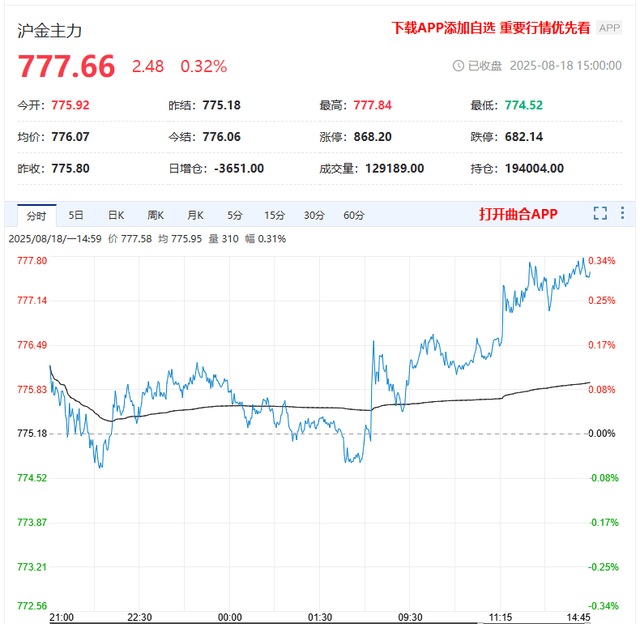
Group 1 - 80% of Wall Street analysts expect gold prices to continue consolidating in the coming week, with only 10% bullish and another 10% bearish, indicating a mixed outlook on future gold prices [1] - Retail investors show stronger optimism, with 63% of 183 participants in an online poll predicting a rise in gold prices, while 18% expect a decline and 19% foresee a consolidation [1] - The closing price of gold in Shanghai increased by 0.32%, reaching 777.66 yuan per gram [1] Group 2 - According to GF Futures, the market sentiment has weakened following trade agreements between multiple countries and the U.S., which may support dollar assets and put pressure on prices [3] - The deterioration of U.S. economic data in July has raised the likelihood of a Federal Reserve rate cut in September, while ongoing trade tensions in some countries have increased market demand for safe-haven assets [3] - Technical analysis indicates that international gold prices are forming a triangle pattern, with resistance at the previous high of 3450 USD, suggesting a need for stronger momentum to break through [3] - The macroeconomic environment is expected to increase volatility in gold prices, but there remains potential for a price surge, with recommendations to construct a bull spread using call options during price pullbacks to reduce long position costs [3]
美国7月关税收入创新高,到底是谁在埋单?
第一财经· 2025-08-13 14:42
Core Viewpoint - The article discusses the significant increase in U.S. tariff revenue, which reached a record high in July, and its implications for consumers and the economy [3][4]. Tariff Revenue Growth - In July, U.S. tariff revenue surged to $28 billion, a 273% increase year-over-year, bringing the total for the fiscal year to $142 billion [3]. - The current tariff revenue accounts for 3.1% of total federal revenue, with projections suggesting it could exceed 5% under current policies [3]. - The Trump administration's "reciprocal tariff rates" could generate an additional $1.3 trillion in revenue during its term, potentially reaching $2.8 trillion by 2034 [7]. Impact on Consumers - The average effective tariff rate for U.S. consumers has reached 18.6%, the highest since 1933, leading to a projected 1.8% increase in price levels this year, equating to a $2,400 reduction in annual income per household [8]. - Specific sectors, such as clothing and textiles, are experiencing significant price hikes, with footwear and apparel prices expected to rise by 39% and 37%, respectively [8]. Economic Implications - The increase in tariffs is expected to compress disposable income, reducing demand for imported goods, which could lead to a decline in tariff revenue over time [4][7]. - Despite the rise in tariff revenue, there are concerns that it may not be sufficient to address the growing national debt, which is nearing $37 trillion [11][12]. Future Projections - The U.S. Treasury Secretary indicated that tariff revenue could reach $300 billion for the fiscal year 2025, but experts caution that this growth may have a ceiling due to its negative impact on economic growth [7][11]. - The Congressional Budget Office (CBO) projects a cumulative federal deficit of $21.8 trillion over the next decade, significantly outpacing expected tariff revenue [12].

美国7月关税收入创新高 到底是谁在埋单?对美国人和美国经济来说意味着什么
Di Yi Cai Jing· 2025-08-13 14:37
Core Insights - The U.S. tariff revenue reached a historic high of $28 billion in July, marking a 273% increase year-over-year, with total revenue for the fiscal year reaching $142 billion [1] - The current tariff revenue accounts for 3.1% of total federal revenue, potentially rising to over 5% under existing policies, a level not seen since World War II [1] - The effective average tariff rate for U.S. consumers has hit 18.6%, the highest since 1933, leading to a projected short-term price increase of 1.8% for consumers [4] Tariff Revenue and Economic Impact - The Trump administration's "reciprocal tariff rate" could generate an additional $1.3 trillion in revenue during its term, potentially reaching $2.8 trillion by 2034 [3] - Despite the increase in tariff revenue, there are concerns about its sustainability, as rising import prices may reduce disposable income and demand for imported goods [3][6] - The increase in tariffs has led to a significant burden on consumers, with estimates suggesting a reduction in household income by approximately $2,400 annually due to rising prices [4] Consumer Price Effects - The clothing and textile sectors are particularly affected, with prices for shoes and clothing expected to rise by 39% and 37% respectively in the short term [4] - A recent survey indicated that only 25% of importers are willing to absorb tariff costs, with many manufacturers planning to pass these costs onto consumers [5] - Goldman Sachs estimates that as of June, U.S. businesses bore 64% of tariff-related price increases, but this is expected to shift, with consumers potentially bearing 67% of the costs by October [5] Fiscal Challenges - Despite the surge in tariff revenue, it remains insufficient to address the U.S. national debt, which is nearing $37 trillion [6] - The recently passed "Inflation Reduction Act" is projected to incur a cost of $3.4 trillion over the next decade, far exceeding anticipated tariff revenues [6] - The Congressional Budget Office forecasts a cumulative fiscal deficit of $21.8 trillion over the next decade, significantly overshadowing expected tariff revenue [6] Legal and Policy Challenges - The Trump administration's tariff policies are facing legal challenges, which could significantly reduce future tariff revenue and potentially require refunds of previously collected tariffs [7]
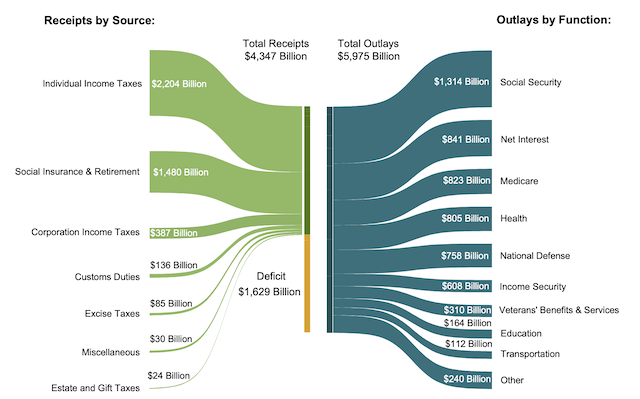
美国7月关税收入创新高,到底是谁在埋单?对美国人和美国经济来说意味着什么
Di Yi Cai Jing· 2025-08-13 11:06
Group 1 - The core point of the article highlights that U.S. tariff revenue has reached a historical high, accounting for 3.1% of federal revenue, with July's tariff income soaring to $28 billion, a 273% increase year-over-year, and total fiscal year revenue reaching $142 billion [1][4] - The current tariff revenue growth is projected to continue, with estimates suggesting it could exceed $300 billion in the fiscal year 2025, driven by policies such as the "equal tariff rate" and ongoing investigations under Section 232 [4][7] - The impact of tariffs on consumers is significant, with an average effective tariff rate of 18.6%, leading to a projected short-term price increase of 1.8%, equating to a reduction of approximately $2,400 in annual income per household [5][6] Group 2 - The sustainability of the current tariff revenue model is questioned, as rising import prices may reduce disposable income and demand for imported goods, potentially leading to a decrease in tariff revenue [2][5] - There is a concern that the increase in tariff revenue may not be sufficient to address the national debt, which is nearing $37 trillion, and the projected fiscal deficit over the next decade is significantly higher than anticipated tariff revenues [7][8] - Legal challenges to the tariff policies could further impact revenue, as unfavorable court rulings may limit the government's ability to implement tariffs and could require refunds of previously collected tariffs [8]
闪评丨“关税填国库” 美国最新预算赤字“打脸”?
Sou Hu Cai Jing· 2025-08-13 09:09
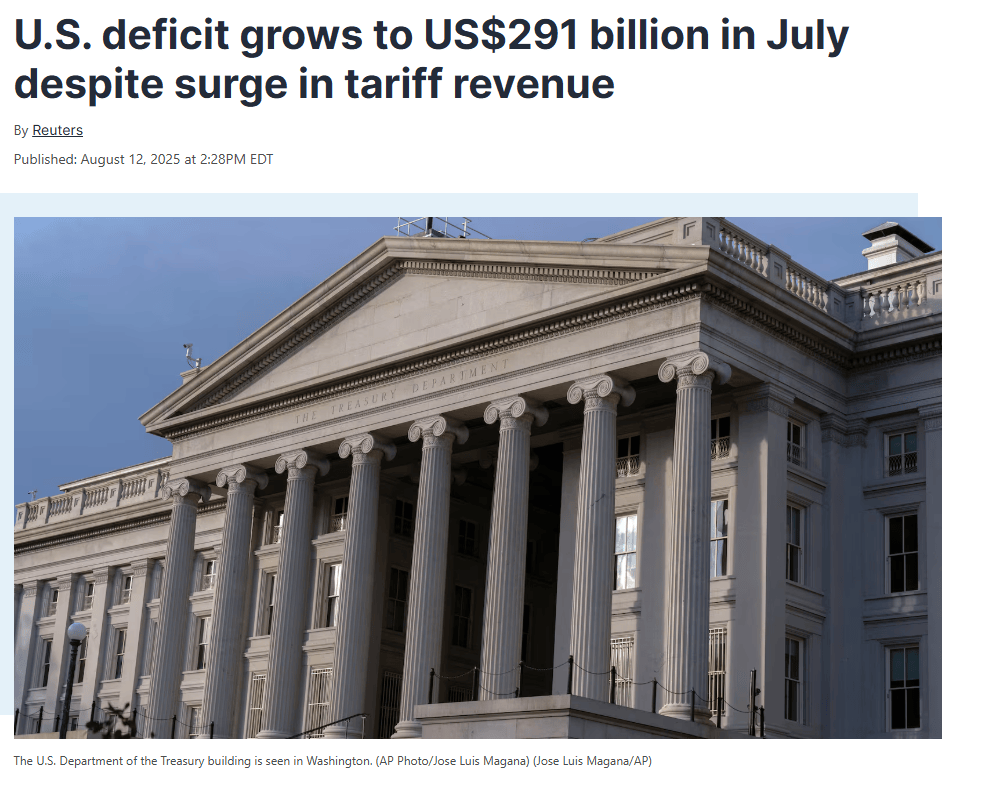
美国财政部公布的最新数据显示,截至当地时间12日下午,美国联邦政府债务规模总额首次超过37万亿美元。 与此同时,7月份美国政府预算赤字达到2910亿美元。这一数字大大超出市场预期。 路透社的报道指出,美国总统特朗普曾表示,关税让"几十亿美元滚滚流入美国国库"。然而,尽管7月关税收入达到280亿美元,创下历史新高,却仍未能阻 止预算赤字的扩大。 路透社报道截图 对此,中国人民大学重阳金融研究院副院长兼宏观研究部主任贾晋京表示,美国国债压力前所未有,关税收入"杯水车薪"。 | 田 Debt to the Penny | | | | | --- | --- | --- | --- | | 田 Table 트 Chart | | | + Select ( | | | | | C Reset | | Record Date TJ | Debt Held by the Public ↑↓ | Intragovernmental Holdings TJ | Total Public Debt Outstanding TJ | | mm/dd/yyyy - mm/dd/yyyy 盲 | ರ | ರ | ರ | | 8/11/ ...