即时配送

Search documents
拼多多将上线即时配送服务
news flash· 2025-06-23 01:19
近日,有消息称多多买菜最快将于8月上线即时配送服务。据华尔街见闻了解,该消息属实。拼多多相 关人员对华尔街见闻表示,该尝试旨在提升平台履约时效,让消费者有更好的消费体验。(全天候科 技) ...

达达被京东私有化,从美股退市!即时零售将成京东流量新抓手
Nan Fang Du Shi Bao· 2025-06-17 15:09
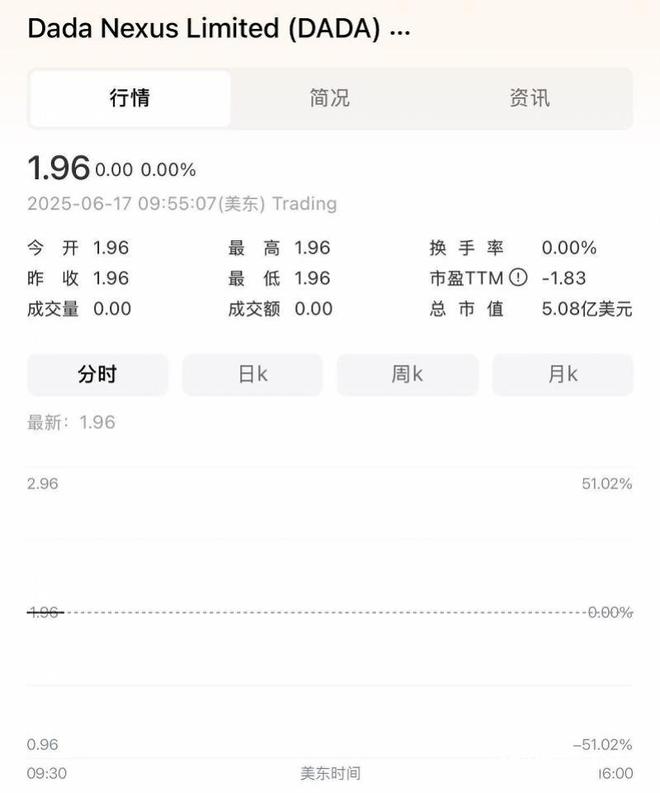
Core Viewpoint - Dada Group has completed its privatization transaction, becoming a wholly-owned subsidiary of JD Sunflower Investment Limited, which is fully owned by JD Group, and will no longer be a publicly listed company starting June 17, 2025 [1][3]. Company Overview - Dada Group was established in 2014 and merged with JD Group's O2O subsidiary in 2016, rebranding in 2019. It went public on NASDAQ in June 2020, becoming the first Chinese company to list in the instant retail sector in the U.S. [3]. - The company has faced continuous losses due to rising sales and marketing expenses, user incentives, and personnel costs, with cumulative losses exceeding 13 billion yuan from 2017 to 2023 [3][4]. Market Position and Performance - JD Group has been increasing its stake in Dada Group to strengthen its instant retail and delivery capabilities, with Dada's active delivery personnel exceeding 1.2 million by the end of 2023 [4]. - In 2024, Dada Group's total revenue was 9.664 billion yuan, a decrease of 8% year-on-year, with a net loss of 2.039 billion yuan, widening by 4.14% compared to the previous year [4]. Privatization Offer - In February 2025, JD Group made a privatization offer to Dada Group at $2.0 per ADS or $0.5 per ordinary share, valuing the company at approximately $520 million [5]. - JD's recent announcement of its food delivery business, which is part of the JD Seconds brand, indicates a strategic move to leverage Dada's delivery capabilities, with daily order volumes exceeding 25 million and over 150,000 restaurants onboarded [5].


美团-W(3690.HK):积极应对外卖竞争 静待长期价值释放
Ge Long Hui· 2025-05-28 18:34
Core Viewpoint - The company's Q1 2025 financial performance exceeded market expectations, with significant growth in core local business and new business revenues [1] Group 1: Overall Performance - Q1 2025 revenue reached 86.6 billion yuan, representing a year-over-year increase of 18% but a quarter-over-quarter decrease of 2% [1] - Operating profit for Q1 2025 was 10.6 billion yuan, up 103% year-over-year and 58% quarter-over-quarter [1] - Net profit for Q1 2025 was 10.1 billion yuan, reflecting an 87% year-over-year increase and a 62% quarter-over-quarter increase [1] - Non-GAAP EBITDA for Q1 2025 was 12.3 billion yuan, a 52% year-over-year increase and a 7% quarter-over-quarter increase [1] - Non-GAAP net profit attributable to shareholders was 10.9 billion yuan, up 46% year-over-year and 11% quarter-over-quarter [1] Group 2: Core Local Business - Core local business revenue grew 18% year-over-year to 64.3 billion yuan, driven by increased transaction volume and reduced subsidy deductions [2] - Operating profit for core local business increased 39% year-over-year to 13.5 billion yuan, surpassing Bloomberg's consensus estimate of 12.2 billion yuan [2] - The company anticipates a slowdown in revenue growth for Q2 2025 due to intensified industry competition [2] Group 3: Business Segments - **Food Delivery Business**: Q1 2025 food delivery orders increased by 9.3% year-over-year, with over 480 brands launching more than 3,000 high-quality satellite stores [2] - **Meituan Flash Purchase**: Q1 2025 saw strong growth in flash purchase business, with over 500 million cumulative transaction users and daily order volume exceeding 18 million [3] - **In-store Travel Business**: Q1 2025 in-store travel revenue grew 20% year-over-year, with active merchants increasing by over 25% [3] Group 4: New Business and International Expansion - New business revenue grew 19% year-over-year to 22.2 billion yuan, with operating losses narrowing to 2.3 billion yuan [4] - Keeta has become the largest food delivery platform in Hong Kong and is expanding into Saudi Arabia and Brazil, with a commitment to invest 1 billion USD over five years [4] Group 5: Profit Forecast and Valuation - Long-term outlook remains positive for the company's core competencies in instant delivery and international expansion, despite increased competition [5] - Revenue forecasts for 2025-2027 are projected at 387.3 billion, 447.7 billion, and 510.6 billion yuan respectively, with Non-GAAP net profit estimates of 40.9 billion, 54.7 billion, and 67.6 billion yuan [5] - The target market capitalization for 2025 is set at 830.2 billion yuan, with a target price of 136 yuan per share [5]

美团-W(03690):W(3690)2025Q1财报点评:积极应对外卖竞争,静待长期价值释放
Guohai Securities· 2025-05-28 11:33
Investment Rating - The report maintains a "Buy" rating for Meituan-W (3690.HK) [1] Core Views - The report emphasizes that Meituan is actively responding to competition in the food delivery sector while awaiting the release of long-term value [3] - The company's Q1 2025 financial performance exceeded market expectations, with significant growth in both revenue and profit metrics [11] Summary by Sections Overall Performance - In Q1 2025, Meituan achieved revenue of 866 billion RMB, representing a year-over-year increase of 18% and a quarter-over-quarter decrease of 2% [11] - Operating profit reached 106 billion RMB, up 103% year-over-year and 58% quarter-over-quarter [11] - Net profit was 101 billion RMB, reflecting an 87% year-over-year increase and a 62% quarter-over-quarter increase [11] - Non-GAAP EBITDA stood at 123 billion RMB, a 52% year-over-year increase [11] Business Segments - **Food Delivery Business**: In Q1 2025, the food delivery segment saw a steady growth with a year-over-year increase in order volume of 9.3%. The company plans to invest 100 billion RMB over the next three years to enhance the quality of the food service industry [7] - **Meituan Flash Purchase**: This segment maintained strong growth, with over 500 million cumulative transaction users by the end of March 2025. The daily order volume for non-food items exceeded 18 million [7] - **In-store and Travel Business**: The in-store and travel segment reported a year-over-year revenue growth of 20% in Q1 2025, with active merchant numbers increasing by over 25% [8] Financial Projections - Revenue forecasts for 2025-2027 are projected at 387.3 billion RMB, 447.7 billion RMB, and 510.6 billion RMB respectively. Non-GAAP net profit forecasts are 40.9 billion RMB, 54.7 billion RMB, and 67.6 billion RMB for the same years [18] - The target market capitalization for Meituan in 2025 is set at 830.2 billion RMB, with a target price of 136 RMB per share [18][19]
下沉市场外卖新势力,跑腿快车在巨头阴影下的本土创新
Zhong Guo Chan Ye Jing Ji Xin Xi Wang· 2025-05-22 08:10
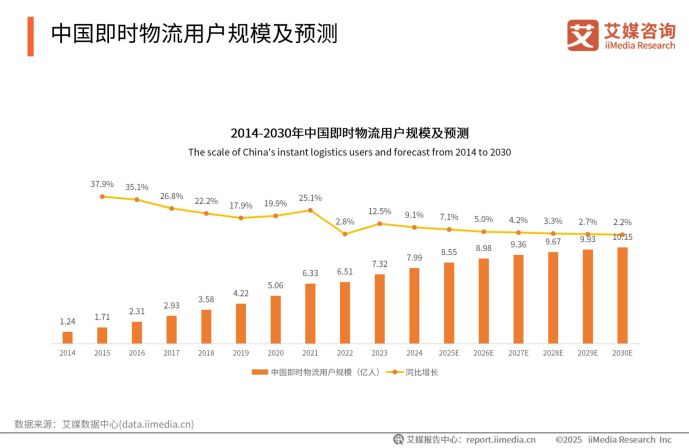
Core Viewpoint - The rise of instant delivery services is significantly driven by consumption upgrades and digital transformation, making it an essential part of life in lower-tier markets [1][2]. Group 1: Market Trends - The lower-tier market, including third-tier cities and rural areas, is becoming a new growth area for the food delivery industry, with a user base expected to grow from 124 million in 2014 to 799 million by 2024 [2]. - The online food delivery market in China is projected to reach a scale of 1.6357 trillion yuan in 2024, with a year-on-year growth of 7.2% and a penetration rate of 28% [4]. - Retail sales in urban areas are expected to reach 42.1166 trillion yuan in 2024, growing by 3.4%, while rural retail sales are projected at 667.29 billion yuan, with a growth rate of 4.3% [7]. Group 2: Policy and Competitive Landscape - Government policies are enhancing the commercial infrastructure in rural areas, promoting initiatives like "delivery to villages" to improve service coverage and reduce costs [10]. - Major players like Meituan, JD, and Ele.me are fiercely competing for market share in lower-tier cities, employing strategies such as zero commission and substantial subsidies [11]. - Local platforms like "Runter Kuaiche" are emerging to cater to specific needs in rural markets, leveraging their local knowledge and community ties to provide personalized services [16][17]. Group 3: Consumer Behavior - The primary consumer group in the lower-tier market consists of individuals aged 25-44, with a significant female user base of 67.01%, who prefer a blend of online and offline shopping experiences [19]. - Over 60% of users order food delivery more than three times a week, with social recommendations playing a crucial role in their decision-making process [19]. Group 4: Future Outlook - The lower-tier market is anticipated to become the "second growth curve" for China's instant delivery industry, driven by ongoing policy support and technological advancements [21].
2025年中国外卖行业发展历程、产业链、发展现状、重点企业及未来趋势研判:网上外卖用户规模持续增长,外卖市场规模突破万亿元[图]
Chan Ye Xin Xi Wang· 2025-05-13 01:33
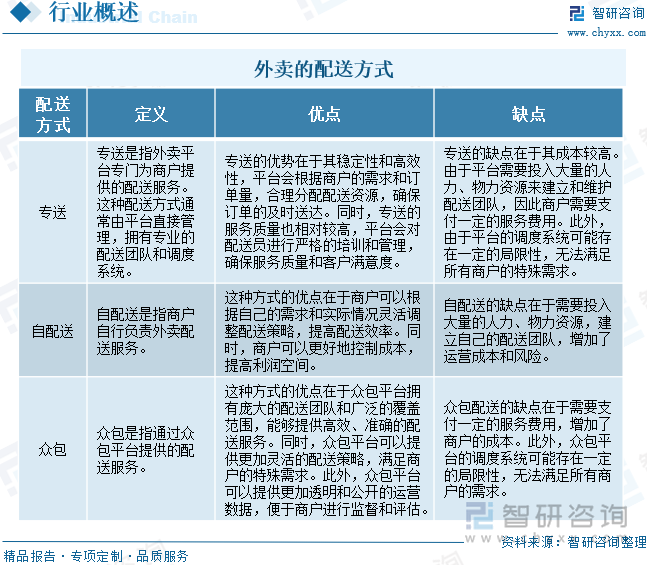
Core Insights - The takeaway from the articles is that the food delivery industry in China has expanded significantly beyond just restaurant meals to include a wide range of products such as groceries, beauty products, and more, becoming a crucial part of daily life for many consumers [1][17]. Industry Overview - The food delivery market in China has grown from CNY 301.29 billion in 2017 to CNY 1,635.7 billion in 2024, with a compound annual growth rate (CAGR) of 27.34% [1][17]. - The penetration rate of the industry has increased from 7.6% in 2017 to 28% in 2024, indicating a growing acceptance and reliance on food delivery services [1][17]. - The industry is driven by the fast-paced lifestyle of urban professionals and students, making food delivery a daily necessity [1][17]. Development Background - The per capita consumption expenditure in China is projected to reach CNY 28,227 in 2024, with food and beverage spending accounting for 29.8% of this figure [10]. - The growth in consumer spending, particularly in food and beverages, reflects an overall increase in consumer purchasing power and a shift in consumption patterns, further supporting the expansion of the food delivery sector [10]. Current Market Status - The restaurant industry in China saw revenues of CNY 4.67 trillion in 2019, with a recovery trend post-COVID-19 leading to projected revenues of CNY 5.62 trillion in 2024 [12]. - The online food delivery user base reached 592 million by the end of 2024, representing 53.4% of the total internet users in China [13]. Competitive Landscape - Major players in the market include Meituan-W, Ele.me, and JD Group, each offering unique services and focusing on different market segments [19][20]. - Meituan-W leads the market with comprehensive food search and delivery services, while Ele.me has expanded into new retail and instant delivery services [19][20]. - JD Group launched its food delivery service in 2025, focusing on chain brands and leveraging its logistics capabilities [19][20]. Delivery Methods - The food delivery industry employs three main delivery methods: dedicated delivery, self-delivery, and crowdsourced delivery, each with its own advantages and disadvantages [4]. - Dedicated delivery offers stability and efficiency but comes with higher costs, while self-delivery allows merchants to control costs but requires significant resource investment [4]. - Crowdsourced delivery provides flexibility and a large delivery network but may incur additional costs for merchants [4]. Future Trends - The "lazy economy" is driving the growth of the food delivery market as consumers increasingly prefer convenience over traditional shopping methods [26]. - The industry is also seeing advancements in delivery technology, including contactless delivery options and the introduction of autonomous delivery vehicles [27]. - The range of products available for delivery is diversifying, moving beyond food to include everyday essentials and other categories, reflecting changing consumer needs [28].
淘宝下场做外卖,能否与饿了么一起站稳脚跟
Qi Lu Wan Bao Wang· 2025-05-01 14:34
Core Insights - The internet industry witnessed significant developments on April 30, with Ele.me launching a "super 10 billion" promotional campaign and Taobao's instant retail service "Xiaoshida" rebranding to "Taobao Flash Purchase," marking Taobao's entry into the takeaway market [1][2] Group 1: Market Developments - Taobao Flash Purchase has been launched in major cities like Beijing, Shanghai, Guangzhou, and Shenzhen, although it is not yet available in Jinan [2] - The price comparison for a popular meal set across platforms shows that Taobao Flash Purchase and Ele.me have competitive pricing, but Meituan offers the lowest prices [5] - The collaboration between Taobao and Ele.me aims to enhance user experience by providing significant discounts and integrating Taobao's e-commerce advantages with Ele.me's delivery services [5][7] Group 2: Competitive Landscape - The partnership between Taobao and Ele.me is expected to leverage Taobao's vast user base and advanced recommendation algorithms to boost Ele.me's order volume [7] - The total subsidy from the three major platforms (Meituan, Ele.me, and Taobao) is projected to reach 30 billion yuan, indicating a fierce price competition in the market [7] - The current market share shows Meituan leading with 65%, followed by Ele.me at 33%, while JD's instant delivery service is gaining traction with over 10 million daily orders [10]

3个月预计支出20亿元?京东“豪赌”即时配送
Qi Lu Wan Bao Wang· 2025-04-28 11:28
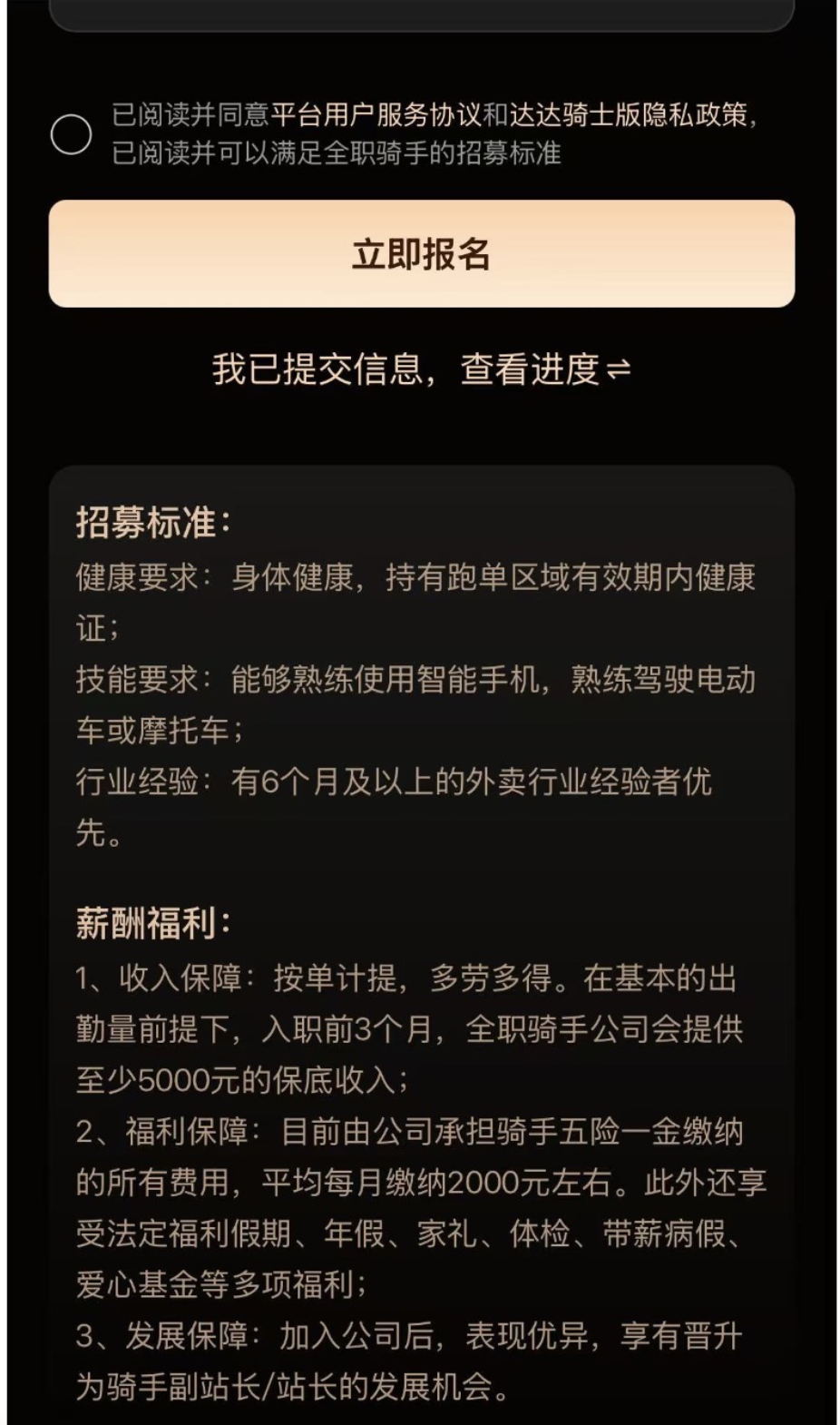
Group 1 - JD.com plans to recruit 100,000 full-time delivery riders over the next three months, offering comprehensive social insurance and a guaranteed minimum salary of 5,000 yuan per month for the first three months of employment [1][2] - The total estimated cost for JD.com to recruit these riders, including social insurance and guaranteed salaries, is approximately 2 billion yuan over three months [2] - The initiative aims to enhance JD.com's delivery business and attract more riders by providing better benefits compared to competitors [2][6] Group 2 - The recruitment strategy is expected to improve JD.com's logistics network and service efficiency, positioning the company favorably in the competitive instant delivery and food delivery markets [6] - JD.com has already seen significant growth in its delivery orders, with over 10 million orders processed by April 22, 2023, indicating a strong demand for its services [5][6] - The company's commitment to providing full social insurance for its riders sets it apart from competitors like Meituan and Ele.me, which only offer partial benefits in select cities [6]