
指数增强策略

Search documents
老船长新航线!九坤投资登榜百亿私募A500指增前三!
私募排排网· 2025-11-17 03:45
Core Viewpoint - The article discusses the performance and potential of the CSI A500 Index in the context of the A-share market, highlighting its superior elasticity compared to the CSI 300 Index and its role as a new investment option for investors [2][5]. Group 1: Market Performance - The CSI A500 Index has shown significant growth this year, outperforming the CSI 300 Index, with historical instances of doubling in value during major market rallies in 2009, 2015, and 2020 [2]. - As of October, the CSI A500 Index has been a focal point for investment products, with notable performance from quantitative strategies, particularly from Jiukun Investment's CSI A500 Index Enhanced Product [2][3]. Group 2: Index Characteristics - The CSI A500 Index, launched in September 2024, includes 500 stocks with large market capitalization and good liquidity, representing a balanced distribution across various industries [5][24]. - It covers 71.2% of total A-share market revenue, 56.1% of market capitalization, and 62.5% of net profit attributable to shareholders, indicating a broad market representation despite comprising less than 10% of the total stock count [5][25]. Group 3: Investment Strategy - The combination of the CSI A500 Index with quantitative strategies offers advantages such as risk diversification, capturing new alpha opportunities in emerging industries, and enhancing liquidity [6][7][8]. - Jiukun Investment's approach emphasizes long-term stability and adaptability in various market conditions, leveraging its extensive experience in quantitative investment [11][15]. Group 4: Future Outlook - The CSI A500 Index is positioned as a key area for quantitative investment strategies, with expectations for continued growth and innovation in investment approaches [15][30]. - The index's active trading and diverse industry representation align well with the principles of quantitative investment, making it a favorable choice for investors seeking to capitalize on market trends [15][31].


沪深300增强超额收益领先市场
CAITONG SECURITIES· 2025-11-15 08:34
Core Insights - The report emphasizes the construction of an AI-based low-frequency index enhancement strategy using deep learning frameworks to build alpha and risk models [3] Market Index Performance - As of November 14, 2025, the Shanghai Composite Index decreased by 0.18%, the Shenzhen Component Index fell by 1.40%, and the CSI 300 Index dropped by 1.08%, indicating a turbulent market with most indices declining [5][8] - Year-to-date performance shows the CSI 300 Index has risen by 17.6%, while the CSI 300 enhanced portfolio has increased by 28.5%, yielding an excess return of 10.9% [20] - The CSI 500 Index has increased by 26.4% year-to-date, with its enhanced portfolio up by 35.0%, resulting in an excess return of 8.6% [25] - The CSI 1000 Index has risen by 25.9% this year, while its enhanced portfolio has surged by 41.7%, achieving an excess return of 15.8% [31] Index Enhancement Fund Performance - For the week ending November 14, 2025, the CSI 300 enhanced fund had an excess return ranging from -1.98% to 1.21%, with a median of 0.24% [12][13] - The CSI 500 enhanced fund's excess return ranged from -0.59% to 2.09%, with a median of 0.32% [12][13] - The CSI 1000 enhanced fund showed an excess return between -0.92% and 1.86%, with a median of 0.03% [12][13] Tracking Portfolio Performance - The report outlines the construction of enhanced portfolios for the CSI 300, CSI 500, and CSI 1000 indices using deep learning frameworks, with weekly rebalancing and a maximum turnover rate of 10% [16] - The alpha signals are derived from a multi-source feature set and stacked multi-model strategies, while risk signals are identified using neural networks [16] CSI 300 Enhanced Portfolio Performance - As of November 14, 2025, the CSI 300 enhanced portfolio has achieved a year-to-date return of 28.5%, compared to the CSI 300's 17.6%, resulting in an excess return of 10.9% [20][21] CSI 500 Enhanced Portfolio Performance - The CSI 500 enhanced portfolio has recorded a year-to-date return of 35.0%, outperforming the CSI 500's 26.4% return, leading to an excess return of 8.6% [25][26] CSI 1000 Enhanced Portfolio Performance - The CSI 1000 enhanced portfolio has increased by 41.7% year-to-date, significantly surpassing the CSI 1000's 25.9% return, resulting in an excess return of 15.8% [31][32]

联博中证500指数增强基金将于11月17日正式发售
Zheng Quan Shi Bao Wang· 2025-11-13 12:25
Core Viewpoint - The launch of the first index-enhanced equity fund by the company in the Chinese market reflects a long-term trend in the recovery of the Chinese equity market, driven by economic transformation and innovation [1] Group 1: Fund Launch - The company announced that the Lianbo CSI 500 Index Enhanced Fund will be available for investors starting November 17 [1] - This fund is the first of its kind in the Chinese market to utilize an index-enhanced strategy [1] Group 2: Market Outlook - The company believes that the recovery of the Chinese equity market this year is not a short-term rebound but part of a long-term trend [1] - The CSI 500 Index includes companies that possess both growth potential and valuation advantages, making it a valuable long-term investment option [1] - Mid-cap stocks represented by the CSI 500 Index are expected to continue benefiting from China's economic growth and transformation [1]
融合价值与成长 工银中证800指数增强发起式即将发行
Zhong Zheng Wang· 2025-11-10 06:14
Core Viewpoint - The A-share market is experiencing a significant recovery, leading to accelerated market style switching and industry rotation, prompting ICBC Credit Suisse Fund to launch a new broad-based enhanced investment tool [1][2]. Group 1: New Investment Tool - ICBC Credit Suisse Fund is launching the ICBC CSI 800 Index Enhanced Initiation Fund (Class A: 025763, Class C: 025764) for public sale from November 12 to November 28, providing investors with a new option for achieving excess returns while managing risk [1]. - The CSI 800 Index comprises stocks from the CSI 300 Index and the CSI 500 Index, covering core stocks in the A-share market with both market capitalization and liquidity [1]. Group 2: Index Characteristics - The CSI 800 Index features a balanced distribution of large and mid-cap stocks, combining the stability of large-cap stocks with the elasticity of mid-cap stocks, which may effectively reduce risks associated with single market capitalization style investments [1][2]. - The index includes mature industry leaders from the CSI 300, such as finance and consumer sectors, as well as growth-oriented stocks from the CSI 500, like pharmaceuticals and electronics, achieving a diversified industry weight [1]. Group 3: Performance and Strategy - Historically, the CSI 800 Index has shown strong performance, with a cumulative increase of 412.3% from its base date (December 31, 2004) to November 7, 2025, demonstrating robust overall return capabilities [2]. - The ICBC CSI 800 Index Enhanced Initiation Fund aims to optimize its investment portfolio through quantitative methods while controlling the risk of deviation from its performance benchmark, striving to achieve returns that exceed those of the CSI 800 Index [2]. Group 4: Management Team - The proposed fund manager, Chen Xin, holds a master's degree in financial mathematics from Peking University and is currently the head of the quantitative team at ICBC Credit Suisse, known for a balanced and disciplined investment style [2]. - The fund management team has established an efficient collaborative investment research system, integrating active and quantitative research teams to broaden Alpha sources [2]. Group 5: Company Background - ICBC Credit Suisse Fund, established in 2005, has consistently prioritized investor interests and has a strong investment research capability [3]. - According to data from Guotai Junan Securities, as of September 30, 2025, ICBC Credit Suisse Fund ranked 2nd, 3rd, and 2nd in excess returns over the past 7, 5, and 3 years among 13 large equity firms, respectively, indicating long-term investment strength and product performance [3].
【广发金工】因子择时:在波动市场中寻找稳健Alpha
广发金融工程研究· 2025-11-07 00:02
Core Viewpoint - The article emphasizes the importance of factor timing in investment strategies, highlighting the need to dynamically select effective factors based on changing market conditions to enhance the stability of multi-factor strategy returns [1][9]. Factor Timing Signals Effectiveness - A total of 92 timing signals were tested, showing an average correlation coefficient of over 15% with the next period's long returns across 77 Alpha factors and 10 Barra style factors. Specifically, deep learning, Level-2, minute frequency, and Barra factors had average correlation coefficients of 17%, 14%, 15%, and 14% respectively, indicating strong predictive power [2][19]. - The deep learning factors such as agru_dailyquote, DL_1, and fimage exhibited average correlation coefficients of 17%, 15%, and 18% respectively, with significant correlations observed in momentum, volatility, liquidity, and market capitalization characteristics [19]. Multi-Signal - Single Factor Timing - To avoid multicollinearity issues, the article employed Partial Least Squares (PLS) for signal aggregation and prediction. The AI image factor fimage achieved a timing success rate of 79%, with an excess annualized return of 8.9% and a Sharpe ratio improvement of 0.67 [2][39]. Multi-Signal - Multi-Factor Timing - The article presented a multi-factor timing strategy that resulted in an annualized return of 37.0% and a Sharpe ratio of 1.72, compared to a non-timed equal-weighted portfolio's annualized return of 20.8% and Sharpe ratio of 0.78. This led to an excess annualized return of 11.6% and a Sharpe ratio improvement of 0.94 [4][5]. Dynamic Multi-Factor Composite - Factor timing can be dynamically integrated into multi-factor composites for strategies like index enhancement. The timing factors in the index enhancement strategies for various indices, including CSI 300 and ChiNext, showed excess annualized returns of 4.56%, 5.98%, 1.08%, 5.67%, and 0.17% compared to the benchmark [5]. Factor Performance Statistics - The article analyzed the performance of 77 Alpha factors and 10 Barra style factors, providing detailed statistics on their returns and predictive capabilities. The results indicated that the factors maintained a strong predictive ability over various time frames [10][19]. Timing Signal Construction - The constructed timing signals fall into four main categories: Momentum, Volatility, Reversal, and Characteristics Spread. Each category has specific methodologies for calculating the signals, focusing on historical returns, volatility, and other characteristics [11][12][13][15][17][18].


沪指一度站上4000点,22只权益类理财近半年净值涨超20%
2 1 Shi Ji Jing Ji Bao Dao· 2025-11-05 08:17
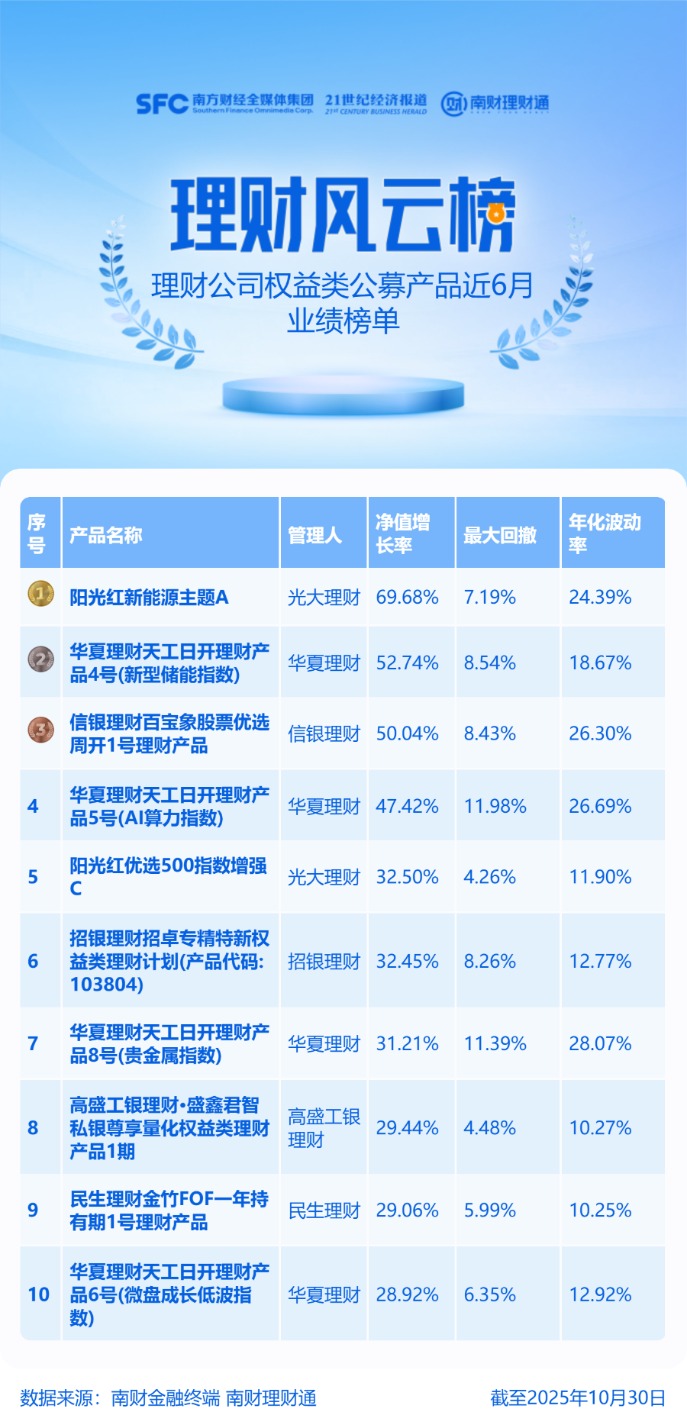
Core Insights - The A-share market has shown significant growth, with the Shanghai Composite Index surpassing the 4000-point mark for the third time in history, reaching a new high of 4025.70 points on October 30, 2023 [3] - The market sentiment is positive, as evidenced by the record high margin trading balance of 2.48 trillion yuan, with financing balance reaching 2.46 trillion yuan [3] - Over the past six months, equity-based wealth management products have performed well, with an average net value growth rate of 23.65%, and 36 products recording positive returns [5] Market Performance - The A-share indices have shown an upward trend over the last six months, with the ChiNext Index leading with a growth rate exceeding 67% [3] - Among the wealth management products, 22 out of 36 recorded net value growth rates above 20%, while some products had single-digit growth rates [5] - Notable performers include Everbright Wealth Management's "Sunshine Red New Energy Theme A" and Huaxia Wealth Management's "Tiangong Day Open Wealth Management Product No. 4 (New Energy Storage Index)" with growth rates of 69.68% and 52.74% respectively [5] Volatility and Future Outlook - Products with strong industry attributes also exhibited higher volatility, with annualized volatility rates for top-performing products reaching 28.07% and 26.69% [6] - Everbright Wealth Management's "Sunshine Red Enhanced 500 Index C" achieved a net value growth rate of 32.5% and is positioned for an index enhancement strategy [6] - Future market expectations indicate a potential for increased volatility in the fourth quarter, with a slow bull market supported by ample liquidity [6]
又一家新晋百亿量化私募!业绩Top10,自营起家,深耕中低频 | 私募深观察
私募排排网· 2025-11-03 03:33
Core Viewpoint - The article focuses on the investment management firm Square and Investment, highlighting its strong performance in the quantitative hedge fund sector and its commitment to research-driven investment strategies [2][6]. Company Overview - Square and Investment Management Partnership (Limited Partnership) is a registered quantitative hedge fund company established in August 2015, recognized with over 70 prestigious awards [6]. - As of October 2025, the firm has surpassed a management scale of 10 billion [2]. Investment Strategy and Team - The company adheres to a core value of "research-driven excellence," with a team composed of experienced fund managers and senior quantitative researchers, each with over 15 years of industry experience [8][10]. - Square and Investment employs a combination of mathematics, statistics, computer science, and finance to develop quantitative hedge fund strategy models aimed at delivering stable long-term performance across different market cycles [8]. Core Strategies and Representative Products - The market-neutral strategy aims to achieve excess returns (alpha) independent of market movements by employing a long-short equity approach [12]. - The firm offers various products, including the Square and Smart Growth No. 1 Private Securities Investment Fund, which focuses on maintaining low correlation with market indices and achieving stable excess returns [14][16]. - The Square and Enhanced Index No. 9 Securities Investment Fund aims to closely track indices while generating potential excess returns through quantitative models [20]. Research and Risk Management - The strategy framework has evolved through localization and continuous iteration, adapting to market changes while maintaining core principles [26]. - The risk management system encompasses pre-trade, intra-trade, and post-trade controls, ensuring comprehensive risk oversight [31][32]. Competitive Advantages - Square and Investment's strategies have demonstrated resilience over a decade, effectively navigating various market conditions [43][44]. - The firm combines traditional and cutting-edge technologies to continuously refine its strategies, ensuring they remain relevant and effective [46]. - The investment team is composed of elite professionals from prestigious institutions, contributing to a robust research and investment culture [47]. Future Development Plans - The company is implementing its "third five-year plan" to balance research and operational efficiency while ensuring growth aligns with strategy capacity [51]. - Plans include expanding data sources, enhancing factor evaluation systems, and developing new model structures to improve service customization [52][54]. - The talent strategy focuses on attracting industry experts and establishing a comprehensive training system to support growth and innovation [55].

指数增强策略跟踪周报-20251102
Xiangcai Securities· 2025-11-02 11:40
Core Insights - The report highlights the strong performance of the CSI 1000 index, which achieved a return of 1.18% during the week of October 27-31, 2025, making it one of the top-performing indices [3][7]. - For the year, the CSI 1000 index has shown a return of 29.99%, outperforming the benchmark index by 3.99% [4][15]. Market Performance - In the week of October 27-31, 2025, the CSI 1000 and CSI 500 indices led in returns, with gains of 1.18% and 1.00%, respectively, while the STAR 50 and SSE 50 indices lagged with returns of -3.19% and -1.12% [3][7]. - Year-to-date, the Micro Index and ChiNext Index have performed exceptionally well, with returns of 67.31% and 48.84%, while the CSI Dividend and SSE 50 indices have underperformed, returning 0.83% and 12.17% [8]. Strategy Performance - The CSI 1000 index enhancement strategy yielded a return of 1.03% for the week, slightly underperforming the index return of 1.18%, resulting in an excess return of -0.15% [4][12]. - In October, the strategy achieved a return of 0.27%, outperforming the index, which had a return of -0.90%, leading to an excess return of 1.17% [14]. - For the year, the strategy's return stands at 29.99%, compared to the index's 26.00%, resulting in an excess return of 3.99% [15]. Investment Recommendations - The CSI 1000 index is noted for its strong performance in 2025, attributed to its strategic focus on sectors such as new energy, semiconductors, and medical devices, which are considered frontier industries [5][18]. - The index is characterized by significant valuation elasticity and policy expectations, making it a high-risk, high-volatility investment option as market risk appetite is expected to tighten towards year-end [5][18].
指数增强策略跟踪周报-20251026
Xiangcai Securities· 2025-10-26 09:51
Core Insights - The report highlights the strong performance of the CSI 1000 Index in 2025, driven by its focus on small-cap companies in sectors such as new energy, semiconductors, and medical devices [5][20] - The report indicates that the CSI 1000 Index has shown significant returns, ranking in the middle among major indices for the year, with a year-to-date return of 31.03%, outperforming the benchmark by 6.50% [4][16] Market Performance - For the week of October 20-24, 2025, the top-performing indices were the ChiNext Index and the Sci-Tech 50 Index, with returns of 8.05% and 7.27% respectively, while the lowest were the CSI Dividend and SSE 50 indices, with returns of 1.05% and 2.63% [3][7] - Year-to-date, the Micro-Cap Index and ChiNext Index led with returns of 66.54% and 48.09%, while the CSI Dividend and SSE 50 indices lagged with returns of 1.32% and 13.45% [8] Strategy Performance - The CSI 1000 Index enhancement strategy yielded a return of 3.55% for the week, surpassing the index return of 3.25% by 0.30% [4][13] - For the month, the strategy achieved a return of 0.18%, while the index returned -2.06%, resulting in an excess return of 2.24% [15] - Year-to-date, the strategy's return was 31.03%, compared to the index's 24.53%, leading to an excess return of 6.50% [16] Investment Recommendations - The report suggests that the CSI 1000 Index remains a strong investment opportunity due to its strategic positioning in high-growth sectors and favorable policy signals following the recent political meetings [5][20] - The report emphasizes the importance of adjusting asset allocations towards lower volatility assets as the year-end approaches, while remaining cautious of the inherent volatility in the CSI 1000 Index [5][20]

高频因子跟踪
SINOLINK SECURITIES· 2025-10-20 11:49
- The report tracks high-frequency stock selection factors, including price range factor, price-volume divergence factor, regret avoidance factor, and slope convexity factor, with their out-of-sample performance being generally strong[2][3][11] - **Price Range Factor**: Measures the activity of stock transactions within different intraday price ranges, reflecting investors' expectations of future stock trends. High price range transaction volume and transaction count factors are negatively correlated with future stock returns, while low price range average transaction volume factor is positively correlated with future stock returns. The factor is constructed by combining three sub-factors: high price 80% range transaction volume factor (VH80TAW), high price 80% range transaction count factor (MIH80TAW), and low price 10% range average transaction volume factor (VPML10TAW). These sub-factors are weighted at 25%, 25%, and 50%, respectively, and are industry market value neutralized[12][14][17] - **Price-Volume Divergence Factor**: Measures the correlation between stock price and trading volume. When price and volume diverge, the likelihood of future price increases is higher, while convergence indicates a higher likelihood of price decreases. The factor is constructed using high-frequency snapshot data to calculate the correlation between snapshot transaction price and snapshot trading volume, as well as snapshot transaction price and transaction count. Two sub-factors are used: price and transaction count correlation factor (CorrPM) and price and trading volume correlation factor (CorrPV). These sub-factors are equally weighted and industry market value neutralized[22][23][25] - **Regret Avoidance Factor**: Based on behavioral finance theory, this factor utilizes investors' regret avoidance emotions to construct effective stock selection factors. It examines the proportion and degree of stock price rebound after being sold by investors. The factor is constructed using transaction data to identify active buy/sell directions, with additional restrictions on small orders and closing trades to enhance performance. Two sub-factors are used: sell rebound proportion factor (LCVOLESW) and sell rebound deviation factor (LCPESW). These sub-factors are equally weighted and industry market value neutralized[26][32][35] - **Slope Convexity Factor**: Derived from the elasticity of supply and demand, this factor uses high-frequency snapshot data from limit order books to calculate the slope and convexity of buy and sell orders. The factor is constructed by aggregating order volume data by level and calculating the slope of buy and sell order books. Two sub-factors are used: low-level slope factor (Slope_abl) and high-level seller convexity factor (Slope_alh). These sub-factors are equally weighted and industry market value neutralized[36][41][43] - **High-frequency "Gold" Portfolio Strategy**: Combines the three high-frequency factors (price range, price-volume divergence, and regret avoidance) with equal weights to construct an enhanced strategy for the CSI 1000 Index. The strategy includes mechanisms to reduce transaction costs, such as weekly rebalancing and turnover rate buffering. The strategy's annualized excess return is 10.20%, with an IR of 2.38 and maximum excess drawdown of 6.04%[44][46][47] - **High-frequency & Fundamental Resonance Portfolio Strategy**: Combines high-frequency factors with fundamental factors (consensus expectations, growth, and technical factors) to construct an enhanced strategy for the CSI 1000 Index. The strategy's annualized excess return is 14.49%, with an IR of 3.46 and maximum excess drawdown of 4.52%[48][50][52]