新经济

Search documents
新经济、新动能行业洞察系列(一):新经济工业行业进阶中的质效观察
Southwest Securities· 2026-01-28 13:25
Group 1: New Economy Overview - The "new economy" is characterized by information technology and globalization, driven by technological and institutional innovations, representing a profound transformation in economic structure and development methods[2] - In 2024, the value added of the "three new" economies (new industries, new business formats, new models) is projected to reach 24.29 trillion yuan, accounting for 18.01% of GDP, an increase of 0.43 percentage points from the previous year[10] - The third industry constitutes 54.7% of the "three new" economy, highlighting the active role of the new economy in the service sector[10] Group 2: Industrial Sector Insights - The report constructs a monitoring system for the industrial sector's economic climate, focusing on key areas such as new energy, new materials, and aerospace[2] - The industrial sector's economic climate is stabilizing and entering a new cycle, with the manufacturing PMI showing recovery trends since 2020, particularly in high-tech industries[2] - Key industries are experiencing differentiated growth, with the communication equipment sector rebounding strongly, while the computer and home appliance sectors are still seeking a bottom[2] Group 3: Risk Factors - Potential risks include fluctuations in domestic and international economic cycles, adjustments in industrial policies, and geopolitical risks[2]
大型科技股表现强势,港股通互联网ETF易方达(513040)、恒生科技ETF易方达(513010)等受关注
Mei Ri Jing Ji Xin Wen· 2026-01-27 10:49
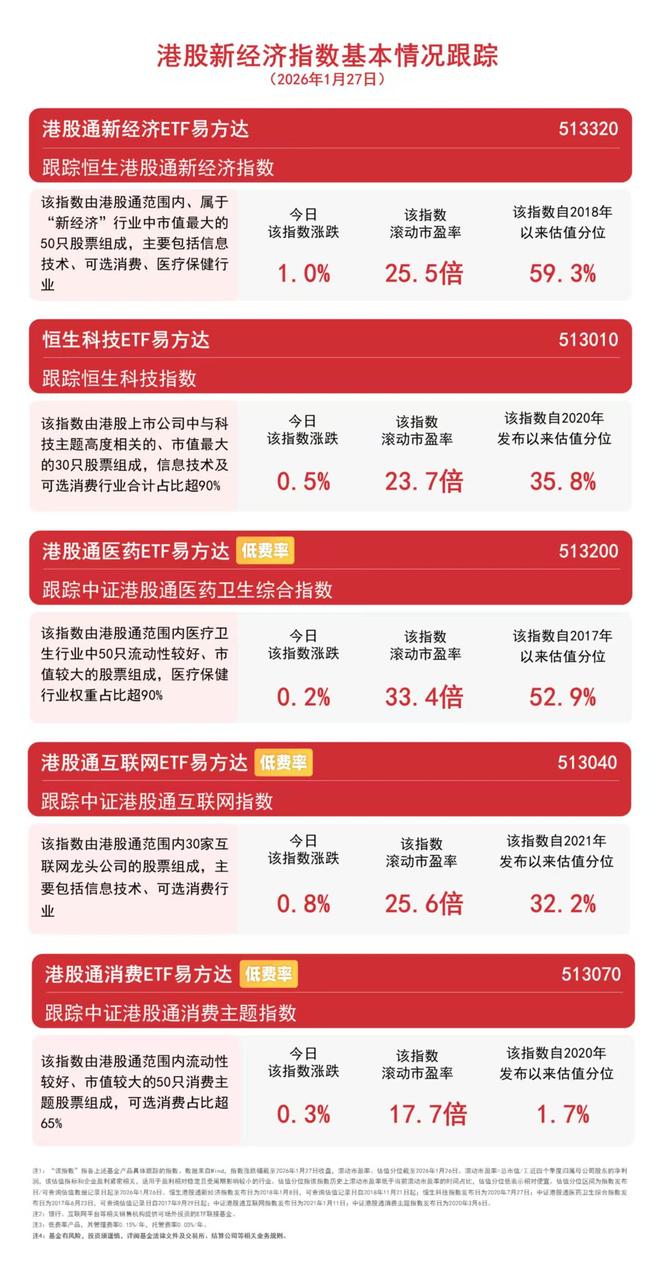
Group 1 - The Hang Seng Hong Kong Stock Connect New Economy Index increased by 1.0%, while the CSI Hong Kong Stock Connect Internet Index rose by 0.8%, the Hang Seng Technology Index by 0.5%, the CSI Hong Kong Stock Connect Consumer Theme Index by 0.3%, and the CSI Hong Kong Stock Connect Healthcare Comprehensive Index by 0.2% [1] - Dongwu Securities indicates that the Hong Kong stock market is in a trend of gradual upward movement, with AI applications expected to accelerate and the semiconductor industry entering a comprehensive price increase phase [1] - Southbound capital flow shows that the information technology sector is one of the main industries for net inflows in the Hong Kong Stock Connect, suggesting a dynamic focus on AI technology in market positioning [1] Group 2 - The E Fund Hong Kong Stock Connect New Economy ETF tracks the Hang Seng Hong Kong Stock Connect New Economy Index, which consists of 50 stocks from the "new economy" sector with the largest market capitalization [2] - The E Fund Hong Kong Stock Connect Technology ETF tracks the Hang Seng Technology Index, comprising 30 stocks highly related to technology, with over 90% of the index made up of information technology and consumer discretionary sectors [2] - The E Fund Hong Kong Stock Connect Healthcare ETF tracks the CSI Hong Kong Stock Connect Healthcare Comprehensive Index, consisting of 50 liquid and large-cap stocks in the healthcare sector, which accounts for over 90% of the index [2] - The E Fund Hong Kong Stock Connect Internet ETF tracks the CSI Hong Kong Stock Connect Internet Index, made up of 30 leading internet companies, primarily in information technology and consumer discretionary sectors [3]

2025年报业绩预告前瞻:进入复苏的盈利周期
GUOTAI HAITONG SECURITIES· 2026-01-27 00:56
Group 1 - The core view of the report indicates that the economic growth center is shifting upwards, driven by AI and overseas expansion, with cyclical sectors benefiting from supply constraints and downstream demand transformation [1][3] - The report highlights four structural characteristics of profit growth in Q4 2025: 1) Emerging economies remain the main high-growth area; 2) Profit share of mid- and downstream manufacturing is increasing; 3) Large and mid-cap companies show greater earnings growth elasticity; 4) High-tech export remains robust [3][4][5] Group 2 - Macro signals show an increase in new economic activity, with inflation and PMI improving significantly in Q4 2025, indicating structural improvements in the economy [6][11] - The growth structure reveals an upstream recovery, resilient midstream, and strong performance in downstream service consumption, with profits in advanced manufacturing continuing to grow rapidly [25][26] - The report notes that the penetration of AI in emerging technologies is driving demand in various sectors, while Chinese companies are accelerating their overseas expansion [5][6][14] Group 3 - The report emphasizes the importance of focusing on low-crowded sectors with upward revisions in profit expectations, such as non-bank financials, batteries, electronics, machinery, and commercial vehicles [4][5][6] - It highlights that the CPI-PPI gap is widening, allowing for smoother cost transmission to mid- and downstream industries, which is expected to enhance profit margins [11][12] - The report also points out that high-tech product exports are showing strong growth, particularly in emerging markets, which are becoming increasingly significant for China's export landscape [14][15][18]
野村中国首席经济学家陆挺:政策呵护慢牛行情
Jin Rong Jie· 2026-01-26 08:03
Group 1 - The core viewpoint is that the current stock market performance is commendable, with policies effectively supporting a slow bull market while preventing extreme volatility [1] - The current market differs from the 2015 "crazy bull" as the policies are designed to maintain a balanced approach, avoiding both overheating and sharp declines [1] - The effectiveness of policies is highlighted by the fact that IPO financing has not increased despite the stock market's rise, indicating a cautious approach to market expansion [1] Group 2 - The focus of fiscal policy will be central this year, with structural monetary policy serving as a supplementary measure, and an increase in policy support is expected after the March meetings [2] - There is limited room for interest rate cuts, estimated at around 0.1 percentage points in the second quarter, reflecting a cautious monetary stance [2] - The balance between new and old economic sectors is crucial for sustainable growth, emphasizing the importance of both new economic development and traditional sectors like real estate and consumption [2]
现金流ETF(159399)涨超0.5%,结构升级提供长期动力
Mei Ri Jing Ji Xin Wen· 2026-01-26 07:42
华泰证券指出,2025年A股"提质增科"之路稳定前行,新经济、硬科技自由流通市值占比进一步提升。 以自由流通市值计,2025年A股新经济(消费+TMT+高端制造)占比由62.8%上行至65.3%,硬科技 (高端制造+部分TMT+部分医药)占比由35.4%上升至41.1%,首次突破40%大关。这一变化得益于AI 科技周期的带动,自2025年初DeepSeek新模型发布以来,全球投资者重新评估中国科技企业实力,驱 动A股泛科技、硬科技企业市值占比中枢提升。从内部行业看,电子、通信设备板块是拉动占比上行的 主因。工程师红利持续向核心资产映射,为结构升级提供了长期动力。 (文章来源:每日经济新闻) 投资者可关注现金流ETF(159399)。市场表现来看,标的指数富时现金流指数2016年至2024年连续9 年跑赢中证红利指数和沪深300指数。现金流ETF(159399)的标的指数聚焦大中市值,标的指数央国 企占比高于同类现金流指数,月月可评估分红,感兴趣的投资者或可持续关注。 ...
化工板块反弹
Nan Hua Qi Huo· 2026-01-26 03:25
Report Summary 1. Report Industry Investment Rating No relevant content provided. 2. Core Viewpoints of the Report - After the technical adjustment of non - ferrous related varieties last week, there are signs of a rebound, and silver has reached a new high. The underlying logic is the demand logic of related commodities driven by the new economy, new energy, and AI economy, and there may be a risk of short - squeeze as the market progresses. The anti - involution logic of low - valued varieties is gradually advancing. Recently, chemical varieties have shown signs of a rebound and increased trading activity, which is worthy of attention. The national policy is determined to rectify involution - style competition and adjust the dynamic adjustment ability of the supply side. It is believed that anti - involution will be an inevitable theme in 2026 [2][5]. 3. Summary by Relevant Catalog 3.1 Week - long Market Viewpoint Summary - The strength - weakness structure of the commodity market in the past week remains unchanged, with non - ferrous metals and precious metals remaining strong. Chemical varieties have also shown strong performance recently. After a recent technical adjustment, non - ferrous commodities are strengthening again, and the upward trend continues [4]. - Gold and silver have broken through new highs after a short - term technical adjustment, and there are no signs of a trend reversal from the technical form [4]. - In the context of the easing of China - Canada trade relations, rapeseed oil has weakened, but soybean oil and palm oil are unaffected. The overall downside space for oils and fats is very limited, and they can be used as long - position allocations [4]. - The chemical sector will generally operate within the anti - involution framework in 2026. The national policy emphasizes the supply - demand adjustment of the petrochemical sector. The production capacity of glass has declined significantly recently, and the valuation of chemical products has reached an extreme level [4]. - Steel in the black sector is one of the key anti - involution varieties, and the downside space for coal is also limited. The coal supply - guarantee market is nearing its end. Recently, chemical varieties are showing signs of an upward trend [4]. 3.2 Data Tables - **Plate Capital Flow**: The total capital flow is 34.115 billion yuan. Among them, precious metals have a capital inflow of 5.764 billion yuan, non - ferrous metals 3.479 billion yuan, black metals - 0.594 billion yuan, energy 0.274 billion yuan, chemicals 4.047 billion yuan, feed and breeding 0.478 billion yuan, oils and fats 2.118 billion yuan, and soft commodities 0.259 billion yuan [9]. - **Black and Non - ferrous Weekly Data**: It shows price percentile, inventory percentile, valuation percentile, position percentile, open - interest change percentile, and annualized basis for various black and non - ferrous varieties such as iron ore, rebar, gold, silver, etc. For example, the price percentile of iron ore is 21.8%, and the inventory percentile is 100% [9]. - **Energy and Chemical Weekly Data**: It details price percentile, inventory percentile, valuation percentile, position percentile, open - interest change percentile, and annualized basis for energy and chemical products such as fuel oil, low - sulfur oil, asphalt, etc. For example, the price percentile of fuel oil is 7.5%, and the inventory percentile is 44.1% [11]. - **Agricultural Product Weekly Data**: It provides price percentile, inventory percentile, valuation percentile, position percentile, open - interest change percentile, and annualized basis for agricultural products such as soybean meal, rapeseed meal, soybean oil, etc. For example, the price percentile of soybean meal is 9.9%, and the inventory percentile is 91.9% [12].
2026史海钩沉亲历一次科网泡沫,我们能学到什么?
Sou Hu Cai Jing· 2026-01-25 01:07
今天分享的是:2026史海钩沉亲历一次科网泡沫,我们能学到什么? 报告共计:24页 回望科网泡沫:一场资本盛宴的启示录 每当市场对新兴技术投资热潮产生疑虑时,历史总似一面镜子,映照出相似的兴奋与暗涌。上世纪90年代那场轰轰烈烈的科网 泡沫,便是一段资本与技术交织的典型篇章。从1995年网景公司上市拉开序幕,到2000年纳斯达克指数攀上历史巅峰后骤然崩 塌,其间不仅是股价的起伏,更是一场关于创新、货币政策和人性逐利的深刻演绎。 一场由技术革命点燃的资本盛宴 科网泡沫的起点,源于互联网技术的崛起。1996年,摩根士丹利分析师玛丽·米克尔发布《互联网趋势》报告,系统描绘了互联 网经济的未来图景,为资本市场注入强心剂。同年,《电信法》出台,打破行业垄断,推动电信基建投资浪潮。技术进步叠加 政策松绑,企业IPO数量激增,尤其科技板块成为市场焦点。这一时期,劳动生产率显著提升,甚至改变了通胀与就业的传统关 系,为货币政策的宽松转向提供了宏观基础。 货币政策:从"友好宽松"到"谨慎收紧" 时任美联储的格林斯潘,在泡沫初期展现出对技术创新的包容态度。他相信生产率提升能抑制通胀,因此在经济强劲、失业率 走低时并未急于加息。这种 ...
唐家成:全球资本寻求多元化布局 香港内联外通提供中国机遇“接入点”
智通财经网· 2026-01-23 05:54
唐家成指,在此背景下,香港资本市场展现出强劲韧性。2025年,香港交易所证券市场的日均交易额近 2500亿港元,市场活力显著提升,IPO市场融资额名列全球交易所榜首。 香港资本市场结构不断升级,与国家经济的发展脉搏同频共振——在香港交易所上市的企业中,中国企 业的占比达65%,这些中国企业贡献了市场总市值的70%至80%,构成了港股的绝对主力。2025年年, 香港新增119家上市企业,其中三分之二属于新经济公司,涵盖人工智能、先进制造、生物医药、清洁 能源等前沿领域。 智通财经APP获悉,1月21日,港交所主席唐家成在达沃斯一个主题圆桌会议上发言表示,在全球地缘 政治与关税政策变化之下,国际投资者更加重视投资组合的多元化布局,比以往更加关注亚洲市场,特 别是中国市场的投资。香港凭借其高度开放的资本市场和互联互通的优势,为寻求布局中国增长故事的 全球资本提供了可靠的"接入点"。 唐家成表示,香港交易所将继续深化其作为超级联络人的角色,把握中国经济不断增长的机遇,也会着 力吸引更多来自世界各地的投资者参与香港市场,连接全球资本与中国机遇。 谈及投资趋势,唐家成倡导长期主义。他指出,清洁能源和人工智能的创新吸引了大 ...

收益率曲线陡峭化
Qi Huo Ri Bao· 2026-01-22 07:22
Group 1 - The monetary policy has implemented structural interest rate cuts, reducing rates by 0.25 percentage points for various structural monetary policy tools, optimizing some tools, and increasing their quotas to support key strategic areas and weak links [2] - The fiscal policy aims for a more proactive approach, with a budget deficit rate expected to remain around 4% in 2026, and the issuance of special long-term bonds projected to increase by 200 billion to 500 billion, reaching between 1.5 trillion and 1.8 trillion [2] - A package of policies focused on boosting domestic demand has been introduced, including interest subsidies for loans to small and micro enterprises, a special guarantee plan of 500 billion for private enterprise loans, and measures to lower the threshold for private enterprise bond issuance [3] Group 2 - The economy is expected to maintain resilience with a GDP growth rate of 5.0% in 2025, highlighting structural optimization and the growth of new economic drivers, despite weaknesses in traditional sectors like real estate and infrastructure [4] - Consumer price index (CPI) rose by 0.8% year-on-year in December 2025, the highest since March 2023, while core CPI remained above 1% for four consecutive months, indicating a gradual recovery in domestic demand [4] - The bond market is experiencing wide fluctuations due to a combination of loose funding, improving economic conditions, and rising prices, with expectations of a steepening yield curve as long-term bonds underperform relative to short-term bonds [5]
新经济动能支撑租赁需求 深圳写字楼市场凸显韧性
Zhong Guo Jing Ying Bao· 2026-01-22 05:24
Core Insights - The Shenzhen Grade A office market is undergoing structural adjustments in 2025, characterized by high new supply and a transformation in corporate leasing demand, leading to a "total pressure, structural differentiation" pattern [1] - New economic sectors such as consumer electronics, smart manufacturing, and brand expansion are becoming significant drivers of leasing demand [1] Supply and Demand Dynamics - In 2025, Shenzhen will see a peak in new supply with 15 projects entering the market, totaling nearly 1.16 million square meters, the highest in three years, while the overall vacancy rate is expected to rise by 1.8 percentage points to 26.2% [1] - The technology sector continues to dominate market demand, accounting for nearly 30% of transaction area, with smart manufacturing showing particularly strong activity [2][3] - Major tech and financial firms are contributing significantly to net absorption, with over half of the total net absorption in 2025 coming from these sectors [2] Rental Trends - Rental levels in the Shenzhen Grade A office market are expected to decline, with a year-on-year decrease of 11.1% in 2025 [4] - The market is experiencing increased tenant bargaining power, leading to more frequent lease restructuring negotiations to stabilize occupancy rates and reduce tenant turnover risk [4] Future Outlook - In 2026, over 1.5 million square meters of new supply is anticipated, with structural supply-demand contradictions expected to persist, maintaining high competition and continued pressure on rental rates and vacancy levels [5] - Tenants are shifting their focus from price-driven decisions to a comprehensive evaluation of cost-effectiveness, property management, and supporting facilities, benefiting high-quality office spaces in core business districts and emerging areas with mature amenities [5]