
科技

Search documents
新春走基层|告别寒风!6万平米超大室内庙会,解锁马年春节新玩法
Zhong Guo Jing Ji Wang· 2026-02-09 23:53
Core Viewpoint - The first Dadu Spring Festival Temple Fair will be held from February 17 to 23, 2026, at the National Convention Center Phase II, offering a modern indoor cultural consumption experience that transcends traditional outdoor fairs in winter [1][2]. Group 1: Event Details - The event will utilize over 60,000 square meters of exhibition space, creating a warm and elegant environment for visitors [1]. - Six themed exhibition areas will cater to different age groups, providing a one-stop experience for New Year festivities [1]. Group 2: Thematic Areas - The Traditional Folk Area will feature Beijing-style snacks prepared on-site and allow visitors to experience traditional crafts such as paper embroidery and cloisonné [1]. - The National Trend and Intangible Cultural Heritage Area will showcase various intangible cultural heritage skills and specialty foods, making traditional techniques accessible to visitors [1]. - The National Style Makeup Area will create immersive family photo opportunities inspired by Suzhou-style gardens, incorporating traditional games like throwing pots and guessing lantern riddles [1]. Group 3: Technology and International Elements - The Joyful Technology and International Culture Area will blend technology with cultural elements, featuring interactive robots, AI family portraits, and a high-speed train simulation, providing an immersive tech experience [1]. - The International Style Area will include cross-cultural projects like Turkish wet painting, allowing visitors to experience global New Year customs without leaving Beijing [2]. Group 4: Organizational Support - The Dadu Spring Festival Temple Fair is guided by multiple departments and associations, including the Beijing State-owned Assets Supervision and Administration Commission, the Municipal Economic and Information Bureau, the Municipal Commerce Bureau, and the Municipal Culture and Tourism Bureau [2]. - The event is organized by the Beichen Group and hosted by the Capital Convention and Exhibition Group [2].
这个小工具是真实用
Xin Lang Cai Jing· 2026-02-09 10:25
Group 1 - The article discusses the utility of a specific small tool, highlighting its practicality and effectiveness in various applications [1] Group 2 - The content emphasizes the positive reception of the tool within the tech community, suggesting it has gained popularity among users [1] - There is an indication that the tool may have features that enhance user experience, although specific details are not provided [1]


广发基金投顾团队:关注“出海+科技”两大主题
Zhong Zheng Wang· 2026-02-06 14:17
Core Insights - The A-share market is experiencing a complex situation as it approaches the Spring Festival holiday, with previous hot sectors like optical modules, non-ferrous metals, and AI tech stocks in the US showing varying degrees of correction [1] - The Guangfa Fund advisory team suggests that after a significant rise in January, the market is becoming more rational, with a focus on "going overseas + technology" themes, emphasizing cyclical industries supported by global demand and sectors intersecting AI and overseas markets [1][3] Industry Performance - As of February 1, approximately 55% of listed companies in A-shares have disclosed their earnings forecasts for 2025, indicating an overall recovery in profitability, although significant industry divergence is noted, with non-bank financials and non-ferrous metals performing particularly well [1] - The median earnings growth forecast for all A-shares in 2025 is 18%, with a quarterly median growth forecast of 11% for Q4 2025. However, historical trends suggest that this data may decline after all companies complete their earnings disclosures [1] Positive Earnings Forecasts - The proportion of positive earnings forecasts varies significantly across industries, with non-bank financials at 100%, non-ferrous metals at 65%, and automotive and beauty care sectors exceeding 50%. In contrast, industries like coal, real estate, and light manufacturing have positive forecast ratios below 20%, indicating lower industry sentiment [2] - High earnings growth industries for 2025 are primarily in three areas: those directly boosted by market or price factors (e.g., non-bank financials and non-ferrous metals), those benefiting from AI-driven demand (e.g., machinery, electronics, computing, and communications), and those supported by overseas market demand (e.g., machinery, media, and batteries) [2] Investment Strategy - The Guangfa Fund advisory team recommends that investors maintain a balanced allocation strategy to mitigate risks and smooth portfolio volatility, especially in a market characterized by significant industry divergence [3] - The company emphasizes its comprehensive asset management capabilities, offering a full range of products to meet diverse investment needs across different economic cycles and market environments, suggesting that investors consider fund advisory combinations for a more manageable investment experience [3]
未来农业什么样?中央一号文件给出答案
Ren Min Ri Bao· 2026-02-06 11:23
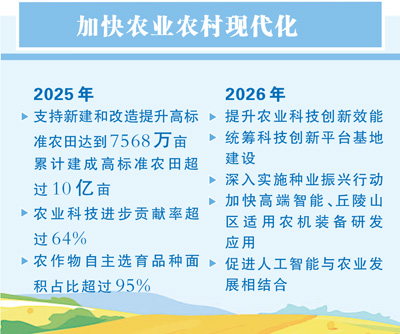
Core Insights - The central document for 2026 emphasizes the integration of technology in agriculture, marking the 14th focus on "three rural issues" since the 18th National Congress of the Communist Party of China [3] - The document highlights the importance of advancing agricultural productivity through technological innovation, including AI, drones, IoT, and robotics [3] Group 1: Technological Advancements - The contribution rate of agricultural technology in China has increased from 54.5% in 2012 to over 64% by 2025, indicating significant progress in agricultural innovation [4] - The comprehensive mechanization rate of crop farming has risen from 57% in 2012 to 76.7% by 2025, showcasing advancements in agricultural equipment [4] Group 2: Transformation of Agriculture - The integration of big data and AI algorithms is transforming traditional agricultural practices, moving from reliance on weather to a more technology-driven approach [5] - Agriculture is evolving into a comprehensive industry that encompasses economic, ecological, social, and strategic functions, necessitating a shift towards new productive forces in agriculture [5] Group 3: Future Outlook - Recent announcements from various provinces highlight the ongoing efforts to integrate technology into agriculture, such as the development of AI breeding platforms and smart agricultural scenarios [6][7] - The continuous progress in technology is expected to bring significant changes to the agricultural sector, suggesting a transformative future for agriculture in China [7]
多空激战!有色韧性凸显,化工逆市冲锋,516020冲高3.45%!港股抄底时刻到了?南向资金连续3日百亿级爆买
Xin Lang Ji Jin· 2026-02-06 09:46
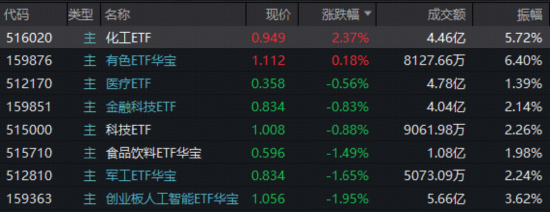
Market Overview - A-shares experienced volatility on February 6, with the Shanghai Composite Index closing down 0.25% at 4065.58 points, and the ChiNext Index down 0.73% [1] - The overall market turnover decreased to 2.16 trillion yuan, marking a continuous six-day decline in trading volume [1] Sector Performance - The chemical and new energy sectors led the market, while the pharmaceutical sector showed relative resilience. Consumer goods experienced a pullback, and technology continued to be sluggish [1] - The chemical ETF (516020) saw a significant inflow of 199 billion yuan, with a daily gain of 2.37% after reaching a peak increase of 3.45% during the day [2][5][6][8] Chemical Sector Insights - The chemical sector is experiencing a strong upward cycle, driven by increased demand for lithium batteries and phosphorous chemicals, with key materials seeing a surge in prices [9][10] - Major stocks in the chemical sector, such as Enjie Co., Ltd. and Zhejiang Longsheng, reported significant gains, with some stocks rising over 6% [6][8] Non-Ferrous Metals Sector - The non-ferrous metals ETF (159876) demonstrated resilience, closing up 0.18% despite initial declines, supported by over 100 billion yuan in inflows [3][11] - The sector is expected to maintain high profitability over the next 3-5 years, driven by supply-demand dynamics and macroeconomic conditions [11] Hong Kong Market Dynamics - The Hong Kong market saw a significant influx of southbound capital, with purchases reaching 133.7 billion HKD, 249.8 billion HKD, and 148.6 billion HKD over three days [4] - The pharmaceutical sector in Hong Kong showed signs of recovery, with the Hong Kong Innovation Drug ETF (520880) rising by 2% during the day, driven by strong earnings forecasts from key companies [15][16] Investment Opportunities - Analysts suggest focusing on leading companies in the chemical sector and those benefiting from rising prices, with recommendations to invest through the chemical ETF (516020) for higher efficiency [10][21] - The Hong Kong Innovation Drug ETF (520880) and the Hong Kong Medical ETF (159137) are highlighted as attractive options for investors looking to capitalize on the pharmaceutical sector's growth [20][21]
代表建言科技高中建设与普惠园转型
Xin Lang Cai Jing· 2026-02-04 22:38
加快科技高中建设 打通科教人才融合"高中枢纽" (来源:南京晨报) 转自:南京晨报 破解教育发展痛点,凝聚育人共识。省十四届人大五次会议正在召开,朱卓君、蒋宇霞等教育界代表接 连建言,一方面呼吁加快科技高中布局建设,夯实科技创新人才培养根基;另一方面建议推动省优民办 普惠园转公办,破解运营难题,让优质教育资源惠及更多家庭。 省人大代表、江苏省天一中学原校长 朱卓君: "推进教育、科技、人才一体化发展,高中阶段是关键节点,加快科技高中建设、推动高中多样化发展 势在必行。"江苏省人大代表、江苏省天一中学原校长朱卓君在参会期间,带来了关于进一步推进科技 高中建设的建议,为培育科技创新人才筑牢基础教育根基发声。 在朱卓君看来,科技高中是衔接基础教育与高等教育、联动科技创新的重要载体,但其建设需系统性规 划与引导。他建议,从宏观层面出台科技高中实施指南与工作标准,明确建设方向、规范发展路径,避 免建设过程中出现同质化、碎片化问题,让科技高中建设有章可循、有据可依。 师资队伍建设是科技高中发展的核心瓶颈,这也是朱卓君重点关注的问题。"当前多数高中教师以单科 培养为主,难以适配科技教育跨学科、重实践的需求。"他提出,需双管 ...
聚焦双科技!恒生指数公司最新发布
Zhong Guo Ji Jin Bao· 2026-02-04 07:52
具体来看,恒生科技指数包含30只成份股,包括网络、金融科技、云端、电子商贸、数码和智能化六大 科技主题,是恒生指数公司眼中增长潜力优异的板块;恒生生物科技指数同样涵盖30只成份股,聚焦药 品、医疗设备、药品分销等生物科技相关行业。两大指数有2只成份股重叠,恒生双科技指数共涵盖58 只成份股。 "我们致力于协助投资者进一步把握科技及生物科技领域的增长机遇。"林颖婷说。 谈及该指数产品的特点,林颖婷对本报记者表示,该指数将两大热门赛道纳入单一基准,依托成熟的恒 生科技指数和恒生生物科技指数,充分利用已有的ETF、期货、期权和结构化产品生态系统,能使指数 权重与两大基础指数保持一致,支持高效地对冲和风险管理。 【导读】恒生指数公司发布恒生双科技指数 2025年港股气氛热烈,科技与生物科技板块表现尤其亮眼。 2月3日,恒生指数有限公司(恒生指数公司)召开发布会,介绍其于2026年1月全新推出的恒生双科技 指数,并分享了新年展望。 根据该公司数据,恒生生物科技指数去年上涨64.5%,扭转4年负回报,录得推出以来最大年涨幅,跑 赢大市及其他主流指数;历史更久的恒生科技指数,全年上涨23.5%,连续第二年录得上涨。 恒生指 ...
超130亿元,“跑了”
3 6 Ke· 2026-02-03 09:56
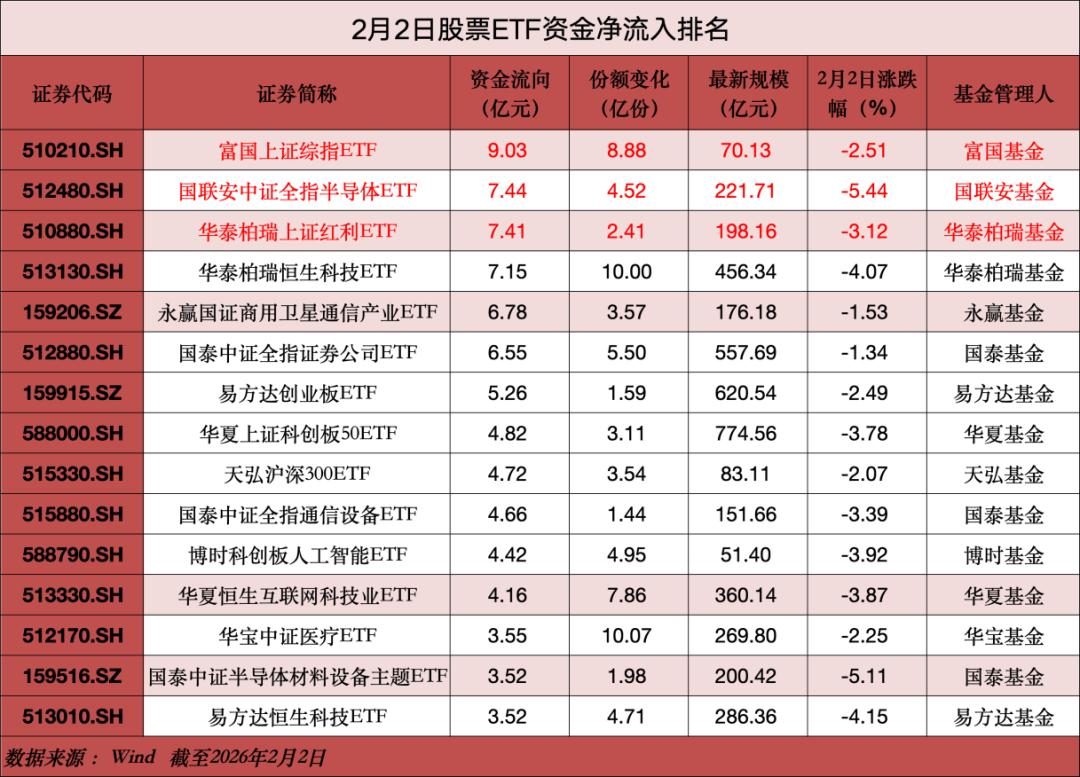
Group 1 - The stock ETF market experienced a net outflow of 790 billion yuan in January, with broad-based ETFs being the main contributors to the outflow [1] - In February, the trend of capital outflow continued, with a single-day net outflow of 13.771 billion yuan on the first trading day, influenced by significant declines in the three major stock indices [1] - Broad-based ETFs and the metals sector were the largest "blood loss" categories, while sector-specific ETFs like semiconductors and pharmaceuticals attracted significant inflows [1][2] Group 2 - As of February 2, the total scale of 1,321 stock ETFs (including cross-border ETFs) was 4.09 trillion yuan, showing a notable decrease due to market declines [2] - Sector-specific ETFs and Hong Kong stock ETFs saw the largest inflows, with 3.715 billion yuan and 3.346 billion yuan respectively on February 2 [2] - The semiconductor sector had a remarkable net inflow of 2.61 billion yuan on February 2, with the Guolian An CSI All-Share Semiconductor ETF leading with a net inflow of 903 million yuan [2] Group 3 - The broad-based ETF sector saw a significant net outflow of 23.778 billion yuan on the previous day, with a total scale decrease of 68.672 billion yuan [5] - The CSI 500 ETF had the largest single-day net outflow of 13.02 billion yuan, followed by the CSI 300 ETF with 7.2 billion yuan [5] - The metals sector also experienced a notable net outflow of 4.39 billion yuan, influenced by market sentiment and short-term profit-taking [6] Group 4 - On February 2, the top inflow ETFs included the Fortune CSI 300 ETF with a net inflow of 903 million yuan and the Guolian An CSI All-Share Semiconductor ETF with 744 million yuan [3][7] - The Huatai-PineBridge CSI Dividend ETF also saw a significant inflow of 741 million yuan, indicating strong investor interest in dividend-related investments [3] - The top inflow for the Hong Kong technology sector ETFs included the Huatai-PineBridge Hang Seng Technology ETF with a net inflow of 715 million yuan [4]
超130亿元,“跑了”!
Zhong Guo Ji Jin Bao· 2026-02-03 06:49
Group 1 - The stock ETF market experienced a significant net outflow of 790 billion yuan in January, with broad-based ETFs being the main contributors to this outflow [2] - On February 2, the first trading day of the month, stock ETFs saw a net outflow of 13.771 billion yuan, influenced by a sharp decline in the three major stock indices [2] - Broad-based ETFs and the metals sector were the largest "bloodletting" categories, while sector-specific ETFs like semiconductors and pharmaceuticals attracted significant inflows [2][3] Group 2 - As of February 2, the total scale of 1,321 stock ETFs (including cross-border ETFs) was 4.09 trillion yuan, showing a notable decrease due to the market downturn [3] - Sector-specific ETFs and Hong Kong stock ETFs saw substantial inflows, with 3.715 billion yuan and 3.346 billion yuan respectively on the previous trading day [3] - The semiconductor sector had a remarkable net inflow of 2.61 billion yuan on February 2, with the Guolian An CSI All-Share Semiconductor ETF leading with a net inflow of 903 million yuan [3] Group 3 - Over the past five days, the SGE Gold 9999 index saw inflows exceeding 13.9 billion yuan, while the specialized chemical index attracted over 7 billion yuan [4] - Leading institutions like E Fund reported a total ETF scale of 642.71 billion yuan, with a net inflow of 800 million yuan on the previous day [4] - Notable single product inflows included 526 million yuan for the ChiNext ETF and 352 million yuan for the Hang Seng Technology ETF [4] Group 4 - Broad-based ETFs continued to experience significant outflows, with a net outflow of 23.778 billion yuan on the previous day, leading to a scale decrease of 68.672 billion yuan [5] - The CSI 500 ETF had the largest single-day outflow of 13.02 billion yuan, followed by the CSI 300 ETF with 7.2 billion yuan [5] Group 5 - The metals sector also faced notable outflows, with a net outflow of 4.39 billion yuan, influenced by expectations surrounding the Federal Reserve's monetary policy and profit-taking sentiments [6] - Despite short-term volatility, the long-term investment logic for the metals sector remains solid, supported by global manufacturing cycles and energy transition demands [6] Group 6 - Current market adjustments are viewed as providing better valuation windows for long-term investments, with a stable long-term market outlook supported by policy measures and improving economic fundamentals [7] - Key factors include ongoing policy support, marginal improvements in economic indicators, and a favorable funding environment with increasing allocations to A-shares from various institutional investors [7]
数说公募主动权益基金四季报:规模/份额双降、周期/金融配置权重上升
SINOLINK SECURITIES· 2026-02-03 02:53
1. Report Industry Investment Rating - No relevant content provided 2. Core Viewpoints of the Report - In Q4 2025, after nearly a year of upward trend, the A - share market started to move sideways and fluctuate, with wide - based indices showing mixed performance. Large and mid - cap value indices significantly outperformed growth indices, and the active equity fund scale and share decreased while the issuance quantity and scale slightly increased [3][8]. - The average stock position of equity funds slightly shrank, and the Hong Kong stock position also declined. Institutions increased the allocation in cyclical and financial sectors and adjusted the allocation in technology, medicine, and consumption sectors [3]. - The performance of theme funds in various industries was differentiated. Cyclical theme funds performed the best, while pharmaceutical theme funds performed the worst [3]. - Among the top 20 fund companies in terms of active equity fund scale, the scale changes compared to Q3 were mixed, with some companies' rankings changing [3]. - In Q4, the active equity fund most heavily held by FOF in terms of holding ratio and quantity was "Fuguo Steady Growth" [3]. 3. Summary by Related Catalogs 3.1 Fund Market Overview - **Performance Review**: In Q4 2025, the A - share market moved sideways and fluctuated after a year - long upward trend. Only the Shanghai Composite Index rose by 2.22% among wide - based indices, while others like the Shenzhen Component Index and the ChiNext Index declined. In terms of style, large and mid - cap value indices outperformed growth indices. The Hang Seng Index and related Hong Kong stock indices also declined [8]. - **Industry Index Performance**: Except for 9 industries such as medicine and beauty care, the remaining 22 industries in the Shenwan 31 - industry index achieved positive returns in Q4. Resources and military industries performed well, while the pharmaceutical industry was weak overall. The top 5 industries in terms of increase were non - ferrous metals (16.25%), petroleum and petrochemicals (15.31%), communication (13.61%), national defense and military industry (13.1%), and light industry manufacturing (7.53%) [11]. - **Equity Fund Performance**: In Q4 2025, ordinary stock - type funds, partial - stock hybrid funds, and flexible allocation funds declined by 1.94%, 1.60%, and 0.04% respectively, while balanced hybrid funds rose by 0.87%. In terms of risk, balanced hybrid funds with lower stock positions had the best drawdown performance, and flexible allocation funds showed better risk - return performance in the long - term [31]. - **Scale and Share**: By the end of Q4 2025, the total scale of active equity funds was 3.81 trillion yuan, a slight decrease of 4.53pct compared to the previous quarter, and the total share was 2.56 trillion shares, a decrease of 2.91pct. Among them, partial - stock hybrid funds had the largest scale, and balanced hybrid funds had the smallest scale [34]. - **Newly Issued Fund Situation**: In Q4, the number and scale of newly issued active equity funds slightly increased. A total of 100 funds were newly issued, with a total scale of 441.67 billion yuan, an increase of 4.72 billion yuan compared to the previous quarter. Partial - stock hybrid funds had the largest newly issued scale [36]. 3.2 Fund Holding Characteristics - **Stock/Hong Kong Stock Position**: In Q4 2025, the equity fund position slightly shrank, with the average stock position at 88.05%, a decrease of 0.88 percentage points compared to the end of the previous quarter. The Hong Kong stock position also decreased, with the average investment market value of Hong Kong stocks accounting for 11.62% of the net value, a decrease of 1.85 percentage points compared to the previous quarter [43]. - **Heavy - Holding Stock Sector Allocation**: In Q4, technology was the most heavily held sector by active equity funds. Except for cyclical, manufacturing, and financial sectors, the proportion of other sectors decreased. Institutions increased the allocation in cyclical and financial sectors and adjusted the allocation in technology, medicine, and consumption sectors [48]. - **Heavy - Holding Stock Industry Allocation**: The electronics industry was still the largest heavily - held industry by equity funds, but the allocation ratio decreased, and non - ferrous metals were significantly increased. The concentration of the top five industries slightly decreased from 58.58% in Q3 to 58.40% [50]. - **Individual Stock Level**: The top 10 individual stocks in terms of heavy - holding market value accounted for by equity funds were Zhongji Innolight, Xinyisheng, CATL, Tencent Holdings, Zijin Mining, Alibaba - W, Cambricon - U, Luxshare Precision, SMIC, and Kweichow Moutai. The market value proportion of Zhongji Innolight, Xinyisheng, and Ping An of China increased significantly, while that of Industrial Fuxing, Alibaba - W, and EVE Energy decreased relatively more [52]. - **Heavy - Holding Stock Market Value and Concentration**: The market value style of equity fund holdings continued to strengthen towards mid - and large - cap stocks. The concentration of the top 50, 100, and 200 heavy - holding stocks slightly decreased, but basically continued the previous trend [61]. 3.3 Fund Company Analysis - **Scale Ranking**: In Q4 2025, the scale changes of the top 20 fund companies in terms of active equity fund scale compared to Q3 were mixed. The top 5 institutions were E Fund, China Europe Asset Management, GF Fund, Fuguo Fund, and Huatai - PineBridge Fund. Among the companies ranked 6 - 20, the equity scale of Yongying Fund further increased, and its ranking rose by 2 places [64]. - **TOP20 Fund Company Heavy - Holding Industries**: The first - largest heavily - held industries of the top 20 fund companies were mainly electronics and medicine and biology. Dacheng Fund's first - largest heavily - held industry was non - ferrous metals, showing certain differences [65]. - **TOP20 Fund Company Heavy - Holding Stocks**: In Q4, the average concentration of the top three heavy - holding stocks of the top 20 fund companies in terms of active equity fund scale was 14.27%, and the concentration of the top five heavy - holding stocks was 21.04%, slightly increasing compared to the previous quarter. Xingquan Fund had the highest concentration of the top three heavy - holding stocks [67]. 3.4 Theme Fund Analysis - **Fund Performance**: In Q4, the performance of theme funds in various industries was differentiated. Cyclical theme funds performed the best, with a quarterly increase of 10.10%, followed by financial and manufacturing theme funds. Pharmaceutical theme funds had the worst performance, with a quarterly decline of 13.15% [71]. - **Pharmaceutical and Consumption Themes**: In pharmaceutical theme funds, the sub - sectors with a relatively high market value proportion in heavy - holding stocks were chemical preparations and other biological products. The sub - sectors with a relatively large increase in heavy - holding proportion were medical R & D outsourcing and traditional Chinese medicine. In consumption theme funds, the sub - sectors with a relatively high market value proportion were liquor and agriculture, forestry, animal husbandry, and fishery. The sub - sectors with a relatively large increase in heavy - holding proportion were food processing and social services [75]. - **Technology and New Energy Themes**: In technology theme funds, the sub - sectors with a relatively high market value proportion in heavy - holding stocks were artificial intelligence and consumer electronics industries. The sub - sectors with a relatively large increase in heavy - holding proportion were optical modules and IDC. In new energy theme funds, the sub - sectors with a relatively high market value proportion were energy storage and solid - state batteries. The sub - sectors with a relatively large increase in heavy - holding proportion were resource stocks and solid - state batteries [79]. 3.5 FOF Holding Analysis - **High - Holding - Ratio Funds**: In Q4 2025, the active equity fund with the highest holding ratio among FOF heavy - holding funds was "Fuguo Steady Growth", with a fund manager of Fan Yan. The fund's holding market value accounted for 2.53% of the total market value of all heavy - holding funds, an increase of 0.13% compared to the previous quarter [81]. - **High - Holding - Quantity Funds**: In Q4 2025, the active equity fund most heavily held by FOF in terms of quantity was still "Fuguo Steady Growth", followed by "Bodaojiu Hang" and "China Europe Dividend Premium Selection" [83]. - **Ratio/Quantity Changes**: In Q4 2025, the active equity funds with the largest increase in holding ratio and quantity among FOF heavy - holding funds were "Huatai - PineBridge Extended Growth Theme" and "China Europe Dividend Premium Selection" respectively [85]. - **New - Generation Fund Managers**: Among the active equity funds managed by new - generation fund managers with less than 3 years of management experience, the fund with the highest holding ratio among FOF heavy - holding funds in Q4 was "Rongtong Industrial Trend Selection", with a fund manager of Li Jin. The fund's holding market value accounted for 0.70% of the total market value of all heavy - holding funds, a quarter - on - quarter increase of 0.37% [87]. - **Holding Own Funds**: Different FOF institutions such as E Fund, China Europe Asset Management, Invesco Great Wall, Fuguo Fund, Huatai - PineBridge Fund, and Xingzheng Global Fund had different situations in holding their own equity funds, with different scales and top - held funds [89][91][94][96][98].




