科技泡沫

Search documents
“大空头”:AI巨头涉嫌虚增利润
财联社· 2025-11-12 00:24
曾因押注美国次贷危机而名声大噪的《大空头》原型人物、投资人迈克尔·伯里(Michael Burry),近日再度掀起波澜,将火力对准了美股最 炙手可热的人工智能(AI)赛道。 他指责美国几家最大的科技公司通过激进的会计操作,在AI热潮中"虚增"盈利。 与此同时,华尔街大型投 行高管及知名做空者频频发出警告,认为美股可能出现回调。 伯里当地时间周一在社交平台X上发文称,那些所谓的"超大规模算力服务商",正在通过延长芯片折旧年限、压低折旧费用,人为放大AI热 潮带来的账面利润。 周一,英伟达股价在上周下跌7%后反弹近6%;Palantir则在上周大跌11%后回升约9%。不过,英伟达和Palantir周二股价再度走低。 伯里最后还表示,他将在11月25日公布更多细节,并让关注者拭目以待。 与此同时,日本软银集团作出了一项令人意外的举动:清仓了"AI芯片霸主"英伟达股份,套现58亿美元,加剧了外界对AI热潮或已触顶的担 忧。 他写道: "通过延长资产的使用年限来低估折旧支出,从而虚增利润,是现代财报中最常见的把戏之一。在以英伟达芯片和服务器为代表、 产品周期仅两三年的情况下,大规模增加资本开支并不应成为企业延长计算设备 ...



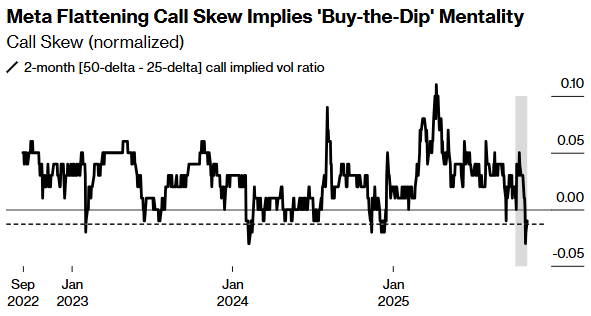
美股波动率抬升!“泡沫恐惧”取代“AI狂热”,投资者谨慎追涨:涌向期权以对冲风险
智通财经网· 2025-11-09 23:33
Core Viewpoint - The S&P 500 index options volatility is on the rise, indicating increasing market pressure after a month of turbulence, with the index ending a three-week streak of gains [1] Group 1: Market Volatility - The Chicago Board Options Exchange Volatility Index (VIX) surged above 20, reflecting heightened market stress [1] - The S&P 500 index's recent pullback reversed a trend of record highs, with simultaneous increases in spot prices and volatility [1] - Factors contributing to increased market volatility include significant fluctuations in individual stock earnings reports and a lack of U.S. government economic data [1][3] Group 2: Investor Behavior - Investors are increasingly aware of market fragility, with minimal factors causing significant declines in the S&P 500 index [1] - There is a notable trend of investors buying call options while hedging against downside risks, indicating a dual approach to market participation [3] - The uncertainty surrounding U.S. government shutdowns and congressional gridlock is also contributing to market volatility [3] Group 3: Economic Indicators - The VIX index remains elevated compared to the same period last year, driven by a combination of rising spot prices and increasing volatility [3] - Analysts suggest that heightened asset price volatility is a clear sign of a potential bubble, reminiscent of the early 2000s tech bubble [3][4] - The actual volatility of the S&P 500 index has more than doubled in the past month, reaching its highest level since June [5] Group 4: Earnings Season Impact - During the early earnings season, individual stock volatility exceeded that of the broader market index, with the Cboe S&P 500 Constituent Volatility Index hitting historical highs [7] - As the earnings season progresses, the trend of rising individual stock volatility may continue to narrow due to a decrease in news surrounding individual stocks [7]
美股AI科技股遭遇重挫 八巨头一周蒸发近万亿美元
Sou Hu Cai Jing· 2025-11-08 02:46
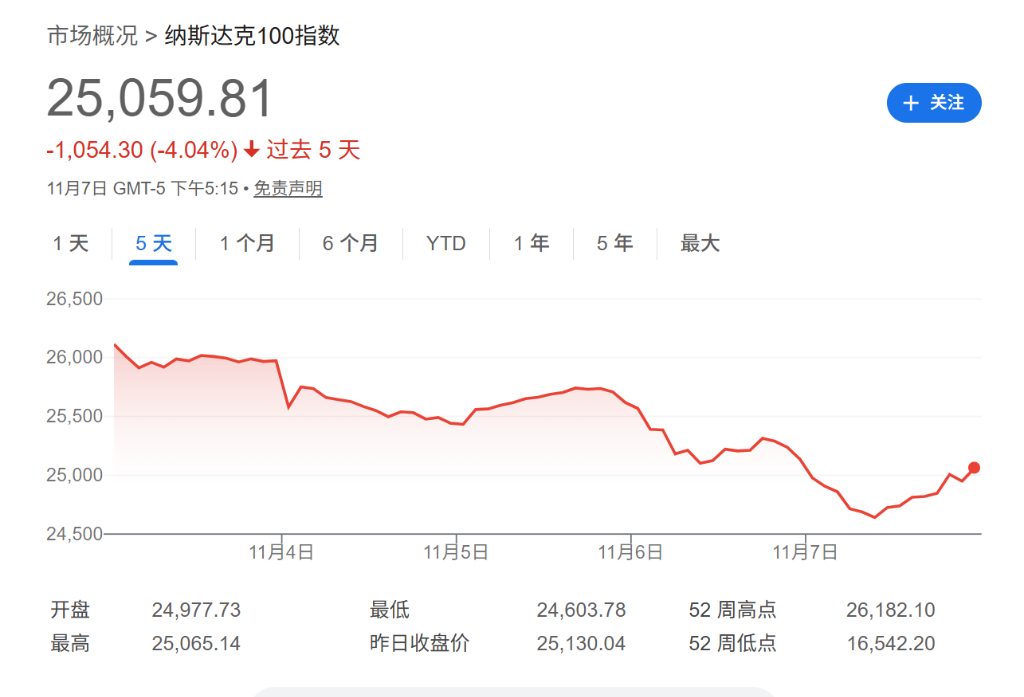
Core Insights - The recent week saw a significant adjustment in U.S. AI-related tech stocks, with a total market value loss of approximately $800 billion (around 5.7 trillion RMB) among eight major companies closely tied to the AI boom [1] - The broader AI concept stocks have experienced nearly a $1 trillion loss in market value, marking the worst weekly decline of the year [1][3] Group 1: Market Performance - The Nasdaq Composite Index, primarily composed of tech stocks, fell by 3% this week, ending a three-week streak of gains and recording its worst performance in five trading days since April [3] - The decline is attributed to multiple factors, including ongoing concerns about high valuations, weak macroeconomic data, and skepticism regarding the sustainability of massive capital expenditures in the AI sector [3] Group 2: Economic Indicators - Recent economic indicators have shown caution, with the University of Michigan's November consumer confidence index dropping to a three-year low and a decline in hiring activity, as indicated by the Chicago Fed's data showing a six-month drop in hiring rates [3] - Major companies like Amazon and Target have announced layoffs, further intensifying market concerns about the economic outlook [3] Group 3: Capital Expenditure in AI - Investment in the AI sector is expanding rapidly, with Microsoft, Amazon, Meta, and Alphabet collectively spending $112 billion on capital expenditures in the last quarter [4] - The industry is increasingly relying on debt financing for AI infrastructure development, raising concerns reminiscent of the blind investment frenzy during the 2000 tech bubble, as noted by Lombard Odier Investment Managers [4]




美国科技股遇4月来“最惨一周”,“AI八巨头”单周市值损失8000亿美元
Hua Er Jie Jian Wen· 2025-11-08 01:07
在一系列对高估值的担忧、宏观经济逆风以及竞争加剧的信号冲击下,与人工智能热潮紧密相关的美国科技公司遭遇了自今年4月以来最惨淡的一 周,投资者情绪显著降温。 本周,以科技股为主的纳斯达克综合指数累计下跌3%,创下自4月份以来最差的单周表现。其中,八家与AI关联最密切的头部公司市值合计蒸发 约8000亿美元,整个与AI相关的美国公司市值自上周五以来损失接近1万亿美元。 宏观经济的不确定性则为市场增添了另一层阴影。由于联邦政府停摆导致关键经济数据缺失,投资者越来越担心自9月底以来劳动力市场可能已大 幅走弱。Visdom投资集团的Mike Zigmont表示: 这场抛售潮的背后,是市场对硅谷科技巨头过高估值的普遍忧虑,与本周浮现的美国劳动力市场疲软迹象以及消费者信心下滑相互交织。密歇根 大学消费者信心指数在11月跌至三年来新低,进一步加剧了市场的紧张情绪。 与此同时,投资者行为也显示出谨慎态度。据摩根大通分析师透露,以逢低买入著称的散户交易者本周选择离场观望。该行在给客户的报告中指 出,零售投资者在Palantir公布财报后减持了头寸,并对今年同样大幅上涨的量子计算股票进行了部分获利了结。 估值担忧与宏观逆风 作为全 ...
软银,市值蒸发近500亿美元
半导体芯闻· 2025-11-07 10:24
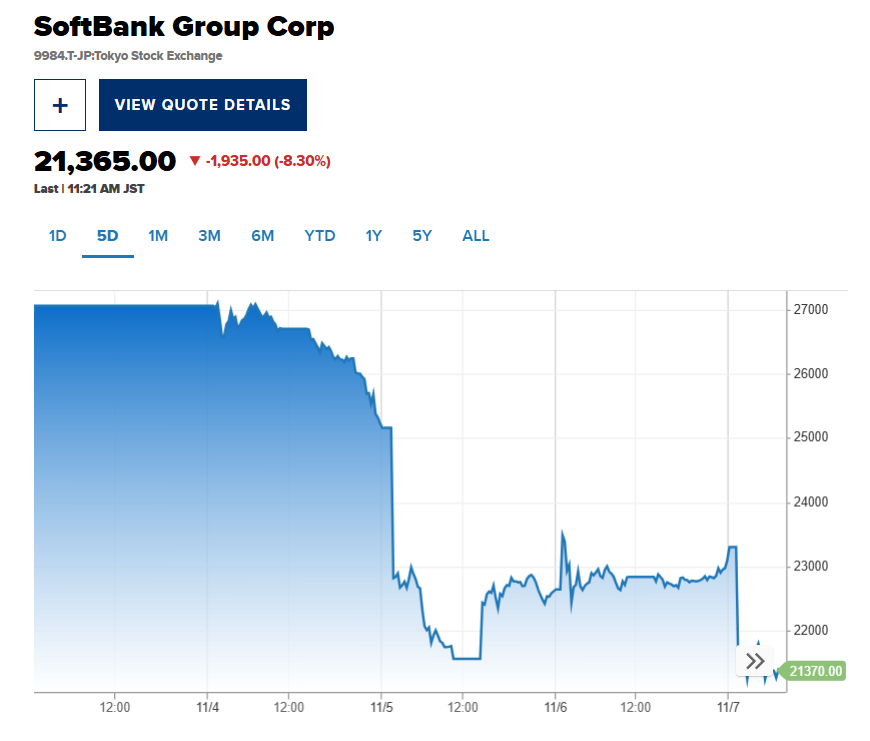
如果您希望可以时常见面,欢迎标星收藏哦~ 来源 :内容来自 BBC 。 周五,日本软银集团(SoftBank Group)的股价再次开始下滑,此前人工智能(AI)相关股票普 遍暴跌,原因是投资者再次对该板块过高的估值产生警惕。 该 集 团 广 泛 投 资 于 基 础 设 施 、 半 导 体 和 应 用 公 司 等 领 域 的 人 工 智 能 公 司 , 其 股 价 收 盘 下 跌 了 6.87%,从盘中早些时候的跌幅中有所收复。 在此之前,软银股价在前一个交易日上涨了近3%,但周三曾暴跌10%,创下自四月以来的最差单 日 表 现 。 本 周 , 其 市 值 蒸 发 了 近 500 亿 美 元 , 并 录 得 自 2020 年 3 月 以 来 最 差 的 周 跌 幅 , 跌 幅 近 20%。 在人工智能相关股票面临新一轮压力后,软银集团的股价下跌。软银持有英国半导体设计公司Arm Holdings的控股权,该公司的芯片为全球移动和人工智能处理器提供动力。在纳斯达克上市的Arm 股价隔夜下跌了1.21%。 另外,彭博社最近援引知情人士的消息报道称,该集团曾在今年早些时候考虑收购美国芯片制造商 美满电子科技(Mar ...

机构:AI并购案反应积极 但警惕热情消退的蛛丝马迹
Xin Lang Cai Jing· 2025-11-07 09:12
Core Insights - The current AI market excitement raises concerns about a potential technology bubble reminiscent of the late 1990s internet bubble, with valuations of AI companies significantly outpacing actual profit expectations [1] - OpenAI's CFO Sarah Friar's controversial remarks about seeking government guarantees for infrastructure loans sparked a significant market reaction, leading to a drop in stock prices for major AI companies like Nvidia [1] - Despite OpenAI's optimistic revenue projections of reaching hundreds of billions by 2030, skepticism remains regarding its ability to fulfill a $1.4 trillion investment commitment over the next eight years [1] Company Insights - OpenAI is facing financial challenges, as indicated by the backlash against Friar's proposal for government-backed loans, which highlights the company's funding difficulties [1] - CEO Sam Altman remains confident about OpenAI's future, citing growth opportunities in enterprise services, consumer electronics, and robotics [1] - Analysts are closely monitoring risk signals within the AI investment cycle, with concerns that massive investments may either reflect confidence in solving profitability issues or indicate a cyclical funding game to sustain chip demand [1] Market Reactions - The market has shown a positive response to AI mergers and acquisitions thus far, but analysts are vigilant for signs of waning enthusiasm [1] - Thomas Ship, head of equity research at LPL Financial, emphasizes the need to be cautious about the sustainability of the current investment climate in AI [1]
AI泡沫担忧席卷全球!软银市值单周蒸发超500亿美元 科技股集体“降温”
智通财经网· 2025-11-07 02:48
Group 1 - SoftBank's stock price has resumed its decline, primarily due to investor concerns over the high valuations in the AI sector, leading to a collective drop in related stocks [1][4] - On Friday, SoftBank's stock fell over 8%, following a 10% drop on Wednesday, marking its worst single-day performance since April, with a slight rebound of nearly 3% on Thursday [1][4] - If the decline continues, SoftBank's market value could decrease by approximately $53 billion this week [1] Group 2 - Many investors view SoftBank as the only listed alternative investment for OpenAI, reflecting a growing cautious sentiment in the market regarding the AI industry [4] - OpenAI's CEO has discussed federal loan guarantee plans with the U.S. government to encourage chip factory construction, indicating potential funding uncertainties [4] - Other Japanese tech stocks also experienced declines, with semiconductor testing equipment manufacturer Advantest down over 6%, and chip manufacturers Renesas Electronics and Tokyo Electron down nearly 4% and about 1.5%, respectively [4] Group 3 - The global chip design company Arm, which is controlled by SoftBank, saw its stock drop 1.21% on NASDAQ, while TSMC, the largest chip foundry, also experienced a 0.6% decline [4] - Asian tech stocks were negatively impacted by the overnight decline of U.S. AI concept stocks, with Qualcomm down nearly 4% despite strong quarterly results, and AMD dropping 7% [6] - Experts express concerns that the current AI valuations are reminiscent of the late 1990s internet bubble, with stock price increases far exceeding actual profit expectations [6] Group 4 - While the economic impact of AI is undeniable, market volatility is also expected, with some experts cautioning against prematurely declaring a bubble [7] - Current AI capital expenditures are primarily supported by cash-rich companies with strong balance sheets, rather than cheap credit or speculative behavior [7] - The greater risk may not be a bubble burst, but rather valuation fatigue, as investors grow weary of paying higher premiums for AI returns that are not being realized in a timely manner [7]

非典型预警,一个百亿私募大佬对AI时代的冷峻思考
3 6 Ke· 2025-11-07 01:53
Core Viewpoint - A prominent private equity manager, Xia Junjie, has expressed a cautious perspective on the current market, indicating that certain popular assets may be hiding a "bubble" [2][3]. Group 1: Market Analysis - Xia Junjie highlights that the current market, particularly driven by AI, exhibits characteristics similar to historical bubbles, such as the 1999 internet bubble and the 2021 new energy boom, in terms of market capitalization, DCF valuation, cumulative gains, and capital participation [4]. - He emphasizes that the emotional highs and lows experienced in the market are likely a result of being in a bubble, reflecting collective psychology and expectations [4][5]. Group 2: Investment Strategy - Xia predicts that the prevailing aggressive investment strategies, which have been popular in recent years, are nearing their end, suggesting a shift away from concentrated bets on specific growth stories [5][6]. - His investment style focuses on undervalued assets, seeking opportunities in areas with low attention and high safety margins, which contrasts with the current market's trend of high valuations [6][7]. Group 3: Historical Context - The article draws parallels between Xia's current warnings and past instances where other investment leaders, like Yang Dong, issued similar cautions at market peaks, indicating a pattern of "high point awakenings" [7][8]. - Yang Dong's previous warnings about the unsustainable nature of investments in the new energy sector serve as a historical reference for the current situation in the AI-driven market [9][10].
2026年美股展望,最值得关注的板块以及一些建议
Sou Hu Cai Jing· 2025-11-04 14:36
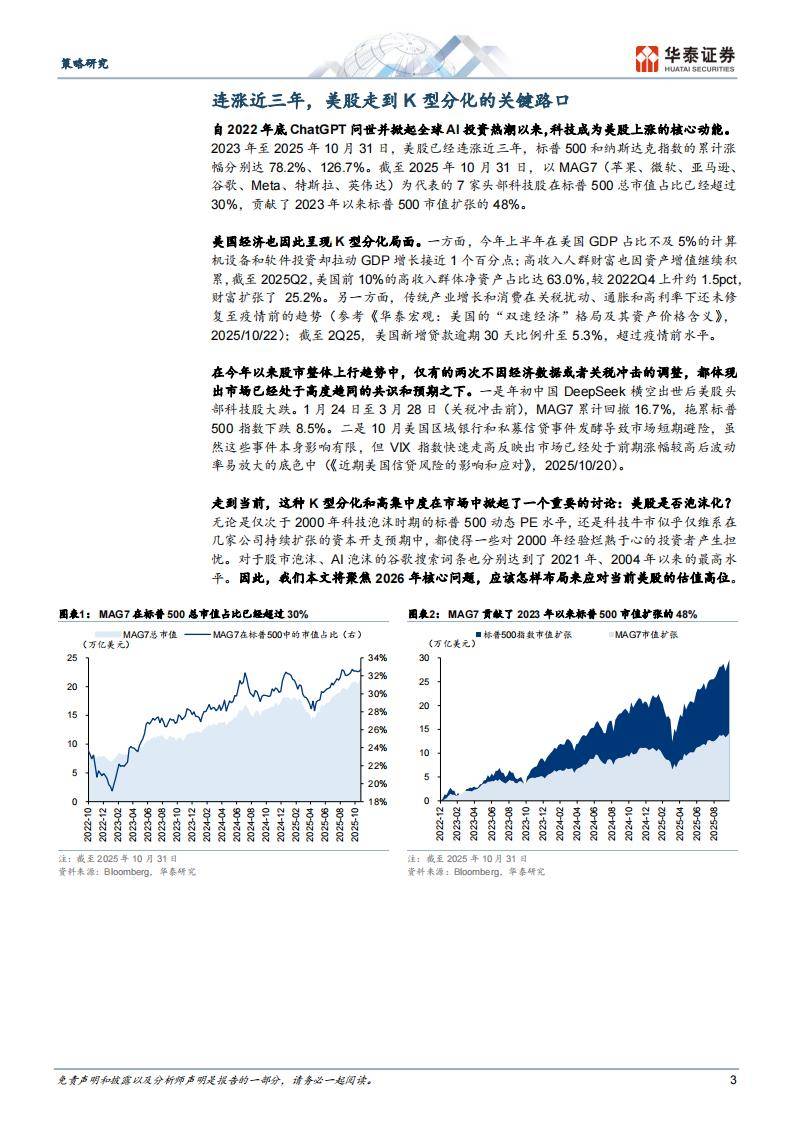
Group 1 - The U.S. stock market has experienced significant growth over the past three years, with the S&P 500 index rising by 78.2% and the Nasdaq index by 126.7% from 2023 to October 2025. The MAG7 companies (Apple, Microsoft, Amazon, Google, Meta, Tesla, Nvidia) account for over 30% of the S&P 500's total market capitalization and contributed 48% of the market expansion since 2023 [1][6][7]. - There are concerns about a potential tech bubble, as the current market concentration resembles the tech bubble of 2000. The price-to-earnings (PE) ratio is nearing its highest level since 1990, and the leverage ratio in the market has increased to 1.7%, surpassing the 1.5% level seen during the 2000 internet bubble [2][3][23]. - The K-shaped economic recovery is evident, with high-income households seeing a net worth share of 63.0% by Q2 2025, up 1.5 percentage points from Q4 2022. Meanwhile, traditional sectors have not fully recovered to pre-pandemic trends [7][8]. Group 2 - The Federal Reserve is expected to continue its accommodative monetary policy into the first half of 2026, with interest rates potentially dropping to the 3.00-3.25% range. However, the scope for further easing is limited, and historical trends suggest that the S&P 500 typically performs poorly in the months leading up to the end of a rate-cutting cycle [2][29]. - Capital expenditures (CAPEX) for MAG7 companies are projected to slow significantly, from a growth rate of 48.8% in 2025 to 18.8% in 2026, and further down to 6.0% in 2027. The future performance of tech stocks will depend on the successful deployment of AI applications and technological breakthroughs [3][34]. - The U.S. economy is expected to show resilience, with real GDP growth projected to rebound to 2.3% in 2026, supported by reduced trade policy uncertainty and accommodative fiscal and monetary policies [3][34]. Group 3 - Investment strategies for 2026 should balance liquidity, fundamentals, and sector structure, focusing on tech leadership in the first half and gradually increasing exposure to cyclical sectors in the latter half of the year [4][45]. - Global diversification is recommended, with high allocation value in developed markets like Germany and Switzerland, and emerging markets such as Saudi Arabia, South Korea, and India [5][47]. - Historical data indicates that after the end of a rate-cutting cycle, sectors like information technology, consumer discretionary, energy, and real estate tend to perform well, making them attractive for investment [5][48].

【招银研究|海外宏观】驶入“迷雾区”——美联储议息会议点评(2025年10月)
招商银行研究· 2025-10-30 11:01
Core Viewpoint - The Federal Reserve has lowered the benchmark interest rate by 25 basis points to a target range of 3.75-4.00%, with plans to stop balance sheet reduction on December 1 and gradually replace maturing agency debt with short-term Treasury bonds. The Fed believes inflation, employment, and financial stability remain controllable, but there are significant internal disagreements regarding future rate cuts [1][5]. Economic Summary - The Fed continues to assess the coexistence of inflationary and employment risks, noting that both "dual risks" are easing. While inflation has upward risks, the overall trend remains manageable. The analysis indicates that commodity inflation is supported by tariffs but is likely one-time, housing service inflation is expected to decline, and other service inflation pressures are weak due to a soft labor market [3][4]. - Employment risks are present but marginal changes may have stabilized. Despite data gaps from government shutdowns, state-level unemployment claims and job vacancies provide decision-making references, showing stable employment conditions over the past month [3]. Policy Summary - The Fed has cut rates by 25 basis points to a range of 3.75-4.0%. There is increasing disagreement among committee members regarding future rate cuts, with some suggesting a pause to observe conditions. Powell likened the current situation to "driving in fog," suggesting a cautious approach [5]. - The Fed will stop balance sheet reduction on December 1, replacing maturing mortgage-backed securities with short-term Treasury bonds. Current bank reserves are nearing acceptable levels, and signs of tightening liquidity in the money market have emerged [5]. Forward-Looking Summary - The Fed's rate-cutting cycle is entering a phase of increased disagreement. In the short term, due to potential government shutdown impacts, a rate cut in December is likely. In the medium term, the policy rate may approach 3% by 2026, with expectations of 3-4 rate cuts before the end of 2026 [6]. - The ongoing investment wave in artificial intelligence and the K-shaped economic recovery are expected to continue, with inflation and employment risks remaining manageable for the foreseeable future [6]. Strategy Summary - Market expectations for rate cuts have shifted, with pricing for a December cut dropping from 23 basis points to 17 basis points, leading to a hawkish market sentiment. U.S. Treasury yields have risen across the board, with the 2-year yield up by 10.8 basis points to 3.60% and the 10-year yield up by 10.0 basis points to 4.098% [7][8]. - The U.S. dollar has strengthened slightly, with the dollar index rising by 0.56% to 99.22. The stock market remains stable, with mixed performances among major indices [8]. - In the medium to long term, the U.S. stock market may face increased volatility, transitioning from a phase driven by valuation and earnings to one driven by earnings growth amid heightened market fluctuations [8].