
自研芯片

Search documents
“特斯拉劲敌”推出首款AI芯片,将在电动车型中取代英伟达?
Zhong Guo Qi Che Bao Wang· 2025-12-15 01:17
Core Viewpoint - Rivian has launched its first custom AI chip, the Rivian Autonomy Processor 1 (RAP1), which aims to replace Nvidia products in future models, boasting performance four times that of previous Nvidia systems [2][3] Group 1: Rivian's AI Chip Development - Rivian's RAP1 chip is designed to be integrated into the upcoming R2 SUV, marking a strategic shift towards in-house chip development to enhance its autonomous driving capabilities [3] - The RAP1 chip utilizes TSMC's 5nm process and features a memory bandwidth of 205GB per second, with two RAP1 chips capable of processing 5 billion pixels per second [3] - Rivian claims that the self-developed chip is a critical turning point for achieving Level 4 autonomous driving, moving beyond the Level 2 capabilities previously supported by Nvidia [3] Group 2: Competitive Landscape - Tesla is also advancing its chip development with the AI5 chip, set for mass production in 2027, which will utilize a 3nm process and offer 2000-2500 TOPS of computing power, five times that of the current HW4 chip [4] - The global automotive industry is witnessing a surge in self-developed chip initiatives, driven by the need for supply chain security, cost efficiency, and differentiated competition [5][6] - American automakers, particularly Tesla, are leading in chip development, with Tesla's FSD chip achieving a computing power of 1000 TOPS, enhancing its autonomous driving capabilities [5] Group 3: Strategic Implications - The shift towards self-developed chips is seen as a necessary strategy for automakers to maintain competitive advantages in the evolving automotive landscape [6][7] - Rivian's approach aims to create a highly integrated smart ecosystem where the chip serves as the core, processing data from sensors to enhance vehicle intelligence [8] - The introduction of the Autonomy Plus subscription service represents a new revenue stream for Rivian, aligning with the trend of combining hardware sales with software profitability [8] Group 4: Industry Transformation - The automotive industry is transitioning from a reliance on Tier 1 suppliers to a model that integrates hardware and software, with self-developed chips being a key breakthrough [7] - The competitive landscape is shifting towards a focus on technological capabilities and strategic safety, making self-developed chips a survival necessity for automakers [9] - The ongoing "chip war" among automakers is expected to shape the profitability and market positioning of companies in the smart vehicle era [9]


自动驾驶愿景遇现实需求考验 ?Rivian(RIVN.US)自研芯片与软件未能掀起波澜
Zhi Tong Cai Jing· 2025-12-12 14:20
Core Viewpoint - Rivian Automotive's recent unveiling of its self-developed autonomous driving chip and AI technology has led to a reassessment of the company's actual value by Wall Street analysts, highlighting a significant divide in opinions regarding Rivian's future prospects [1] Group 1: Technology and Product Development - Rivian plans to equip its upcoming R2 SUV with the Rivian Autonomy Processor 1 (RAP1) chip and a new lidar sensor, aiming for full autonomous driving capabilities [2] - The RAP1 chip utilizes advanced chiplet packaging technology with a memory bandwidth of 205GB per second, significantly enhancing Rivian's autonomous driving capabilities [2] - The new system, Autonomy Compute Module 3, can process 5 billion pixels per second, outperforming the current Nvidia system used in Rivian vehicles by four times [2] Group 2: Market Position and Analyst Ratings - Needham reaffirmed a "Buy" rating for Rivian, raising the target price to $23, citing confidence in Rivian's unique market positioning and vertical integration that allows for rapid learning and iteration in autonomous driving technology [3] - Morgan Stanley remains cautious, maintaining an "Underweight" rating with a target price of $12, highlighting concerns over demand risks that could limit data collection necessary for advanced autonomous driving [4] - Wells Fargo holds a neutral stance with an "Equal Weight" rating, noting the low margin for error in Rivian's business and the need for the company to prove its ability to grow its customer base while maintaining low advertising costs [5] Group 3: Company Background and Challenges - Rivian, which went public in 2021, was initially seen as a strong competitor to Tesla but has faced operational challenges, with production expected to fall below 50,000 vehicles this year [6] - The company has experienced significant stock price declines, losing over 80% from its IPO peak, despite ongoing commitments from partners like Volkswagen to invest nearly $6 billion in joint projects [6] - Rivian's core autonomous driving system, the Large Driving Model, aims to enhance driving capabilities in existing models before the full R2 platform launch in 2027, although initial software upgrades will be limited compared to Tesla's Full Self-Driving features [7]
技术赋能,全球布局,锦好医疗深耕听力赛道,打造助听器领军品牌
Zhong Guo Zheng Quan Bao· 2025-12-12 08:27
Core Viewpoint - JinHao Medical is a leading enterprise in the hearing health sector, achieving rapid growth through continuous technological innovation and global market expansion, with a mission to become the world's most trusted medical device brand and the number one brand in the hearing aid industry [1] Technological Advancements - The company emphasizes the importance of core technology, investing heavily in R&D to achieve breakthroughs in chip design, algorithm development, and product miniaturization, including the successful development of low-power digital hearing aid chips and AI speech enhancement algorithms [2][4] - JinHao Medical is focusing on AI hearing aid algorithms to enhance user experience by improving speech clarity in noisy environments and utilizing clinical data for intelligent fitting and adjustment through apps and remote services [3] Global Market Expansion - The hearing aid market in China has grown from 2.84 billion to 5.51 billion yuan from 2015 to 2019, with a CAGR of 18.02%, indicating significant growth potential for JinHao Medical's market strategies [5] - The company is expanding its market presence through online platforms like JD and Tmall, as well as establishing retail networks and leveraging international certifications to enter global markets [5][6] Brand Development and Positioning - JinHao Medical is focusing on building its own brand while maintaining ODM relationships, ensuring differentiated product designs and avoiding direct competition [6][7] - The company aims to enhance its brand image by controlling product quality and establishing a reputation for high-quality, reliable, and cost-effective products [7] Future Growth Strategy - JinHao Medical plans to extend its business along the hearing aid industry chain through internal growth and external acquisitions, targeting core components and retail channels to strengthen its market position [8]
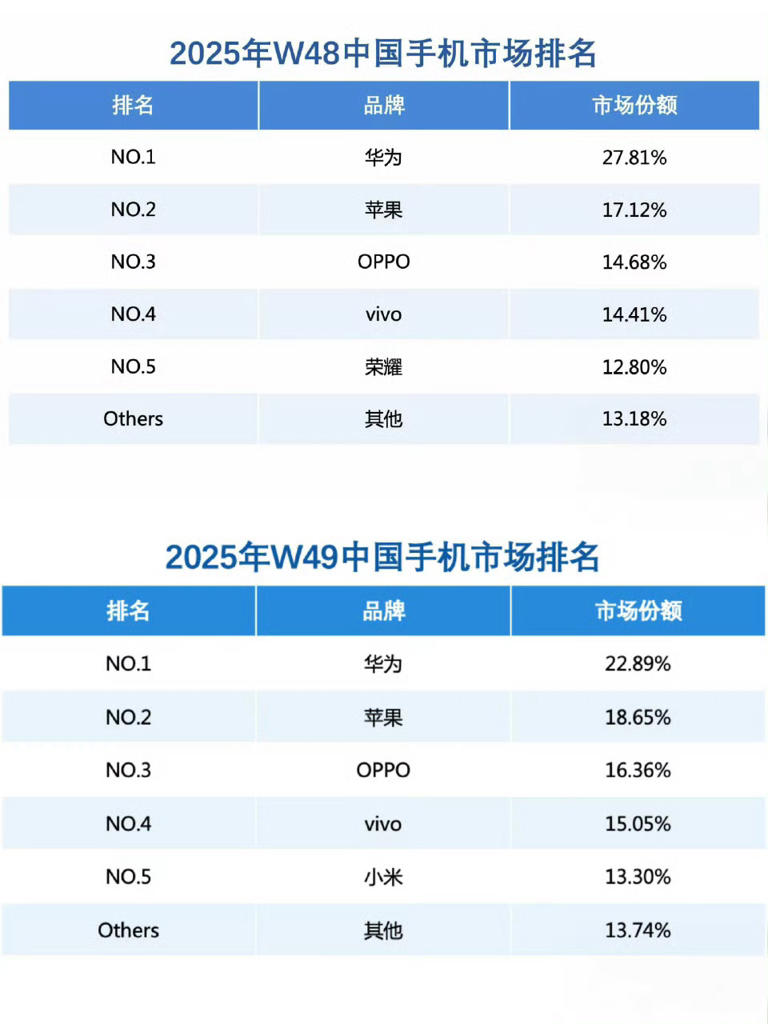
Mate80发布后,华为连续两周重夺中国手机市场第一
Xin Hua Cai Jing· 2025-12-11 13:51
Core Insights - Huawei has regained the top position in the domestic smartphone market, surpassing Apple for two consecutive weeks since the launch of the Mate80 series [1][6]. Market Share Summary - In week 48, Huawei achieved a market share of 27.81%, significantly ahead of Apple's 17.12%. OPPO, vivo, and Honor ranked third to fifth with shares of 14.68%, 14.41%, and 12.80% respectively [3]. - In week 49 (December 1-7), Huawei maintained its lead with a market share of 22.89%, while Apple followed with 18.65%. OPPO and vivo ranked third and fourth with shares of 16.36% and 15.05%, and Xiaomi was fifth with 13.30% [5]. Pricing Strategy - Despite a global increase in storage prices, Huawei has reduced the pricing of its new models compared to the previous generation. This is attributed to improved yield rates of self-developed chips and the maturation of the Harmony OS [5].

苹果自研芯片负责人或将离职:库克以升职加薪挽留,但仍无动于衷
Sou Hu Cai Jing· 2025-12-08 07:56
约翰尼·斯鲁吉在2008年加入苹果公司,在苹果领导了几乎所有自研芯片的开发,包括iPhone上的A系列, Apple Watch上的S系列以及用于Mac与iPad上的M系列芯片。 苹果首个自研系统级芯片A4、全球首颗64位手机芯片A7,以及标志着苹果电脑从英特尔处理器转向自家 Apple Silicon的M1芯片,均是约翰尼·斯鲁吉领导开发的。 苹果近期的人事变动真是不少!根据彭博社最新的报道,苹果硬件技术高级副总裁约翰尼·斯鲁吉正考虑从 公司离职。 提起名字,大家可能对这位技术大佬并不熟悉,但如果你看过发布会,肯定会熟悉他的面孔,他经常在发 布会上出镜介绍苹果自研芯片。 爆料称,约翰尼·斯鲁吉表示他不愿意在其他首席执行官手下工作。不难看出,约翰尼·斯鲁吉计划离职, 可能更多还是与库克未来辞任苹果CEO一事相关。 如果约翰尼·斯鲁吉真的不久后离职,那么他将成为近期苹果第五位离职的高管,近期苹果设计主管、人工 智能主管、总法律顾问以及环境/政策副总裁都相继离职。 据知情人士透露,约翰尼·斯鲁吉向库克已经透露他正在认真考虑不久之后的离职相关事宜,并且他并非退 休离职,而是打算加入其他公司。 为了留住约翰尼·斯鲁吉 ...

苹果芯片主管也要跑路,库克被曝出现健康问题
3 6 Ke· 2025-12-08 01:00
Core Insights - Apple is experiencing significant executive turmoil, with the departure of key figures including Johny Srouji, the architect of Apple's self-developed chips, marking a critical point in the company's leadership [1][3][7] Group 1: Executive Departures - Johny Srouji, Apple's Senior Vice President of Hardware Technologies, has expressed intentions to leave the company, potentially joining another firm [3][4] - This month alone, Apple has seen the departures of four executives, including AI head John Giannandrea and Chief UI Designer Alan Dye, the latter moving to Meta [3][7] - Srouji has been with Apple since 2008 and has played a pivotal role in the development of Apple's A-series and M-series chips, as well as initiating the self-developed modem project [4][6] Group 2: Internal Response and Leadership Changes - CEO Tim Cook is reportedly making efforts to retain Srouji, including salary increases and a potential promotion to CTO, which would position him as the second-in-command at Apple [6][11] - The recent executive changes have led to a restructuring of Apple's leadership, with power consolidating among four key executives: John Ternus, Eddy Cue, Craig Federighi, and new COO Sabih Khan [11][12] - Apple has also made strategic hires, such as bringing in Meta's Chief Legal Officer Jennifer Newstead to replace Kate Adams, who is set to retire [9][10] Group 3: Broader Implications - The ongoing executive shakeup is seen as one of the largest in decades for Apple, raising questions about the company's future direction and leadership stability [7][12] - Concerns have also been raised regarding Tim Cook's health, as there have been observations of him exhibiting signs of tremors during meetings, although these claims have been denied by close associates [12][13][14]

技术赋能 全球布局 锦好医疗深耕听力赛道 打造助听器领军品牌
Zhong Guo Zheng Quan Bao· 2025-12-07 20:36
Core Viewpoint - JinHao Medical is positioned as a leading enterprise in the hearing health sector, focusing on technological innovation and global market expansion to achieve rapid growth and break overseas monopolies [1] Group 1: Technological Advancements - The company emphasizes the importance of core technology and has increased R&D investment, achieving breakthroughs in chip design, algorithm development, and product miniaturization [2] - JinHao Medical is concentrating on AI hearing aid algorithms to enhance user experience, improving speech enhancement in noisy environments and enabling smart fitting and adjustment through apps and remote services [3] - The company has developed several core technologies in self-researched chips, including low-power audio signal conversion and noise enhancement algorithms, and is optimizing the next generation of AI hearing aid chips [4] Group 2: Market Expansion - The hearing aid market in China has shown significant growth, with a CAGR of 18.02% from 2015 to 2019, and JinHao Medical aims to expand its market share through a comprehensive market strategy [5] - The company has established online stores on platforms like JD and Tmall, and is building a retail network combining direct sales and distribution [5] - JinHao Medical is leveraging global certifications to enter international markets, including partnerships with major retailers in the U.S. and establishing subsidiaries in Southeast Asia [5] Group 3: Brand Development - JinHao Medical has made significant strides in developing its own brand, focusing on product differentiation and a full-channel strategy to achieve simultaneous domestic and international market growth [6] - The company is enhancing its brand image by controlling product quality and establishing a differentiated brand identity, targeting both OTC and professional medical-grade products [7] - The company is committed to building a robust talent system to support long-term development, focusing on attracting skilled professionals to enhance R&D and product innovation [7] Group 4: Future Strategy - JinHao Medical plans to extend its business along the hearing aid industry chain through internal growth and external acquisitions, aiming to integrate upstream and downstream resources [8] - The company will focus on acquiring core components and technologies related to hearing aids, as well as retail channels and established brands, to enhance its industry influence and competitiveness [8]
锦好医疗深耕听力赛道 打造助听器领军品牌
Zhong Guo Zheng Quan Bao· 2025-12-07 20:22
Core Insights - JinHao Medical is a leading enterprise in the hearing health sector, achieving rapid growth through continuous technological innovation and a global market strategy, aiming to become the world's top hearing aid brand [1][5] Technological Advancements - The company emphasizes the importance of core technology, investing heavily in R&D to achieve breakthroughs in chip design, algorithms, and product miniaturization, successfully developing low-power digital hearing aid chips and AI-enhanced algorithms [1][3] - JinHao Medical is focusing on AI technology to enhance user experience, improving speech recognition in noisy environments and enabling smart fitting and adjustment through apps and remote services [2][3] Market Expansion Strategy - The hearing aid market in China has shown significant growth, with a CAGR of 18.02% from 2015 to 2019, and JinHao Medical aims to capture a larger market share through a comprehensive global expansion strategy [4] - The company is establishing a retail network both online and offline, leveraging platforms like JD.com and Tmall in China, and entering international markets through partnerships with major retailers like Walmart and CVS [4][5] Brand Development - JinHao Medical is transitioning from an ODM model to building its own brand, focusing on product differentiation and a dual-channel strategy to cater to both OTC and professional healthcare markets [5][6] - The company is committed to maintaining high product quality and a strong brand image, positioning itself as a reliable and cost-effective choice for consumers [6] Future Growth Plans - JinHao Medical plans to extend its business along the hearing aid industry chain through both organic growth and acquisitions, targeting key components and retail channels to enhance its competitive edge [6]
性能提升25%!亚马逊新一代自研服务器芯片Graviton5问世 冲击x86霸权
智通财经网· 2025-12-05 01:28
Core Insights - Amazon Web Services (AWS) has launched its next-generation in-house server CPU, Graviton5, which is claimed to be the most powerful and energy-efficient data center CPU to date [1][2] - The introduction of Graviton5 and the AI ASIC chip Trainium3 highlights AWS's ongoing expansion of its chip product lineup and a shift towards in-house development [1][2] - AWS's self-developed Graviton series CPUs now account for over half of the new large-scale CPU clusters added in the past three years, indicating a significant reduction in reliance on Intel and AMD [1] Product Details - Graviton5 offers up to a 25% performance improvement compared to its predecessor while maintaining industry-leading energy efficiency, enabling faster application performance and reduced computing costs [2] - The L3 cache capacity of each Graviton5 core is 2.6 times that of Graviton4, with network and storage bandwidth increased by 15% to 20% [2] - The M9g instance based on Graviton5 is currently in preview, while C9g and R9g instances are planned for release in 2026 [3] Market Context - The trend of cloud giants like Amazon, Microsoft, and Google developing their own server CPUs and AI accelerators may significantly reduce their procurement of server CPUs from Intel and AMD, as well as the overall demand for NVIDIA's AI GPU clusters [1][5] - The shift towards in-house ARM architecture CPUs allows cloud providers to optimize for specific workloads, potentially leading to significant cost savings and improved performance [5][6] - Despite the rise of ARM-based CPUs, x86 architecture (Intel and AMD) remains the dominant choice in the global server market, particularly for traditional enterprise cloud infrastructure [6]

理想汽车-W(2015.HK):销量、业绩暂承压 L系列亟待重振
Ge Long Hui· 2025-12-02 03:59
Core Viewpoint - The company reported a significant decline in revenue and net loss for Q3 2025, indicating ongoing challenges in sales and profitability [1][3]. Group 1: Q3 2025 Performance - The company achieved a revenue of 27.4 billion yuan in Q3 2025, representing a year-on-year decrease of 36.2% and a quarter-on-quarter decrease of 9.5% [1]. - The net loss for the quarter was 620 million yuan, highlighting financial difficulties [1]. - Vehicle deliveries for Q3 2025 totaled 93,000 units, down 39.0% year-on-year and 16.1% quarter-on-quarter [1]. Group 2: Revenue and Margin Analysis - Automotive sales revenue reached 25.9 billion yuan in Q3 2025, reflecting a year-on-year decline of 37.4% and a quarter-on-quarter decline of 10.4% [1]. - The average selling price (ASP) per vehicle was 278,000 yuan, which increased by 7,000 yuan year-on-year and 17,000 yuan quarter-on-quarter [1]. - The gross margin for the automotive business was 15.5%, down 5.4 percentage points year-on-year and 3.9 percentage points quarter-on-quarter, primarily due to estimated recall costs associated with the MEGA model [1]. Group 3: Future Guidance and Product Strategy - The company provided a delivery guidance for Q4 2025 of 100,000 to 110,000 units, with October deliveries at 32,000 units, suggesting an average monthly delivery of 34,000 to 39,000 units for November and December [1]. - The L series model upgrades are deemed crucial for reversing the current sales decline, with expectations for significant enhancements in 2026 [2]. - The anticipated upgrades for the L series include high-level autonomous driving features, larger battery capacity, and potential design changes [2]. Group 4: Profit Forecast and Investment Outlook - The net profit forecasts for 2025 to 2027 have been adjusted to 900 million, 3.6 billion, and 6 billion yuan, respectively, reflecting a downward revision from previous estimates [3]. - Despite the pressures on sales and performance in 2025, the company maintains strong foundational capabilities, including cash reserves of 98.9 billion yuan and a leading self-built charging network [3]. - The company retains a "recommended" rating, anticipating improvements in fundamentals driven by the L series upgrades and advancements in smart technology [3].
