资金流入

Search documents
华建集团2025年10月21日涨停分析:公司治理优化+城市更新转型+资金流入
Xin Lang Cai Jing· 2025-10-21 02:09
Core Insights - Huajian Group (SH600629) reached its daily limit up on October 21, 2025, with a price of 40.93 yuan, marking a 10% increase and a total market capitalization of 39.716 billion yuan [1] Company Developments - Recent governance adjustments include the cancellation of the supervisory board and the establishment of specialized committees, which streamline decision-making processes and support long-term standardized development [1] - The company is focusing on urban renewal and digital transformation, having signed new urban renewal contracts worth 393 million yuan and invested over 14 million yuan in digital initiatives, which are expected to foster new growth opportunities [1] Industry Context - Urban renewal is a key initiative promoted by the state for high-quality urban development, with continuous policy support creating a favorable environment for the company's urban renewal business [1] - The engineering consulting services industry plays a significant role in economic development and urban construction, aligning with the company's transformation direction despite a decline in performance in the first half of the year [1] Market Activity - On October 16, 2025, the company was listed on the "Dragon and Tiger List" with a trading volume of 2.237 billion yuan, indicating significant attention from capital markets, with net buying from retail and foreign investors totaling 1.299 billion yuan [1] - Although no clear technical signals have been mentioned, the substantial capital inflow provides momentum for the stock price increase [1]

资金狂飙!连续41个月净流入后,ETF正改写华尔街的游戏规则
Jin Shi Shu Ju· 2025-10-15 09:43
Core Insights - Investors are rapidly channeling funds into U.S. ETFs, with inflows surpassing $1 trillion this year, indicating a significant shift from traditional mutual funds to lower-cost, more liquid ETFs [1] - This trend is expected to continue, potentially reaching an annual record of $1.4 trillion by the end of 2025, driven by a broad range of ETF categories benefiting from this influx [1] - The U.S. ETF industry has seen a consistent net inflow for 41 consecutive months, with assets reaching $12.7 trillion as of the end of September [1] Fund Flows and Market Dynamics - The momentum of ETF inflows has accelerated this year, with a nearly 23% increase in asset inflows year-to-date [1] - The outflow of funds from mutual funds, totaling $481 billion in the first nine months of 2025, is expected to continue driving higher ETF inflows [1] - The historical milestone of $1 trillion in ETF inflows was first achieved on December 11 of the previous year, marking a significant moment in the industry [1] Industry Perspectives - Industry experts emphasize the need for accelerated innovation, expanded market access, and enhanced investor education in light of the growing ETF market [1] - Discussions among asset managers about launching new ETFs or converting existing mutual funds into ETFs are becoming increasingly common, reflecting the industry's adaptive strategies amid market uncertainties [2]
接近300万,A股新开户数大增
Zhong Guo Zheng Quan Bao· 2025-10-11 05:17
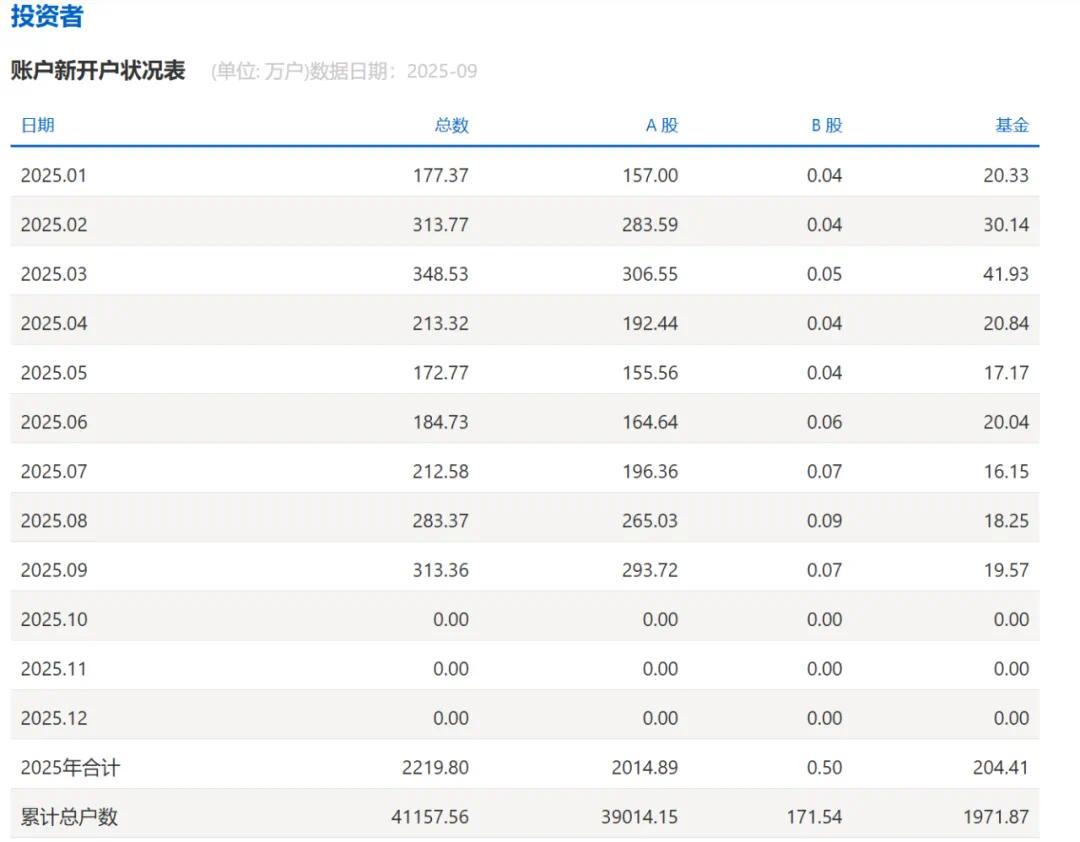
Core Insights - The number of new A-share accounts opened in September 2025 reached 2.9372 million, marking a year-on-year increase of 60.73% and a month-on-month increase of 10.83% [1] - As of the end of September 2025, a total of 20.1489 million new A-share accounts have been opened this year, reflecting a year-on-year growth of 49.64% [1] Monthly New Account Data - Monthly new A-share account openings from January to September 2025 were as follows: 1.5737 million, 2.8359 million, 3.0655 million, 1.9244 million, 1.5556 million, 1.6464 million, 1.9636 million, 2.6503 million, and 2.9372 million respectively [3] - The September 2025 new account figure of 2.9372 million is the second highest for the year, only behind March 2025's 3.0655 million [3] Year-on-Year Comparison - The September 2025 new account openings significantly surpassed the same month in the previous year, with September 2024 recording only 1.8274 million new accounts [3][4] - The total new accounts opened in 2024 amounted to 24.9989 million, compared to 20.1489 million in 2025 so far [4] Market Performance and Investor Sentiment - Since June 2025, the A-share market has shown a strong upward trend, with the Shanghai Composite Index, Shenzhen Component Index, and ChiNext Index rising by 15.99%, 34.72%, and 62.46% respectively from June 1 to September 30 [5][6] - Analysts suggest that the current market still holds certain value, with a continuous "profit-making effect" driving funds into the market [7] Future Market Outlook - The market is expected to maintain a trend of steady upward movement with low volatility in October 2025, following the patterns observed in September [7] - Investors are advised to focus on potential shifts in market style in the fourth quarter, as historical data indicates a tendency for previously leading sectors to lag while lagging sectors may catch up [7]

香港房地产市场稳步复苏 股市表现与楼市形成共振
Jing Ji Guan Cha Bao· 2025-10-08 09:15
Core Insights - The Hong Kong residential market continues to show strong trading momentum, with monthly transaction volumes exceeding 5,000 since March 2023, leading to a total of approximately 16,700 residential sale agreements in Q3 2023, a year-on-year increase of 63% [1] - The removal of buyer stamp duties and the increase in property value limits starting in 2024 significantly reduce purchasing costs, contributing to heightened buyer interest [1] - The influx of mainland buyers, accounting for 24% of new and second-hand transactions in 2024, has become a major driver of demand, with this figure rising to 17.74% in the first half of 2025 [1] Market Dynamics - The easing of the financial environment and rising rental yields are encouraging buyer participation in the market [1] - The introduction of talent attraction programs in Hong Kong is expected to support long-term rental and sales market demand, with non-local student enrollment in public universities increasing from 20% to 40% starting in the 2024/25 academic year [1] - The Hang Seng Index has risen by 31% since April 2025, and the total IPO fundraising in Hong Kong reached HKD 107 billion in the first half of 2023, reflecting a 22% year-on-year increase, indicating a positive correlation between the stock market and the real estate market [1] Comparative Analysis - The experience of Hong Kong's real estate market reversal highlights the importance of talent policies, capital inflow, and stock market linkage as key factors [2] - Similar conditions are emerging in core mainland cities like Shanghai, which may accelerate market stabilization through policies aimed at housing quality and urban renewal [2] - The stabilization of the mainland real estate market is expected to rely on sustained economic performance rather than mere supply-demand adjustments, with Hong Kong's approach to interest rate adjustments providing insights for mainland regulatory policy [2]
资金流入太猛,高盛上调明年底金价目标价至4900美元
华尔街见闻· 2025-10-07 11:30
Core Viewpoint - Goldman Sachs has significantly raised its gold price forecast for the end of 2026 to $4,900 per ounce, an increase of $600 or nearly 14% from the previous forecast of $4,300, driven by a 17% rise in gold prices since August 26 due to "sticky" fund inflows, primarily from Western ETF investments and central bank purchases [1][2][4]. Group 1: Price Forecast and Drivers - The forecast indicates a potential 23% increase in gold prices over the next two years, with central bank purchases contributing 19 percentage points and a 5 percentage point contribution from increased ETF holdings due to Federal Reserve rate cuts [2][8]. - The key drivers of the recent gold price surge are identified as Western ETF inflows and central bank purchases, contrasting with stable speculative positions [4][8]. - Despite the higher starting point, Goldman Sachs maintains its expectation of a 23% price increase by the end of 2026, reflecting structural changes in the gold market driven by central banks and institutional investors [5][10]. Group 2: Central Bank Purchases and Market Dynamics - Central bank purchases are expected to average 80 tons in 2025 and 70 tons in 2026, with emerging market central banks likely to continue diversifying their reserves into gold, contributing significantly to the projected price increase [8][9]. - The structural growth in central bank purchases is largely attributed to the trend of reserve diversification following the freezing of Russian reserves in 2022, with expectations that this trend will persist for three years [9][10]. - The anticipated Federal Reserve rate cuts, projected to be 100 basis points by mid-2026, are expected to boost Western ETF holdings, contributing positively to gold price increases [8].


资金流入太猛 高盛上调明年底金价目标价至4900美元
Zhi Tong Cai Jing· 2025-10-07 03:36
Core Viewpoint - Goldman Sachs has significantly raised its gold price forecast for the end of 2026 to $4,900 per ounce, an increase of $600 or nearly 14% from the previous estimate of $4,300, driven by a 17% rise in gold prices since August 26 due to persistent capital inflows, primarily from Western ETFs and central bank purchases [1][2]. Group 1: Price Forecast and Drivers - The forecast indicates a potential 23% increase in gold prices over the next two years, with central bank purchases contributing 19 percentage points and ETF holdings driven by Federal Reserve rate cuts contributing 5 percentage points [2]. - The key drivers of the recent gold price surge are identified as persistent capital inflows from Western ETFs and central bank purchases, contrasting with stable speculative positions [2]. - Goldman Sachs maintains its price increase forecast despite a higher starting point, expecting central bank purchases to average 80 tons in 2025 and 70 tons in 2026, contributing significantly to the price increase [2][3]. Group 2: Market Dynamics and Risks - The structural growth in central bank purchases is attributed to the diversification trend following the freezing of Russian reserves in 2022, with expectations that this trend will continue for three years [3]. - The adjustment in forecasts reflects a structural change in the gold market driven by central banks and institutional investors, providing clear allocation signals for long-term investors [3]. - The risks associated with the upgraded gold price forecast are skewed to the upside, as private sector diversification into the relatively small gold market may lead to ETF holdings exceeding implied valuations based on interest rates [2].
资金流入太猛,高盛上调明年底金价目标价至4900美元
Hua Er Jie Jian Wen· 2025-10-07 02:56
Core Viewpoint - Goldman Sachs has significantly raised its gold price forecast for the end of 2026 to $4,900 per ounce, an increase of $600 or nearly 14% from the previous estimate of $4,300, driven by a 17% rise in gold prices since August 26 due to "sticky" fund inflows, primarily from Western ETFs and central bank purchases [1][2] Group 1: Fund Inflows - The recent surge in gold prices is mainly attributed to two types of "sticky" fund inflows: Western ETF investments and central bank purchases, contrasting with stable speculative positions [2] - Western ETF holdings have fully reached Goldman Sachs' implied valuation level based on U.S. interest rates, indicating that the recent strong performance of ETFs is not an overreaction [2] - Central bank purchases have rebounded, reflecting a recovery after the summer lull, with expectations of continued growth in central bank buying [2][3] Group 2: Price Forecast and Risks - Despite the higher starting point, Goldman Sachs maintains its forecast for a 23% price increase by the end of 2026, with central bank purchases contributing 19 percentage points and ETF inflows from Federal Reserve rate cuts contributing 5 percentage points [3][4] - The risk for the upgraded gold price forecast remains skewed to the upside, driven by private sector diversification into the relatively small gold market, which may push ETF holdings beyond implied valuations based on interest rates [3] - Structural growth in central bank purchases is expected to continue, particularly from emerging market central banks diversifying their reserves into gold [3][4]
华建集团2025年9月30日涨停分析:公司治理优化+战略转型+资金流入
Xin Lang Cai Jing· 2025-09-30 01:51
Core Viewpoint - Huajian Group's stock reached the daily limit on September 30, 2025, with a price of 28.69 yuan, marking a 10.01% increase, and a total market capitalization of 27.839 billion yuan [1] Group 1: Company Developments - The company has recently implemented over 30 new or revised governance policies, focusing on key areas such as related party transactions, board operations, and information disclosure, which enhances operational efficiency and market image [2] - Huajian Group is strategically transitioning towards urban renewal and digital transformation, establishing dedicated institutions and investing funds to explore new business growth points [2] Group 2: Industry Context - The engineering consulting services industry is closely linked to capital inflow and infrastructure construction, with the potential for increased government investment in urban renewal, presenting development opportunities for the sector [2] - On September 26, 2025, Huajian Group was listed on the "Dragon and Tiger List" with a transaction volume of 946 million yuan, indicating significant interest from retail and foreign investors, which reflects market confidence in the company's future [2] Group 3: Market Dynamics - Despite a decline in the company's performance in the first half of the year, the net buying from retail and foreign investors has likely contributed to the stock price increase, offsetting negative factors and driving the stock to its limit on September 30, 2025 [2]
港股市场前景看好,政策与资金双重助力
Xin Lang Cai Jing· 2025-09-20 02:10
Group 1 - The Hong Kong stock market is showing unique investment value due to a combination of factors, particularly driven by policy support and capital inflows [1] - The Chinese government's proactive fiscal policy and moderately loose monetary policy provide a stable environment for economic growth, benefiting the Hong Kong stock market [1] - Recent policy measures announced by the Chief Executive of Hong Kong aim to attract more companies to list in Hong Kong, enhancing market vitality and providing investors with diverse investment options [1] Group 2 - There is a significant inflow of capital into the Hong Kong stock market, with southbound funds exceeding 1 trillion HKD this year, indicating increased demand from mainland investors [1][2] - The attractiveness of Hong Kong stocks has increased for foreign investors due to the U.S. entering a rate-cutting cycle, making it a primary channel for allocating quality Chinese assets [1] - The valuation of the Hong Kong stock market remains significantly lower than other major markets, providing potential investment opportunities, especially in the technology sector [2] Group 3 - The industry structure of the Hong Kong stock market is undergoing optimization, with a shift from a finance-dominated market to a more diversified one, particularly in non-essential consumer goods and information technology [3] - The rise of new economic forces allows investors to access emerging companies through the Hong Kong stock market, effectively diversifying market risks and reducing portfolio volatility [3] - The current environment in the Hong Kong stock market is favorable for various types of investors, whether they seek steady long-term growth or aim to capitalize on short-term fluctuations [3]
下周正式降息,全球资金加速流入,中国市场迎来投资新机遇
Sou Hu Cai Jing· 2025-09-16 16:58
Group 1 - The core viewpoint indicates a strategic shift in capital flow, with short-term funds targeting bank stocks while growth stocks are being quietly absorbed, driven by a decline in interest rates and a corresponding decrease in discount rates, enhancing the future cash flow value of growth stocks [2] - A notable observation is that despite the overall market not showing significant gains, the trading structure reveals signs of strategic adjustments, with institutions reallocating from dollar-denominated assets to A-shares, particularly those with undervalued valuations [2][4] - The influx of foreign capital is not merely a reaction to the "China story," but rather a pursuit of cost-effectiveness and liquidity opportunities, as highlighted by a macro analyst's perspective on the nature of foreign investment [6] Group 2 - The data on capital flows indicates that while northbound capital net purchases reached a peak in August, the distribution of funds is highly uneven, with a few core industries attracting significant investment, suggesting a targeted approach rather than a broad-based strategy [8] - The valuation gap between A-shares and major Western stock indices has been frequently discussed, with some comparable companies in sectors like semiconductors and new energy showing price-to-earnings ratios that are even 20% lower than their US counterparts, indicating a tangible investment appeal [10] - The market is witnessing a shift from passive acceptance of foreign capital to actively seeking a new balance between passive reception and proactive engagement, as the rhythm of capital inflow becomes clearer [14]