
大语言模型

Search documents
理想基座模型负责人近期很满意的工作: RuscaRL
理想TOP2· 2025-10-03 09:55
Core Viewpoint - The article discusses the importance of reinforcement learning (RL) in enhancing the intelligence of large models, emphasizing the need for effective interaction between models and their environments to obtain high-quality feedback [1][2]. Summary by Sections Section 1: Importance of Reinforcement Learning - The article highlights that RL is crucial for the advancement of large model intelligence, with a focus on how to enable models to interact with broader environments to achieve capability generalization [1][8]. - It mentions various RL techniques such as RLHF (Reinforcement Learning from Human Feedback), RLAIF (AI Feedback Reinforcement Learning), and RLVR (Verifiable Reward Reinforcement Learning) as key areas of exploration [1][8]. Section 2: RuscaRL Framework - The RuscaRL framework is introduced as a solution to the exploration bottleneck in RL, utilizing educational psychology's scaffolding theory to enhance the reasoning capabilities of large language models (LLMs) [12][13]. - The framework employs explicit scaffolding and verifiable rewards to guide model training and improve response quality [13][15]. Section 3: Mechanisms of RuscaRL - **Explicit Scaffolding**: This mechanism provides structured guidance through rubrics, helping models generate diverse and high-quality responses while gradually reducing external support as the model's capabilities improve [14]. - **Verifiable Rewards**: RuscaRL designs rewards based on rubrics, allowing for stable and reliable feedback during training, which enhances exploration diversity and ensures knowledge consistency across tasks [15][16]. Section 4: Future Implications - The article suggests that both MindGPT and MindVLA, which target digital and physical worlds respectively, could benefit from the advancements made through RuscaRL, indicating a promising future for self-evolving models [9][10]. - It emphasizes that the current challenges in RL are not just algorithmic but also involve systemic integration of algorithms and infrastructure, highlighting the need for innovative approaches in building capabilities [9].



人工智能就是大语言模型?丨中新真探
Zhong Guo Xin Wen Wang· 2025-10-03 08:40
Core Viewpoint - Large language models are a subset of artificial intelligence technology and should not be equated with AI as a whole [1] Group 1: Definition and Scope of AI - Artificial intelligence encompasses a wide range of research areas, including various machine learning algorithms, image recognition, speech recognition, robotics action strategy optimization, and natural language processing [1] - Large language models represent a significant breakthrough in the field of natural language processing within artificial intelligence [1] Group 2: Advancements in AI - With the aid of multimodal technology, large language models can now process various types of information, including sound, images, and even videos [1] - Large language models are just one branch of the broader artificial intelligence field and do not directly equate to AI itself [1]

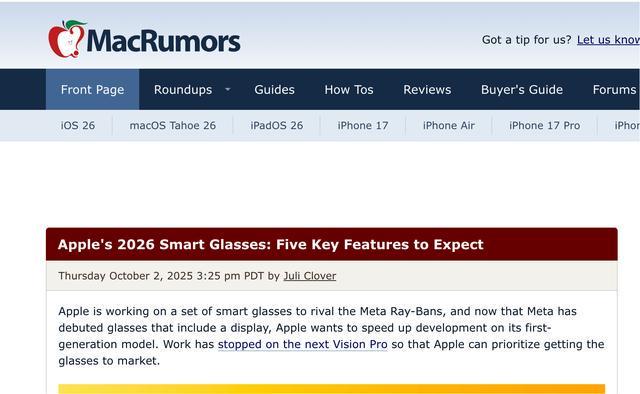
苹果2026年智能眼镜前瞻:五大关键功能值得期待
Huan Qiu Wang Zi Xun· 2025-10-03 03:51
Core Insights - Apple is accelerating the development of smart glasses to compete with Meta's Ray-Ban series, even pausing some work on the next-generation Vision Pro to prioritize the glasses' market launch [1]. Group 1: Product Positioning - The smart glasses will initially be positioned as a fashion accessory, similar to the first-generation Apple Watch, offering various frame and arm material options for personalized aesthetics [4]. - Despite the need to accommodate a battery, chips, and multiple cameras, the final thickness of the glasses remains unclear, but Apple plans to offer different colors, sizes, and shapes [4]. Group 2: Role of Siri - Siri will play a central role in the glasses, relying on voice control, with a more intelligent version set to launch in Spring 2026, based on large language models [5]. - Users will be able to interact with Siri for various tasks, including providing feedback on surroundings, searching for information, translating languages, and more, aiming to match Meta's AI capabilities [5]. Group 3: Expected Features - The first-generation glasses will not have a display like Meta's latest models but will feature AI capabilities, cameras, and audio functions comparable to Meta's basic Ray-Ban glasses [6]. - Rumored functionalities include taking photos, recording videos, playing audio, providing navigation, answering questions, and identifying objects in the environment [6][7]. Group 4: Dependency on iPhone - The glasses will use a custom Apple chip based on the Apple Watch chip but will not operate independently, requiring an iPhone for full functionality, which may help extend battery life [7]. Group 5: Launch Timeline - Apple is pushing for a potential showcase of the smart glasses by the end of 2026, with a possible market launch in early 2027, although pricing details remain unconfirmed [7].

美股高开 半导体板块走强 Q3交付超预期特斯拉涨2.2%
Ge Long Hui A P P· 2025-10-02 13:52
Market Overview - US stock market opened with Dow Jones up 0.04%, S&P 500 up 0.26%, and Nasdaq up 0.59% [1] Semiconductor Sector - Semiconductor sector showed strength with ASML rising 3.45% and Nvidia increasing by 1.50% [2] Oil and Energy Sector - Occidental Petroleum increased by 0.6%, while Berkshire Hathaway plans to acquire its chemical business for $9.7 billion [3] Technology Sector - Nebius surged 6.6% as Microsoft will utilize Nebius data centers for large language model development [4] - Tesla rose by 2.2% as third-quarter delivery exceeded expectations; Rivian fell over 3% after lowering its delivery forecast for the fiscal year [5] - AMD increased nearly 3% amid reports that Intel is in early talks with TSMC to include AMD in its foundry customer list [6]
美股小幅高开 半导体板块走强 Q3交付超预期特斯拉涨2.2%
Ge Long Hui· 2025-10-02 13:45
Core Points - US stock market opened with Dow Jones up 0.04%, S&P 500 up 0.26%, and Nasdaq up 0.59% [1] Semiconductor Sector - Semiconductor sector showed strength with ASML rising 3.45% and Nvidia increasing by 1.50% [1] Oil and Gas Sector - Occidental Petroleum rose 0.6% as Berkshire Hathaway announced an acquisition of its chemical business for $9.7 billion [1] Technology Sector - Nebius surged 6.6% as Microsoft plans to utilize Nebius data centers for large language model development [1] - Tesla increased by 2.2% after exceeding delivery expectations for the third quarter [1] - Rivian fell over 3% as the company lowered its delivery forecast for the fiscal year [1] - AMD rose nearly 3% amid reports that Intel is in early talks with TSMC to include AMD in its foundry customer list [1]
英伟达持仓概念股Nebius盘前涨超6%
Ge Long Hui A P P· 2025-10-02 10:58
Core Insights - Nvidia's holding concept stock Nebius saw a pre-market increase of over 6% [1] - Microsoft is reportedly planning to utilize Nebius data centers for the development of large language models [1] Company Summary - Nebius, associated with Nvidia, is experiencing a significant stock price increase, indicating positive market sentiment and potential growth opportunities [1] - The collaboration with Microsoft for large language model development suggests a strategic partnership that could enhance Nebius's market position and technological capabilities [1]


28岁融资过亿,他说大语言模型已“撞墙”,3D是蓝海
混沌学园· 2025-10-01 11:58
Core Viewpoint - The evolution of large language models has slowed down, creating space for the flourishing of AI applications and agents, while 3D models are just beginning to emerge as a blue ocean opportunity [5][70]. Group 1: Company Overview - VAST is a company focused on AI 3D model development, with its product Tripo allowing users to generate complete 3D content from text, images, or multimodal inputs [13][46]. - The company has successfully completed three rounds of financing, each raising tens of millions of dollars [14]. Group 2: Product Development - Tripo 3.0, launched in August, represents a significant advancement, enabling direct use in various industries without requiring users to have prior knowledge of 3D modeling [46][47]. - The transition from Tripo 2.0 to 3.0 involved extensive work on data, algorithms, and system optimization, resulting in improvements in controllability, success rates, precision, and performance [47][49]. Group 3: Market Position and Strategy - The company aims to create a user-friendly 3D creation tool to lower barriers for creators, addressing the lack of accessible tools for 3D content generation [73][96]. - VAST's strategy includes developing both foundational models and applications, allowing for closer user feedback and guiding future model iterations [71][72]. Group 4: User Insights and Applications - The company has engaged with around 1,000 users to gather insights, discovering diverse applications beyond initial expectations, such as in design and art [99][100]. - Tripo Studio has already contributed over half of the company's revenue, indicating strong market demand and user engagement [98]. Group 5: Future Vision - The future of 3D content creation is envisioned as a platform where everyone can participate, similar to the evolution of video and photo sharing in the past decade [79][80]. - The ultimate goal is to transition from a compressed form of content creation to a more natural, 3D-based interaction, reflecting a broader trend in technology towards "decompression" [108][109].

2025年中国企业级AI Agent应用实践研究报告
Sou Hu Cai Jing· 2025-10-01 04:17
Core Insights - The report analyzes the enterprise-level AI Agent market in China, projecting a market size of approximately 23.2 billion yuan by 2025, with a compound annual growth rate (CAGR) of 120% from 2023 to 2027 [1][4] - The AI large model application market is expected to reach 32.8 billion yuan by 2025, with a CAGR of 131% during the same period [1][4] - The current application landscape shows a "leading head and hesitant middle and small enterprises" characteristic, with 70% of leading enterprises willing to pay for customized solutions, focusing on intelligent customer service and supply chain optimization [1][4] - The penetration rates for intelligent customer service exceed 70%, while data analysis stands at 60%, with vertical fields like government and finance accelerating their expansion [1][4] Definition and Background - AI large models are defined as deep learning models with over 100 million parameters, categorized into general and vertical models, single-modal and multi-modal models, and open-source and closed-source models [6][8] - AI Agents are systems with environmental perception, autonomous decision-making, and action execution capabilities, characterized by four key dimensions: perception, planning, action, and memory [8][12] Application Status of AI Agents - The enterprise-level AI Agent market is projected to reach approximately 23.2 billion yuan by 2025, with a significant divide in procurement between leading enterprises and small to medium-sized enterprises [4][39] - The application of AI Agents is transitioning from "popular" to "integrated" levels, with leading enterprises exploring advanced applications while many others remain at the initial stages [39] Trends and Outlook - The report highlights a shift towards AI as a new productivity tool, moving from "AI assisting humans" to "AI autonomously serving" [5] - Over 60% of central enterprises are building a "large model + Agent" dual-engine system, indicating a strong trend towards integration [5] - The emergence of new product trends in AI Agents includes coding intelligent agents, CUA, and multi-modal interactive agents [5] Investment Landscape - In 2024, AI investment in the U.S. is expected to reach 109 billion USD, focusing on foundational technology breakthroughs, while China's AI investment is projected at 14.6 billion USD, with a 14% year-on-year decline [22][23] - Despite the overall decline, investment is increasingly concentrated on leading companies in the sector, with Beijing maintaining its position as a core hub for AI innovation in China [22][23] Policy Support - The Chinese government has announced plans to deepen the "Artificial Intelligence +" initiative, aiming for widespread integration of AI across six key sectors by 2027, with a target application penetration rate exceeding 70% [25][26]

复旦、同济和港中文等重磅发布:强化学习在大语言模型全周期的全面综述
机器之心· 2025-09-30 23:49
Core Insights - The article discusses the significant advancements in reinforcement learning (RL) techniques that enhance the capabilities of large language models (LLMs), particularly in understanding human intent and following user instructions [2][3] - A comprehensive survey titled "Reinforcement Learning Meets Large Language Models" has been conducted by researchers from top institutions, summarizing the role of RL throughout the entire lifecycle of LLMs [2][3] Summary by Sections Overview of Reinforcement Learning in LLMs - The survey details the application strategies of RL in various stages of LLMs, including pre-training, alignment fine-tuning, and reinforcement reasoning [3][6] - It organizes existing datasets, evaluation benchmarks, and mainstream open-source tools and training frameworks relevant to RL fine-tuning, providing a clear reference for future research [3][6] Lifecycle of LLMs - The article systematically covers the complete application lifecycle of RL in LLMs, detailing the objectives, methods, and challenges faced at each stage from pre-training to reinforcement [11][12] - A classification overview of the operational methods of RL in LLMs is presented, highlighting the interconnections between different stages [5][6] Focus on Verifiable Rewards - The survey emphasizes the focus on Reinforcement Learning with Verifiable Rewards (RLVR), summarizing its applications in enhancing reasoning stability and accuracy in LLMs [7][9] - It discusses how RLVR optimizes the reasoning process and improves the model's adaptability to complex tasks through automatically verifiable reward mechanisms [7][9] Key Contributions - The article identifies three main contributions: a comprehensive lifecycle overview of RL applications in LLMs, a focus on advanced RLVR techniques, and the integration of key research resources essential for experiments and evaluations [9][11] - It provides valuable references for researchers interested in exploring RL in the context of LLMs [11][12] Challenges and Future Directions - Despite significant progress, challenges remain in scalability and training stability for large-scale RL applications in LLMs, which are still computationally intensive and often unstable [12][13] - Issues related to reward design and credit assignment, particularly in long-term reasoning, pose difficulties for model learning [12][13] - The article highlights the need for standardized datasets and evaluation benchmarks to facilitate comparison and validation of RL fine-tuning methods [12][13]

寻找AI的杀手级应用:机器人、智能驾驶和可穿戴设备
2 1 Shi Ji Jing Ji Bao Dao· 2025-09-30 23:08
Core Insights - The continuous iteration of AI large models is driving transformative upgrades in traditional industries, particularly in the chip sector, which is expected to undergo significant changes [1] - AI is anticipated to foster the evolution of new industries and demands, with a focus on smart driving and robotics, as highlighted by Qualcomm's efforts in adapting its technology for various sectors [2] - The emergence of physical and biological intelligence is expected to lead to breakthroughs in AI healthcare, new drugs, and foundational sciences, with a projected increase in the number of robots surpassing humans by 2035 [3] Group 1: AI Development Trends - Zhang Yaqin identified five trends in AI development, including the transition from generative AI to intelligent agents and the rapid rise of AI risks [1] - The scaling law in the pre-training phase is expected to slow down, while the structure of the industry will evolve into a "foundation model + vertical model + edge model" framework [3] Group 2: Qualcomm's Strategic Focus - Qualcomm is actively exploring the robotics and smart wearable device markets, believing that their application scale could rival or exceed that of smartphones [2] - The company has launched the "Leap Dragon" brand to target industrial and embedded IoT markets, aiming to create a comprehensive platform matrix covering both consumer and industry-grade terminals [2] Group 3: Market Opportunities and Challenges - The robotics market is unique, with a significant overlap in technology between automotive and robotics sectors, presenting opportunities for chip development tailored to specific applications [4] - Qualcomm has been collaborating with local supply chain partners in China to foster innovation, particularly in the XR (AR and VR) space, which has seen extensive development over the past decade [5] Group 4: Industry Collaboration and Future Outlook - Qualcomm emphasizes the importance of collaboration with industry partners to drive the redesign and redefinition of products through AI [6] - The company is committed to providing high-quality products and has integrated NFC support in its chips to meet IoT application demands [7] - By creating application demonstration cases and conducting industry-specific analyses, Qualcomm aims to help various sectors, including manufacturing, realize the potential of 5G and AI technologies for transformation [8]

