物理AI

Search documents
今夜无显卡,老黄引爆Rubin时代,6颗芯狂飙5倍算力
3 6 Ke· 2026-01-06 09:40
Core Insights - NVIDIA unveiled its new Vera Rubin architecture at CES 2026, boasting a 5x increase in inference performance and a 3.5x increase in training performance compared to the previous Blackwell architecture, while reducing costs by 90% [1][3][8] - The Rubin platform is designed to address the urgent demand for AI computing power, with large-scale production set to begin in the second half of 2026 [3][10][47] Group 1: Vera Rubin Architecture - The Vera Rubin architecture integrates CPU, GPU, networking, storage, and security into a cohesive system, moving away from merely stacking GPUs to creating a unified AI supercomputer [13] - Key components of the Rubin platform include the Vera CPU, Rubin GPU, NVLink 6, ConnectX-9 SuperNIC, BlueField-4 DPU, and Spectrum-6 Ethernet, all designed to enhance AI performance [14][16] - The Rubin GPU achieves 50 PFLOPS of NVFP4 computing power, significantly outperforming the Blackwell GPU [16][27] Group 2: Performance Enhancements - The Rubin architecture's training speed reaches 35 petaflops, while inference tasks can achieve up to 50 petaflops, marking a substantial improvement over Blackwell [27][28] - The architecture's HBM4 memory bandwidth has increased to 22 TB/s, and the NVLink interconnect bandwidth has doubled to 3.6 TB/s, facilitating efficient multi-GPU training [27][29] - The platform reduces the number of GPUs needed for training MoE models by 75%, leading to significant energy savings [28][32] Group 3: AI Applications and Innovations - NVIDIA introduced AlphaMayo, an end-to-end autonomous driving AI capable of reasoning and decision-making without human intervention [49][55] - The company is also launching a comprehensive open-source suite for physical AI, which includes models and frameworks for various applications, including robotics [62][64] - The new DGX SuperPOD, featuring multiple Rubin NVL72 racks, can handle thousands of AI agents and millions of tokens, providing a robust AI infrastructure [41][39] Group 4: Market Impact and Future Outlook - Major cloud providers like AWS, Microsoft Azure, and Google Cloud are expected to be the first to deploy the Rubin architecture, with widespread commercial use anticipated by late 2026 [47] - The advancements in AI infrastructure are expected to drive a significant increase in investment in AI, with estimates of $3 to $4 trillion over the next five years [8] - NVIDIA's innovations are set to redefine the AI landscape, making high-performance computing more accessible and affordable, akin to electricity [8][71]



黄仁勋,重磅发声!
Zheng Quan Shi Bao· 2026-01-06 08:56
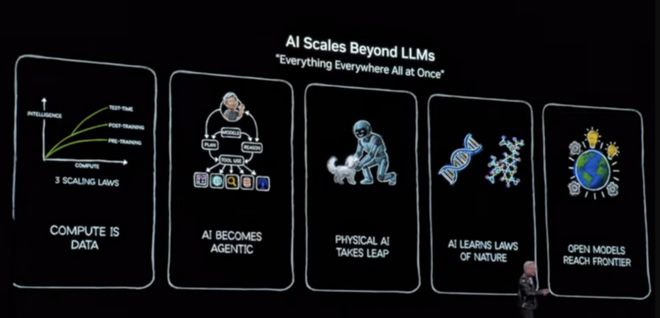
Core Insights - Huang Renxun stated that the "ChatGPT moment of physical AI" is approaching, highlighting a significant transformation in the computing industry driven by AI advancements [1][2]. Group 1: Industry Transformation - The computing industry is undergoing a historic transformation every 10-15 years, characterized by a "dual platform shift" where applications are built on AI, and the core computation is shifting from CPU to GPU [2]. - Approximately $10 trillion of global computing infrastructure is transitioning towards AI, with billions of dollars in venture capital flowing into the AI sector [2]. Group 2: Technological Breakthroughs - The Vera Rubin AI supercomputer was launched to address the exponential growth in AI model size and inference token requirements, featuring a design that integrates six custom chips and significantly enhances performance [3]. - The open model ecosystem is rapidly expanding, with models like DeepSeek R1 gaining traction and NVIDIA providing open-source tools to empower global enterprises and research institutions [3]. - Agentic systems, capable of reasoning and planning, are expected to be fully adopted by 2025, transforming software programming methodologies [3]. - The Cosmos foundational model, which can understand physical laws and generate realistic simulation data, is positioned as a key support for robotics and autonomous driving [3]. - The Alpamayo autonomous driving AI has achieved "thinking driving," utilizing end-to-end training to make autonomous decisions and explain actions clearly [3]. Group 3: Industry Collaboration - NVIDIA announced strategic partnerships with Siemens, Palantir, and others to integrate AI into various industrial processes, addressing labor shortages and enhancing automation [4]. - The AI ecosystem now encompasses a wide range of robotics applications, from consumer to industrial robots, all built on NVIDIA's Jetson platform [4]. Group 4: Open Access and Participation - NVIDIA aims to create a full-stack AI platform that allows every enterprise and individual to participate in the AI revolution, providing comprehensive tools for data processing, model training, and deployment [5]. - The introduction of a "blueprint" framework enables developers to easily create customized AI assistants, balancing privacy and functionality [5]. - The future is projected to see widespread adoption of autonomous vehicles, physical AI robots, and AI-driven smart industries, with NVIDIA committed to driving this technological revolution [5].
小鹏汽车-W(09868):强势产品周期开启战略转型,“物理AI”公司
NORTHEAST SECURITIES· 2026-01-06 08:40
Investment Rating - The report assigns a "Buy" rating for the company [7] Core Insights - The company achieved total revenue of 20.38 billion yuan in Q3 2025, a year-on-year increase of 101.8%, with net loss significantly narrowing to 0.38 billion yuan. Total deliveries reached 116,007 units, up 149.3%, marking a historical high. The comprehensive gross margin exceeded 20% for the first time, reaching 20.1%, indicating a notable improvement in profitability [1][4] - The company has launched a "dual power" strategy combining pure electric and range-extended vehicles to address user range anxiety. The first range-extended model, X9 EREV, was launched in November 2025, featuring a 63.3 kWh battery and a conversion efficiency exceeding 3.6 kWh/L, achieving a pure electric range of 452 km. Additional range-extended versions of key models are expected in Q1 2026, alongside four new models in 2026, including two SUVs based on the MONA platform [2] - The company is transitioning from "smart cars" to a "physical AI" company, showcasing its commitment and specific path at the 2025 Technology Day. The core technology, VLA 2.0, enhances reasoning efficiency by 12 times and improves average takeover mileage in complex scenarios by 13 times. The model is set to be fully deployed in Ultra models by Q1 2026 and is expected to extend to robotics and other embodied intelligence fields [3] - The company forecasts revenues of 75.8 billion yuan, 132.1 billion yuan, and 166.3 billion yuan for 2025, 2026, and 2027, respectively, with year-on-year growth rates of 85.4%, 74.3%, and 25.9%. The net profit attributable to the parent company is projected to be -1.55 billion yuan, 2.00 billion yuan, and 6.13 billion yuan for the same years [4][5]
黄仁勋携Rubin架构亮相CES,英伟达铁了心要做“AI卖铲人”
Tai Mei Ti A P P· 2026-01-06 08:37
Core Insights - NVIDIA's CEO Jensen Huang emphasized that artificial intelligence is driving a structural reset across the entire computing industry, positioning NVIDIA as a provider of foundational tools and systems for this transformation [1][3][15] Group 1: AI Market Evolution - Huang reiterated his "platform theory," stating that the computing industry undergoes a fundamental reset every 10 to 15 years, with AI representing a dual-platform migration: the reconstruction of applications and a complete rewrite of the computing stack [3][15] - The global traditional computing system is valued at approximately $10 trillion, which is being systematically modernized for AI computing, with investments coming from corporate R&D budgets, venture capital, and industrial migration [3][15] Group 2: Physical AI - Huang introduced the concept of "Physical AI," aiming to integrate intelligence into the real world, moving beyond digital applications [4][6] - The evolution of AI capabilities is categorized into several stages, culminating in agentic systems that can think and execute tasks in the physical world, addressing the challenges of limited and costly real-world data [6][7] Group 3: Vera Rubin Architecture - The Vera Rubin architecture is a system-level design consisting of six chips, aimed at supporting agentic and physical AI, addressing the limitations of Moore's Law and the exponential growth of model sizes and token generation [8][9] - The architecture features a custom Vera CPU with 88 physical cores and a Rubin GPU that exceeds the performance of its predecessor while maintaining a lower transistor count, emphasizing a new design approach rather than merely increasing scale [11][14] Group 4: System-Level Innovations - The Rubin architecture integrates multiple components to create a cohesive system, allowing for high-density computing and significant performance improvements, including a threefold increase in computational density within a single rack [13][14] - Innovations in energy efficiency and security are highlighted, with the architecture expected to save approximately 6% of energy in global data centers while supporting encrypted computing for secure model deployment [14] Group 5: Competitive Landscape - Huang's presentation aimed to provide a framework for the industry, indicating that AI will permeate every sector and that competition will shift from model parameters to a comprehensive battle for computing power, data, simulation, and system engineering capabilities [15] - NVIDIA's role as a "shovel seller" remains crucial, as it builds platforms and shapes rules while maintaining core engineering capabilities, signaling a shift in the competitive landscape as AI transitions from digital to physical realms [15]
黄仁勋,重磅发声!
证券时报· 2026-01-06 08:16
Core Viewpoint - The computing industry is undergoing a historic transformation characterized by a "dual platform shift," with AI becoming the core driver of innovation and investment across various sectors [3][4]. Group 1: Dual Platform Shift - The computing industry is experiencing a significant change every 10-15 years, marked by a dual platform shift where applications are built on AI, and the core computation moves from CPU to GPU [3]. - AI is fundamentally restructuring software development and operational logic, enabling real-time content generation and understanding of context [3]. - Approximately $10 trillion in global computing infrastructure is transitioning towards AI, with billions in venture capital flowing into the AI sector [3]. Group 2: Key Technological Breakthroughs - The Vera Rubin AI supercomputer has been launched to address the exponential growth in AI model size and inference token requirements, featuring a design that integrates six custom chips [5][6]. - Open model ecosystems are rapidly emerging, with models like DeepSeek R1 gaining traction and closing the gap with leading models through rapid iteration [6]. - Agentic systems, capable of reasoning and planning, are expected to be fully mainstream by 2025, transforming software programming practices [6]. - The "ChatGPT moment" for physical AI is approaching, with the Cosmos model enabling realistic simulations for robotics and autonomous driving [6]. - The Alpamayo autonomous driving AI has achieved "thinking driving," capable of making decisions and explaining actions, set to debut in vehicles in the US, Europe, and Asia [6]. Group 3: Industry Collaboration and Ecosystem - Strategic partnerships with companies like Siemens and Palantir aim to integrate AI into various industrial processes, addressing labor shortages and automation needs [8]. - The AI ecosystem is expanding across robotics, with applications in consumer, industrial, and medical fields, showcasing the versatility of AI technologies [8]. - Nvidia's mission is to create a comprehensive AI platform that allows participation from all sectors, promoting widespread AI innovation [9].
黄仁勋罕见提前宣布:新一代GPU全面投产
21世纪经济报道· 2026-01-06 05:23
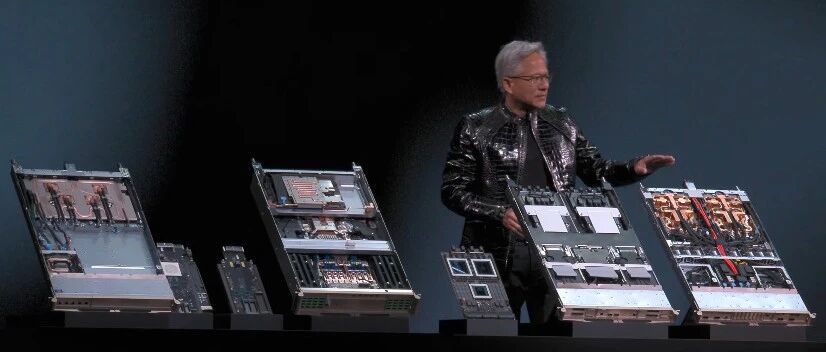
Core Viewpoint - NVIDIA has accelerated its AI chip platform release with the introduction of the "Rubin" platform at CES 2026, marking a shift in its product announcement strategy and emphasizing the growing demand for AI computing in both training and inference [2][4]. Group 1: Rubin Platform Overview - The Rubin platform, which integrates six chips including the NVIDIA Vera CPU and Rubin GPU, is designed for extreme collaborative performance, enhancing AI training performance by 3.5 times and operational performance by 5 times compared to the previous Blackwell architecture [4]. - The Rubin platform's inference token cost can be reduced by up to 10 times, and the number of GPUs required for training MoE models is decreased by four times [5]. - The NVL72 system, which includes 72 GPU packaging units, was also announced, with each unit containing two Rubin dies, totaling 144 Rubin dies in the system [5]. Group 2: Ecosystem and Market Response - Major cloud providers and model companies such as AWS, Microsoft, Google, OpenAI, and Meta have shown strong interest in the Rubin platform, indicating a positive market response [6]. - NVIDIA's early announcement of Rubin aims to provide engineering samples to ecosystem partners for preparation of subsequent deployment and scaling applications [6]. Group 3: Full-Stack AI Strategy - NVIDIA's presentation at CES included a range of AI products, signaling a shift from training scale to inference systems, with the introduction of the Inference Context Memory Storage Platform designed for efficient management of KV Cache [8]. - The company is expanding its focus on physical AI, releasing open-source models and frameworks that extend AI capabilities into robotics, autonomous driving, and industrial edge scenarios [8][9]. - The Cosmos and GR00T series models were introduced for robotics, enabling machines to understand and act in the physical world, while the Alpamayo model family was launched for autonomous driving, supported by a high-fidelity simulation framework [11].
黄仁勋“带货”Rubin,A股谁有望受益?
天天基金网· 2026-01-06 05:18
Core Insights - NVIDIA's CEO Jensen Huang highlighted the transformative impact of next-generation accelerated computing and AI across industries during his keynote at CES 2026 [2] - The demand for AI training and inference computing is surging, with the Rubin architecture entering full-scale production and expected to launch in the second half of 2026, offering up to a 10x reduction in token costs compared to the previous Blackwell generation [2][4][5] NVIDIA Rubin Platform - The NVIDIA Rubin platform features six new chips designed for extreme collaboration, significantly reducing training times and inference token costs [4] - The six chips include NVIDIA Vera CPU, NVIDIA Rubin GPU, NVIDIA NVLink 6 Switch, NVIDIA ConnectX-9 SuperNIC, NVIDIA BlueField-4 DPU, and NVIDIA Spectrum-6 Ethernet Switch [4] - Innovations in the Rubin platform include the latest NVIDIA NVLink interconnect technology, a Transformer engine, confidential computing, and RAS engine [4] AI Model Advancements - The Rubin platform accelerates intelligent agent AI, advanced reasoning, and large-scale mixture of experts (MoE) model inference, reducing the number of GPUs needed for training MoE models by four times compared to previous generations [5] - The platform introduces a new generation of AI-native storage architecture designed for gigascale inference context, enhancing response capabilities and throughput [5] Market Deployment and Partnerships - NVIDIA Rubin products will be available through partners like AWS, Google Cloud, Microsoft, and others in the second half of 2026 [5] - CoreWeave will collaborate with NVIDIA to leverage Rubin's advancements in inference and MoE models, while major server manufacturers like Cisco, Dell, HPE, Lenovo, and Supermicro are expected to launch Rubin-based servers [6] Physical AI and Open Source Models - Huang announced the arrival of "physical AI's ChatGPT moment," with machines beginning to understand and act upon real-world data [12][13] - NVIDIA introduced the open-source physical AI foundational model, Cosmos, which has been pre-trained on vast datasets to understand the workings of the world [13] - The Alpamayo series of open-source AI models aims to accelerate the development of safe, reasoning-based autonomous vehicles, garnering interest from industry leaders [14] Robotics and Ecosystem Development - Global robotics leaders are developing products based on NVIDIA's Isaac platform and GR00T foundational model, covering various applications from industrial to consumer robotics [15] - NVIDIA emphasizes the importance of building an open-source AI ecosystem, with models like DeepSeek R1 demonstrating rapid industry adoption and collaboration [15] Industry Implications - The introduction of the Vera Rubin platform is expected to drive demand for high-speed optical modules and CPO technology, with companies in the supply chain already preparing for this shift [9][10] - The increased power requirements of the Rubin GPU, estimated at around 1800 watts, will elevate the demands on power supply and cooling systems [10]
排队两小时入场,数千人现场听讲!英伟达新一代GPU发布,黄仁勋称“开源模型彻底改变了人工智能”,还提到了3个中国大模型
Xin Lang Cai Jing· 2026-01-06 05:04
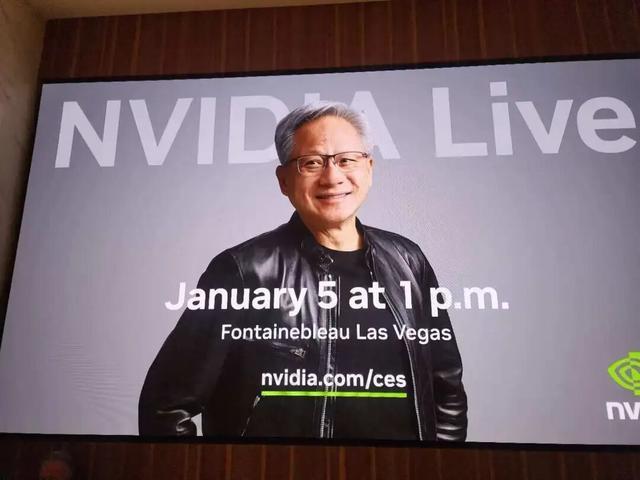
炒股就看金麒麟分析师研报,权威,专业,及时,全面,助您挖掘潜力主题机会! (来源:每日经济新闻) 每经记者:杨卉 每经编辑:陈柯名,文多 黄仁勋认为,相比最前沿的AI模型,开源模型落后约6个月,但这个距离正逐步缩短,开源模型彻底改 变了人工智能,吸引所有人参与其中。"我们现在知道,当开源、开放创新、全球每家公司每个行业的 创新被激活时,AI将无处不在。与此同时,开放模型去年真的起飞了。AI模型现在能推理的能力强大 得不可思议。"黄仁勋表示。 黄仁勋还提到了AI搜索引擎工具Perplexity:"当我第一次意识到它同时使用多个模型时,我觉得这完全 是天才之举。" 随后黄仁勋提及了AI Agent(人工智能体),他认为未来人们会拥有个人的定制AI,"你能教它为你的 公司实现独有的技能"。 图片来源:每经记者 杨卉 摄 美国当地时间1月5日11点,英伟达创始人、首席执行官黄仁勋的"CES2026"(2026年国际消费电子展) 主题演讲开始前两小时,现场已排起了长队,每日经济新闻记者在现场注意到,场内约有3000人。 黄仁勋演 讲海报 图片来源:每经记者 杨卉 摄 黄仁勋依旧穿着皮衣亮相,登场后向大家问候了"新年好" ...
NVIDIA推出Alpamayo系列开源AI模型与工具,加速安全可靠的推理型辅助驾驶汽车开发
Xin Lang Cai Jing· 2026-01-06 04:37
Core Insights - NVIDIA has launched the Alpamayo series of open-source AI models, simulation tools, and datasets aimed at advancing the development of safe and reliable inference-based autonomous driving vehicles [1][3] Group 1: Technology and Features - The Alpamayo series introduces a VLA reasoning model based on chain-of-thought, enhancing decision-making capabilities in autonomous driving systems to handle rare and complex scenarios [1][3] - Alpamayo 1 is the first reasoning model designed for the autonomous driving research community, featuring a 10 billion parameter architecture that generates driving trajectories from video input while providing reasoning insights [3][4] - AlpaSim is a fully open-source end-to-end simulation framework that offers realistic sensor modeling and configurable traffic dynamics, supporting rapid validation and strategy optimization [4] Group 2: Data and Ecosystem - NVIDIA provides a diverse large-scale open dataset for autonomous driving, containing over 1,700 hours of driving data across various geographic areas and environmental conditions, essential for developing reasoning architectures [4] - The Alpamayo ecosystem integrates open models, simulation frameworks, and datasets into a unified system, allowing developers and research teams to build upon it for their projects [3][4] Group 3: Industry Support and Impact - Leading companies in the mobility sector, including Lucid, Jaguar Land Rover, and Uber, have shown significant interest in Alpamayo, aiming to develop reasoning-based autonomous driving stacks for achieving Level 4 autonomy [5] - Industry experts emphasize the growing need for AI systems that not only process data but also possess reasoning capabilities to handle real-world behaviors, highlighting the importance of advanced simulation environments and rich datasets [5] - The open-source nature of Alpamayo is expected to accelerate innovation across the industry, enabling partners to adjust and optimize models according to their unique needs [5]
老黄All in物理AI!最新GPU性能5倍提升,还砸掉了智驾门槛
创业邦· 2026-01-06 04:28
来源丨 量子位(ID:QbitAI) 作者丨西风 闻乐 刚刚,英伟达CEO黄仁勋穿着鳄鱼皮夹克,在全球最大消费电子展 CES 2026 上发布AI新品。 这是五年来,英伟达首次来到CES却没有发游戏显卡,态度很明确:全力 搞AI。 全力搞出来的结果也让围观群众直呼:竞争对手如何追上英伟达? 下一代Rubin架构GPU 推 理、训练性能分 别是 Blackwell GB 200的5倍和3.5倍 (NVFP4数据格 式)。 除此之外,老黄还带来了五大领域的全新发布,包括: 面向Agentic AI的 NVIDIA Nemotron 模型家族 面向物理AI的 NVIDIA Cosmos 平台 面向自动驾驶开发的全新 NVIDIA Alpamayo 模型家族 同时,英伟达宣布持续向社区 开 源训 练框架 以 及 多模 态数据 集 。其中数据集包括10万亿语言 训练token、50万条机器人轨迹数据、45.5万个蛋白质结构、100TB车辆传感器数据。 这次的核心主题,直指 物理AI 。 用网友的话来说: 这是英伟达将护城河从芯片层进一步拓展到全栈平台层(模型+数据+工具)的体现,通过这种方式可 以持续拉动更多GPU与基 ...