AGI

Search documents
智谱、MiniMax争当大模型第一股,这些“坑”必须要注意
2 1 Shi Ji Jing Ji Bao Dao· 2025-12-24 00:41
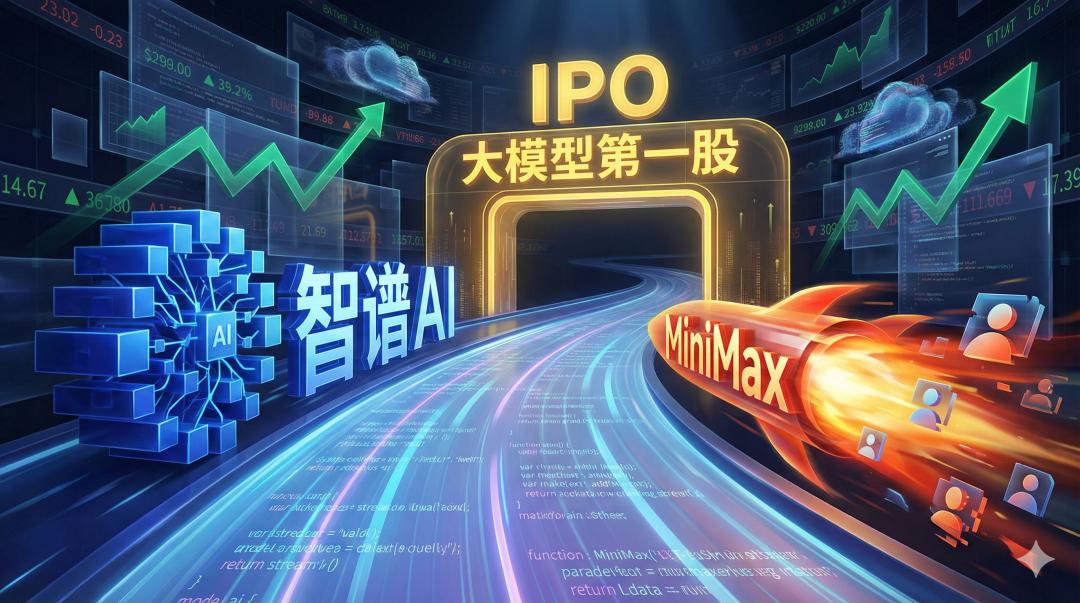
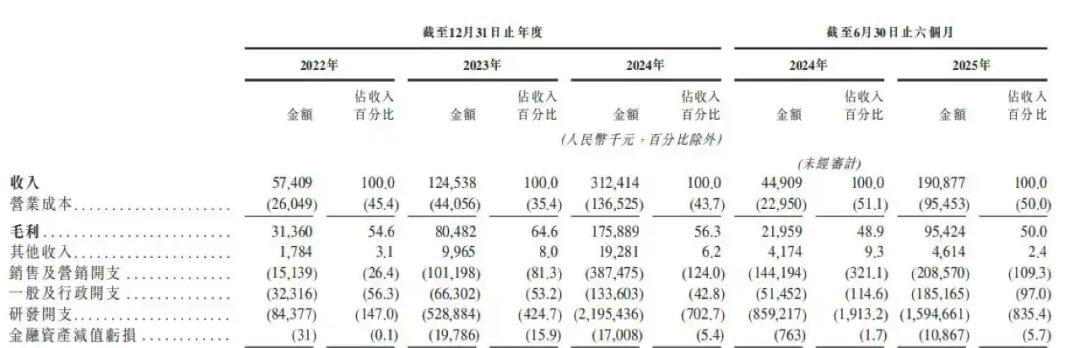
21世纪经济报道记者 章驰 智谱与MiniMax同属"中国AI六小龙"的明星企业,虽然同处AGI赛道,但两家公司在基因、战略及商业 化路径上却展现出截然不同的图景。 智谱历经8轮融资,募集资金超83.6亿人民币,背后站着美团、蚂蚁、腾讯、小米等半个互联网圈。 MiniMax同样获得了阿里、腾讯、红杉中国等顶尖机构的数轮加持。 国内顶尖大模型独角兽智谱与MiniMax开启IPO巅峰对决,三天内相继递交招股书。这场大模型"第一 股"之争,究竟是AGI造富还是资本碎钞机?一文拆解两大公司的招股书,帮你厘清招股书里这些你可 能会忽略的"坑"。 两者目前均处于亏损换增长的阶段,面临极高的"烧钱"压力,主要成本均流向了昂贵的算力资源和顶尖 人才获取。2024年智谱收入3.12亿元,亏损29.58亿元。MiniMax2024年收入约2.1亿人民币,亏损4.65亿 美元(约32.7亿人民币)。 To B 垂直深耕 vs To C 全球收割 风险因素:深度分析"带刺"条款 MiniMax正面临好莱坞巨头的"天价起诉"。迪士尼、环球、华纳兄弟等好莱坞巨头们指控海螺AI生成了 其拥有版权的视频角色,索赔金额上限达7500万美元。但 ...
拆解招股书,看懂中国大模型独角兽的两种“活法”
3 6 Ke· 2025-12-24 00:40
Core Insights - The competition for the title of "the world's first stock of large models" is unfolding between two Chinese companies, Zhipu AI and Minimax, with their prospectuses revealing critical business details beyond the title itself [1] - The prospectuses highlight three key dimensions: the quality of real revenue, the pressure of computing costs on profits, and the survival period supported by cash reserves [1] - The prospectuses also show that the two companies are following distinctly different paths in their business models, representing potential breakout directions for Chinese large model companies in the current market environment [1] Financial Performance - Zhipu AI reported a revenue of 312 million CNY (approximately 31.2 million USD) for 2024, while Minimax reported about 30.38 million USD (approximately 216 million CNY) [4] - Zhipu AI's gross margin stands at 56.3%, significantly higher than Minimax's 12.2%, indicating a stark difference in their business models [3][5] - Both companies are in a "high investment for growth" phase, with Zhipu AI experiencing a net loss of 2.96 billion CNY and Minimax a loss of 465 million USD [4] User Data and Market Focus - Zhipu AI primarily targets B-end enterprises and developers, boasting over 12,000 enterprise clients and 4.5 million developers, while Minimax focuses on C-end users with 27.6 million monthly active users [5] - Zhipu AI's revenue structure shows a heavy reliance on localized deployments, contributing 85% of its revenue, while Minimax's revenue is increasingly derived from AI-native applications, which account for about 71% [14][15] Product Structure and Innovation - Zhipu AI's core product is the GLM series, which competes with OpenAI, while Minimax's abab series focuses on interactive and multi-modal capabilities [5] - Zhipu AI's revenue model is primarily based on privatized deployment (84.5%), whereas Minimax operates on a subscription model for AI applications [5] Globalization and Market Strategy - Minimax has shifted its revenue sources from 80% domestic to 73% international, indicating a strong commitment to globalization [14] - Both companies are exploring international markets, with Zhipu AI generating revenue in Southeast Asia and Minimax aggressively pursuing global expansion [17] Cash Reserves and Financial Viability - As of December 31, 2024, Zhipu AI holds approximately 2.457 billion CNY in cash, while Minimax has about 1.046 billion USD, indicating a significant difference in their financial stability [23][24] - Zhipu AI's cash reserves can sustain operations for about 11 months without new financing, while Minimax's reserves can last approximately 37.5 months [24] Risk Factors and Challenges - Both companies express concerns about high survival thresholds in the rapidly evolving AI technology landscape, with Zhipu AI focusing on supply chain security and geopolitical issues, while Minimax highlights its status as an uncommercialized company facing high bankruptcy risks [25][26] - The reliance on expensive computing resources and the significant R&D expenditures exceeding revenues pose financial challenges for both companies [20][21] Valuation and Market Position - The valuation of Zhipu AI and Minimax is approximately 40 billion CNY and 4 billion USD, respectively, which is significantly lower than that of OpenAI, indicating a potential undervaluation in the market [27][28] - The competitive landscape is intensifying, with established players like Alibaba and ByteDance posing significant challenges to the market position of Zhipu AI and Minimax [29]

招股书里的MiniMax:当聪明人决定不再为巨头打工
华尔街见闻· 2025-12-23 14:03
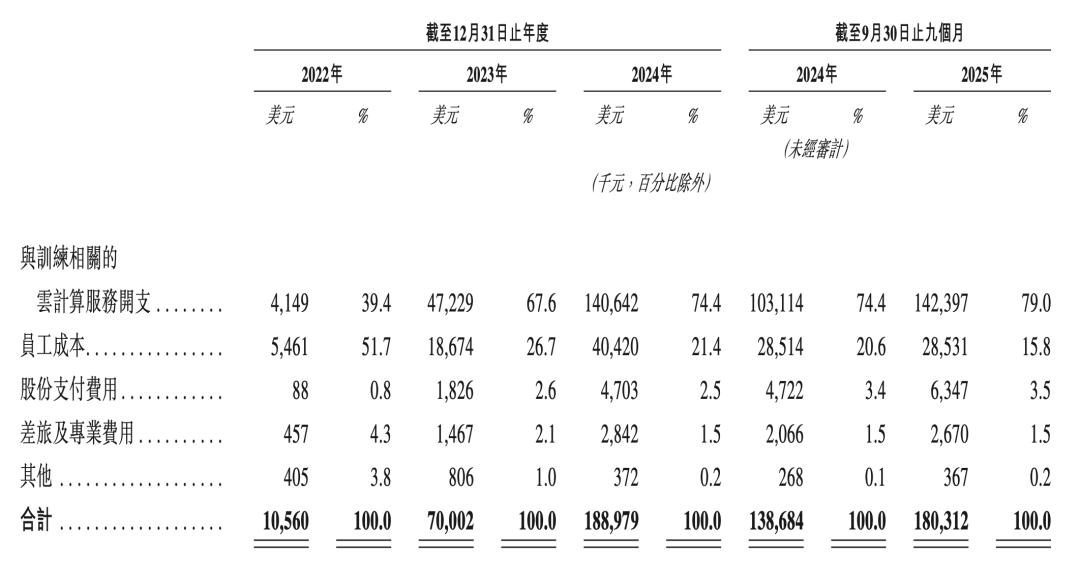
Core Viewpoint - The article posits that 2025 will be a year of differentiation in the AI industry, with the narrative chosen by companies determining their perspective on the market [1]. Group 1: MiniMax's Emergence - MiniMax, a unicorn company with only 385 employees and an average age of 29, is poised for an IPO, having successfully commercialized its AI models without relying on a major internet company's traffic [2]. - The company has achieved significant scale with products like Talkie and Hailuo, generating real user engagement and revenue, while holding $11 billion in cash reserves to sustain operations for 50 months without additional funding [2][3]. - MiniMax's success challenges the traditional "burn money" model of large internet firms, attracting strategic investments from major players like MiHoYo, Alibaba, Tencent, and top investment firms [3]. Group 2: Financial Efficiency - MiniMax has spent approximately $500 million since its inception, significantly less than the annual marketing budgets of larger firms, yet it has developed a full-stack multimodal model that competes with giants like OpenAI [6]. - The company's cloud computing service expenses related to training have dramatically decreased from 1365% of revenue in 2023 to 266.5% in the first nine months of 2025, indicating a transition from a money-burning phase to a profitable growth phase [11]. Group 3: Global Strategy - MiniMax has shifted its focus to international markets, with over 70% of its revenue coming from overseas, making it the most internationally oriented AI company in China [15]. - The company has avoided the domestic market's price wars by targeting markets with higher willingness to pay, such as North America and Europe, where SaaS payment habits are more established [15][16]. Group 4: Organizational Efficiency - MiniMax operates with a flat organizational structure, allowing for rapid decision-making and innovation, with over 80% of its code generated by AI, enhancing productivity [20][21]. - The company has achieved impressive revenue per employee metrics, generating approximately $53 million in revenue in the first nine months of 2025, showcasing its high operational efficiency compared to traditional software firms [20]. Group 5: Industry Narrative - The article contrasts two narratives in the AI industry: one that views AI as a resource-heavy endeavor dominated by large firms, and another that sees it as a reconfiguration of productivity driven by efficiency and innovation [24]. - MiniMax embodies the latter narrative, demonstrating that a small, agile team can challenge larger competitors without relying on extensive resources [24][25].

智谱、MiniMax争夺“大模型第一股”:高增长之下各有难题
3 6 Ke· 2025-12-23 12:44
Core Insights - The AI large model industry is at a critical juncture for capital value realization, with Beijing Zhiyu Huazhang Technology Co., Ltd. (Zhiyu) and Shanghai Xiyu Technology Co., Ltd. (MiniMax) both filing for IPOs on the Hong Kong Stock Exchange within 48 hours of each other [1][2][6] Company Paths - Zhiyu focuses on B-end and G-end services, while MiniMax is centered on C-end subscriptions, indicating a divergence in their development strategies [3][7] - The competition between these two companies serves as a test of the feasibility of their respective business paths as the industry transitions from technical exploration to commercialization [4] Financial Performance - Zhiyu's revenue projections show a compound annual growth rate (CAGR) of over 130%, with revenues expected to grow from 57.4 million RMB in 2022 to 3.12 billion RMB in 2024 [8][10] - MiniMax's revenue is projected to increase from 3.5 million USD in 2023 to 30.5 million USD in 2024, reflecting a staggering growth rate of 782% [12][14] Profitability Challenges - Both companies are experiencing significant losses despite revenue growth, with Zhiyu's adjusted net losses projected to reach 2.466 billion RMB in 2024 and MiniMax's net losses expected to be 465 million USD [18][19] - The losses are primarily attributed to high R&D and infrastructure investments, with Zhiyu's cumulative R&D expenditure reaching approximately 4.4 billion RMB [18][20] Market Positioning - Zhiyu's business model emphasizes a high barrier to entry with its foundational model technology, while MiniMax's strategy focuses on rapid commercialization through a multi-modal product approach [25][28] - The capital market's response to these companies will reflect a preference for either long-term technological autonomy or quick commercial potential [28][31] Competitive Landscape - The competition for the title of "AI large model first stock" is intensifying, with both companies having secured substantial funding and high valuations, indicating strong investor interest [27] - The market remains fragmented, with Zhiyu holding a 6.6% market share among independent general-purpose model developers in China [25] Future Considerations - The sustainability of their business models will be crucial for both companies post-IPO, as they navigate the challenges of maintaining growth while managing losses [31][32]
四年只花5亿美元,MiniMax 穷不穷?
3 6 Ke· 2025-12-23 12:44
但当你真正翻开这份招股书,你会发现这种"穷",其实是一场对行业惯性的人效挑战。 效率的胜利:1%的资金与 29岁的团队 在中国的大模型牌桌上,MiniMax 始终是一个难以被归类的"另类"。 当同行们动辄融资百亿、卷入算力军备竞赛,甚至为了一个投流渠道挥金如土时,MiniMax 在招股书中甩出了一个让业界集体沉默的数据:从 2022 年成 立至今,一共才花了约 5 亿美元。 5 亿美元是什么概念? 放在硅谷,这甚至不够 OpenAI 塞牙缝——后者的累计花销估算已达 400 亿至 550 亿美元。放在国内,这笔钱可能也就够大厂买个半年的流量包。 对这份招股书,质疑声随之而来:在 AGI 这场动辄千亿起跳的豪赌局里,区区 5 亿美元能买到通往未来的门票吗?MiniMax 是不是没钱了?是不是在这 场残酷的淘汰赛中,为了"活下去"而不得不选择了"消费降级"? 在MiniMax 这份招股书里,硅基君最大的一个感受就是,极致的效率。 MiniMax从2023年开始进行商业化,营收已达到346万美元,2024年直接飙升到3052万美元,同比暴涨了782.2%。2025年前9个月,公司的营收额再度大涨 175%,达到53 ...
宇树机器人“天花板级”后空翻,马斯克坐不住了
Sou Hu Cai Jing· 2025-12-23 09:19
Core Viewpoint - The performance of the Yushu G1 robots at Wang Leehom's concert has gained significant attention, including praise from Elon Musk, highlighting the growing interest in humanoid robots and their capabilities in entertainment [2][4][14]. Group 1: Performance and Recognition - The Yushu G1 robots showcased impressive dance moves, including a complex backflip, which drew admiration from the audience and notable figures like Elon Musk [2][12]. - Musk's endorsement on social media has attracted millions of viewers, indicating the potential for increased visibility and interest in humanoid robotics [4][22]. - The performance is seen as a significant achievement in the field of robotics, demonstrating advanced motion control and stability [12][14]. Group 2: Industry Context and Competition - The rise of Yushu robots has sparked a trend among other robotics companies to showcase their robots' dancing abilities, indicating a shift in how robots are perceived and utilized in entertainment [6][22]. - Despite the positive attention, there is underlying competition, particularly with Musk's own humanoid robot, Optimus, which also aims to excel in similar capabilities [4][15]. - The robotics industry is currently facing challenges, with rental prices for humanoid robots dropping significantly from earlier highs, suggesting a need for innovative marketing strategies to revitalize interest [23][24]. Group 3: Technical Challenges and Capabilities - Humanoid robots like Yushu G1 possess multiple degrees of freedom, requiring precise control algorithms to execute complex movements without losing balance [7][8]. - Achieving advanced dance moves involves overcoming significant technical hurdles, including rapid adjustments to maintain stability and coordination [9][10][11]. - The ability to perform intricate maneuvers, such as the Webster backflip, is considered a milestone in robotic motion intelligence, reflecting the technological advancements in the field [12][13]. Group 4: Market Implications - Musk's praise may serve as a strategic marketing move, potentially benefiting the broader robotics rental market, which has seen a decline in demand [22][26]. - The current state of the robotics industry reflects a focus on hardware capabilities, with a need for further development in artificial general intelligence (AGI) to enhance functionality [26].


酷特智能:酷特数智化企业级操作系统,由1.0已升级到2.0版本,并已正式研发完成并发布
Mei Ri Jing Ji Xin Wen· 2025-12-23 03:53
Core Viewpoint - The company has successfully completed and released the upgrade of its enterprise-level operating system from version 1.0 to 2.0, marking a significant milestone in its collaboration with Huawei in the apparel industry [1] Group 1: Product Development - The upgraded system, known as the Cool AI 2.0, is the first AGI achievement in the apparel sector, developed in partnership with Huawei [1] - The core products of the system, including Cool Xiao Zhi, Cool Xiao Jiang, and Cool Xiao Yi, have been integrated into practical scenarios for intelligent enterprises and enterprise clusters [1] - The company plans to continue iterating on the system, focusing on collaborative intelligence and deepening industry applications [1] Group 2: Market Engagement - The company has been actively promoting the upgraded system through various platforms, including the Huawei Developer Conference and discussions with AI experts [1] - Future announcements regarding the company's H-share listing will be made, although there remains significant uncertainty regarding this process [1]
DeepMind重磅:AGI可能正在你眼皮底下「拼凑」出来,我们却毫无准备
3 6 Ke· 2025-12-23 01:08
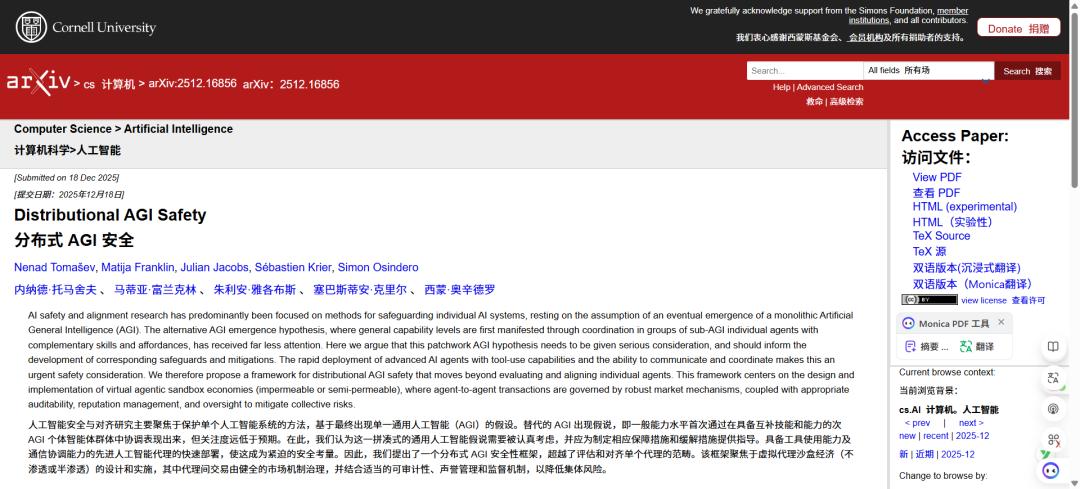
当所有人都在盯着GPT-5会不会成为超级AI时,DeepMind泼了一盆冷水:别看那边了,真正的AGI可能正在你眼皮底下悄悄「拼凑」出来——通过成百上 千个普通AI Agent的协作。更可怕的是,我们对此几乎毫无准备。 2025年12月18日,Google DeepMind在arXiv发布了一篇重磅论文《Distributional AGI Safety》。这篇论文提出了一个颠覆性观点:我们可能一直在为错误 的敌人做准备。 从RLHF(人类反馈强化学习)到Constitutional AI (Anthropic的宪法AI),从机械可解释性到价值对齐,几乎所有AI安全研究都在假设:AGI会是一个单一 的、无比强大的超级模型——就像某个科技巨头开发的GPT-10,智商碾压人类。 但DeepMind说:你们可能看错方向了。 AGI或许不会以「超级大脑」的形式出现,而是通过多个「次级AI」的协作,像拼图一样组合而成。论文将这种形式称为「Patchwork AGI」(拼凑型 AGI)。 这不是科幻设想。论文指出,实现这一场景的技术基础已经就绪:AI Agent正在快速部署(Claude Computer Use、GPT ...

腾讯研究院AI速递 20251223
腾讯研究院· 2025-12-22 16:08
Group 1: Generative AI Developments - Gemini 3 Flash outperformed Gemini Pro with a score of 78% in SWE-Bench Verified tests, surpassing Pro's 76.2%, and is 3 times faster than 2.5 Pro while reducing token consumption by 30% [1] - MiniMax has open-sourced its VTP (Visual Tokenizer Pre-training Framework), discovering a Scaling Law in AI visual generation, which resolves the paradox of training performance [3] - Tongyi Qwen launched the Qwen-Image-Layered model, which disassembles images into multiple RGBA layers for independent manipulation, enhancing high-fidelity editing capabilities [4] Group 2: Company Updates and Financial Performance - MiniMax is preparing for an IPO in Hong Kong, with a team of 385 people averaging 29 years old and having spent $500 million, which is less than 1% of OpenAI's expenses [5] - MiniMax reported revenue of $53.44 million for the first nine months of 2025, a year-on-year increase of over 170%, with over 70% of revenue coming from overseas [6] Group 3: Technological Innovations - Shanghai Jiao Tong University introduced the LightGen chip, expanding photonic computing into large model semantic media generation, achieving high-resolution image generation and outperforming NVIDIA's A100 by two orders of magnitude [7] - DeepMind's research suggests that AGI may emerge from multiple smaller AGI agents collaborating rather than from a single large model, proposing a four-layer defense framework for distributed risks [8]
赵何娟对话张宏江:世界模型已是兵家必争之地|2025 T-EDGE全球对话
Tai Mei Ti A P P· 2025-12-22 14:52
Core Insights - The discussion highlights the transformative impact of AI, particularly the emergence of superintelligence, which may lead to job displacement [2][8] - The conversation emphasizes the high expectations surrounding world models and next-generation AI models, with significant investments being made in startups despite their early stages [4][20] - The debate around the sustainability of scaling laws in AI development is addressed, with experts suggesting that new paths must be explored beyond traditional scaling [19][20] Group 1: AI Development and Trends - The emergence of new AI startups in Silicon Valley has led to valuations reaching $4 billion to $5 billion, indicating strong market confidence in world models [4] - The scaling law, which has been a guiding principle in AI development, is believed to be reaching its limits, prompting calls for new technological pathways [19][20] - The efficiency of scaling laws has diminished over time, suggesting that while progress continues, it may not be as rapid as in previous years [19][20] Group 2: Competitive Landscape - The competition between Google and OpenAI is highlighted, with both companies having distinct advantages; however, it is too early to determine a clear winner [6][41] - The potential for coexistence of multiple systems in the AI era is discussed, drawing parallels to the PC and mobile internet eras [41] - The importance of execution and resource management in AI development is emphasized, particularly in relation to Google's full-stack capabilities [34] Group 3: Infrastructure and Investment - The current phase of AI development is characterized by significant infrastructure investments, including data centers and energy resources, which are essential for future growth [48][49] - Concerns about high debt levels in AI infrastructure investments are raised, with the need for a balance between investment and sustainable returns [50] - The analogy of AI infrastructure investments to historical infrastructure developments, such as railroads and electricity, is presented to argue against the notion of a bubble [48][49]