
智能驾驶

Search documents
长安汽车定增被受理 将于深交所上市
Xin Lang Cai Jing· 2026-01-26 11:15
Core Viewpoint - Changan Automobile is issuing A-shares to raise up to 600 million yuan for investments in new energy vehicle development and other projects [1][3]. Group 1: A-Share Issuance - Changan Automobile plans to issue 630,252,100 A-shares, which will not exceed 30% of the current total share capital [1][3]. - The funds raised will be used for new energy vehicle and smart platform development, global R&D center construction, and core capability enhancement projects [1][3]. Group 2: Business Overview - Changan Automobile's main business includes the R&D, manufacturing, and sales of vehicles (passenger and commercial) and engines [1][3]. - The company is actively developing three electric technologies: battery, electric motor, and electronic control, along with smart cockpit and autonomous driving technologies [1][3]. - Changan is exploring new business areas such as automotive life services, new marketing strategies, battery swapping services, and future industries like humanoid robots and flying cars [1][3]. Group 3: Brand Development - Changan has established three major brands: Changan, Deep Blue, and Avita, with differentiated sub-brands under Changan [2][4]. - The company has launched several classic models in the traditional fuel vehicle sector, including the CS series, Yidong series, and UNI series [2][4]. - In the new energy sector, Changan is focusing on models like Changan Qiyuan E07, Deep Blue S07, and Avita 11, aiming to provide high-quality products and services to consumers [2][5].

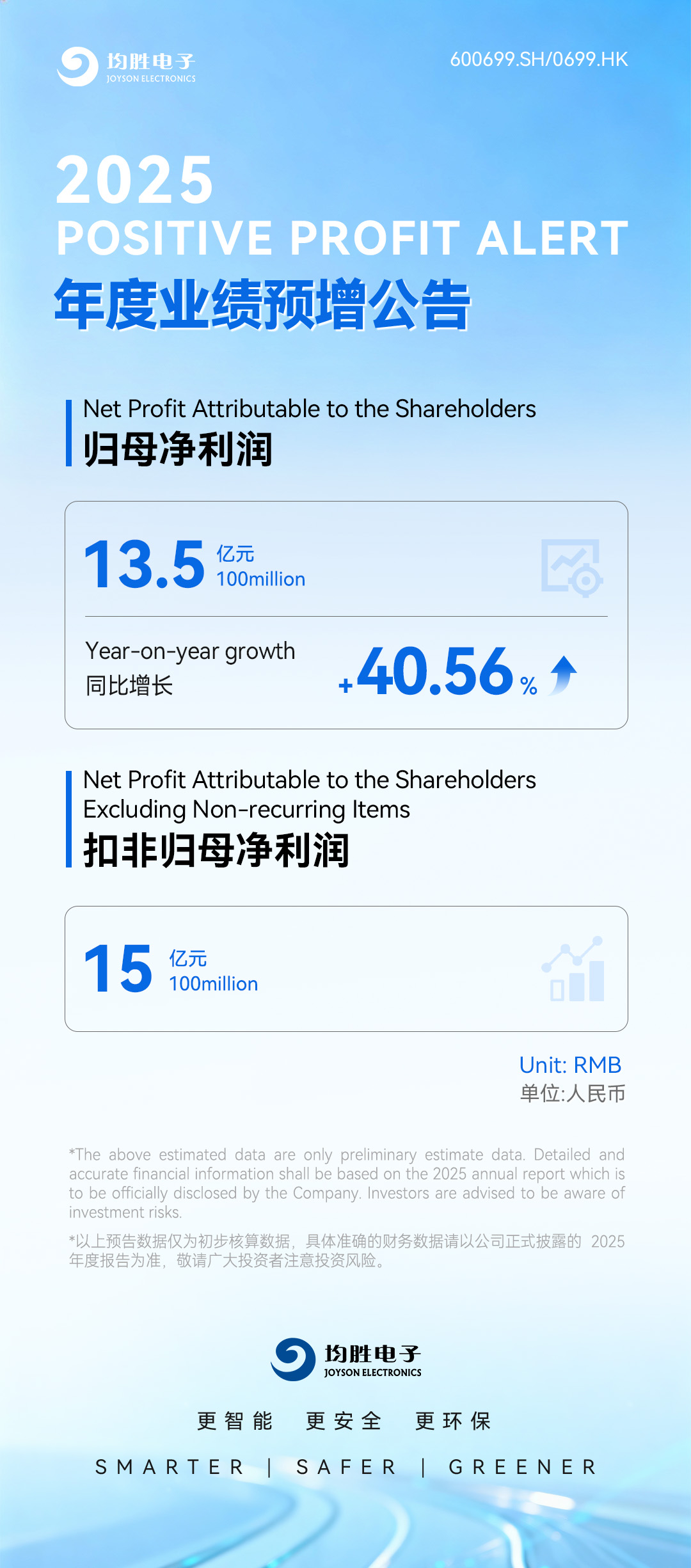
均胜电子:预计2025年归母净利润13.5亿元,同比增长超40%
Xin Lang Cai Jing· 2026-01-26 11:09
Core Viewpoint - Joyson Electronics (均胜电子) expects a significant increase in net profit for the year 2025, projecting approximately 1.35 billion RMB, which represents a year-on-year growth of 40.56% compared to the previous year [1][5]. Financial Performance - The estimated net profit attributable to shareholders is about 1.35 billion RMB, an increase of approximately 390 million RMB from the previous year [5]. - The expected annual net profit excluding non-recurring items is around 1.5 billion RMB [5]. Business Development - In 2025, Joyson Electronics has achieved a breakthrough in the automotive intelligence sector, transitioning from product development to mass production orders, securing over 20 billion RMB in orders across various intelligent automotive products [5]. - The company has received a total of approximately 71.4 billion RMB in new orders globally for the first three quarters of 2025 [5]. Strategic Upgrade - Joyson Electronics is upgrading its strategy to "Automotive + Robotics Tier 1," expanding its research and manufacturing expertise from the automotive sector into the robotics industry [5]. - The company has established a comprehensive layout for key robotic component solutions and has launched a product matrix including AI head assemblies, universal controllers, energy management assemblies, and mecha kits [5]. - Collaborations have been formed with robotics companies such as Zhiyuan Robotics, Galaxy General, and RIVR, with some products already in bulk supply or sampling stages [5].


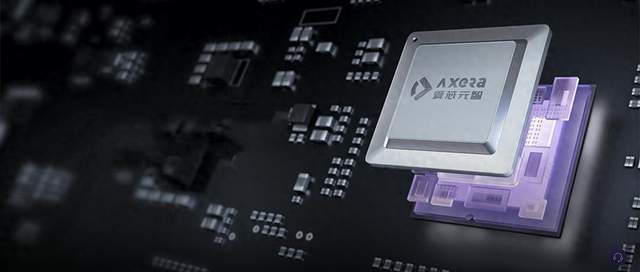
豪威集团(00501)拟斥资不超过5000万美元认购爱芯元智首次公开发行股份
智通财经网· 2026-01-26 11:09
Core Viewpoint - The company,豪威集团, aims to deepen strategic collaboration with 爱芯元智 by leveraging core technologies in visual terminals, edge inference, and smart vehicles, enhancing long-term competitiveness through effective integration of technology and industry resources [1] Group 1: Strategic Collaboration - The collaboration focuses on strategic cooperation in automotive intelligent driving and edge AI fields [1] - The partnership is expected to promote efficient integration of both companies' technological and industrial resources [1] Group 2: Financial Commitment - The wholly-owned subsidiary, 韦尔香港, plans to use its own funds to subscribe for shares in 爱芯元智's initial public offering on the Hong Kong Stock Exchange, with a maximum investment of up to 50 million USD [1] - The shareholding ratio will be determined based on the market value at the time of issuance [1]

智能驾驶朋友圈盘点:华为系、Momenta系、自研系三派系势不可挡
Zhong Guo Qi Che Bao Wang· 2026-01-26 10:35
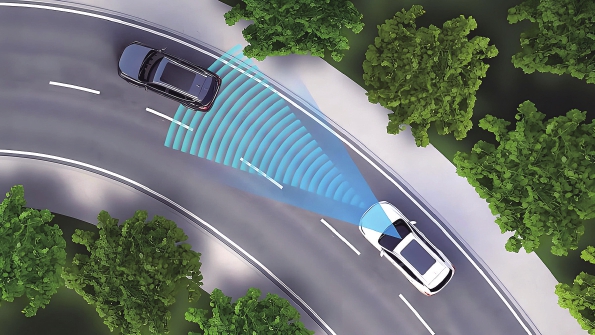
Core Insights - Since 2025, multiple automotive companies have chosen to collaborate with Huawei and Momenta, although some self-research companies also partner with them, the core intelligent driving systems remain primarily self-developed [2] - The intelligent driving landscape is dominated by Huawei and Momenta, while self-research companies maintain significant market presence due to their terminal sales advantages [2] User Base Distribution - In the domestic intelligent driving market, Huawei, Momenta, and self-research companies lead in user numbers, while other factions have relatively dispersed and low user concentration [3] - From January to November 2025, Huawei's HI model achieved a deployment of 134,100 vehicles, accounting for 19.76% of third-party suppliers [3] - By the end of 2025, Huawei's QianKun intelligent driving system had accumulated over 5.42 billion kilometers of assisted driving, successfully avoiding 2.12 million potential collisions [3] - Momenta's city NOA deployment reached 414,400 vehicles, representing 61.06% of third-party suppliers during the same period [3] Market Share and Collaboration - From January 2023 to October 2024, Momenta achieved a market share of 60.1% in the city NOA third-party intelligent driving market, with 8 out of the top 10 global automotive companies collaborating with Momenta [4] - Self-research companies include BYD, Li Auto, Xiaomi, Tesla, and NIO, with BYD's "Tianshen Eye" system activated in 94.13% of its models [4][11] Technological Pathways - Huawei's intelligent driving system boasts a full-stack self-research capability, integrating chips, software algorithms, and sensors into a cohesive technology ecosystem [7] - Huawei's ADS system features a "chip-algorithm-cloud" architecture, enhancing data processing efficiency and system stability [7] - Momenta employs a data-driven innovation model, utilizing an "end-to-end large model" for scalable production, achieving significant breakthroughs in technology [10] Business Strategies - Huawei adopts a dual-track strategy of binding with leading automotive companies while expanding into the mid-to-low-end market [8] - Momenta's open cooperation strategy lowers the entry barrier for automotive companies, with over 130 models in mass production [10] Technical Route Characteristics - Different technical routes exist within the intelligent driving ecosystem, each with its advantages and disadvantages, leading to a diverse market landscape [14] - The pure vision route is cost-effective but struggles with recognizing unusual obstacles and performs poorly in extreme weather [14] - The multi-sensor fusion route, while providing precise measurements, incurs high hardware costs and complex data calibration [14] - End-to-end and modular routes reduce cumulative errors but face challenges in model interpretability and training costs [15]
均胜电子:预计2025年归母净利润13.5亿元 同比增长40.56%
Zhong Zheng Wang· 2026-01-26 10:31
Core Viewpoint - Junsheng Electronics (600699.SH/0699.HK) anticipates a significant increase in net profit for 2025, projecting approximately 1.35 billion yuan, which represents a year-on-year growth of 40.56% compared to the previous year [1] Financial Performance - The company expects a net profit attributable to shareholders of about 1.35 billion yuan, an increase of approximately 390 million yuan from the previous year [1] - The projected annual net profit excluding non-recurring items is around 1.5 billion yuan [1] Business Development - In 2025, Junsheng Electronics has achieved a breakthrough in automotive intelligence, transitioning from "product development to mass production orders" [1] - The company has secured over 20 billion yuan in orders for automotive intelligent products, including smart driving domain control, cabin integration, in-car multi-screen, and central computing unit (CCU) [1] - For the first three quarters of 2025, the total amount of new orders acquired globally by the company reached approximately 71.4 billion yuan [1] Strategic Upgrade - Junsheng Electronics has upgraded its strategy to "Automotive + Robotics Tier 1," aiming to extend its R&D and manufacturing expertise from the automotive sector to the robotics industry [1] - The company has established a layout for key components in robotics solutions, launching a product matrix that includes AI head assemblies, full-domain controllers, energy management assemblies, and mech kits [1] - Collaborations have been formed with overseas robotics companies such as Zhiyuan, Galaxy General, and RIVR, with some products already in bulk supply or sampling stages [1]
保时捷中国CEO表态:正考察多家中国智驾供应商 持开放合作态度
Feng Huang Wang· 2026-01-26 06:45
Core Viewpoint - Porsche is actively exploring partnerships with multiple Chinese smart driving suppliers and is open to collaboration with Chinese intelligent driving companies [1] Group 1 - Porsche's CEO Alexander Pollich confirmed that the company is conducting assessments of various Chinese smart driving suppliers [1] - The company is simultaneously advancing related research to evaluate potential collaborations [1] - Porsche maintains an open attitude towards cooperation with Chinese intelligent driving enterprises [1]

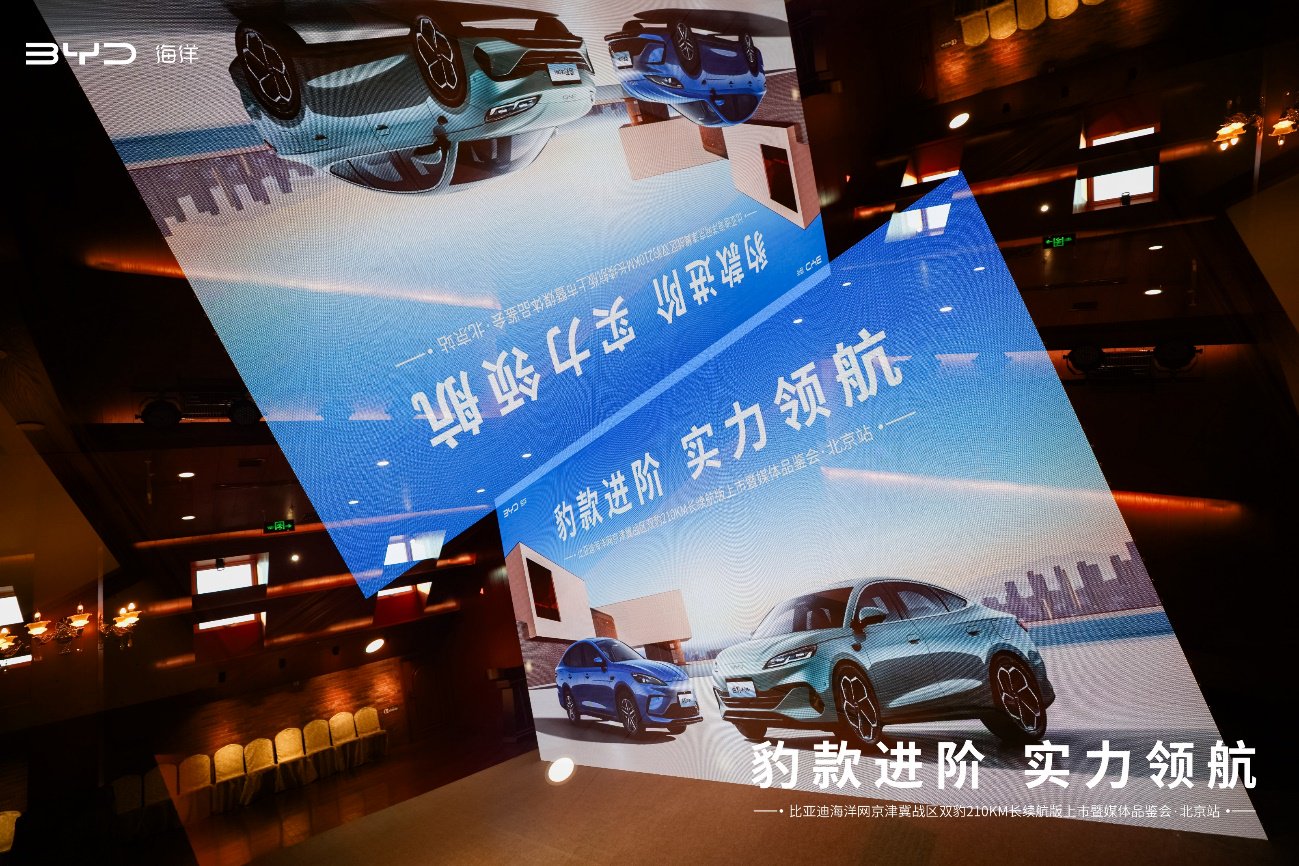
双豹升级 纯电续航210km!比亚迪海洋网2026款海豹05/06DM
Zhong Guo Zhi Liang Xin Wen Wang· 2026-01-26 06:38
Group 1 - BYD Ocean Network launched the 2026 models of Seal 05DM-i and Seal 06DM-i in Beijing, with starting prices of 89,800 yuan and 116,800 yuan respectively, both offering a pure electric range of 210 km [1] - The core purpose of the 210 km pure electric range model is to provide users with a higher value experience, enabling "low cost, zero anxiety" green travel across a wider range of life scenarios, allowing most users to achieve "one charge a week" [3] - The 210 km pure electric range is attributed to improvements in battery energy density and optimization of the vehicle's energy management system, while the lithium iron phosphate battery pack has enhanced safety performance [5] Group 2 - BYD conducted long-distance pure electric road test experiences in low-temperature environments, covering various road conditions, with all test vehicles showing no significant battery depletion [7] - The "Heavenly Eye" intelligent parking experience area attracted significant attention, showcasing complex parking scenarios where users can control the vehicle's parking process via a mobile app, enhancing convenience [9] - The system can currently recognize over 100 parking scenarios and continuously optimizes parking strategies through deep learning, aiming for "everyone can park easily" [11]

思特威(688213):2025年业绩预告点评:营收业绩高增,看好高端产品出货量持续提升
Guohai Securities· 2026-01-26 06:04
Investment Rating - The investment rating for the company is "Buy" (maintained) [1][9] Core Insights - The company is expected to achieve a revenue of 8.8 to 9.2 billion yuan in 2025, representing a year-on-year increase of 47% to 54%, and a net profit attributable to shareholders of 976 million to 1.031 billion yuan, reflecting a year-on-year growth of 149% to 162% [4][5] - The company's revenue growth is driven by significant increases in high-end product shipments across three main sectors: smart security, smartphones, and automotive electronics [5][6] - The company is well-positioned to benefit from ongoing government subsidies for consumer electronics and the expansion of electric vehicle markets in Canada and Germany, which are expected to enhance the demand for its products [6][8] Revenue Performance - The company anticipates a median revenue of 9 billion yuan for 2025, with a year-on-year growth of 51%, and a median net profit of 1.003 billion yuan, with a year-on-year increase of 155% [5] - The expected net profit margin for 2025 is 11.15%, an increase of 4.57 percentage points year-on-year, indicating improved profitability and operational efficiency [5] Product Development and Market Trends - The company has launched several high-end products, including a 50-megapixel camera sensor for smartphones and an 8.3MP automotive-grade CMOS image sensor, which are set to enter mass production in 2026 [6][8] - The company is focusing on enhancing its market share in high-end security and smart home applications, as well as capitalizing on emerging opportunities in machine vision [5][6] Financial Forecast - Revenue projections for 2025, 2026, and 2027 are 90.5 billion, 122.45 billion, and 152.43 billion yuan, respectively, with corresponding year-on-year growth rates of 52%, 35%, and 24% [8] - Net profit forecasts for the same years are 1.003 billion, 1.517 billion, and 1.983 billion yuan, with year-on-year growth rates of 155%, 51%, and 31% [8]

又一国产AI芯片IPO来了!芯片首富虞仁荣参投,估值百亿
Sou Hu Cai Jing· 2026-01-26 05:01
Core Viewpoint - Aixin Yuanzhi, an AI chip unicorn based in Ningbo, Zhejiang, is preparing for its IPO on the Hong Kong Stock Exchange, showcasing its significant growth in the AI chip market and its strategic focus on high-performance AI inference systems for edge computing and terminal devices [2][4]. Company Overview - Aixin Yuanzhi was founded in May 2019 by former CTO of Unisoc, Qiu Xiaoxin, and specializes in AI inference system chips (SoC) [4][17]. - The company has developed five generations of SoCs by September 30, 2025, with over 165 million units delivered, focusing on applications in visual terminal computing, smart vehicles, and edge AI inference [4][30]. Market Position - Aixin Yuanzhi is the largest provider of mid-to-high-end visual edge AI inference chips globally, with a market share of 24.1% in 2024, and ranks fifth in overall visual edge AI inference chips with a 6.8% market share [5][6]. - The company is the second-largest domestic supplier of smart driving SoCs in China, having sold over 518,000 units, and ranks third in edge AI inference chips with a 12.2% market share [5][7]. Financial Performance - Revenue figures for Aixin Yuanzhi from 2022 to the first nine months of 2025 are as follows: 0.50 billion, 2.30 billion, 4.73 billion, and 2.69 billion RMB, respectively. Net profits during the same period were -6.12 billion, -7.43 billion, -9.04 billion, and -8.56 billion RMB [7][10]. - The adjusted net profits were -4.44 billion, -5.42 billion, -6.28 billion, and -4.62 billion RMB, totaling -20.76 billion RMB [10]. Research and Development - Aixin Yuanzhi invests heavily in R&D, with expenses of 4.46 billion, 5.15 billion, and 6.28 billion RMB in 2022, 2023, and 2024, respectively [7][12]. - As of September 30, 2025, the company employed 499 R&D personnel, accounting for approximately 80% of its total workforce, with over half holding master's degrees or higher [38][39]. Product Development - The company has launched several SoC series, including the AX520, AX620, AX630, AX650, and M55H, with applications in smart vehicles and edge AI inference [31][34]. - Aixin Yuanzhi's core technology includes the Axera Neutron NPU and Axera Proton AI-ISP, which enhance AI inference performance and image processing capabilities [35][37]. Sales and Distribution - The majority of Aixin Yuanzhi's revenue comes from direct sales and distribution, with significant contributions from major clients, accounting for 91.5% of total revenue in 2022 [40][41]. - The company anticipates continued growth in its smart vehicle and edge computing SoC sales, with substantial year-on-year increases projected [27][34].
东吴证券:首予希迪智驾“买入”评级 深耕无人矿卡的智能驾驶平台型企业
Zhi Tong Cai Jing· 2026-01-26 02:59
Group 1 - The core viewpoint of the report is that Xidi Zhijia (03881) is rated as "Buy" by Dongwu Securities, with expected revenue growth driven by the increasing orders for unmanned mining trucks, leading to a turnaround in net profit [1] - The company is a leading intelligent driving technology platform focused on unmanned mining trucks, founded in 2017 by Professor Li Zeshang, known as the "father of DJI" [1] - Revenue projections for the company from 2025 to 2027 are 1.078 billion yuan, 2 billion yuan, and 4.05 billion yuan, representing year-on-year increases of 162.90%, 85.53%, and 102.47% respectively [1] Group 2 - The company provides a comprehensive solution for unmanned mining, integrating intelligent driving and V2X technologies, which can be promoted to other application scenarios [2] - Following the mining accident in Inner Mongolia in 2023, national policies are pushing for automation in mining, with a target for 60% of coal mining capacity to be intelligent by 2026, benefiting the company as a leading supplier [2] - The Chinese smart driving commercial vehicle market is expected to reach 4.8 billion yuan by 2024 and grow to 774.3 billion yuan by 2030, driven by favorable policies and continuous technological advancements [2] Group 3 - The company is a domestic leader in V2X intelligent transportation solutions, utilizing advanced perception technology and algorithms for traffic optimization [3] - The V2X solutions enable information exchange between traffic participants and urban infrastructure, facilitating intelligent traffic prediction and decision-making [3] - The V2X market in China is projected to reach 2 billion yuan by 2024, with a compound annual growth rate of 50.9% from 2024 to 2030, indicating rapid growth in the coming years [3]
