
未来产业

Search documents
「十五五」时期重点产业前瞻与发展路径研究丨36氪研究院
36氪· 2025-12-31 00:14
Core Insights - The "14th Five-Year Plan" period prioritizes the construction of a modern industrial system, marking a strategic shift from single-point technological breakthroughs to systematic industrial upgrades [6][19]. - The new energy industry is transitioning from a focus on installed capacity to building a "source-grid-load-storage" collaborative system, emphasizing dynamic balance between production and consumption [7]. - The aerospace sector is developing a dual-driven model of national engineering and commercial space, with large aircraft industrialization and commercial space driving the scale and capability of the industry chain [8]. - Future industries such as 6G and quantum technology place China in the global leading tier of R&D, aiming to seize the high ground in technology standards and industrial ecosystems through forward-looking layouts [9]. - The transformation of traditional industries emphasizes not only greening and intelligentization but also explicitly promotes "service-oriented manufacturing," guiding the manufacturing sector to extend services throughout the product lifecycle [10]. Group 1: Modern Industrial System - The construction of a modern industrial system is the primary task of the "14th Five-Year Plan," highlighting its core position as a foundation for new era development [19][20]. - The modern industrial system consists of three parts: upgrading traditional industries, developing emerging pillar industries, and strategically laying out future industries [20]. Group 2: Emerging Pillar Industries - The cultivation of emerging pillar industries is positioned as the strategic core of the modern industrial system, providing a strong new growth engine for high-quality development [23]. - Key emerging pillar industries include new energy, new materials, aerospace, and low-altitude economy, which are expected to drive explosive growth in multiple trillion-level markets [23]. Group 3: New Energy - The new energy sector has evolved into a comprehensive ecosystem encompassing "production, storage, transmission, and application," with a strategic significance in ensuring national energy security and achieving carbon neutrality [24]. - As of the end of 2024, China's cumulative installed capacity of new energy reached 1.41 billion kilowatts, maintaining a global leading position [25]. - The annual new installed capacity during the "14th Five-Year Plan" period is expected to remain around 30 million kilowatts [25]. Group 4: New Materials - The new materials industry in China has rapidly grown, with total output value exceeding 8 trillion yuan in 2024, but still faces structural challenges with about 30% of key high-end materials relying on imports [34]. - Significant breakthroughs are being made in various fields, including third-generation semiconductor materials and high-end alloys for aerospace applications [39]. Group 5: Aerospace - The aerospace sector has formed a dual-driven model of national major projects and commercial markets, with the C919 large aircraft and commercial space rapidly developing [42]. - The market size of China's aerospace manufacturing industry is expected to reach 601.7 billion yuan by 2025, with a compound annual growth rate of approximately 14.05% [42]. Group 6: Low-altitude Economy - The low-altitude economy, driven by various manned and unmanned aerial vehicles, is expected to reach a scale of 505.95 billion yuan in 2023, with a year-on-year growth of 33.8% [50]. - The market is projected to exceed 1 trillion yuan by 2026, with a compound annual growth rate of approximately 29.6% from 2021 to 2026 [50]. Group 7: Future Industries - Future industries represent cutting-edge technological and industrial development directions, including quantum technology, biomanufacturing, hydrogen energy, and brain-computer interfaces [61]. - The quantum technology sector is expected to grow significantly, with the industry scale projected to reach approximately 80 billion USD by 2024 and potentially near 1 trillion USD by 2035 [64].


创新为锚 智造为帆 新兴产业“未来已来” 中国科技创新如何“惊艳”世界
2 1 Shi Ji Jing Ji Bao Dao· 2025-12-30 23:14
Core Viewpoint - The article emphasizes the importance of innovation in driving China's economic transformation, highlighting the strategic focus on building a modern industrial system and fostering emerging and future industries as outlined in the "14th Five-Year Plan" [1] Group 1: Economic Transformation - China's economic transformation is marked by a shift from traditional growth drivers to the rapid rise of emerging and future industries, aligning with the strategic direction of the "14th Five-Year Plan" [1] - The emergence of strategic emerging industries and future industries is creating new growth poles, supported by increased R&D investment and technological breakthroughs [1] Group 2: Global Competitiveness - Continuous technological advancements and industrial upgrades are reshaping China's core competitiveness in the global market [1] - The focus on innovation as a core driver is positioning China to capture a higher status within global industrial and value chains, contributing to sustained economic growth [1]
2025安徽资本市场大事记:从拿下“开门红”到跨境上市 186家上市公司数量稳居中部第一
Mei Ri Jing Ji Xin Wen· 2025-12-30 15:03
Group 1 - In 2025, Anhui's capital market achieved significant milestones, including successful listings and innovative policies, contributing to a vibrant investment environment [1] - The first company to list in 2025 was Star Map Measurement and Control Technology Co., which became the first new listing on the Beijing Stock Exchange and the first commercial aerospace stock [2] - Anhui was the first in the country to implement "Ten Measures for Market Value Management," leading to several companies announcing share buybacks and increases in holdings [3] Group 2 - From January to August 2025, Anhui's listed companies raised 12.599 billion yuan through refinancing, marking a 196% increase year-on-year, the highest in three years [4] - Chery Automobile successfully listed on the Hong Kong Stock Exchange, achieving a market capitalization exceeding 200 billion HKD on its first trading day [5] - Fulede completed a record 7.33 billion yuan refinancing project, the largest in Anhui's history, to enhance its competitiveness in the semiconductor equipment sector [6] Group 3 - Anhui's first "New Third Board + H-share" company, Anhui Jinyan Kaolin New Materials Co., was listed on the Hong Kong Stock Exchange, enhancing cross-border capital operations for resource-based enterprises [7] - The number of listed companies in Anhui reached 186, ranking first in Central China and seventh nationwide, with a nearly 50% increase since the end of the 13th Five-Year Plan [8] - The "15th Five-Year Plan" outlines a forward-looking layout for future industries, focusing on emerging technologies and establishing mechanisms for investment growth and risk sharing [9] Group 4 - The capital market in Anhui showed active performance, with nearly 20 stocks doubling in price by the end of 2025, indicating strong market vitality [10] - Anhui's business environment optimization score ranked third nationally, alongside Guangdong, reflecting ongoing efforts to improve the investment climate [11]
年度记忆|“未来之城”的多元魅力
Bei Jing Ri Bao Ke Hu Duan· 2025-12-30 11:44
Core Viewpoint - Xiong'an New Area is rapidly developing as a model for high-quality urban development in China, with significant investments and growth in GDP, showcasing its strategic importance and innovative potential [1][23]. Investment and Economic Growth - Since the 14th Five-Year Plan, Xiong'an New Area has maintained an annual investment scale of 200 billion yuan, with an average annual GDP growth rate of 17.1% [1]. - The area serves as a concentrated hub for the relocation of non-capital functions from Beijing and aims to set a national standard for high-quality development [1]. Infrastructure and Urban Development - The Xiong'an New Area's startup zone covers 38 square kilometers and is crucial for the implementation of the first batch of Beijing's non-capital function relocation projects [3]. - Key infrastructure includes the China Sinochem Building, which serves as the headquarters for China Sinochem Holdings, and the China Star Network headquarters, the first central enterprise registered in Xiong'an [5][6]. - The Xiong'an City Computing Center, known as the "city brain," integrates operational data for the entire city [30]. Ecological and Smart City Initiatives - Xiong'an prioritizes ecological value in its development, integrating green spaces and water bodies into urban planning, exemplified by the "Thousand-Year Show Forest" and Baiyangdian Lake [14]. - The area is advancing smart city technologies, including underground utility tunnels for essential services and intelligent traffic systems with smart poles and autonomous vehicles [31][38]. Community and Social Development - Xiong'an is enhancing community engagement in urban governance, ensuring that 169,000 relocated residents and 37,900 new residents have access to quality living conditions [39]. - The area is focused on creating a high-quality living environment, with facilities such as smart dining halls and community centers [40][41]. Innovation and Future Industries - Xiong'an is positioning itself as a hub for future industries, with initiatives to foster innovation and entrepreneurship, including the establishment of over 200 tech companies in the Zhongguancun Science Park [28]. - The first "Xiong'an-made" satellite is set to be produced, marking a significant milestone in the commercial satellite manufacturing industry [25][26].
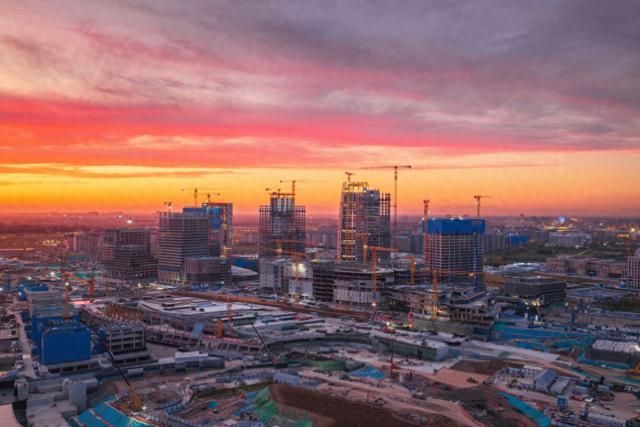
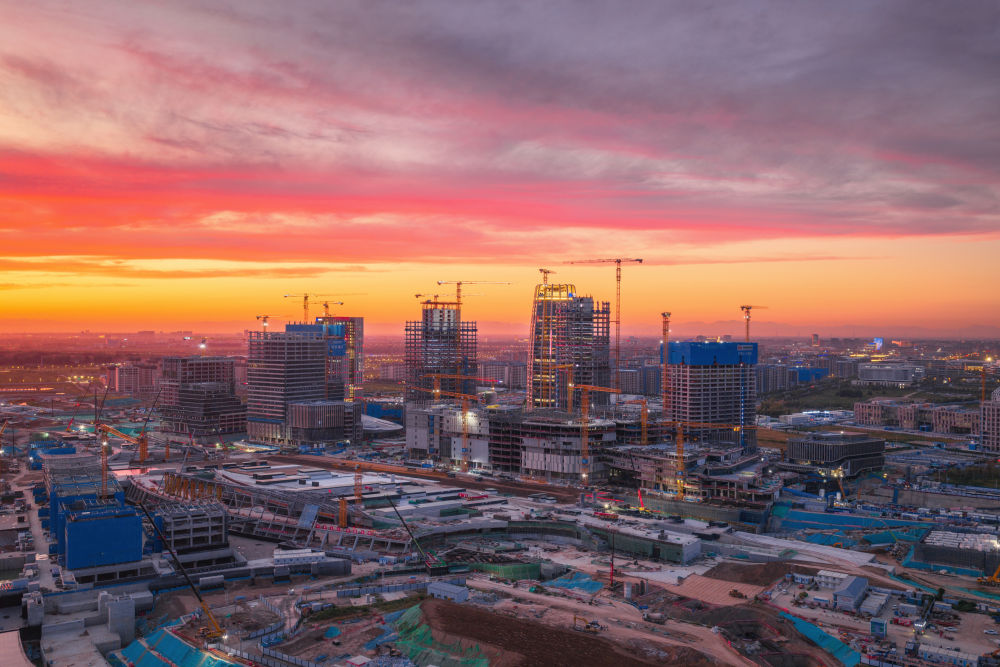
新华社出图·年度记忆|“未来之城”的多元魅力
Xin Hua She· 2025-12-30 07:33
Core Viewpoint - Xiong'an New Area is rapidly developing into a model for high-quality urban development, showcasing significant investment and growth since its establishment, with a focus on innovation and ecological sustainability [2][25][49] Investment and Economic Growth - Since the 14th Five-Year Plan, Xiong'an New Area has maintained an annual investment scale of 200 billion yuan, with an average annual GDP growth rate of 17.1% [2] - The area serves as a concentrated hub for the relocation of non-capital functions from Beijing and aims to set a national standard for high-quality development [2] Infrastructure and Urban Development - The Xiong'an New Area's startup zone covers an area of 38 square kilometers and is crucial for the initial implementation of high-end innovation resources and the first batch of Beijing's non-capital function relocation projects [5] - Key infrastructure includes the Beijing-Xiong'an Expressway, which will reduce travel time from Beijing to Xiong'an to approximately one hour by the end of December 2023 [14] Ecological and Smart City Initiatives - Xiong'an prioritizes ecological value over urban development, integrating green landscapes and water features into its urban planning [17] - The area is equipped with advanced smart city technologies, including underground utility tunnels and intelligent traffic systems, enhancing urban safety and efficiency [34][41] Innovation and Future Industries - Xiong'an is positioning itself as a hub for future industries, with over 200 technology companies established in the Zhongguancun Science Park within the area [27] - The first "Xiong'an-made" satellite is set to be produced, showcasing the area's capabilities in satellite manufacturing and space technology [29] Community and Quality of Life - Xiong'an is committed to improving the quality of life for its residents, with 169,000 relocated residents and 37,900 new residents benefiting from enhanced living conditions and community services [42] - The area features various community facilities, including smart dining halls and recreational centers, promoting a high-quality lifestyle for its inhabitants [44][45]
多地积极培育未来产业 10只概念股筹码集中
Zheng Quan Shi Bao Wang· 2025-12-30 00:23
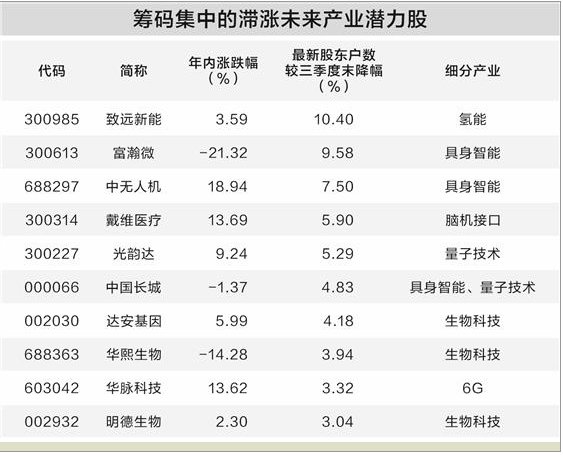
Core Insights - The article highlights the growing focus on future industries in China, as emphasized in the "14th Five-Year Plan," which aims to cultivate and expand emerging industries and future sectors [1] - It discusses the importance of exploring diverse technological routes, typical application scenarios, feasible business models, and market regulatory rules to drive economic growth through sectors like quantum technology, biomanufacturing, hydrogen energy, nuclear fusion, brain-computer interfaces, embodied intelligence, and 6G mobile communication [1] Group 1: Market Trends - The article notes that over 381 concept stocks have seen a decline in shareholder numbers compared to the end of Q3, with more than 40 companies experiencing a decrease, and 27 companies showing a decline exceeding 3% [1] - 福晶科技 (Fujing Technology) has seen a significant drop in shareholder numbers, with a decrease of nearly 26% compared to the end of Q3 [1] Group 2: Investment Opportunities - Among the 27 companies with a shareholder decline over 3%, only 10 companies have recorded a year-to-date increase of less than 19%, indicating potential for price recovery in the future industry sector [1] - The table lists several companies with their respective year-to-date performance and shareholder decline percentages, highlighting potential stocks for future investment, such as 致远新能 (Zhiyuan New Energy) with a 3.59% increase and a 10.40% decline in shareholder numbers [2]



创投“国家队”亮相 新兴产业和未来产业迎利好
Zhong Guo Qing Nian Bao· 2025-12-30 00:00
Core Viewpoint - The National Venture Capital Guidance Fund has officially launched, marking a significant milestone for the venture capital industry in China, aimed at supporting technological innovation and development in key sectors [1][2]. Group 1: Fund Structure and Investment Strategy - The National Venture Capital Guidance Fund is established with a three-tier structure: "Fund Company - Regional Fund - Sub-Fund," which aligns national strategies while considering regional industrial characteristics [2]. - The fund will utilize 100 billion yuan from special long-term government bonds, encouraging social capital participation at the regional fund and sub-fund levels [2]. - The fund focuses on early-stage, small, long-term investments in hard technology, targeting strategic emerging industries and future industries as outlined in the 14th Five-Year Plan [1][5]. Group 2: Regional Funds and Investment Intentions - Three regional funds have been established: Beijing-Tianjin-Hebei Venture Capital Guidance Fund, Yangtze River Delta Venture Capital Guidance Fund, and Guangdong-Hong Kong-Macau Greater Bay Area Venture Capital Guidance Fund, each with a total scale exceeding 50 billion yuan [3]. - The regional funds have signed investment intentions with 49 sub-funds and 27 direct investment projects, indicating readiness for operational investment [3]. Group 3: Market Impact and Trends - The venture capital market in China is showing signs of recovery, with a reported 18.3% increase in the number of newly raised funds and an 8.0% increase in total fundraising scale in the first three quarters of 2025 [3]. - Key investment areas include IT, semiconductors, biotechnology/healthcare, and mechanical manufacturing, reflecting a focus on hard technology sectors [3]. Group 4: Role of the Guidance Fund - The National Venture Capital Guidance Fund aims to address the long-term capital shortage in the venture capital industry by acting as an "angel investor" to support early-stage innovative enterprises [5]. - The fund will complement existing funds focused on growth-stage cultivation and technology transfer, avoiding redundancy in the market [5]. Group 5: Performance Management and Regulatory Framework - The Ministry of Finance will actively fulfill its responsibilities as a state investor, focusing on performance evaluation and compliance of the guidance fund [6]. - A comprehensive risk prevention system covering the entire lifecycle of the fund will be established to enhance the effectiveness of fund utilization [6].
蓄力破局量子科技迎接产业化关键一跃
Zhong Guo Zheng Quan Bao· 2025-12-29 21:13
Core Insights - Quantum technology is positioned as a key driver of future industries in China's 14th and 15th Five-Year Plans, indicating a strategic focus on its industrialization and application [1][2] - The global competition in quantum technology is intensifying, with major countries like the US, UK, and Canada significantly increasing their investments and policy support to secure leadership in this field [2][3] Investment and Funding - The US plans to increase quantum research funding from $1.8 billion to $2.7 billion for the fiscal years 2025-2029, emphasizing practical application development [2] - The UK has allocated £10.13 billion for quantum technology over the next four years, building on previous investments exceeding £1 billion since 2014 [3] - Canada has initiated the "Canadian Quantum Champions Program" with an investment of CAD 92 million to support local quantum computing firms [3] Technological Advancements - China has made significant strides in quantum communication and computing, achieving a leading position globally with projects like the "Micius" satellite and the "Zuchongzhi" superconducting quantum computer [3][4] - Quantum precision measurement is entering the commercialization phase, with the cold atom quantum gravity meter being a notable example of practical application [5][6] Market Potential - The global quantum computing market is projected to exceed $800 billion by 2035, driven by advancements in quantum technology and its integration with artificial intelligence [6] - The development of specialized quantum computers is progressing, with companies like Boson Quantum delivering the first 1000-qubit coherent optical quantum computer [6] Challenges and Bottlenecks - The industry faces challenges such as a shortage of skilled talent, insufficient application scenarios, and limited developer scale, which hinder the acceleration of quantum technology commercialization [7][8] - The lack of downstream companies for algorithm development and application exploration is a significant barrier to creating a positive feedback loop for technology iteration [8] Ecosystem Development - The successful industrialization of quantum technology requires a collaborative ecosystem that fosters innovation and addresses market needs, emphasizing the importance of patience and strategic investment in talent and infrastructure [8]
最具前景十大未来产业赛道分析
Sou Hu Cai Jing· 2025-12-29 20:22
Competitive Landscape - The global landscape is characterized by a "leading countries leading, catching-up countries accelerating" pattern, with the US, Europe, Japan, and South Korea innovating through legislation, subsidies, standards, and talent in advanced manufacturing, AI, quantum technology, and next-generation communications [1] - McKinsey predicts that AI alone could contribute $25.6 trillion to the global economy by 2030, equivalent to 8% of global GDP [1] - GVR forecasts a compound annual growth rate (CAGR) of over 21% for humanoid robots from 2023 to 2030 [1] - China is at a critical window for economic transformation, with over 30 provincial-level regions actively implementing future industry policies, marking the start of a comprehensive "top-level strategy + local pilot" approach [1] Development Significance - Future industries are seen as the "main battlefield" for global value chain restructuring and a "first-mover advantage" in cultivating new productive forces and long-term competitive advantages [5] - These industries are characterized by disruptive technological breakthroughs and cross-industry integration, capable of upgrading traditional industries and creating entirely new business models [5] Domestic and International Landscape Overview International Layout - Quantum Technology: Focus on quantum communication, computing, encryption, internet, and sensors across the US, Europe, and Japan [7] - Artificial Intelligence: Common hotspots include brain-like intelligence, small data, next-generation cloud computing, human-computer interaction, and ethical-legal-social issues [7] - Advanced Networks and Communications: Progress in 6G, next-generation wireless networks, secure redundant communications, blockchain, and satellite internet [7] - Hydrogen and Energy Storage: Parallel development of green hydrogen, blue hydrogen, ammonia energy, smart grids, and various energy storage technologies [7] - Biotechnology: Rapid industrialization in precision medicine, gene therapy, synthetic biology, and intelligent biological manufacturing [7] Domestic Layout - The "14th Five-Year Plan" and the 2035 vision outline six major directions for future industries: brain-like intelligence, quantum information, gene technology, future networks, deep-sea and aerospace development, and hydrogen and energy storage [9] - The Ministry of Industry and Information Technology and other departments have detailed six fields for future industry innovation: future manufacturing, future information, future materials, future energy, future space, and future health [9] Key Provincial Investments - Beijing: Focus on six major directions with a target of a 3 trillion yuan AI industry scale and a 10 trillion yuan radiation effect [11] - Shanghai: Utilizing "Mosu Space" to gather over 100 large model enterprises and support more than 200 AI companies [12] Research Institutions Highlights - The Chinese Academy of Engineering has identified key areas such as intelligent manufacturing, additive manufacturing, micro-nano manufacturing, and humanoid robots [13] - Various institutions provide multi-dimensional validation on track potential, regional indices, technological trends, and global rankings [13] Ten Key Tracks for Future Industries - The Future Industry Research Center has proposed ten key tracks for 2025, including general artificial intelligence, humanoid robots, cell and gene therapy, commercial aerospace, high-level autonomous driving, new energy storage, clean hydrogen, low-altitude economy, computing chips, and the metaverse [15] Track 1: General Artificial Intelligence - The global landscape shows the US leading while China accelerates, with major players like OpenAI, Anthropic, and Baidu making significant advancements [17] - Beijing and Shanghai have set ambitious targets for AI industry scale and support across various dimensions [17] Track 2: High-Level Autonomous Driving - Diverse technological routes are being pursued by companies like Tesla, Waymo, and Baidu, with significant testing and operational milestones achieved [20][21] Track 3: Commercial Aerospace - Major players like SpaceX and Blue Origin are shaping a global landscape, while China is developing its own capabilities with ambitious industry targets [22][23] Track 4: Humanoid Robots - The industry is concentrated in regions like the Yangtze River Delta, with significant advancements in product capabilities and market potential [24][25] Track 5: New Energy Storage - The global new energy storage capacity is projected to grow significantly, with various technologies being developed and cost reductions anticipated [26] Track 6: Low Altitude Economy - The low-altitude economy is emerging with a focus on eVTOL and drones, supported by numerous policies and technological advancements [27] Track 7: Clean Hydrogen - The clean hydrogen sector is evolving with significant production capacity expected from China, the US, and Europe [28] Track 8: Computing Chips - The AI chip market is experiencing explosive demand, with various architectures competing and significant growth projected [29][30] Track 9: Cell and Gene Therapy - Major international and domestic players are advancing in gene therapy, with significant market growth anticipated in China [31][32] Track 10: Metaverse - The metaverse is developing with key players in both Silicon Valley and Beijing, supported by a robust policy framework [33][34] Conclusion - Future industries are not merely linear extensions of single technologies but represent a systemic engineering approach involving scientific discovery, technological invention, industrial transformation, and ecological reconstruction [35]

多地积极培育未来产业 10只潜力股浮现
Zheng Quan Shi Bao· 2025-12-29 19:15
Group 1 - The core focus of the news is on the development and support of future industries in China, as highlighted by the "14th Five-Year Plan" which emphasizes nurturing emerging industries and exploring diverse technological routes and business models [3] - Various cities, including Beijing, Shenzhen, and Shanghai, are actively promoting future industries through initiatives and financial measures, with Beijing supporting 83 potential future industry companies and facilitating over 2 billion yuan in financing for 60 companies [4][5] - The future industries mentioned have significantly outperformed the market, with specific indices showing substantial annual growth, such as the nuclear fusion index rising over 83% and the 6G index increasing by more than 80% [5] Group 2 - Future industries are characterized by strong growth momentum, driven by disruptive technologies, with a projected median net profit of over 650 billion yuan for related companies by 2025, indicating a year-on-year growth of over 20% [6] - Specific companies within the future industries are expected to see remarkable profit increases, with over 60 companies projected to achieve net profit growth exceeding 100% by 2025, including notable firms like Foton Motor and Sino Medical [6][7] - A subset of companies has shown a decrease in shareholder numbers, indicating potential for price recovery, with 10 companies identified as having significant rebound potential due to their stock performance being below 19% for the year [8][9]
