人民币国际化

Search documents
2026年中国人民银行上海总部工作会议:健全系统性金融风险防范处置机制
Zhong Guo Jing Ying Bao· 2026-01-13 03:11
Core Viewpoint - The People's Bank of China (PBOC) has outlined key priorities for 2026, focusing on strict governance, monetary policy, financial services, reform, risk management, and enhancing financial capabilities [2][3]. Group 1: Governance and Policy - The PBOC emphasizes the importance of strict party governance, prioritizing the study and implementation of Xi Jinping's important speeches and directives as a political task [2]. - Continuous efforts will be made to strengthen grassroots party building and enhance the construction of the cadre team, with a firm stance against corruption [2]. Group 2: Monetary Policy - The PBOC aims to implement a moderately loose monetary policy, guiding financial institutions to achieve reasonable loan growth and maintain low social financing costs [2]. - Policies supporting agriculture and small enterprises will be effectively utilized, alongside innovative tools for financial management [2]. Group 3: Financial Services - The establishment of a comprehensive financial service system covering the entire lifecycle of technology enterprises is a priority [2]. - The PBOC will promote the efficient implementation of green finance standards and enhance financial services for small and micro enterprises, as well as support rural revitalization [2]. Group 4: Financial Reform and Opening Up - The PBOC will collaborate with the central bank to advance offshore financial development in Shanghai and expand pilot reforms in the Lingang New Area [2]. - Efforts will be made to promote the internationalization of the Renminbi and implement foreign exchange management reform pilot policies [2]. Group 5: Risk Management - The PBOC is focused on improving mechanisms for preventing and resolving systemic financial risks and enhancing the macro-prudential management framework [3]. - Continuous actions will be taken to combat illegal activities in the foreign exchange sector [3]. Group 6: Financial Management and Services Enhancement - The PBOC will work on improving payment convenience and steadily develop digital currency [3]. - Optimization of tax refund services for outbound travelers and cash circulation environments will be prioritized [3].
【高端访谈】以金融之力服务国家发展大局—访中银香港总裁孙煜
Zhong Guo Jin Rong Xin Xi Wang· 2026-01-13 02:46
Core Viewpoint - Hong Kong is positioned as a key player in the financial sector, leveraging its unique advantages to support national strategies and enhance its role as an international financial center [1][2]. Group 1: Hong Kong's Financial Position - Hong Kong is currently the largest offshore RMB business hub, the second-largest cross-border wealth management center, the third-largest exchange-traded products market, the fourth-largest foreign exchange market, and the fifth-largest capital market globally [2]. - The core competitiveness of Hong Kong's international financial center stems from its connection to the mainland, its integration with international standards, and its unique institutional advantages under the "One Country, Two Systems" framework [2][3]. Group 2: Future Development Directions - The financial industry in Hong Kong should proactively align with national development strategies, aiming to establish itself as a crucial source for enhancing the financial power of the nation [2]. - There is a focus on developing offshore RMB business as a key driver for Hong Kong's financial center, enhancing financial infrastructure, product services, currency cooperation, and risk management [2][4]. Group 3: IPO Market Recovery - The Hong Kong IPO market has shown significant recovery, highlighting its role as a vibrant financial market [3]. - This recovery is characterized by three aspects: the increasing role of Hong Kong as an international financing platform for A+H companies, improved inclusivity and efficiency for new economy enterprises, and heightened foreign investment participation [3]. Group 4: Cross-Border Financial Hub - With the acceleration of mainland enterprises going global, Hong Kong is positioned as a "super connector" to facilitate cross-border investments [4]. - Financial institutions in Hong Kong are encouraged to develop a comprehensive service system to support outbound investments, enhancing operational efficiency and risk management for enterprises [4][5]. Group 5: Regional Collaboration and Market Integration - Hong Kong has established various capital market connectivity mechanisms with the mainland and Southeast Asia, facilitating efficient investment channels [6]. - The evolving global economic landscape presents strategic opportunities for capital market integration among the mainland, Hong Kong, and Southeast Asia, driven by new trade agreements and collaborative economic initiatives [6].



债市早报:资金面有所收敛;配置盘进场加力,债市走强
Sou Hu Cai Jing· 2026-01-13 02:46
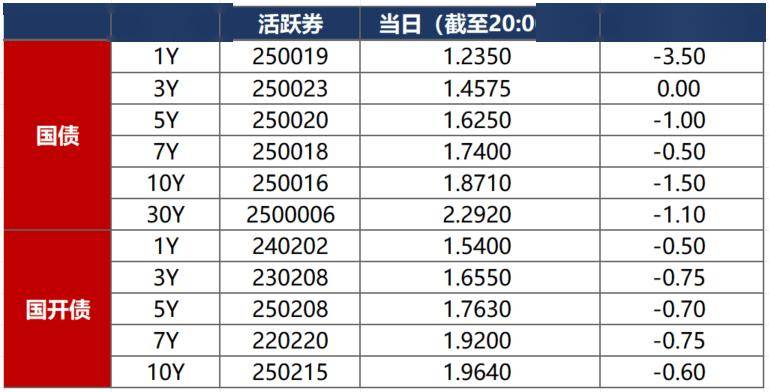
Core Viewpoint - The financial market shows signs of tightening with rising repo rates, while the bond market strengthens due to increased buying activity, and convertible bonds also see collective gains. Group 1: Domestic News - The National Development and Reform Commission, along with three other departments, has issued guidelines to enhance the planning and direction of government investment funds, marking the first systematic regulation at the national level [2]. - The People's Bank of China held a work meeting focusing on six key areas for 2026, including financial reform, offshore financial services, and promoting the internationalization of the Renminbi [2]. Group 2: International News - President Trump announced a 25% tariff on any country conducting business with Iran, effective immediately, which led to a short-term increase in international oil prices [3]. - Brent crude oil futures rose over 1.4% to $64.23 per barrel, while WTI crude oil futures increased by 1.27% to $59.69 per barrel following the announcement [3]. Group 3: Commodity Market - On January 12, WTI crude oil futures closed up by $0.38, a 0.64% increase, at $59.50 per barrel, while Brent crude oil futures rose by $1.35, a 0.84% increase, to $63.87 per barrel [4]. Group 4: Financial Market Operations - The People's Bank of China conducted a 7-day reverse repo operation of 861 billion yuan at a fixed rate of 1.40%, resulting in a net injection of 361 billion yuan after accounting for maturing repos [5]. - Major repo rates increased, with DR001 rising by 5.43 basis points to 1.327% and DR007 increasing by 1.75 basis points to 1.490% [6]. Group 5: Bond Market Dynamics - The bond market strengthened as the 10-year government bond yield approached 1.90%, prompting increased buying activity [7]. - As of January 12, the yield on the 10-year government bond (active bond 250016) decreased by 1.50 basis points to 1.8710%, while the 10-year policy bank bond (active bond 250215) fell by 0.60 basis points to 1.9640% [7][8]. Group 6: Credit Bonds - On January 12, four industrial bonds experienced significant price deviations, with "H1碧地01" dropping over 98% and "H1碧地02" increasing over 360% [9]. - Companies such as Hejia Holdings and Shanxi Coal Group reported financial difficulties, including loan defaults and overdue payments [10][13]. Group 7: Convertible Bonds - The convertible bond market saw collective gains, with major indices rising by 1.37% for both the CSI Convertible Bond Index and the Shanghai Convertible Bond Index [15]. - The trading volume in the convertible bond market reached 108.47 billion yuan, an increase of 6.595 billion yuan from the previous trading day [15].
数字人民币钱包应接入应用场景
Sou Hu Cai Jing· 2026-01-12 23:16
数字人民币1.0版本局限于线上支付功能。 数字人民币2.0版本来了!日前中国人民银行发布《关于进一步加强数字人民币管理服务体系和相关金 融基础设施建设的行动方案》,称今年1月1日起正式启动实施新一代数字人民币计量框架、管理体系、 运行机制和生态体系。数字人民币推行10年后,迈向"新纪元"。 值得一提的是,新版数字人民币不再局限于移动支付功能,而是能像活期存款一样计息,同时无需网络 也能完成支付。 数字人民币是中国人民银行发行的数字形式的法定货币。 正如一位银行工作人员所说:"由于微信、支付宝的用户黏性强,导致数字人民币一直没有得到全面推 广。"那么,这次升级换代后的数字人民币能否得到更进一步的推广? 利好 余额能计付利息 提现无需手续费 据权威消息,数字人民币是中国人民银行发行的数字形式的法定货币,由指定运营机构参与运营,以广 义账户体系为基础,支持银行账户松耦合功能,与实物人民币等价,具有价值特征和法偿性。 和数字人民币1.0版本相比,对于普通消费者,数字人民币2.0有以下几点优势:首先,数字人民币钱包 余额能计付利息。日前,中国工商银行、中国建设银行、中国农业银行、中国银行、中国邮政储蓄银 行、交通银行、 ...


人民银行上海总部:持续推进人民币国际化
Xin Lang Cai Jing· 2026-01-12 21:04
Core Viewpoint - The People's Bank of China (PBOC) Shanghai Headquarters has outlined its commitment to maintaining a moderately accommodative monetary policy and enhancing financial reforms and higher-level opening-up to support the development of Shanghai as an international financial center, aiming for a strong start to the 14th Five-Year Plan [1] Group 1: Key Work Focus for 2026 - The first focus is to persistently advance strict governance of the Party, enhancing grassroots party building and reinforcing the construction of the cadre team while combating corruption [2] - The second focus is on effectively implementing a moderately accommodative monetary policy, guiding financial institutions to achieve reasonable loan growth and balanced distribution, and promoting low financing costs [2] - The third focus is to deepen the "five major articles" of finance, establishing a comprehensive financial service system for technology enterprises, promoting green finance standards, and enhancing financial services for small and micro enterprises [2] - The fourth focus is on advancing financial reform and opening up, supporting offshore financial development in Shanghai, promoting the internationalization of the Renminbi, and implementing foreign exchange management reforms [2] - The fifth focus is to enhance financial management and service capabilities, improving payment convenience, developing digital currency, and optimizing cash circulation [2] - The sixth focus is on continuously preventing and mitigating risks in key areas, improving systemic financial risk prevention mechanisms, and combating illegal activities in the foreign exchange sector [3]
践行金融报国使命 构建一流投行新格局
Zhong Guo Zheng Quan Bao· 2026-01-12 20:45
Core Viewpoint - China Galaxy Securities has achieved record total assets and net profit, positioning itself among the top tier in the industry, reflecting its commitment to national strategies and reform initiatives [1] Group 1: Five Core Elements for Development - Functionality is the core orientation, emphasizing the alignment of financial services with national development, focusing on technology finance, green finance, inclusive finance, pension finance, and digital finance [2] - Professional capability is fundamental, requiring securities firms to provide specialized solutions to meet diverse financial needs, thereby enhancing long-term client trust [2] - Internationalization is essential for differentiation and responding to national strategies, with a focus on global market integration and cross-border financial services [3] - Risk management is a safety baseline, necessitating a comprehensive risk management system to ensure high-quality development and prevent systemic financial risks [3] - Cultural construction is the spiritual core, promoting human capital investment and enhancing industry culture to foster a cohesive development force [4] Group 2: Practical Implementation and Achievements - China Galaxy Securities adheres to the principle of "financial patriotism" and aims to rank among the top five in key operational indicators by 2025, showcasing its commitment to national strategies [5] - In technology finance, the company has facilitated significant projects, including a major asset purchase and strategic financing for electric vehicle companies [5] - In green finance, it has created innovative financial products to address carbon tariffs and support carbon neutrality goals [6] - In inclusive finance, the company has served over 19 million clients and developed successful poverty alleviation projects [6] - In pension finance, it leads in personal pension account openings and product sales, establishing a comprehensive pension service ecosystem [6] - In digital finance, it has engaged in significant research and development initiatives, including the use of digital currency for investment [6] Group 3: Future Development Directions - The company emphasizes the integration of party leadership with corporate governance to ensure alignment with national policies and enhance talent development [8] - It aims to deepen reforms to stimulate new growth, focusing on optimizing business structures and enhancing international revenue contributions [9] - The company seeks to take a leading role in financial service cooperation, promote fair competition standards, and enhance international market connectivity [10]
货币市场日报:1月12日
Xin Hua Cai Jing· 2026-01-12 16:58
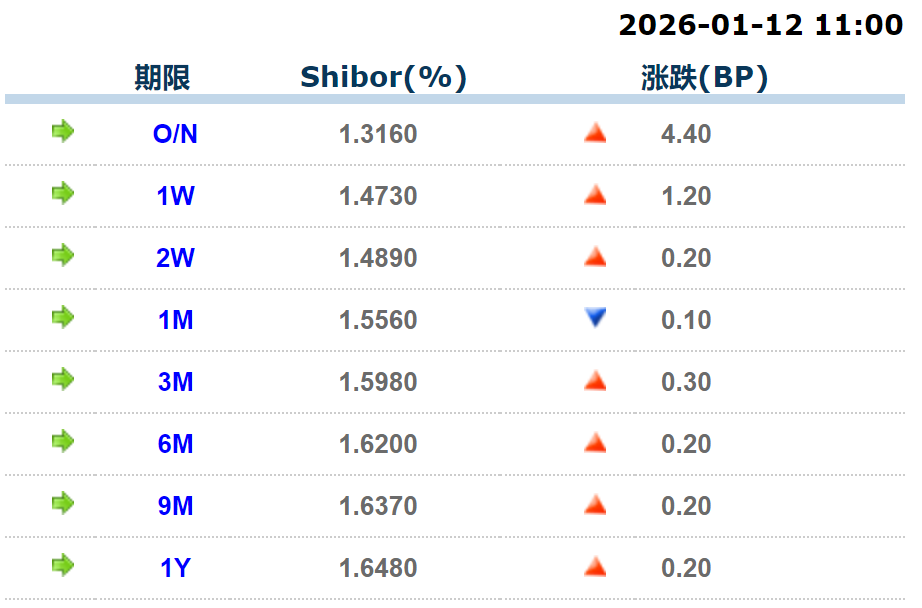
Group 1 - The People's Bank of China conducted a 7-day reverse repurchase operation of 861 billion yuan at an interest rate of 1.40%, maintaining the previous rate, resulting in a net injection of 361 billion yuan after 500 billion yuan of reverse repos matured on the same day [1] - The Shanghai Interbank Offered Rate (Shibor) for short-term instruments saw a slight increase, with the overnight Shibor rising by 4.40 basis points to 1.3160%, the 7-day Shibor increasing by 1.20 basis points to 1.4730%, and the 14-day Shibor up by 0.20 basis points to 1.4890% [1][2][3] Group 2 - In the interbank pledged repo market, various rates increased slightly, with DR001 and R001 weighted average rates rising by 5.4 basis points and 4.1 basis points, respectively, to 1.327% and 1.3895%, while transaction volumes for DR001 increased by 775 billion yuan and decreased by 208 billion yuan for R001 [7][8] - The weighted average rates for DR007 and R007 rose by 1.8 basis points and 0.9 basis points, respectively, to 1.4902% and 1.5249%, with transaction volumes increasing by 246 billion yuan and 1111 billion yuan [7][8] Group 3 - The overall funding situation on January 12 was balanced, with overnight rates for pledged loans trading around 1.45% and deposit certificates around 1.48-1.50%, indicating a slightly tight funding environment [11] - In the secondary market for negotiable certificates of deposit, trading sentiment was relatively subdued, with yields for various maturities showing narrow fluctuations, such as the 1-month yield closing at approximately 1.54% and the 3-month yield at 1.605%, reflecting minor changes from the previous week [12]
央行上海总部:引导金融机构贷款合理增长
2 1 Shi Ji Jing Ji Bao Dao· 2026-01-12 13:03
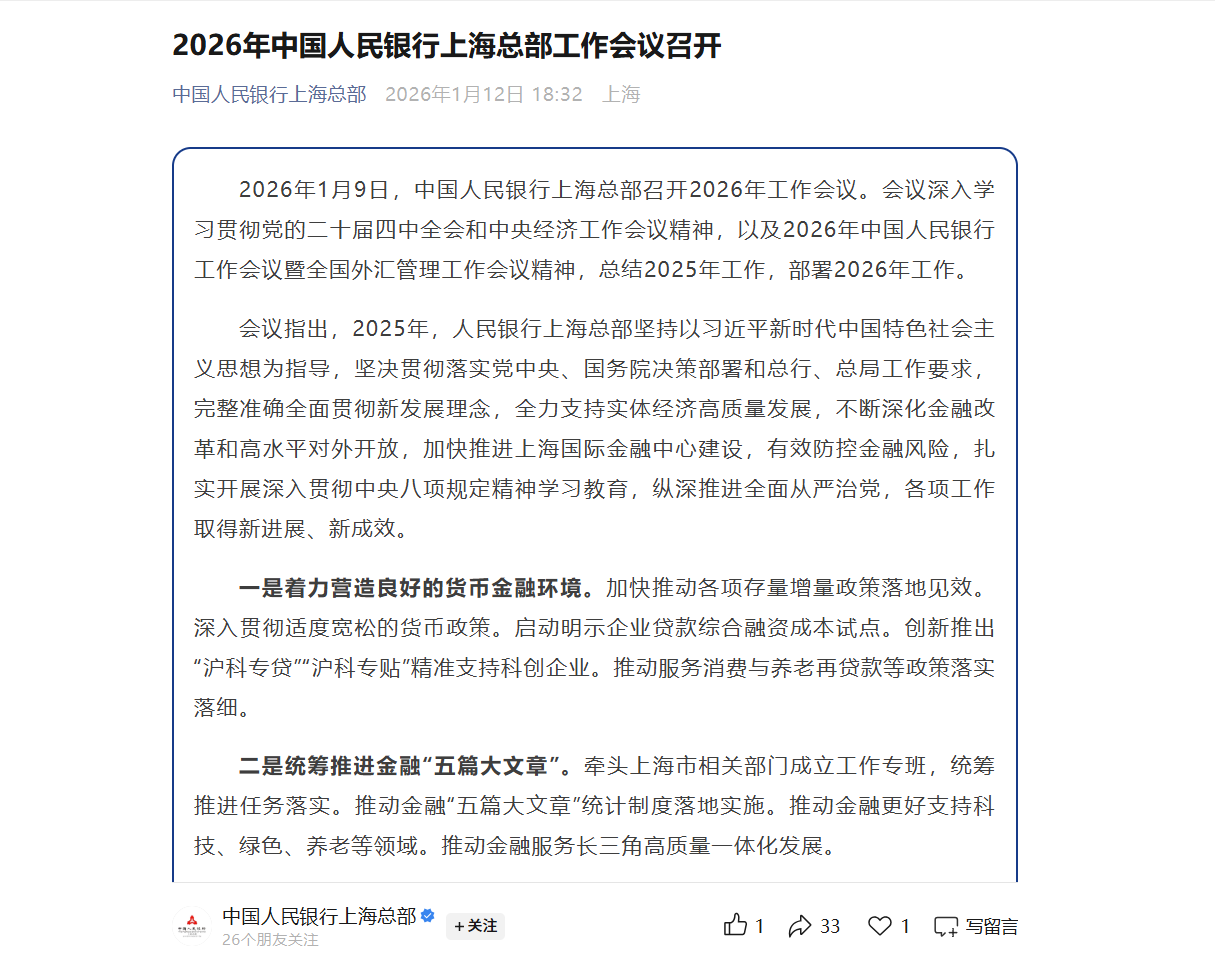
Core Viewpoint - The People's Bank of China Shanghai Headquarters is focusing on creating a favorable monetary and financial environment while promoting financial reforms and high-level openness in 2026 [1][4]. Group 1: Monetary Policy and Financial Environment - The central bank aims to implement a moderately loose monetary policy, accelerating the effectiveness of various existing and new policies [1]. - Initiatives include launching pilot programs for comprehensive financing costs for corporate loans and introducing targeted support for technology innovation enterprises [1]. - The bank plans to enhance service consumption and implement policies related to re-loans for elderly care [1]. Group 2: Financial Development and Support - The Shanghai Headquarters will promote the "Five Major Financial Articles" to better support technology, green finance, and elderly care sectors [1][4]. - A comprehensive financial service system covering the entire lifecycle of technology enterprises will be established [4]. - Continued efforts will be made to enhance financial services for small and micro enterprises and support rural revitalization [4]. Group 3: Financial Reform and Openness - The bank is committed to supporting the construction of Shanghai as an international financial center and promoting offshore trade financial service reforms [1][4]. - Initiatives include the formal operation of a digital RMB international operation center and the issuance of offshore bonds [1]. - The bank will also deepen reforms in the foreign exchange sector and promote the internationalization of the RMB [1][4]. Group 4: Financial Management and Risk Prevention - The bank aims to improve financial management and service levels, including the promotion of a unified bank settlement account system [2][4]. - A financial risk monitoring and analysis system will be established to prevent and mitigate financial risks [2][5]. - Continuous efforts will be made to combat illegal activities in the foreign exchange sector [5].
抓捕马杜罗会如何影响货币格局?
Xin Lang Cai Jing· 2026-01-12 12:28
来源:FT中文网 美国抓捕马杜罗对美元有直接的负面影响,同时,对人民币国际化有间接的正面影响。 文丨李楠、陈开宇 2026新年伊始,美国发动了对委内瑞拉的军事袭击,堪比好莱坞编剧设计的剧情,美国特种兵成功地抓捕了委内瑞拉总统马杜罗,并押送回美国受审。国 际社会一片哗然,此事件对国际秩序、军事线路、国际法、地缘政治等多方面的影响众说纷纭。本文重点讨论此事件对美元、虚拟货币和人民币国际化的 影响。 我们认为,美国抓捕马杜罗对美元有直接的负面影响,会推高虚拟货币的价格和波动,同时,对人民币国际化有间接的正面影响。 一、美元霸权走弱源自美国财政的"滞胀循环" 2026年极可能爆发历史上最大的全球金融危机,而这个危机的根源来自于美元。 其次,美元的信任基础在快速削弱。从"长臂管辖""踢出SWIFT"等手段开始,美元开始不受信任。世界上主要大宗商品交易中,使用美元的比重正在下 降;中国的CIPS交易量屡创记录。 其三,美元和美债作为外汇储备资产的吸引力在下降。2025年,各国央行的黄金储备量增加,推动了主要的避险资产黄金的价格屡创新高,甚至已经不再 是避险资产的白银等贵金属的价格也创记录地大涨。 在世界对美元信心不断削弱 ...

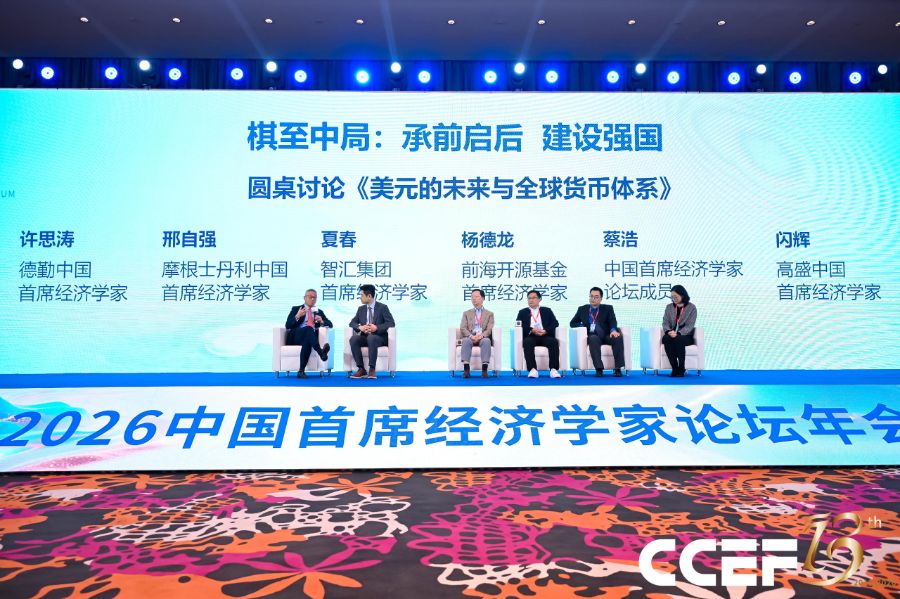
首席经济学家激辩汇市:美元大循环趋于弱化,人民币怎么走
2 1 Shi Ji Jing Ji Bao Dao· 2026-01-12 12:07
Core Viewpoint - The global monetary system is experiencing a shift towards multipolarity, with the weakening dominance of the US dollar and a potential strategic opportunity for the internationalization of the Chinese yuan as the yuan appreciates against the dollar [1][8]. Group 1: Dollar's Weakening Position - Since 2025, the US dollar index has declined from around 110 to approximately 100, indicating a weakening of the dollar's dominance in the international reserve system [3]. - Experts attribute the dollar's decline to high US government debt, which has reached $38 trillion, and fluctuating government policies that undermine confidence in the dollar [4][5]. - The transition from a gold-backed dollar to one primarily supported by US government credit has led to growing skepticism about the dollar's reliability [3][4]. Group 2: Predictions for Yuan Appreciation - Experts predict that the yuan will continue to appreciate against the dollar, with potential annual increases of 2%-3% over the next few years, leading to a total appreciation of over 30% in about a decade [6][7]. - The yuan's recent crossing of the 7 mark against the dollar is seen as a precursor to further appreciation, driven by the dollar's decline [6][7]. - High-quality development in China's manufacturing sector is expected to mitigate the impact of yuan appreciation on export enterprises, allowing them to adapt to currency fluctuations [7]. Group 3: Strategic Opportunities for Yuan Internationalization - The weakening of dollar credit opens up opportunities for the yuan's internationalization, with a potential shift towards a global monetary system where the dollar, euro, and yuan coexist [8]. - Experts emphasize the importance of strengthening domestic economic fundamentals to effectively seize the opportunity for yuan internationalization [8][9]. - Recommendations include expanding domestic demand and establishing offshore yuan trading centers to enhance the yuan's role in international trade and investment [9].