货币市场

Search documents
大量抛售,中国现有美国国债只剩6826亿美元,美债光环逐渐消失
Sou Hu Cai Jing· 2026-02-15 18:23
Group 1 - The global financial landscape is changing, with a monetary game emerging where gold is seen as a "spear" and U.S. Treasuries as a "shield," indicating a loss of confidence in the dollar's dominance and providing a historical opportunity for the rise of the renminbi [1] - In 2025, global central banks collectively increased their gold reserves, with a total net increase of 328 tons, led by Poland, which added 102 tons, while China increased its gold holdings by approximately 27 tons over 12 months [3] - Concurrently, there is a trend of selling U.S. Treasuries, with China's holdings dropping to $688.7 billion from a peak of $1.3 trillion in 2013, indicating a nearly 50% reduction in a decade [3][5] Group 2 - Other countries are also reducing their U.S. Treasury holdings, with Canada selling $56.7 billion and Norway reducing by $22.2 billion in October, while India has been selling for five consecutive months, including a $12 billion reduction in October [5] - The decline in confidence towards U.S. Treasuries is attributed to the rising U.S. national debt, which reached $38.56 trillion by February 2026, with interest payments projected to exceed $1 trillion in the 2026 fiscal year [7] - The U.S. debt-to-GDP ratio is increasing, raising concerns about the U.S. government's ability to repay its debts, leading to fears that the Federal Reserve may resort to excessive money printing, effectively imposing an "inflation tax" on dollar asset holders [9] Group 3 - Trust issues stemming from the Trump administration's policies have contributed to the sell-off of U.S. Treasuries, as allies felt uncertain about U.S. commitments and faced pressure for increased military spending [10] - The U.S. has weaponized the dollar through sanctions, causing countries to reconsider the safety of holding assets in the U.S., as seen with the freezing of accounts like that of the Colombian president [12] - Concerns over asset safety have become a primary driver for central banks to adjust their foreign exchange reserves, leading to a "gold rush" and a sell-off of U.S. Treasuries, as countries prepare for a potential multipolar currency system [14]

货币市场日报:2月6日
Xin Hua Cai Jing· 2026-02-06 16:24
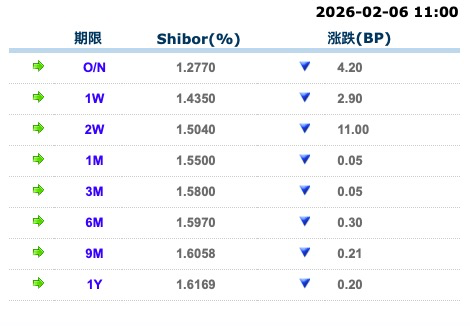
Core Viewpoint - The People's Bank of China (PBOC) conducted reverse repurchase operations totaling 315 billion yuan for 7-day and 3000 billion yuan for 14-day tenors, resulting in a net withdrawal of 1460 billion yuan from the market due to 4775 billion yuan of 7-day reverse repos maturing on the same day [1]. Group 1: Market Operations - This week, the PBOC performed a total of 10055 billion yuan in reverse repos, leading to a cumulative net withdrawal of 7560 billion yuan as 17615 billion yuan of 7-day reverse repos matured [1]. - The Shanghai Interbank Offered Rate (Shibor) showed a downward trend, with the 14-day rate falling to 1.5%. Specifically, the overnight Shibor decreased by 4.20 basis points to 1.2770%, the 7-day Shibor fell by 2.90 basis points to 1.4350%, and the 14-day Shibor dropped by 11.00 basis points to 1.5040% [1][2]. Group 2: Interbank Repo Market - In the interbank pledged repo market, short-term funding rates slightly declined. The weighted average rates for DR001 and R001 fell by 4.4 basis points and 3.2 basis points, respectively, to 1.275% and 1.3605%, with transaction volumes increasing by 706 billion yuan and 1314 billion yuan [4]. - The weighted average rates for DR007 and R007 decreased by 2.1 basis points and 2.3 basis points, respectively, to 1.4613% and 1.5288%, with transaction volumes increasing by 142 billion yuan and decreasing by 1569 billion yuan [4]. Group 3: Money Market Rates - The money market maintained a balanced and slightly loose stance, with overnight deposit rates trading in the range of 1.48%-1.50% and 7-day rates around 1.52%-1.54% [10]. - The secondary market for negotiable certificates of deposit (NCDs) remained active, with long-end yields showing a slight downward trend while short-end yields remained stable. The 1-month NCD closed at approximately 1.55%, unchanged from the previous day [11].
货币市场日报:2月3日
Xin Hua Cai Jing· 2026-02-03 12:27
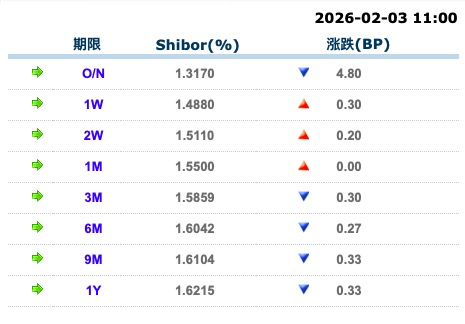
Core Viewpoint - The People's Bank of China conducted a 7-day reverse repurchase operation of 105.5 billion yuan at an interest rate of 1.40%, resulting in a net withdrawal of 296.5 billion yuan from the open market due to the maturity of 402 billion yuan in reverse repos on the same day [1]. Group 1: Market Rates - The Shanghai Interbank Offered Rate (Shibor) showed slight fluctuations, with the overnight Shibor decreasing by 4.80 basis points to 1.3170%, while the 7-day Shibor increased by 0.30 basis points to 1.4880%, and the 14-day Shibor rose by 0.20 basis points to 1.5110% [1][2]. - The overnight funding rate in the interbank pledged repo market slightly fell to around 1.3%, while the 7-day and 14-day rates saw minor increases [4]. Group 2: Trading Activity - The overall funding environment on February 3 was relatively loose, with overnight rates for certificates of deposit trading around 1.52%-1.55% and 7-day rates at 1.52%-1.53% [10]. - The secondary market for certificates of deposit was active, with yields showing slight upward movements, particularly for 3-month and 6-month maturities [11]. Group 3: Central Bank Operations - In January, the central bank reported a net injection of 700 billion yuan through Medium-term Lending Facility (MLF) and a net withdrawal of 79 million yuan through Standing Lending Facility (SLF) [13]. - The central bank emphasized the importance of maintaining a reasonable growth in credit volume and balanced allocation, aiming to support the real economy effectively [14].
金价飙至5200美元!美元贬值给中国送机遇,为何却暗藏陷阱?
Sou Hu Cai Jing· 2026-02-02 03:23
Group 1 - The article highlights the decline of the US dollar, with the index dropping from 93 in 2021 to 78, while gold prices have surged to a historic high of $5,200 per ounce [2] - The Trump administration's "America First" policy has led to increased tariffs on 32 countries, contributing to the dollar's depreciation and creating uncertainty in the currency market [2] - The rise of gold as a safe-haven asset is noted, with silver prices also increasing by 50% this year, reflecting a shift in investor sentiment [2] Group 2 - The internationalization of the Renminbi (RMB) is gaining momentum, with cross-border payments expected to increase by 38% by 2025, raising its global share to 4.7% [4] - Significant progress in RMB settlements is observed in the resource sector, with the share of oil transactions in the Middle East settled in RMB rising from 12% to 29% [4] - Despite these advancements, the RMB still only accounts for 2.9% of global foreign exchange reserves, indicating challenges in becoming a reserve currency [4] Group 3 - The article discusses the implications of the US Federal Reserve's interest rate policies on the RMB, highlighting the dilemma faced by Chinese companies regarding foreign debt and currency fluctuations [6] - A "killing with kindness" strategy is suggested, where the US Chamber of Commerce promotes the RMB as a potential replacement for the dollar, which could backfire on China during a financial crisis [6] - The article outlines a pragmatic approach for China, emphasizing the need for solidifying RMB settlements in commodities, piloting digital currency in ASEAN, and addressing domestic economic challenges [6]
特朗普表态引发美元贬值下亚洲货币与大宗商品市场走势分析
Sou Hu Cai Jing· 2026-01-28 12:17
Group 1: Dollar Depreciation and Policy Signals - Trump's remarks indicate a shift in the U.S. government's stance towards a more tolerant view of dollar fluctuations, contrasting with previous administrations' emphasis on a strong dollar [1] - The market interprets this as a potential policy inclination to weaken the dollar to enhance export competitiveness, leading to a sell-off of the dollar [1] - Despite rising U.S. Treasury yields and expectations of the Federal Reserve pausing interest rate cuts, the dollar continues to decline, highlighting the dominant role of policy signals in the current market [1] Group 2: Asian Currency Market Trends - The Japanese yen shows complex volatility against the dollar, with a key short-term level at 152, influenced by domestic political cycles and potential central bank interventions [2] - The yen's movements are affected by political uncertainty ahead of upcoming elections, with historical data indicating increased volatility during such periods [2] - The South Korean won faces significant depreciation pressure, reaching its lowest level since March 2009, driven by domestic political and economic factors, as well as uncertainties regarding U.S. trade policies [4] Group 3: Renminbi Resilience - The renminbi exhibits orderly adjustments against the dollar, recently surpassing the 6.9 mark, reflecting market supply and demand dynamics [3] - Compared to the 2019 response when the renminbi first broke 7, the current market shows increased tolerance for exchange rate fluctuations, indicating a maturation of the renminbi's formation mechanism [3] - The future trajectory of the renminbi will be influenced by U.S.-China interest rate differentials, trade environments, and domestic economic recovery [3] Group 4: Commodity Market Analysis - International oil prices have risen above $66 per barrel, continuing an upward trend influenced by the dollar's depreciation and demand stimulation [5] - Gold prices have reached a historical high of over $5200 per ounce, driven by increased demand for alternative value storage assets amid dollar weakness and inflation concerns [6] - Industrial metal prices are experiencing widespread increases, but there are warnings of potential price corrections due to weakening demand and macroeconomic factors [7]
U.S. dollar hits lows again as stablecoin volumes surge 140%
Yahoo Finance· 2026-01-26 18:53
Group 1 - The U.S. dollar has fallen to a four-month low, influenced by potential interventions from Japan to support its currency [3] - The Japanese yen experienced a nearly 3% increase following reports of coordinated actions to stabilize the currency, indicating market reactions to fiscal policy concerns [4] - The weakening of the dollar is typically associated with Japan selling dollars to buy yen during currency market interventions [4] Group 2 - As the U.S. dollar weakens and macroeconomic uncertainty rises, there has been a significant surge in stablecoin trading volume [5] - The anxiety surrounding the dollar's value has led to increased interest in alternative assets like Bitcoin, reflecting broader concerns about currency debasement [2]
资金观察,货币瞭望:政策宽松加结构性降息,预计1月市场利率下行
Guoxin Securities· 2026-01-16 09:09
Core Insights - The report indicates a policy easing combined with structural interest rate cuts, predicting a decline in market interest rates in January [4][52][77] Group 1: Overseas Monetary Market Indicators - The expectation for interest rate cuts in overseas markets has weakened, with short-term US Treasury rates rebounding to around 3.7% [6] - The Federal Funds rate and SOFR rates have remained stable since December [6] Group 2: Domestic Monetary Market Indicators - Price indicators show that the interbank and exchange repo rates generally increased in December, with R001, GC001, R007, and GC007 changing by -7BP, 14BP, 7BP, and 14BP respectively [11][19] - Volume indicators reveal that the overnight transaction volume in both interbank and exchange markets increased compared to the previous month, although the proportion slightly declined [34] - The excess reserve ratio is estimated to be 1.6% for December and 1.1% for January [4][42] Group 3: January Funding Outlook - The central bank's supportive stance, combined with the seasonal tendency for liquidity to ease after the year-end, suggests a decline in market interest rates in January [4][52] - The central bank is expected to net withdraw liquidity in January, with a slight decrease in the excess reserve ratio anticipated [72] Group 4: Short-term Bond Yield Changes - In December, the yields on short-term bonds showed mixed trends, with 1-year government bonds and 1-year policy bank bonds changing by -3BP and -2BP respectively [25] - The yield spread between 1-year AAA short-term financing bonds and government bonds slightly widened by 6BP [25] Group 5: Money Market Fund Returns - The 7-day annualized yield for the Yu'ebao fund was 1.02% in December, with the average yield for the top ten money market funds showing a slight increase [28] Group 6: Seasonal Trends in Monetary Indicators - December saw a significant reduction in fiscal deposits, with a decrease of 13,845 billion yuan, while January is expected to see a seasonal increase in fiscal deposits of around 4,000 billion yuan [59] - The M0 increased by 3,892 billion yuan in December, with an expected increase of 7,000 billion yuan in January due to cash demand ahead of the Spring Festival [53]
货币市场日报:1月12日
Xin Hua Cai Jing· 2026-01-12 16:58
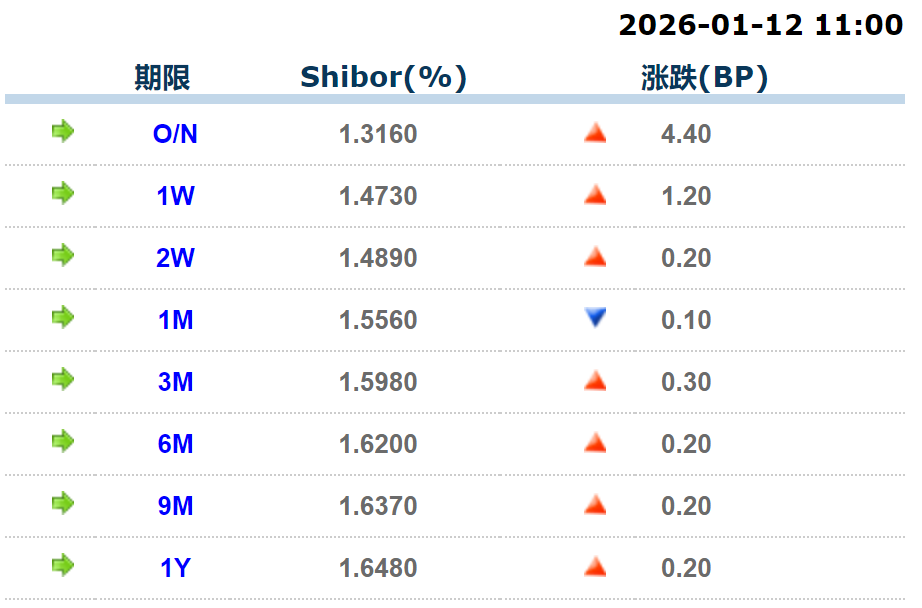
Group 1 - The People's Bank of China conducted a 7-day reverse repurchase operation of 861 billion yuan at an interest rate of 1.40%, maintaining the previous rate, resulting in a net injection of 361 billion yuan after 500 billion yuan of reverse repos matured on the same day [1] - The Shanghai Interbank Offered Rate (Shibor) for short-term instruments saw a slight increase, with the overnight Shibor rising by 4.40 basis points to 1.3160%, the 7-day Shibor increasing by 1.20 basis points to 1.4730%, and the 14-day Shibor up by 0.20 basis points to 1.4890% [1][2][3] Group 2 - In the interbank pledged repo market, various rates increased slightly, with DR001 and R001 weighted average rates rising by 5.4 basis points and 4.1 basis points, respectively, to 1.327% and 1.3895%, while transaction volumes for DR001 increased by 775 billion yuan and decreased by 208 billion yuan for R001 [7][8] - The weighted average rates for DR007 and R007 rose by 1.8 basis points and 0.9 basis points, respectively, to 1.4902% and 1.5249%, with transaction volumes increasing by 246 billion yuan and 1111 billion yuan [7][8] Group 3 - The overall funding situation on January 12 was balanced, with overnight rates for pledged loans trading around 1.45% and deposit certificates around 1.48-1.50%, indicating a slightly tight funding environment [11] - In the secondary market for negotiable certificates of deposit, trading sentiment was relatively subdued, with yields for various maturities showing narrow fluctuations, such as the 1-month yield closing at approximately 1.54% and the 3-month yield at 1.605%, reflecting minor changes from the previous week [12]
Bitcoin bulls eye possible tailwind as U.S. dollar index continues to leg lower
Yahoo Finance· 2025-12-23 14:47
Core Viewpoint - The U.S. dollar index (DXY) is experiencing a decline, trading near its 2025 low, following a significant drop in the first half of 2025 after a strong gain post the November 2024 election of Donald Trump [1][2]. Group 1: Dollar Performance - The dollar's substantial drop in 2025 was initially accompanied by a broader market reaction, with stocks, gold, and bitcoin rising sharply to new records [2]. - Despite the dollar's weakness, gold, silver, and copper have reached new record highs, while bitcoin and the broader crypto markets have faced significant declines [2]. Group 2: Technical Analysis - The DXY index is currently trading just above a critical long-term support level established since the 2008 global financial crisis, which has been tested multiple times [3]. - The potential for the dollar to fall below this major support level is heightened as foreign central banks, including the Bank of Japan, move towards tighter monetary policies, contrasting with pressure on the U.S. Federal Reserve to lower interest rates [4]. Group 3: Implications for Crypto - A break below the long-term support level of the dollar could potentially trigger a reversal in the downtrend of the cryptocurrency market, which has not yet benefited from the weak dollar this year [5].
IC平台:美元指数三连涨突破98.50,涨势能否延续?
Sou Hu Cai Jing· 2025-12-19 09:58
Core Viewpoint - The market is cautious ahead of the University of Michigan Consumer Confidence Index release, with the dollar index rising. However, expectations for a Federal Reserve rate cut are increasing due to soft CPI data for November, which may put pressure on the dollar [1][3]. Group 1: Dollar Index and Market Sentiment - The dollar index (DXY) has risen for the third consecutive trading day, trading around 98.60 during the European session [3]. - Traders are closely watching the upcoming release of the December Consumer Confidence Index from the University of Michigan [3]. Group 2: CPI Data and Federal Reserve Expectations - The November Consumer Price Index (CPI) in the U.S. unexpectedly decreased to 2.7%, below the market expectation of 3.1% [3]. - The core CPI, excluding volatile food and energy prices, increased by 2.6%, which is lower than the expected 3.0% and represents the slowest growth rate since 2021 [3]. - According to the CME FedWatch tool, the probability of the Federal Reserve maintaining interest rates in January is 73.3%, down from 75.6% the previous day, while the probability of a 25 basis point rate cut has risen from 24.4% to 26.6% [3]. Group 3: Political Influence on Monetary Policy - President Trump stated that the next Federal Reserve chair will be someone who believes in significant rate cuts, indicating potential shifts in monetary policy [3].