积极的财政政策

Search documents
上世纪美国是怎样走出大萧条的?
Sou Hu Cai Jing· 2025-04-29 00:09
Group 1 - The core event discussed is the stock market crash on October 24, 1929, known as "Black Thursday," which led to a significant economic downturn in the United States [1] - The stock index dropped from a peak of 363 to an average decline of 40%, resulting in massive financial losses for many Americans [1] - The Great Depression caused severe social issues, including a high dropout rate among students and a significant increase in unemployment, with 8.3 million unemployed in the U.S. and 5 to 7 million in the U.K. [1] Group 2 - President Roosevelt's initial response to the Great Depression involved addressing the banking crisis by ensuring banks could reopen and providing liquidity through the Federal Reserve [3] - Roosevelt abandoned the gold standard, which allowed the Federal Reserve to print more money without the constraint of gold reserves, thus injecting liquidity into the banking system [3][4] - Following the abandonment of the gold standard, public confidence returned, leading to a significant deposit of $1 billion into banks, which helped stabilize the financial system [4] Group 3 - Roosevelt's government spending initiatives aimed to stimulate the economy by providing wages to workers, which in turn increased consumer spending and economic activity [6] - The analogy of digging and filling holes illustrates how government spending can create jobs and stimulate demand across various sectors [6] - Some analysts argue that World War II played a crucial role in fully reviving the U.S. economy by creating demand for military supplies and industrial production [7]


财政部发布国有大行注资特别国债发行计划:4月24日启动发行
2 1 Shi Ji Jing Ji Bao Dao· 2025-03-31 13:20
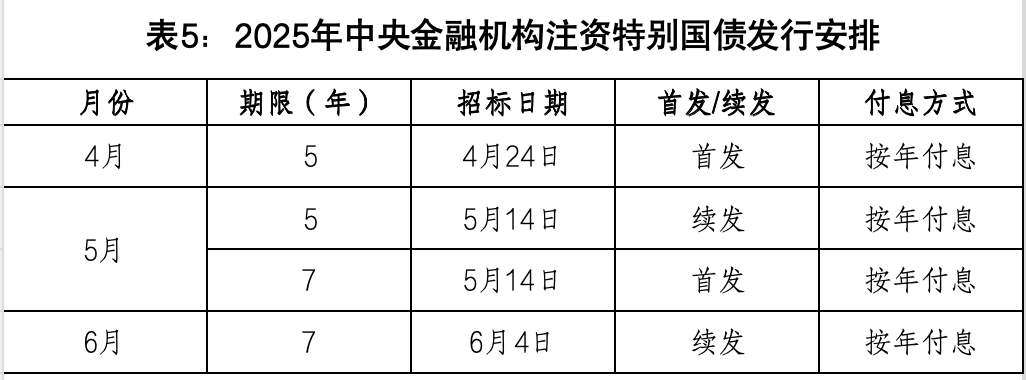
二季度国债发行安排显示,这次5000亿元特别国债的期限分为5年、7年两种,其中4月24日将启动中央金融机构注资特别国债的发行,期限为5 年,5月份还有一次续发;5月14日,将启动7年期的特别国债发行,6月份有一次续发。 | 表5: 2025年中央金融机构注资特别国债发行安排 | | --- | 21世纪经济报道记者周潇枭 北京报道 3月31日下午,财政部对外公布2025年第二季度关键期限国债、短期国债、超长期一般国债、储蓄国债、中 央金融机构注资特别国债发行有关安排。 | 月份 | 期限(年) | 招标日期 | 首发 续发 | 付息方式 | | --- | --- | --- | --- | --- | | 4月 | 5 | 4月24日 | 首发 | 按年付息 | | 5月 | 5 | 5月14日 | 续发 | 按年付息 | | | 7 | 5月14日 | 首发 | 按年付息 | | 6月 | 7 | 6月4日 | 续发 | 按年付息 | (截图来自财政部官网) 3月31日上午,财政部消息显示,按照党中央和国务院决策部署,2025年,财政部将发行首批特别国债5000亿元,积极支持中国银行、中国建设银 行、交通 ...
刚刚,财政部重磅发布!
凤凰网财经· 2025-03-24 12:59
来源|中国证券报 更加积极的财政政策有何内涵?财政部网站3月24日发布的2024年中国财政政策执行情况报告显示,2025年财政政策要更加积极,持续用力、更加给力。 具体体现在五个方面:一是提高财政赤字率,加大支出强度、加快支出进度;二是安排更大规模政府债券,为稳增长、调结构提供更多支撑;三是大力优 化支出结构、强化精准投放,更加注重惠民生、促消费、增后劲;四是持续用力防范化解重点领域风险,促进财政平稳运行、可持续发展;五是进一步增 加对地方转移支付,增强地方财力、兜牢"三保"底线。 落实落细一揽子化债政策,坚决遏制新增隐性债务 报告明确,重点做好以下工作: 要点速览: 图:财政部网站 加大民生保障力度,多渠道增加居民收入 适当提高退休人员基本养老金,提高城乡居民基础养老金和城乡居民基本医疗保险财政补助标准等 加大中央本级科技投入,全力支持关键核心技术攻关 统筹用好化债支持政策,支持地方加快偿还政府拖欠企业账款 支持全方位扩大国内需求。 大力提振消费。加大民生保障力度,多渠道增加居民收入。推进实施提振消费专项行动,加大消费品以旧换新支持力度。适当 提高退休人员基本养老金,提高城乡居民基础养老金和城乡居民基本医疗 ...
财政部部长蓝佛安:打好政策“组合拳”,更加积极的财政政策将持续发力
Xin Hua Cai Jing· 2025-03-24 08:06
财政部部长蓝佛安:打好政策"组合拳",更加积极 的财政政策将持续发力 赤字率提高到4%左右,赤字规模达到5.66万亿元,全国一般公共预算支出29.7万亿元,新增政府债务总 规模11.86万亿元……在23日至24日举办的中国发展高层论坛2025年年会上,财政部部长蓝佛安通过一 系列数据,向海内外嘉宾详解今年更加积极的财政政策如何发力。 "2025年党中央明确要实施更加积极的财政政策,持续用力、更加给力,这是在去年9月26日一揽子增量 政策基础上,对财政政策的进一步深化提升。"蓝佛安说。 针对当前我国经济运行面临的一些困难和挑战,蓝佛安表示,与过去相比,现在我国经济和财政实力明 显增强,宏观调控和财政治理的实践经验更加丰富。我国经济发展的信心和底气来自于我国经济基础 稳、优势多、韧性强、潜力大的长期发展支撑,也来自于始终对风险保持清醒认识并留有后手,为应对 可能出现的冲击和挑战预留了充足的财政空间。 此次年会吸引了众多跨国公司的全球高管参会。蓝佛安表示,财政政策将支持推动更高水平对外开放, 积极稳外贸稳外资,在政策支持政府采购等方面一视同仁,平等对待各类经营主体,持续优化营商环 境,吸引更多外资企业与中国经济共同 ...
蓝佛安详解如何实施更加积极的财政政策|宏观经济
清华金融评论· 2025-03-13 10:43
文/ 财政部党组书记、部长 蓝佛安 中央经济工作会议明确提出,2 02 5年要实施更加积极的财政政策,持续 用力、更加给力,打好政策"组合拳"。持续用力,就是要做好政策衔接, 既让已出台的政策发挥最大效能,又及时出台新的有力度的政策,根据外 部影响程度动态调整,前后贯通、接续发力。更加给力,就是要用好用足 政策空间,加强超常规逆周期调节,提高宏观调控的前瞻性、针对性、有 效性,使政策力度更大、效果更好,各方面更有获得感。具体体现在五个 方面:一是提高财政赤字率,加大支出强度、加快支出进度。二是安排更 大规模政府债券,为稳增长、调结构提供更多支撑。三是大力优化支出结 构、强化精准投放,更加注重惠民生、促消费、增后劲。四是持续用力防 范化解重点领域风险,促进财政平稳运行、可持续发展。五是进一步增加 对地方转移支付,增强地方财力、兜牢"三保"底线。 一、迎难而上、积极作为,2024年财政工作取得新进展新成效,有力促进完成全年经济社会发展目标任 务 2024年是实现"十四五"规划目标任务的关键一年,外部压力加大、内部困难增多。以习近平同志为核心 的党中央沉着应变、综合施策,特别是三季度打破常规、果断出手,及时推出一揽 ...

山东将提升财政调控效能加力支持消费品以旧换新
Zhong Guo Jing Ji Wang· 2025-03-11 23:39
Core Viewpoint - In 2025, China will implement a more proactive fiscal policy, with a focus on enhancing resource allocation and precise funding to support economic recovery and growth [1][5]. Group 1: Fiscal Policy Implementation - The Shandong Provincial Finance Department aims to deepen the implementation of a more proactive fiscal policy, emphasizing resource coordination and precise funding to provide solid fiscal support for economic recovery [2][3]. - The fiscal policy will prioritize improving people's livelihoods, promoting consumption, and enhancing economic resilience, linking these aspects to boost living standards and create new economic growth points [2][6]. Group 2: Investment in People's Livelihoods - Shandong will increase basic livelihood investment, ensuring that the proportion of livelihood expenditure remains stable at around 80% [2][7]. - The province will enhance fiscal regulation effectiveness and provide strong support for consumption, including expanding the scope of policies for trade-in programs for consumer goods [2][7]. Group 3: Economic Resilience and Investment - Shandong will focus on developing new productive forces by supporting education, technology innovation, and green low-carbon initiatives to stimulate internal economic dynamics [3][8]. - The province will also aim to expand effective investment by leveraging government investment to attract social investment and enhance the efficiency of special bonds [3][8]. Group 4: Fiscal Reform Initiatives - The Shandong Provincial Finance Department plans to deepen fiscal and tax reforms, launching a series of signature reform outcomes unique to Shandong [4][9]. - Key reforms will include improving the modern budgeting system, enhancing budget management, and increasing financial support for major strategic tasks and basic livelihoods [4][9].
积极的财政政策如何发力?预算报告给出四点线索
互联网金融· 2025-03-10 10:01
Core Viewpoint - The government is implementing a more proactive fiscal policy, with a proposed deficit rate of around 4% and a deficit scale of 5.66 trillion yuan, marking an increase of 1.6 trillion yuan from the previous year [1][3]. Group 1: Significant Fiscal Expansion - The broad fiscal policy is significantly expanding, with the narrow deficit rate reaching 4% for the first time and the broad deficit scale expected to increase by 2.9 trillion yuan to 13.86 trillion yuan, resulting in a historical high broad deficit rate of 9.8% [3][4]. - The issuance of special government bonds is set at 1.8 trillion yuan, which could potentially boost GDP growth by approximately 0.5-1 percentage points [4]. Group 2: Decline in Non-Tax Revenue - The expected growth rate for general public budget revenue is only 0.1%, while expenditure is projected to grow by 4.4% [6]. - Non-tax revenue is anticipated to decrease by 14.2%, reflecting a significant reduction in its contribution to public finance [7][8]. Group 3: Optimization of Expenditure Structure - The expenditure structure is shifting towards education, social security, and healthcare, with budget growth rates for these areas set at 8.3%, 4.7%, and 5.0% respectively, all higher than traditional infrastructure spending [10][11]. - The government aims to invest more resources in human capital and social welfare to create a positive cycle of economic development and improvement in living standards [10]. Group 4: Significant Increase in Central Expenditure - The central deficit is arranged at 4.86 trillion yuan, an increase of 1.52 trillion yuan from last year, with 95% of the new deficit borne by the central government [13]. - The central government's leverage is being increased to boost confidence and demand, with a focus on investment and support for national consumption policies [13][14].
中国宏观经济研究院院长黄汉权:以新质生产力为驱动的发展态势在形成,稳住楼市股市有助于提振消费
21世纪经济报道· 2025-03-08 04:26
Core Viewpoint - The government aims for a GDP growth target of around 5% for 2025, emphasizing the need for stable employment, risk prevention, and improving people's livelihoods, supported by economic growth potential and favorable conditions [1][6]. Group 1: Economic Growth and Conditions - The economic growth target of 5% for 2025 is supported by several favorable conditions, including more proactive macroeconomic policies, particularly in fiscal and monetary areas [6][10]. - The government plans to increase the scale of new government debt to 11.86 trillion yuan, a rise of 2.9 trillion yuan from the previous year, which will positively impact investment and consumption [6][10]. - The balance of contributions from exports, investment, and consumption to economic growth is noted, with significant advancements in strategic emerging industries driven by technological innovation [5][6]. Group 2: Fiscal and Monetary Policies - The fiscal policy will see a deficit rate increase to around 4%, with a total deficit scale of 5.66 trillion yuan, marking a nearly 40% increase from last year [10]. - The monetary policy will be more accommodative, maintaining ample liquidity and supporting sectors like technology innovation and consumption [10][11]. Group 3: Consumption and Investment - To boost consumption, the government will implement special actions, including increasing income for low- and middle-income groups and stabilizing asset values in real estate and stock markets [11][12]. - Investment efficiency will be improved by selecting key projects for government investment and encouraging private sector participation in infrastructure projects [12][14]. Group 4: Key Industries and Reforms - Focus areas for new quality productivity include digital economy, green economy, life sciences, and low-altitude economy, with significant technological breakthroughs expected [15][16]. - Key reforms to be pushed include enhancing the vitality of business entities, accelerating the construction of a unified national market, and deepening fiscal and tax reforms to increase local financial autonomy [17][18].

全国政协委员韩保江:经济增速定在5%左右有这些考虑
21世纪经济报道· 2025-03-06 10:18
Core Viewpoint - The government work report sets a GDP growth target of around 5% for 2025, emphasizing the need for job creation, stabilizing expectations, and achieving modernization goals [3][4]. Group 1: Economic Growth Target - The 5% growth target is aimed at creating sufficient new jobs, with approximately 12 million new graduates entering the job market [3]. - Maintaining a stable growth rate of around 5% is crucial for stabilizing market expectations and signaling to investors and consumers that the economy remains resilient [3]. - Achieving the goal of modernization by 2035 requires sustained economic growth of around 5% to reach a per capita GDP close to $30,000 [3]. Group 2: Macroeconomic Policies - The report advocates for a more proactive fiscal policy and moderately loose monetary policy to address uncertainties and support economic growth [6][7]. - Increasing the deficit ratio to around 4% and expanding the issuance of special bonds are part of the proactive fiscal measures [7]. - A moderately loose monetary policy aims to maintain liquidity and encourage banks to provide low-cost funding to enterprises [7]. Group 3: Consumer and Investment Strategies - To boost consumption, the focus should be on increasing residents' income, especially for low- and middle-income groups, and optimizing income distribution [9]. - Investment efficiency can be improved by identifying promising industries and projects, supported by favorable government policies [10]. - Expanding domestic demand is essential, especially in light of external pressures, by enhancing both consumption and investment [9]. Group 4: Development of New Productive Forces - Developing new productive forces is necessary for sustained economic growth, moving beyond traditional industries to create new demand through innovation [11]. - Local governments should tailor their development strategies based on regional advantages, avoiding uniform approaches [12]. Group 5: Economic System Reforms - Key reforms include establishing a unified national market to enhance resource allocation efficiency and support the development of the private economy [14][15]. - The government should focus on maintaining order and providing services, stepping back from direct market involvement [16]. Group 6: Risk Management - The real estate market is in a stabilization phase after significant adjustments, requiring supportive policies to ensure healthy development [17]. - Effective management of local debt risks involves setting clear borrowing limits and ensuring that debt is used efficiently [18].

5000亿元!10.34万亿元!刚刚,财政部发声:“持续用力、更加给力”!
证券时报· 2025-03-06 07:38
今年将发行首批特别国债5000亿元,中央对地方转移支付安排10.34万亿元。 3月6日(星期四)下午,十四届全国人大三次会议举行记者会,邀请国家发展和改革委员会主任郑栅洁、 财政部部长蓝佛安、商务部部长王文涛、中国人民银行行长潘功胜、中国证券监督管理委员会主席吴清, 就发展改革、财政预算、商务、金融证券等相关问题回答中外记者提问。 财政部部长蓝佛安在十四届全国人大三次会议经济主题记者会上表示,更加积极的财政政策体现了宏观调 控针对性和前瞻性,可以理解为"持续用力、更加给力"。一方面,在市场存量政策上下功夫,抓好去年四 季度出台的一揽子政策落地见效;另一方面在谋划好增量政策上出实招,用好用足政策空间,围绕惠民 生、促消费、增后劲。 蓝佛安表示,为应对内外部可能出现的不确定性因素,中央财政预留了充足的储备工具和政策空间。 蓝佛安透露,今年将发行首批特别国债5000亿元,支持国有大型商业银行补充核心一级资本。此外,今年 转移支付力度更加给力,中央对地方转移支付安排10.34万亿元,同口径增长8.4%,重点是增加一般性转 移支付,增强地方政府财力。 同时,今年在重点领域保障上更加给力。今年全国教育支出,社会保障和就业 ...