贸易保护主义

Search documents
罕见改口?特朗普终于承认,美国人正在为关税而付出代价
Sou Hu Cai Jing· 2025-11-23 08:27
不过,特朗普依然坚持认为这项政策对美国有利,甚至声称通过关税避免了多场战争。与此同时,许多 民主党控制的州以及私营企业已经提起诉讼,反对特朗普的关税政策。最高法院预计将在年底做出裁 决,能否推翻关税政策将取决于特朗普任命的几位保守派法官的立场。 11月6日,美国最高法院举行了一场特别的听证会,重点讨论特朗普政府的全面关税政策。无论是保守 派还是自由派的法官,都毫不留情地对关税的合法性提出了严厉质疑。值得注意的是,欧盟本应因关税 取消而感到高兴,但他们却没有表现出任何欣喜,反而一副愁容满面。 特朗普的关税征收依据是1977年出台的《国际紧急经济权力法》。这部法律最初是为了应对进口问题, 但并没有提及可以用来征收关税。首席大法官约翰·罗伯茨直接提出了关键问题:关税本质上是税收, 而税收一直是国会的专属权力,特朗普怎么能通过外交权力绕过国会进行征税呢? 特朗普一度坚称,关税实际上是外国给美国政府交的钱,本想用这个说法来为自己辩护,然而却发现经 济学家们并不买账。美国消费者在实际生活中感受到了物价上涨,这些额外的成本正是关税的转嫁。最 终,特朗普在11月7日的椭圆形办公室中承认,民众确实为此付出了代价。 这一逻辑其实 ...

荒唐!中国割草机器人被欧盟贴上“倾销”标签
Jing Ji Guan Cha Wang· 2025-11-23 04:31
Core Viewpoint - The European Union has initiated an anti-dumping investigation against Chinese robotic lawn mowers, which is perceived as a protectionist measure that overlooks the technological, performance, and environmental advantages these products offer to European consumers [1][4]. Group 1: Investigation Details - The EU Commission announced the investigation on November 19, 2025, targeting robotic lawn mowers that operate without direct human control, including necessary components like charging stations and navigation devices [1]. - The investigation is expected to be completed within a year, but not exceeding 14 months [1]. - The complaint originated from Husqvarna's Czech subsidiary, which accused Chinese exports of unfair pricing that harms the EU industry [2]. Group 2: Market Impact - Chinese imports of robotic lawn mowers have been increasing in both absolute volume and market share, negatively impacting EU industry sales, pricing levels, and market share [3]. - In the first nine months of the year, exports of Chinese robotic lawn mowers to the EU grew by 37.7% in volume and 80.6% in value, reaching $2 billion [3]. - The average price of Chinese robotic lawn mowers exported to Europe is $207.3, which is 43% higher than the global average price of $144.6 [3]. Group 3: Industry Response - Industry experts argue that the EU's anti-dumping claims are unfounded, emphasizing that European buyers value the performance and technological innovations of Chinese products [4]. - Companies like Ninebot emphasize their focus on mid-to-high-end markets, relying on technological innovation rather than price competition [5]. - The International Data Corporation (IDC) reported a significant increase in global demand for robotic lawn mowers, with a 327.2% year-on-year growth in shipments [6]. Group 4: Company Strategies - Companies are preparing to respond to the investigation by submitting necessary documentation and evidence to counter the claims [8]. - Ninebot and Longxin General have stated that the investigation will have a limited impact on their operations, with strategies in place to adapt to potential trade barriers [9]. - Daya Co. plans to adjust its production structure in response to the investigation, having already established a global production strategy [9].



美国又虚空造牌,贝森特称愿放弃100%关税,中国对应取消稀土管制
Sou Hu Cai Jing· 2025-11-23 03:50
中方推出最新的稀土管制措施后,特朗普威胁的100%关税为什么不敢落下?为什么说美国又在虚空造牌? 中国推出了一系列新的稀土管控措施,不仅对稀土产品出口作出了严格规定,包括稀土设施和技术分享,都受到了严格管控。因为全球超过90%的重稀土提 炼都需要经过中国,因此这实际上直接切断了美国在全球,试图摆脱中国稀土依赖的布局。 虽然特朗普在10月11日一度威胁要对中国加征100%的关税,但是随着美股暴跌,特朗普政府的官员已经迅速转变了口风,所谓的100%关税实际上仅仅只是 停留在口头上。 而贝森特到现在,还认为美国依然占据着优势,他声称,就算中方不愿意对话,美国也有足够多的手段可用,"力度相当甚至可能超过他们对稀土采取的措 施"。他还坚称特朗普政府此前采取贸易措施,对中国"影响很大"。 按照贝森特的说法,美国之所以不会对华实施100%的关税,是因为中方要主动取消对稀土的管控措施,否则美国还会打出更多的"王牌"。 但这并不意味着中美已经失去了沟通的渠道,实际上,就在10月13日当天,中美还举行了工作层级的会谈,而美国财政部长贝森特对局势的缓和还持乐观态 度,他也承认,特朗普提到的100%关税"不一定会真的发生"。 这其实 ...
特朗普准备关税“备胎方案”!修改对巴西商品关税范围
Zhong Guo Ji Jin Bao· 2025-11-23 03:30
Group 1 - The Trump administration is preparing a backup plan in case the Supreme Court overturns his significant tariff powers, including the potential use of Trade Act Sections 301 and 122, which grant the president unilateral authority to impose tariffs [1][3] - Current average tariff rates on U.S. imports are approximately 14.4%, with over half of these tariffs imposed under the International Emergency Economic Powers Act (IEEPA) [3] - If the Supreme Court rules against the Trump administration, the government may be forced to refund over $88 billion in tariffs already collected [5] Group 2 - The Trump administration has modified tariffs on Brazilian goods, maintaining a 40% tariff on some products while eliminating additional tariffs on specific Brazilian agricultural products and aircraft parts [6] - Brazilian Vice President Alckmin noted that while some tariffs have been lifted, approximately 22% of Brazilian exports to the U.S. are still subject to high tariffs, indicating ongoing trade negotiations [7]
美国关税,突发!B计划曝光!
券商中国· 2025-11-23 02:32
Group 1 - The Trump administration is preparing a backup plan to reinstate tariffs if the Supreme Court overturns its current tariff authority [2][3] - The backup plan involves utilizing other legal provisions, specifically Sections 301 and 122 of the Trade Act, which grant the President unilateral power to impose tariffs [2][3] - The administration's commitment to tariffs remains strong, with Trump emphasizing that tariffs will be a core part of his economic policy regardless of the court's decision [2][3] Group 2 - The Supreme Court's decision on the legality of Trump's tariffs is uncertain, with potential outcomes ranging from upholding the tariffs to completely abolishing them [3][5] - The effective tariff rate on imported goods is estimated to be around 14.4%, with over half of this stemming from tariffs imposed under the International Emergency Economic Powers Act [3][5] - If the court rules against the administration, it may lead to the refund of over $88 billion in tariffs already collected [5][6] Group 3 - The administration has various legal tools at its disposal to replicate existing tariff policies, but these alternatives may face legal challenges and limitations [4][5] - The use of Section 122 allows for tariffs up to 15%, but with a maximum duration of 150 days, which raises concerns about its effectiveness [4][5] - The Trump administration's reliance on the International Emergency Economic Powers Act for tariffs is unprecedented, leading to legal scrutiny and challenges from affected businesses and states [6][7]

日本GDP六个季度首现负增长,关税冲击成“罪魁祸首”
Sou Hu Cai Jing· 2025-11-22 07:43
日本此次GDP六个季度以来首次出现负增长,是多种因素共同作用的结果,但美国关税等措施无疑是其中的重要推手。这一现象不仅反映出日本 经济在应对外部冲击时的脆弱性,也为全球其他经济体敲响了警钟。在全球贸易保护主义抬头的背景下,各国应加强合作,共同维护公平、公 正、开放的国际贸易秩序,避免因关税等措施引发经济动荡。对于日本而言,如何调整经济结构,降低对出口的依赖,增强经济的内生动力,将 是其未来需要面对的重要课题。 日本经济对出口的依赖程度较高,而此次三季度出口大幅下降成为拖累经济的关键因素。数据显示,日本三季度出口较上一季度下降1.2%。部分 企业为避开即将生效的关税,曾在条件允许时加速出口,这一行为虽然在一定程度上抬高了前期部分出口数据,但也透支了后续的出口增长动 力。与此同时,日本三季度进口环比下降0.1%,进口与出口的双重压力,让日本经济在三季度陷入了困境。 依赖出口的日本经济,以丰田汽车等汽车制造商为龙头。这些企业近年来虽将生产转移到海外,试图规避关税冲击,但关税的"长臂管辖"仍对日 本经济造成了重大打击。美国关税等措施的实施,使得日本出口产品在国际市场上的竞争力下降,订单减少,企业利润受损,进而影响到整 ...
多边贸易体系面临更大重塑压力
Sou Hu Cai Jing· 2025-11-21 23:27
Core Insights - The World Trade Organization's report indicates a significant shift in G20 trade policies, with restrictive measures now covering more trade volume than facilitative measures for the first time since the monitoring mechanism was established in 2009, highlighting a rise in global protectionism [2][6] Group 1: Trade Facilitation Measures - The G20 implemented 184 trade facilitation measures, the second highest in the last decade, covering a trade volume of $2.05 trillion, nearly doubling from the previous period's $1.07 trillion [3] - Of these measures, 129 were related to import facilitation, accounting for 70% and covering $1.90 trillion, which is 10.5% of the G20's total imports [3] - These measures included lowering or eliminating import and export tariffs, simplifying customs procedures, and easing export quantity restrictions, which helped alleviate supply chain pressures and reduce production costs [3] Group 2: Trade Restrictive Measures - The report recorded 185 trade restrictive or potentially restrictive measures, the highest since monitoring began in 2009, covering a trade volume of $2.90 trillion, significantly up from $829 billion in the previous period [4] - Import-restricted trade volume reached $2.60 trillion, more than four times the previous period's $598 billion, with $2.35 trillion directly related to U.S. trade policies since early 2025 [4][5] - Types of restrictive measures included increased import tariffs, complex customs procedures, and setting limits on import and export quantities, with the U.S. being a key driver of these measures [5] Group 3: Long-term Structural Adjustments in Global Trade Policy - The increase in restrictive measures over facilitative ones reflects a systemic spillover effect rather than isolated actions by individual countries, indicating a gradual rise in protectionist policies [6] - The surge in restrictive trade policies and the spread of protectionism are contributing to greater uncertainty in global trade, with potential risks including supply chain reconfiguration and increased regionalism [6] - The growing number of restrictive measures is prompting countries to strengthen regional trade arrangements and bilateral agreements, which may further undermine the relative position of multilateralism in global trade [6]
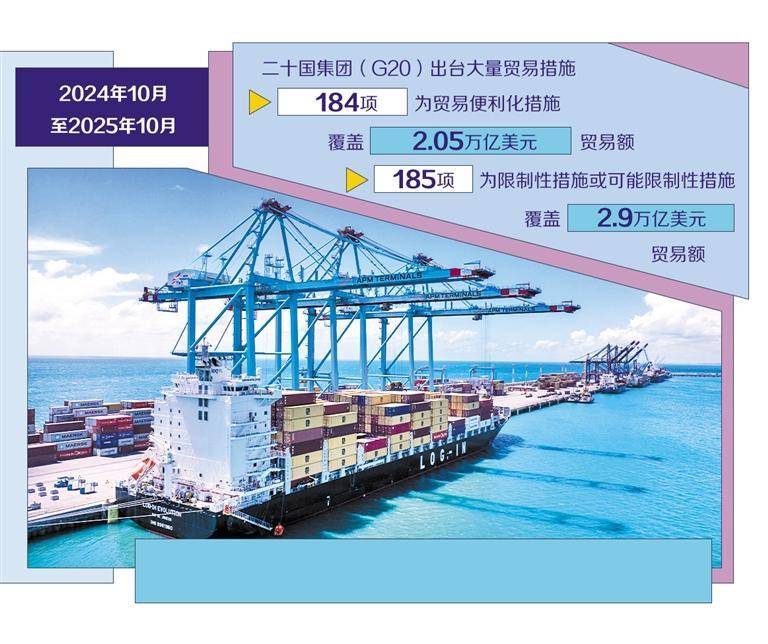
世贸组织报告显示——多边贸易体系面临更大重塑压力
Jing Ji Ri Bao· 2025-11-21 22:45
贸易限制性措施加剧贸易环境不确定性。报告共记录了185项贸易限制性或可能限制性的措施,创下了 贸易监测措施自2009年启动以来的最高纪录,覆盖贸易额高达2.90万亿美元,较上一期8290亿美元规模 大幅增加。其中进口受限贸易额高达2.60万亿美元,为上一期5980亿美元的4倍多。报告还指出,高达 2.35万亿美元的贸易受限额与2025年年初以来的美国贸易政策直接相关。限制性措施在类型上包括加征 进口关税、海关程序复杂化、设定进出口数量限制等。报告称,美国是推动限制性贸易措施的核心驱动 力,其采取的措施包括但不限于对加拿大、印度、巴西等多国实施25%至50%的额外进口关税,停止所 有国家的低价值免税进口豁免,对铜、木材、家具等产品实施新关税,以及与部分国家签署框架协议。 报告指出,限制性措施对二十国集团进口的影响迅速扩大,进口受限比例在1年之内从12.9%大幅跳升 至22%,反映关税链式反应正在累积。 全球贸易政策方向迎来长期性结构性调整。报告指出,贸易限制性措施在覆盖贸易额上首次盖过便利化 措施,反映的是"系统性外溢影响"而非某一国家的孤立行动,表明保护主义政策正逐渐抬头,而不是短 期震荡。限制性贸易政策加剧 ...
突发快讯!白宫通告全球:特朗普签署行政令,修改对巴西商品关税范围,引国际高度关注
Sou Hu Cai Jing· 2025-11-21 21:57
Core Points - The article discusses the significant adjustments made by the Trump administration regarding tariffs on Brazilian imports, highlighting a strategic balance between trade protectionism and domestic consumer needs [1][3]. Tariff Adjustment Details - The tariff adjustments are characterized by a targeted approach, maintaining a 40% tariff on industrial products and certain raw materials while exempting specific agricultural products like coffee and beef, as well as key aerospace components [3]. - This dual strategy aims to protect domestic manufacturing while alleviating inflationary pressures on essential consumer goods [3]. Strategic Considerations - The tariff changes reflect a threefold strategic calculation: addressing domestic consumer concerns, advancing U.S.-Brazil trade negotiations, and signaling a dual approach to trade policy [5]. - The exemption of tariffs on essential goods is seen as a move to mitigate domestic pressures and restore political support for the Trump administration [5]. - The retention of high tariffs on industrial goods serves to apply pressure on Brazil while demonstrating a willingness to negotiate with constructive partners [5]. Brazil's Response - Brazil's government has adopted a combination of strong rhetoric and flexible strategies in response to U.S. tariff policies, emphasizing the impact on American consumers [7]. - Brazil has diversified its export markets, significantly increasing coffee exports to China by 28%, thereby reducing reliance on the U.S. market [7]. - The Brazilian administration maintains open communication channels with the U.S. while advocating for its own trade interests [7]. Global Impact - The tariff adjustments highlight ongoing challenges in global trade, particularly the impact of unilateral trade policies on multilateral trade systems [9]. - Brazil faces an average tariff of 33% from the U.S., indicating a broader trend of trade protectionism affecting Latin America [9]. - The uncertainty in trade policies is prompting global companies to reassess their supply chains, leading to a long-term restructuring of global trade dynamics [9]. Conclusion Insights - The adjustments in tariffs reveal the complexities of modern international trade, emphasizing the need for a balance between competing interests [11]. - Emerging economies like Brazil can learn from these developments by diversifying their trade relationships and enhancing their negotiating power [11]. - The article underscores that despite rising protectionism, the interconnectedness of global supply chains and economic interests remains a driving force in international trade [11].
荷兰对中方阳奉阴违,至今未完全交出安世控制权,中方放话斗争到底!
Sou Hu Cai Jing· 2025-11-21 04:38
再者,当今世界的半导体产业链条极为复杂,任何一个环节的扭曲都可能引发供需失衡。安世半导体作为全球半导体供应链中不可忽视的一环,其 控制权的争夺将直接关系到整个产业的发展。因此,中国商务部的提醒尤为重要:如果荷兰继续延迟解决安世半导体的问题,最终受损的将是整个 欧盟的利益。面对全球经济形势的不确定性,各国更需把握机遇,表达善意,寻求共赢局面,而非通过单边措施来维护自身利益。 值得注意的是,自中方说出"斗争到底"的坚定态度后,舆论普遍解读为这是中国政府在探讨更大规模的战略反击。这表明,中国企业在国际市场上 的竞争能力与底气正在增强,反映出国家在高科技领域日益增强的自信。因此,荷兰在处理这一事件时,需更加谨慎,不仅要考虑短期的经济利 益,更要思考长远的战略布局。 在当今全球化的经济环境中,半导体产业作为高科技领域的核心,成为各国战略竞争的重要战场。而荷兰与中国之间围绕安世半导体的纠纷,无疑 是这场博弈中的一出精彩对决。近日,两国关于这一问题的磋商引发了广泛关注。在这场围绕投资控制权的争夺中,双方虽然达成了一些表面共 识,但实质上却暗藏着更为复杂的战略考量。 首先,让我们回顾一下事件的背景。安世半导体(Nexperi ...