
全国统一大市场

Search documents
山东:2026年首个“政策包”来了!
Xin Hua Wang· 2026-01-01 03:18
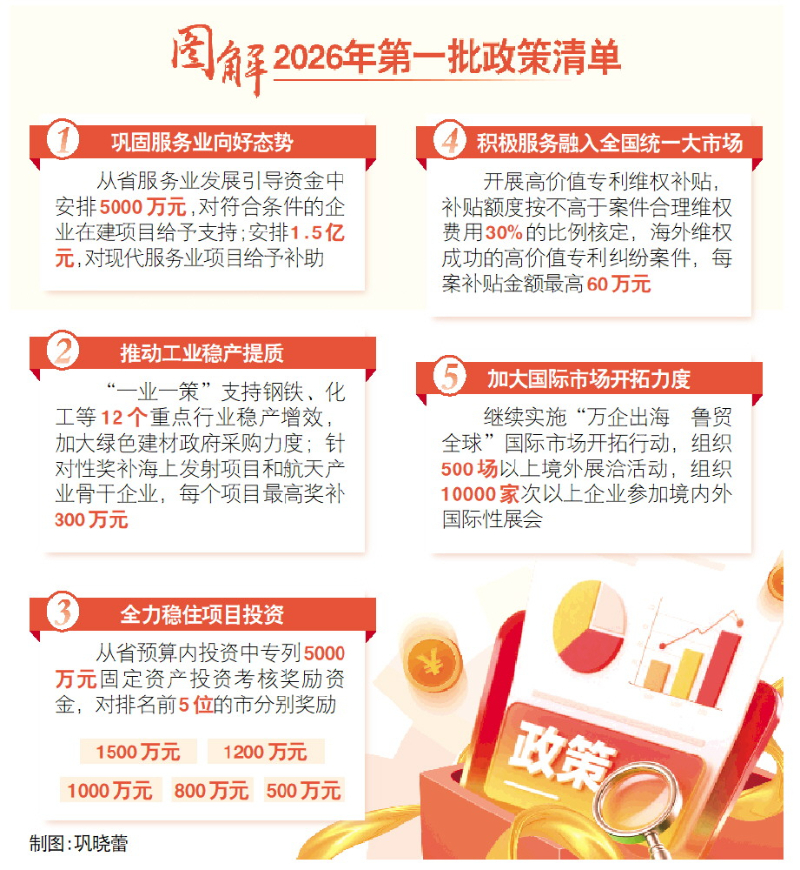
Core Viewpoint - The Shandong Provincial Government has released the first batch of policies for 2026 aimed at promoting economic stability and quality improvement, consisting of 28 measures across five areas, with a focus on supporting high-quality enterprises and project development [4]. Group 1: Economic Support Measures - The 2026 policy list includes 20 reward and subsidy measures, all aimed at enhancing enterprise development and project construction to stimulate market vitality [4]. - The policies are designed to integrate supply and demand, enhance service industry support, accelerate key project construction, and help enterprises explore overseas markets [4][5]. Group 2: Service Industry Focus - Shandong will allocate 50 million yuan from the provincial service industry development fund to support new and "quasi-standard" enterprises, with an additional 150 million yuan for modern service industry projects [5]. - Specific funding includes 90 million yuan for high-end productive service industries such as artificial intelligence and industrial internet, and 60 million yuan for key service sectors like logistics and warehousing [6]. Group 3: Industrial Stability and Quality Improvement - The province will implement tailored support for 12 key industries, including steel and chemicals, to stabilize production and enhance efficiency [6]. - Financial incentives will be provided for commercial space launch projects and key aerospace enterprises, with subsidies up to 3 million yuan per project [6]. Group 4: Investment and Market Integration - The policy aims to stabilize project investment by adjusting fixed asset investment assessments and providing 50 million yuan in rewards for top-performing cities [7]. - New models for attracting investment will be developed, including subsidies for high-value patent protection and support for public service platforms [7][8]. Group 5: International Market Expansion - Shandong will provide financial support for enterprises participating in key exhibitions and developing cross-border e-commerce, with plans for over 500 overseas exhibition activities in 2026 [8]. - The focus will be on traditional and high-value industries, with initiatives to support around 1,000 enterprises in cross-border marketing and brand development [8]. Group 6: Policy Implementation and Accessibility - The effectiveness of the policy package relies on its implementation, with plans to develop detailed measures and improve accessibility through the "Luhuitong" policy platform [9]. - The goal is to ensure that enterprises can quickly benefit from the policies, aiming for a strong economic start in the first quarter of the year [9].

体系化学理化研究阐释 | 经济改革理论的创新和突破
Xin Lang Cai Jing· 2026-01-01 02:18
转自:求是网 体系化学理化研究阐释 经济改革理论的创新和突破 ——学习习近平经济思想的经济改革理论 丁晓钦 改革是解放和发展社会生产力的关键,通过经济改革不断健全和完善经济体制,是激发经济发展活力、 确保经济持续健康发展的重要途径。党的十八大以来,习近平总书记深刻把握我国经济发展阶段性特征 和外部环境变化,立足我国经济社会发展伟大实践,着眼于推动高质量发展,坚持以经济体制改革为重 点全面深化改革,创造性地提出一系列新思想新观点新论断,形成了习近平经济思想的经济改革理论。 经济改革理论作为习近平经济思想的重要内容,既是改革思想的经济篇,也是经济思想的改革篇,深刻 回答了新时代以来我国以改革促发展的一系列重大理论和实践问题,揭示了社会主义现代化进程中经济 改革的一般规律,阐明了当前和今后一个时期以中国式现代化全面推进强国建设、民族复兴伟业的动力 所在,具有重大理论和实践意义。 一 经济改革的主要目的,在于通过不断调整生产关系激发社会发展内生动力,促进上层建筑更好适应经济 基础,最大限度地释放经济发展潜力,提升经济运行整体效率。纵观全球发展历程,二战后世界各国都 把经济改革当作破解经济发展难题、走出经济发展困境的重 ...

新年首个“政策包”来了!“含金量”满满
Da Zhong Ri Bao· 2026-01-01 01:53
Core Viewpoint - The first policy package of 2026, consisting of 28 measures, aims to support quality enterprise development and project construction, with 20 measures focused on rewards and subsidies to stimulate market vitality [1] Group 1: Economic Support Measures - The policy list includes five areas with 28 measures, emphasizing the integration of supply to stabilize the economy and enhance service industry support [1] - A total of 500 million yuan is allocated to support new and "quasi-standard" enterprises, with additional funds for modern service projects, particularly in high-end productive services [2] - The government will provide 1 billion yuan to support key projects in marine services and cultural tourism, including discounts for certain tourist attractions [2] Group 2: Industrial and Investment Support - The policy emphasizes "one industry, one policy" to support 12 key industries, including steel and chemicals, and aims to stabilize the construction industry through increased green building material procurement [3] - A total of 5 million yuan is allocated for fixed asset investment assessment rewards, with additional incentives for provincial enterprises in emerging industries [3] - The policy aims to optimize land and carbon emission indicators to ensure the construction of key projects [3] Group 3: International Market Development - The province will provide funding support for enterprises participating in key exhibitions and developing cross-border e-commerce, with a focus on traditional and high-value industries [5] - The "Ten Thousand Enterprises Going Global" initiative will organize over 500 overseas exhibition activities, involving more than 10,000 enterprises [5] - The policy aims to foster the integration of cross-border e-commerce with industrial clusters, supporting around 1,000 enterprises in various aspects of international marketing [5] Group 4: Implementation and Accessibility - The effectiveness of the policy package relies on its implementation, with plans to develop supporting measures and streamline the application process for enterprises [6] - The "Ru Hui Tong" policy platform will be utilized to enhance the accessibility of policy benefits, ensuring that enterprises can quickly access and enjoy the advantages of the new policies [6]
跃马扬鞭正当时(社论)
He Nan Ri Bao· 2025-12-31 23:29
Group 1 - The year 2026 marks the beginning of the "15th Five-Year Plan," which is a critical phase for the development of Henan province, emphasizing the need for strategic planning and execution to achieve success [3] - The provincial government has effectively released domestic demand potential, optimized the industrial system, and made significant progress in integrating into the national unified market, leading to improved governance and enhanced public welfare [2] - Key industrial clusters such as equipment manufacturing, modern food, and new materials have emerged, contributing to a robust economic landscape in Henan, with notable achievements in agricultural production and infrastructure development [2] Group 2 - The future five years are seen as a key stage for Henan to leverage its advantages, enhance innovation, deepen reforms, and promote high-quality development while focusing on consumer and investment potential [3] - The province aims to strengthen agricultural development, promote rural revitalization, and ensure ecological sustainability through green and low-carbon transitions [3] - There is a strong emphasis on improving people's livelihoods and addressing risks in key areas, showcasing a commitment to overcoming challenges and achieving ambitious goals [3]
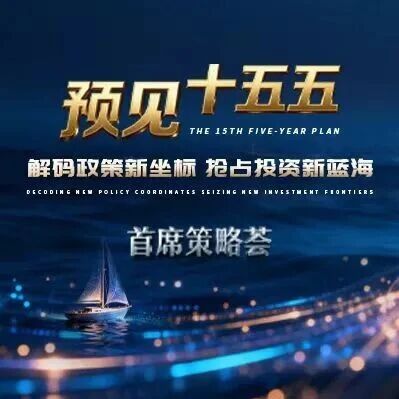
大变局、新蓝海:九方智投首席策略荟解码“十五五”投资新坐标
第一财经· 2025-12-31 13:06
Core Insights - The event held by Jiufang Zhituo focused on decoding investment opportunities under the new "15th Five-Year Plan" and emphasized the importance of technology innovation as a key to breaking through challenges [1][2] Macroeconomic Analysis - The global economy is expected to continue its stable recovery, with China's economy projected to grow between 4% and 5% in 2026, supported by fiscal policies and technological breakthroughs [5][7] - The meeting highlighted the need for a modern industrial system and emphasized the importance of income distribution reform to increase the final consumption rate above 50% [5][8] Investment Opportunities - The capital market is anticipated to experience structural opportunities concentrated in high-end manufacturing, technology consumption, and artificial intelligence [1][5] - The A-share market is expected to see a growth range of 10% to 20% in 2026, with the Shanghai Composite Index potentially reaching 4500 points [12][11] Sector Focus - The focus on technology remains strong, with an emphasis on AI applications transitioning from upstream computing power to downstream applications, particularly in mobile devices [15][21] - The renewable energy sector is expected to see a dual focus on "technology alpha" and "cyclical beta," with significant growth in the energy storage market driven by policy changes [23][21] AI Investment Trends - The discussion around AI investment highlighted a shift from "AI enabled" to "AI first," indicating a fundamental change in business models driven by AI [19][18] - The criteria for identifying "AI native" companies include a significant portion of revenue derived from AI and a high user retention rate [21][19] Precious Metals Outlook - The overall outlook for precious metals in 2026 is positive, with gold prices expected to rise due to ongoing demand and market conditions [16][12] - Silver is anticipated to benefit from industrial demand, particularly in the photovoltaic sector, with potential price elasticity higher than gold [16][12]
中集车辆接待17家机构调研,包括睿远基金、中信证券、长江证券、西南证券等
Jin Rong Jie· 2025-12-31 13:03
Group 1 - The core viewpoint of the news is that CIMC Vehicles has been actively engaging with various investment institutions to address investor concerns regarding its performance fluctuations and to highlight its strategic initiatives in the North American market and global southern markets [1][2]. Group 2 - CIMC Vehicles conducted investor meetings from December 1 to December 26, 2025, with 17 institutions, including Ruiyuan Fund and CITIC Securities [1]. - The company's latest stock price is 9.15 yuan, down 0.52 yuan or 5.38% from the previous trading day, with a total market capitalization of 17.148 billion yuan [1]. - The rolling P/E ratio of the automotive manufacturing industry is 27.12, with a median of 20.46, while CIMC Vehicles has a P/E ratio of 19.84, ranking 7th in the industry [1]. - For the first three quarters of 2025, CIMC Vehicles reported a non-recurring net profit attributable to shareholders of 622 million yuan, impacted by geopolitical issues and trade wars affecting market structure [1]. - The company has localized its manufacturing and delivery of semi-trailers in North America, including box-type and refrigerated semi-trailers [1]. - In the global southern market, CIMC Vehicles experienced a revenue increase of 15.79% and a sales volume increase of 21.39% in the first three quarters of 2025, with a gross margin increase of 2.6 percentage points [2]. - The company has sold over 30,000 units of the CIMC-Shaanxi Automobile "Three Good Development" model and established 15 "Three Good Centers" nationwide [2]. - As of September 30, 2025, CIMC Vehicles had 29,809 shareholders, a decrease of 5,707 from the previous count, with an average holding value of 575,300 yuan and an average holding of 62,900 shares [2].

年度报告 | 于613篇推文,见动能之变
Mei Ri Jing Ji Xin Wen· 2025-12-31 12:40
Group 1: Economic Trends and Developments - The year 2025 is characterized as "extraordinary" by the Central Economic Work Conference, highlighting significant economic transformations and developments [1] - China’s exports have shown resilience despite a complex external environment, with ASEAN, EU, and Belt and Road countries becoming key growth engines for foreign trade [2] - The "14th Five-Year Plan" is nearing completion, with new development strategies focusing on expanding domestic demand, high-level openness, and innovation-driven growth [2] Group 2: Artificial Intelligence and Innovation - The term "Hangzhou Six Dragons" has emerged as a key phrase in the artificial intelligence sector, marking a significant development in AI applications across various industries [3][4] - The introduction of local regulations for the embodied intelligent robot industry in Hangzhou signifies a growing focus on AI, with predictions indicating that the AI industry will grow from 486.2 billion yuan in 2026 to 1 trillion yuan by 2030, with a compound annual growth rate of 19.8% [4] - The Central Economic Work Conference has emphasized the establishment of international technology innovation centers in major regions, aiming to integrate innovation resources across broader areas [5] Group 3: Investment in Human Capital - The government has explicitly stated the importance of "investing in people," with initiatives such as childcare subsidies and free preschool education reflecting a shift towards prioritizing human development [6][7] - This focus on human capital is seen as a strategic adjustment to stimulate domestic demand and enhance economic growth, especially as the country transitions from a "demographic dividend" to a "talent dividend" [7] Group 4: Trade Connectivity and Foreign Trade - Trade is identified as a crucial mechanism for connecting domestic and international economic cycles, with traditional foreign trade provinces continuing to play a significant role [9] - The central government has initiated measures to enhance the integration of domestic and foreign trade, with a focus on diversifying markets and fostering new competitive advantages [10] Group 5: Infrastructure and Logistics - The revival of inland river shipping is highlighted as a strategic focus, with plans to increase the share of inland cargo transport in the overall transportation system by 2030 [11][12] - The development of inland shipping is seen as a means to lower logistics costs and enhance the efficiency of resource allocation across the country [12] Group 6: Economic Powerhouses - Economic powerhouses such as Guangdong, Jiangsu, and Zhejiang are expected to contribute significantly to national GDP, with the central government reiterating the importance of these provinces in driving economic growth [13][14] - The "15th Five-Year Plan" emphasizes the need for these provinces to lead development efforts, with specific targets set for GDP growth and modernization [14] Group 7: Hainan Free Trade Port - The establishment of the Hainan Free Trade Port is marked as a significant step in China's openness, with the port being the largest and most diverse in the world [15] - The operationalization of the free trade port is seen as a systemic experiment in opening up various sectors, including trade, finance, and talent [15][16]
“两新”政策如何优化?怎样持续扩大有效投资?国家发展改革委解读近期经济热点
Xin Hua Wang· 2025-12-31 11:17
Group 1: Optimization of "Two New" Policy Implementation - The "Two New" policy for 2026 focuses on optimizing support for equipment updates, promoting green low-carbon smart products, and enhancing fund usage supervision [2] - The support scope has been expanded to include updates in the livelihood, safety, and consumer infrastructure sectors, with a focus on high-impact consumer goods [2] - Subsidty standards have been adjusted, including differentiated subsidies for old elevator replacements and a shift to percentage-based subsidies for cars and energy-efficient appliances [2] - The implementation mechanism will be optimized to ensure uniform subsidy standards across the nation and address issues like subsidy unpredictability and fraud [2] Group 2: Continuous Expansion of Effective Investment - The National Development and Reform Commission (NDRC) has organized the early batch of "Two Heavy" construction projects for 2026, totaling approximately 295 billion yuan [3] - About 220 billion yuan is allocated for "Two Heavy" construction projects, focusing on urban underground pipelines, high-standard farmland, and logistics cost reduction [3] - Over 75 billion yuan is designated for central budget investments in urban renewal, water conservancy, ecological protection, and pollution control [3] - The NDRC is also promoting "soft construction" measures to improve investment models and mechanisms in urban infrastructure [3] Group 3: Advancing the National Unified Market Construction - The construction of a national unified market is described as both a critical and ongoing challenge, with a focus on problem-oriented approaches [4] - The NDRC plans to publish a list of obstacles to the construction of a unified market and develop policies to promote healthy investment [4] - Efforts are underway to eliminate local barriers to market entry, with over 38,000 documents reviewed and more than 2,300 regulations identified for revision or repeal [5] Group 4: Promotion of National Zero-Carbon Park Construction - The establishment of zero-carbon parks is a key step towards systematic innovation in renewable energy and pollution control technologies [6] - The first batch of 52 zero-carbon parks has been announced, characterized by balanced regional distribution and strong renewable energy absorption capabilities [6] - The NDRC emphasizes that the announcement is not merely for recognition but aims to create "green transformation highlands" with actionable plans and guaranteed funding [6]
中集车辆(301039) - 2025年12月26日投资者关系活动记录表
2025-12-31 08:26
Group 1: Investor Relations Activities - The company participated in multiple one-on-one roadshow meetings from December 1 to December 26, 2025, with various financial institutions including CITIC Securities and Southern Fund [2] - The company also attended several broker strategy meetings during the same period, including events hosted by Guojin Securities and Dongfang Securities [3] Group 2: Business Performance and Strategy - The company's performance has been under pressure due to geopolitical issues and trade conflicts affecting the North American market, leading to a structural change in the market [3] - In Q3 2025, the North American semi-trailer market demand remained weak, with new order volumes at historical lows, and dealer inventories down nearly 50% year-on-year [5] - The company aims to enhance its supply chain resilience in North America while expanding its global southern market strategy, achieving a revenue growth of 15.79% and a sales increase of 21.39% in the southern semi-trailer business in the first three quarters of 2025 [7][8] Group 3: Product Development and Innovation - The company is focusing on developing a "pure electric head and trailer integrated product" to meet user needs throughout the product lifecycle [4] - The "Three Good Development" initiative has established 15 centers nationwide, with plans for 10 more, contributing to the sales of over 30,000 vehicles [6][7] Group 4: Market Expansion and Local Adaptation - The company is actively building local assembly and delivery centers in the global southern market, enhancing local economic integration and creating jobs [8] - The company is committed to supporting the construction of a unified national market by establishing a marketing service company in the northwest and improving resource coordination [9]
国家发展改革委:2026年提前批“两重”项目共安排约2200亿元
智通财经网· 2025-12-31 07:07
智通财经APP获悉,12月31日,国家发展改革委召开12月份新闻发布会。会上,国家发展改革委政策研 究室副主任李超表示,近日国家发展改革委抓紧组织下达2026年提前批"两重"建设项目清单和中央预算 内投资计划,共计约2950亿元。"两重"建设方面,强化"两重"性质、坚持自上而下、注重软硬结合,共 安排约2200亿元,支持城市地下管网、高标准农田、三北工程、有效降低全社会物流成本等领域的281 个项目,进一步突出"两重"建设的战略性、前瞻性、全局性。中央预算内投资方面,聚焦需要集中力 量、持续投入、补短板调结构惠民生的公共领域,安排超过750亿元,支持城市更新、水利、生态保护 修复、污染治理、节能降碳等方面的673个项目,充分发挥政府投资引导带动作用。 李超表示,与此同时还加快推出一批"软建设"举措,推动各类资金财尽其用,不断提高投资效益。比 如,推动完善城市地下管网建设改造投融资模式和市政公用事业价费机制,健全灌区农业节水激励机 制,加快完善现代物流标准体系,着力构建固体废弃物综合治理体系等,推动形成项目建设实施和运营 维护的长效机制。 中央经济工作会议对明年经济工作作出全面部署,国家发展改革委,深入学习领会 ...