
红利策略

Search documents
中小风格行情特征鲜明,500质量成长ETF(560500)上涨0.42%
Sou Hu Cai Jing· 2025-06-09 03:55
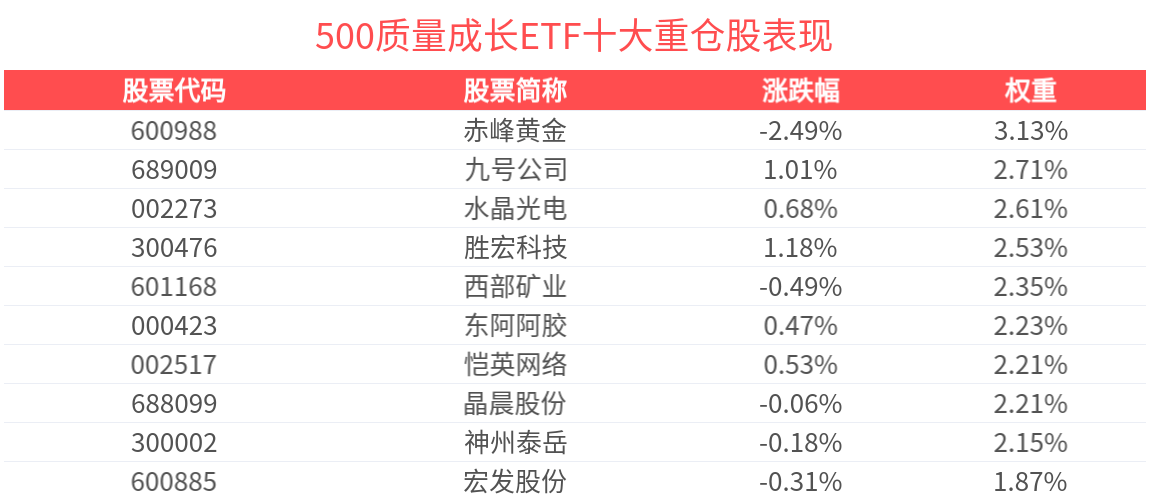
Core Insights - The article highlights the performance of the CSI 500 Quality Growth Index, which has shown a positive trend with a 0.35% increase as of June 9, 2025, and mentions specific stocks that have performed well within this index [1] - It emphasizes the outperformance of small-cap stocks this year, driven by improved risk appetite among individual investors, with a focus on identifying high-quality potential "new blue chips" [1] - The report indicates that the quality factor has gained prominence, with the CSI 500 Quality Index outperforming for two consecutive years, while dividend strategies have narrowed, leaving banks as the sole standout [1] Performance Summary - As of May 30, 2025, the top ten weighted stocks in the CSI 500 Quality Growth Index include Chifeng Jilong Gold Mining (600988), Ninebot (689009), and Shenghong Technology (300476), collectively accounting for 23.79% of the index [2] - The performance of individual stocks within the index varies, with notable movements such as Chifeng Jilong Gold Mining decreasing by 2.49% and Ninebot increasing by 1.01% [4] Investment Strategy - The report suggests that investors should focus on stocks with high SIRR (Sustainable Internal Rate of Return) and improving performance in semi-annual reports, particularly within the small-cap segment [1] - It also notes that as economic stability improves, high SIRR stocks in the CSI 300 Quality Growth Index are expected to gradually rise [1]

本周聚焦:近期多家银行宣布分红派息
GOLDEN SUN SECURITIES· 2025-06-08 10:58
Investment Rating - The report maintains an "Overweight" rating for the banking sector [7] Core Insights - The average dividend yield for listed banks is 4.14% as of June 6, 2025, with state-owned banks yielding between 4.3% and 5% [2][3] - The dividend payout ratios for several banks have increased compared to 2023, indicating a positive trend in shareholder returns [1][2] - The banking sector is expected to benefit from expansionary policies aimed at stabilizing the economy, which may enhance investment opportunities [3] Summary by Sections Dividend Distribution - As of June 6, 2025, 11 banks have completed their annual dividend distributions, with notable early payouts in April and May, compared to previous years [1] - Some banks have increased their annual dividend payout ratios, such as Ningbo Bank (+6.4%), Xi'an Bank (+7.3%), and others [1] Sector Performance - The banking sector is projected to benefit from government policies aimed at economic stabilization, with specific banks like Ningbo Bank, Postal Savings Bank, and others highlighted as potential investment opportunities [3] - The report emphasizes the stability of bank profits and the long-term value of dividends, making the sector attractive for medium to long-term investments [2] Key Data Tracking - The average daily trading volume for stocks reached 12,089.75 billion yuan, reflecting an increase from the previous week [4] - The balance of margin financing and securities lending increased by 0.13% to 1.81 trillion yuan [4]






投资加点红︱为什么说当下红利投资进入顺风区
Xin Lang Ji Jin· 2025-06-06 02:59
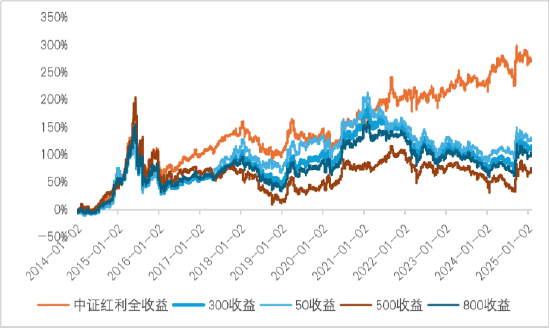
Core Viewpoint - The current market environment is favorable for dividend investment, with policies and interest rate trends supporting the attractiveness of dividend assets [3][5][6]. Group 1: Dividend Index Performance - The Dividend Total Return Index has shown a consistent upward trend since 2014, indicating that long-term holding of dividend assets yields positive returns [1]. - The performance of dividend assets is expected to improve due to new regulations in public funds that emphasize long-term performance, aligning well with the characteristics of dividend investments [3]. Group 2: Market Conditions Favoring Dividend Assets - The current dividend yield of the CSI Dividend Index is 6.36%, placing it in the 96th percentile of the past decade, suggesting high dividend payouts and stable company earnings [5][8]. - There is a historical inverse relationship between dividend assets and interest rates, where declining interest rates enhance the appeal of dividend-paying stocks, leading to increased investment in these assets [5][6]. Group 3: Strategic Implications for Investors - The emphasis on long-term performance in public fund regulations magnifies the advantages of dividend strategies, making them a key focus for investors looking for stable returns [6]. - Despite potential short-term market fluctuations, the long-term stability and lower valuations of dividend assets present a compelling investment opportunity in the current environment [6].
基本功 | 固收+都能加些啥?
中泰证券资管· 2025-06-05 08:07
Group 1 - The core idea emphasizes the importance of foundational knowledge in investment and fund selection, suggesting that solid fundamentals are essential for successful investing [2] - ELR+ can incorporate various assets and strategies, with common combinations including fixed income and equities, which can be further categorized into high dividend strategies, dividend strategies, and cyclical stock strategies. Additionally, participation in stock IPOs to capture listing premiums is mentioned [3] Group 2 - A promotional offer is available for new investors holding Zhongtai Asset Management products, providing a reward for first-time certification before April 30 [5]

基本功 | 固收+都能加些啥?
中泰证券资管· 2025-06-05 08:07
扫码进入基本功专栏 持有人首次认证有礼啦!只要在4月30日前持有中泰资管产品并持有至今且的新朋友,长按识别下方 二维码前往认证,即可获得 影音会员月卡 一份 本材料不构成投资建议,观点具有时效性。本公司承诺以诚实信用、勤勉尽责的原则管理和运用基金资产,但不 保证基金一定盈利,也不保证最低收益。投资有风险,基金过往业绩不代表其未来表现。基金管理人管理的基金 的业绩不构成对其他基金业绩表现的保证。投资者投资基金时应认真阅读基金的基金合同、招募说明书、基金产 品资料概要等法律文件。基金管理人提醒投资者基金投资的"买者自负"原则,请投资者根据自身的风险承受能力 选择适合自己的基金产品。基金有风险,投资须谨慎。 基本功的基,就是基金的基。 做好投资、买对基金, 从夯实投资基金的基本功开始。 1分钟GET一个知识点, 起步更轻松。 ELR+ 可以怎么加? "+"的部分包括多种资产 和策略,常见的有以下几种。 固收+股票,这是较为常见的搭配,根据股票性质的 不同,还可分为 高股息策略. 红利策略、周期股策略 等。也可参与股票 打新,赚取新股上市溢价。 ...

华安基金:险资长期投资试点扩围,红利板块或受增量资金青睐
Xin Lang Ji Jin· 2025-06-04 09:03
Market Overview and Key Insights - The Hong Kong stock market showed divergence last week, with the dividend sector continuing to lead gains, as the Hang Seng China Central State-Owned Enterprises Dividend Total Return Index rose by 0.25%, while the Hang Seng Index fell by 1.11% and the Hang Seng Tech Index dropped by 1.43% [1] - Southbound capital inflows continued to expand, averaging a net inflow of HKD 5.6 billion per day, totaling approximately HKD 28.1 billion, compared to a net outflow of about HKD 19 billion the previous week [1] - The insurance capital long-term investment pilot program is accelerating, with an announcement to further expand the pilot scope and approve an additional HKD 60 billion, bringing the total approved amount to HKD 222 billion [1][2] Insurance Capital and Dividend Stocks - Under the new accounting standards, insurance capital is increasingly inclined to allocate to high-dividend stocks, as dividends can be recognized in profit while market value fluctuations do not impact current profits, thus stabilizing earnings [2] - The dividend yield of the Hang Seng China Central State-Owned Enterprises Dividend Index is 7.91%, significantly higher than the 6.33% of the CSI Dividend Index, with a price-to-book ratio of 0.6 and a price-to-earnings ratio of 6.46 [2] - The low interest rate environment and weak economic recovery in China are favorable for dividend strategies, with state-owned enterprises showing strong willingness and capability to distribute dividends [2] ETF Overview - The Huaan Hong Kong Stock Connect Central State-Owned Enterprises Dividend ETF (code: 513920) tracks the Hang Seng China Central State-Owned Enterprises Dividend Index, reflecting the performance of high-dividend securities listed in Hong Kong with state-owned enterprises as major shareholders [3] - This ETF is the first in the market to combine the attributes of Hong Kong stocks, state-owned enterprises, and dividends, providing investors with opportunities to capitalize on the valuation reshaping of state-owned enterprises [3] ETF Performance - The top ten weighted stocks in the Hang Seng China Central State-Owned Enterprises Dividend Index include major banks and insurance companies, with Citic Bank and China People's Insurance Group each holding a weight of 4.0% [5] - The performance of these stocks over the past 12 months shows varying total returns, with Citic Bank at 8.0% and China People's Insurance Group at 4.7% [5]

日成交额、规模屡创上市以来新高!港股红利ETF博时(513690)兼备低估值+高股息,备受市场关注
Xin Lang Cai Jing· 2025-06-04 02:51
Core Viewpoint - The arrival of a low interest rate era highlights the importance of dividend assets, particularly in the Hong Kong stock market, where state-owned enterprises play a significant role in dividend distribution [1] Group 1: Dividend Assets in the Market - A-shares are expected to see total dividends exceed 2.4 trillion yuan in 2024, with state-owned enterprises accounting for over 80% of this amount [1] - Hong Kong's central enterprises are positioned as key dividend payers, offering both high yields and valuation advantages [1] - The current trading congestion of Hong Kong dividend assets has decreased, supported by the ongoing pilot programs for long-term capital inflows [1] Group 2: Investment Strategies and Recommendations - The banking sector continues to show mid-to-long-term investment value, with ongoing dividend plans and valuation enhancement initiatives from major banks [1] - High dividend yield and strong asset quality banks are recommended for their absolute return potential and cost-effectiveness in allocation [1] Group 3: Performance of Dividend Indices and ETFs - The leading dividend index in the Hong Kong market is the Hang Seng Hong Kong Stock Connect High Dividend Yield Index, with the corresponding ETF, Bosera (513690), ranking first in both scale and daily trading volume [2] - As of June 4, 2025, the Bosera ETF reached a new high in price and size, totaling 4.043 billion yuan [2] Group 4: Advantages of the Bosera ETF - The Bosera ETF has a leading dividend yield of 8.02%, significantly higher than its peers, making it an attractive option for investors seeking stable income [4] - The top holdings of the ETF focus on energy and financial sectors, with notable performance in recent months, showcasing both cyclical resilience and defensive attributes [5] - The ETF employs strict risk control measures, excluding stocks with significant price declines and ensuring liquidity, thus enhancing the investment experience [7]



红利+微盘: 反转策略姐妹花
雪球· 2025-05-31 02:32
Core Viewpoint - The article discusses the advantages of reversal strategies in the A-share market, highlighting the unique characteristics of this market that make such strategies effective [3][6]. Group 1: Market Characteristics - A-share market is known for its rapid trend changes and high volatility, with popular sectors averaging a duration of less than six months over the past decade [3]. - The market is characterized by a high proportion of retail investors, leading to emotional trading that exacerbates short-term fluctuations [4]. - Intense capital competition results in a "quick in and out" trading behavior among investors [5]. Group 2: Reversal Strategies - Reversal strategies, which involve buying recently underperforming stocks, leverage market sentiment swings to identify value recovery opportunities [6]. - The article introduces two main reversal strategies: Dividend Strategy and Micro-cap Strategy [6]. Group 3: Dividend Strategy - The Dividend Strategy focuses on stocks with significantly high dividend yields, which are often undervalued due to market pessimism or short-term fluctuations [7]. - This strategy aims to capture price recovery as the market corrects its mispricing of stable assets, with regular rebalancing being crucial for its effectiveness [8]. Group 4: Micro-cap Strategy - The Micro-cap Strategy targets the smallest listed companies, which are often overlooked and can experience significant price rebounds when market conditions improve [9]. - These stocks are sensitive to market trends and can quickly respond to changes, making them attractive during specific market phases [9]. - The performance of micro-cap stocks has outpaced mainstream indices in 2023, indicating their potential for high returns [9]. Group 5: Combined Strategy Benefits - Combining Dividend and Micro-cap Strategies can provide complementary advantages, reducing volatility and expanding the range of investment opportunities [10]. - The Dividend Strategy offers stability, while the Micro-cap Strategy provides high elasticity, allowing for a balanced approach to different market conditions [10]. Group 6: Conclusion - The article emphasizes the importance of understanding the underlying logic of these strategies and their applicable environments for achieving excess returns in the A-share market [16]. - It suggests that ordinary investors can consider index funds or quantitative products that track these strategies for diversified participation [16].

节前最后一个交易日银行板块逆势上涨,国企红利ETF(159515)涨0.37%
Sou Hu Cai Jing· 2025-05-30 06:02
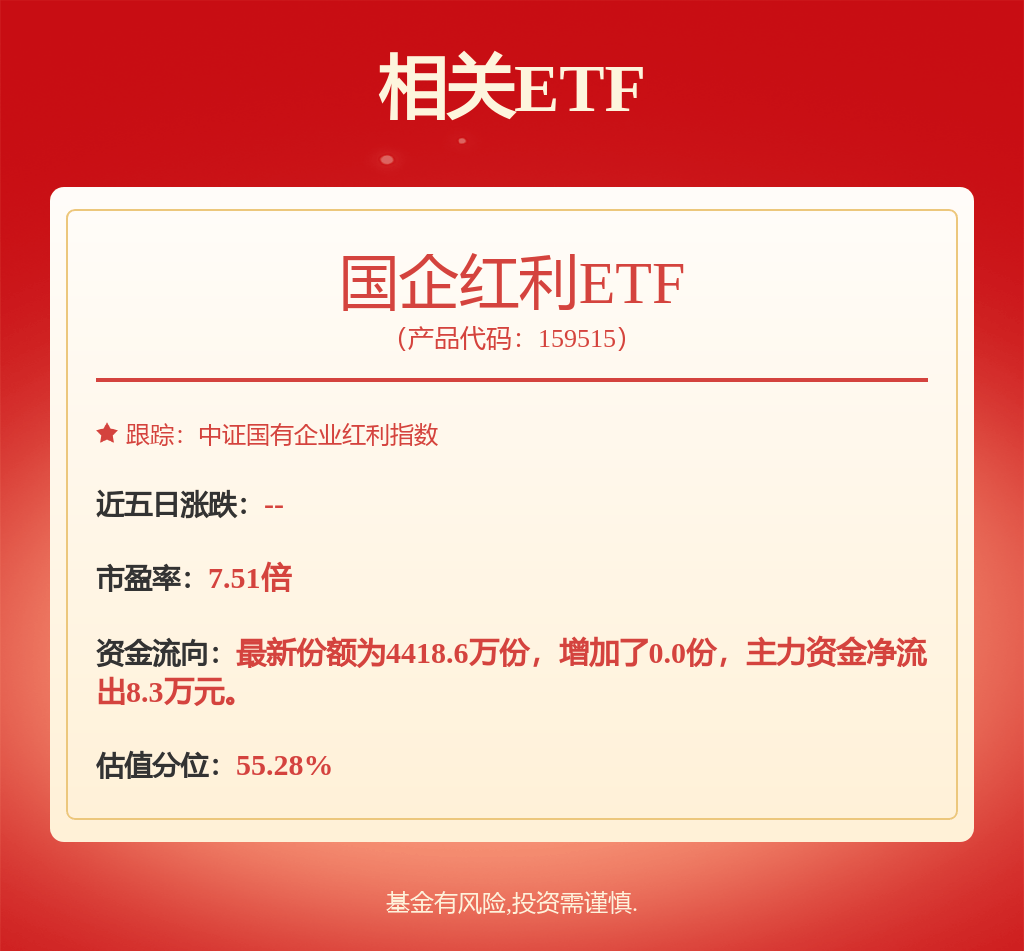
Group 1 - The core viewpoint of the articles highlights the performance of the national enterprise dividend sector, which is showing resilience amid a broader market decline, with the National Enterprise Dividend ETF (159515) rising by 0.37% [1] - The banking sector is entering a dividend season, with disclosed annual dividends for 2024 amounting to 616.126 billion yuan, including over 230 billion yuan in interim dividends from the previous year [1] - Major banks reported a total annual dividend exceeding 420 billion yuan, with many small and medium-sized banks also announcing profit distribution plans, indicating a strong focus on dividend attributes in the banking sector [1] Group 2 - The National Enterprise Dividend Index (code 000824) combines themes of state-owned enterprises and dividend strategies, enhancing the effectiveness of investment strategies [2] - The National Enterprise Dividend ETF (159515) tracks the China Securities State-Owned Enterprise Dividend Index (000824), which is expected to benefit from further reforms in state-owned enterprises, improving profitability and operational efficiency [2] - The dividend factor is anticipated to identify high-quality state-owned enterprises with strong profitability and low valuations, making the National Enterprise Dividend ETF a noteworthy investment opportunity [2]
主动增强型红利策略:优选景气赛道,挖掘红利Alpha
Xiangcai Securities· 2025-05-29 15:16
Group 1 - The report emphasizes a balanced high dividend and high payout strategy by combining dividend yield and payout ratio factors to identify investment opportunities [4][12][19] - High dividend sectors include banking, coal, and oil & petrochemicals, which are characterized by low valuations and stable returns, presenting good allocation opportunities as state-owned enterprises enhance market value management [4][19] - High payout sectors focus on consumer industries such as textiles, food and beverage, and light manufacturing, which exhibit high payout ratios and good growth potential, benefiting from stable free cash flow and active capital markets under current growth policies [4][19] Group 2 - The stock selection criteria involve identifying stocks with sustainable dividend strategies, setting minimum dividend yield requirements, and utilizing a scoring system based on payout ratio, dividend yield, growth, and valuation [5][20][23] - The backtesting results indicate a cumulative return of 194.19% over five years, with an annualized return of 24.15%, significantly outperforming the dividend quality index by 125.07% [5][28][30] Group 3 - The industry weight adjustment strategy includes monitoring key indicators such as net interest margin and non-performing loan ratios in the banking sector, while also considering risks affecting asset quality [6][41] - For the coal industry, the focus is on monitoring coal prices and consumption rates, with expectations of marginal improvement as summer electricity demand rises [6][41] - The oil and petrochemical sector is analyzed based on price differentials and supply-demand dynamics, with expectations of oversupply continuing into 2025 [6][41] Group 4 - Future optimization strategies include expanding industry selection beyond current sectors based on historical data, establishing differentiated evaluation logic for various industries, and incorporating operational quality indicators to enhance the sustainability of dividends [9][45][48]