
量子计算

Search documents
券商晨会精华 | 国产GPU发展有望加速 带动集成电路制造以及设备和材料需求
智通财经网· 2025-12-24 00:30
市场昨日冲高回落,沪深两市成交额1.9万亿,较上一个交易日放量379亿。从板块来看,海南自贸概念 局部强势,半导体设备、有色·钨概念表现活跃。下跌方面,商业航天概念冲高回落,旅游概念多股下 挫。截至昨日收盘,沪指涨0.07%,深成指涨0.27%,创业板指涨0.41%。 在今天的券商晨会上,华泰证券指出,中国游戏企业的出海已全面进入"高质量增长新时代";银河证券 表示,国产GPU发展有望加速,带动集成电路制造以及设备和材料需求;中信建投认为,量子计算产业 正迎来高速增长阶段。 华泰证券:中国游戏企业的出海已全面进入"高质量增长新时代" 中信建投:量子计算产业正迎来高速增长阶段 中信建投表示,2025年是"国际量子科学与技术年",亦是量子科技加速从理论研究向产业应用迈进的关 键之年。全球主要国家纷纷加码量子战略布局,我国"十五五"规划将量子科技列为未来产业之首,量子 科技已然成为全球新的角力场。量子计算作为量子科技皇冠上的宝石,技术壁垒最高、颠覆性最强、成 长潜力最大,有望通过实现指数级算力突破重塑经典计算边界,是下一代科技革命的关键引擎。当前, 量子计算正处在含噪声的中等规模量子时代,超导、离子阱、光量子以及中 ...



中信建投:量子计算是下一代科技革命的关键引擎
Xin Lang Cai Jing· 2025-12-24 00:02
Core Insights - 2025 is designated as the "International Year of Quantum Science and Technology," marking a pivotal year for the transition of quantum technology from theoretical research to industrial application. Major countries are intensifying their quantum strategic layouts, with China's "14th Five-Year Plan" prioritizing quantum technology as a key future industry, establishing it as a new arena for global competition [1][3][18]. Industry Overview - Quantum computing, regarded as the crown jewel of quantum technology, possesses the highest technical barriers, the strongest disruptive potential, and the greatest growth prospects. It is expected to redefine the boundaries of classical computing through exponential computing power breakthroughs, serving as a critical engine for the next technological revolution [1][3][18]. - The quantum computing industry is entering a high-growth phase, with the global market projected to exceed $800 billion by 2035. The downstream sector is still in its early development stage but holds significant growth potential [1][11][29]. Technological Landscape - The current era of quantum computing is characterized as the noisy intermediate-scale quantum (NISQ) era, with mainstream technological paths such as superconducting, ion trap, photonic, and neutral atom technologies advancing simultaneously without convergence. The upstream of the industry chain, which includes quantum chips and measurement control systems, is a key development focus [1][4][22]. - The midstream encompasses quantum computers and software algorithms, where high costs and algorithm complexity may lead cloud platforms to become critical for accelerating penetration into downstream applications [4][22]. Market Potential - According to Photon Box Research Institute, the quantum computing industry is expected to enter a high compound growth phase, with the global market size projected to grow from approximately $5 billion in 2024 to around $800 billion by 2035, capturing nearly 90% of the quantum technology market share. The upstream sector is relatively mature and shows significant growth, while the downstream sector is in its infancy with substantial growth potential [11][29].


他,2025地表最狠科技人
3 6 Ke· 2025-12-24 00:00
Core Viewpoint - Alphabet, Google's parent company, has seen a significant market value increase of approximately $530 billion in November, driven by strong expectations regarding its dominance in the AI sector, particularly with the launch of its TPU chips, which are seen as a direct challenge to Nvidia's market position [1][2]. Group 1: Leadership and Strategy - Sundar Pichai, the CEO of Google, is recognized for his calm and strategic leadership during critical times, successfully guiding the company through challenges and positioning it for future growth [2][10]. - Pichai's background as a product manager has shaped his approach to leadership, emphasizing product experience and user engagement [5][10]. - Under Pichai's leadership, Alphabet's market value increased from $300 billion in 2015 to $930 billion in 2019, showcasing his effective management and strategic vision [10]. Group 2: AI and Technological Advancements - The launch of Gemini 3.0, Google's latest AI model, has surpassed competitors like GPT-5 in benchmark tests, marking a significant comeback for Google in the AI landscape [12][16]. - Google's TPU chips, designed specifically for AI computations, have become a competitive advantage, reducing operational costs significantly compared to Nvidia's GPUs [17][18]. - The integration of Gemini 3.0 across Google's product ecosystem allows for seamless user experiences and enhances the company's advertising revenue, which reached $741.8 billion in Q3 [23][24]. Group 3: Organizational Culture and Management Style - Pichai's management style is characterized by humility and a collaborative approach, fostering a positive internal culture at Google [25][26]. - His ability to communicate effectively with diverse teams has been crucial in aligning Google's various departments towards common goals [10][26]. - Pichai's focus on working with talented individuals has been a key factor in Google's strategic decisions, especially in the face of competition from OpenAI [27][28].

华尔街见闻早餐FM-Radio|2025年12月24日
Sou Hu Cai Jing· 2025-12-23 23:30
Market Overview - Technology stocks supported the market, with major US indices opening lower but closing higher, marking four consecutive days of gains, and the S&P 500 reaching a record high [1] - Nvidia shares surged by 3% following news about chip tariffs, while Tesla fell over 0.6%, being the only tech giant to decline [1] - The approval of an oral weight-loss drug in the US led Novo Nordisk's stock to rise over 9%, contributing to European indices hitting historical highs [1] - The US GDP grew by 4.3% in Q3, the fastest growth in two years, impacting interest rate expectations and causing US Treasury prices to fall [2][10] - Bitcoin dropped over 2% during the day, falling below $87,000 [1] Company News - Novo Nordisk's oral GLP-1 weight-loss drug received FDA approval, with a monthly price of $149, showing potential for a 16.6% weight reduction and cardiovascular risk reduction [22] - Smart driving technology advanced as Beijing issued the first L3-level autonomous driving vehicle licenses, marking a significant step in China's autonomous vehicle industry [9][26] - Zhizhu AI launched its flagship model GLM-4.7, outperforming leading models in several benchmarks, indicating a competitive edge in the AI market [9] Industry Developments - The US added "untrusted supplier lists" for the drone sector, prompting China's Ministry of Commerce to call for the immediate withdrawal of such measures [8] - The real estate market in China is set to stabilize by 2026, focusing on controlling supply and inventory through city-specific policies and enhancing project financing [2][7] - The copper market reached a historic high of over $12,000 per ton, driven by supply shortages and increased demand due to tariff expectations [13] - The global AI infrastructure spending is expected to surpass office building investments, with Oracle signing a significant leasing deal worth $248 billion [23][24]

重磅!全球关键电子材料应用进展与我国未来发展方向(23000字)
材料汇· 2025-12-23 15:04
Core Viewpoint - The article emphasizes the importance of electronic materials in various high-tech industries, highlighting the need for innovation and domestic production capabilities to enhance China's competitiveness in the global market [7][9]. Group 1: Industry Overview - Electronic materials are crucial for manufacturing electronic devices, integrated circuits (ICs), and optoelectronic devices, directly impacting product functionality and efficiency [7]. - The global semiconductor industry is projected to reach a total sales of $526.8 billion in 2023, with IC electronic materials accounting for approximately 12.7% of this market [7]. - The demand for electronic materials is increasing in sectors such as ICs, display technology, photovoltaic energy, and high-end capacitors/resistors, driven by advancements in information technology and communication [7][9]. Group 2: Key Electronic Materials - **Semiconductor Materials**: Silicon (Si) is the primary material used in over 95% of semiconductor devices, with a market dominated by companies like Shin-Etsu Chemical and Sumco, holding over 90% market share in 8-12 inch wafers [11][15]. - **Electronic Specialty Gases**: The market for electronic specialty gases is highly concentrated, with major players like Air Products and Linde holding over 80% market share. The largest category, NF3, has a market size of $8.8 billion [16][18]. - **Photoresists**: The photoresist market is critical for IC manufacturing, with costs accounting for about 35% of total chip manufacturing costs. The development of EUV photoresists is essential for advanced nodes below 7nm [19][21]. - **Wet Electronic Chemicals**: The global market for wet electronic chemicals was valued at 639.1 billion yuan in 2022, with a projected growth rate of 8.9% annually [25]. - **CMP Materials**: Chemical Mechanical Polishing (CMP) materials are vital for achieving high precision in wafer manufacturing, with the global market for CMP pads and slurries growing significantly from 2016 to 2021 [28][29]. - **Third-Generation Semiconductor Materials**: Materials like SiC and GaN are gaining traction due to their superior properties for high-frequency and high-power applications, with China's market for these materials reaching approximately 85.4 billion yuan in 2023 [30][31]. Group 3: Market Dynamics and Trends - The electronic materials industry is characterized by a high degree of international competition, with the U.S., Europe, Japan, South Korea, and China being the main players [8]. - The ongoing technological revolution and industrial transformation present both challenges and opportunities for the electronic materials sector, necessitating advancements in material performance to meet the demands of emerging technologies like 6G and quantum computing [8][9]. - The article highlights the need for China to enhance its domestic production capabilities and innovation in electronic materials to ensure supply chain security and reduce reliance on foreign imports [9].

美股散户势力崛起:2025年资金破纪录,华尔街机构正被迫“随散户起舞”
智通财经网· 2025-12-23 13:33
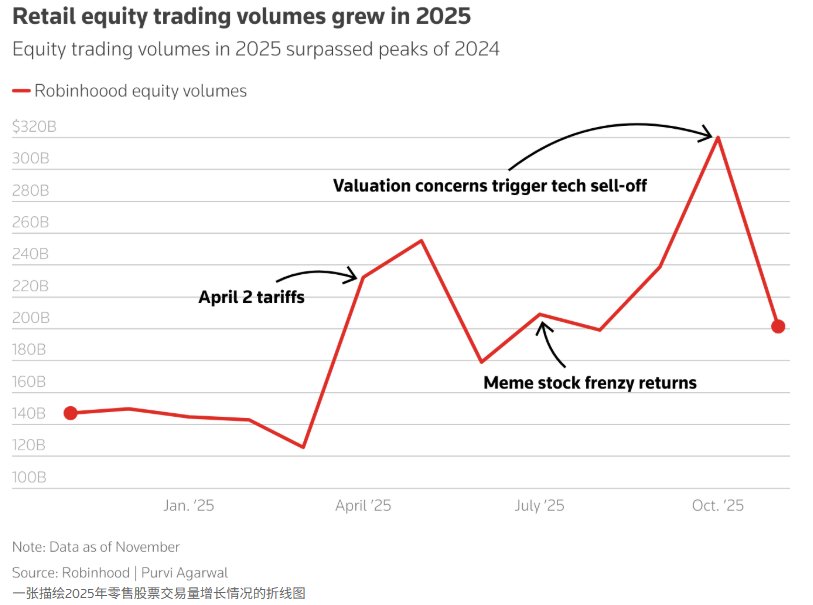
Core Viewpoint - Retail investor inflows into the US stock market are expected to reach a record high in 2025, driven by interest rate cut expectations, making individual investors a significant force behind the potential market rebound that may continue into next year [1]. Group 1: Retail Investor Activity - Retail investors have contributed $302 billion to the US stock market in 2025, a 53% increase from $197 billion in the same period last year, and 14% higher than the record $270 billion during the retail trading frenzy in 2021 [1]. - Retail trading accounted for approximately 20%-25% of total trading activity this year, peaking at around 35% in April [1]. - Retail investors have been actively buying quality stocks during market sell-offs, notably after the global market crash in April triggered by tariff policies, which helped push the S&P 500 index to new highs, with the index up about 16% this year [1]. Group 2: Popular Stocks and Trends - AI concept stocks like Nvidia and Palantir have become favorites among retail investors, with Palantir's value more than doubling as retail investors bought the dip when institutional investors exited due to valuation concerns [5]. - Tesla's stock reached a historical high on December 17, marking its first peak since the end of 2024, indicating strong retail interest [5]. - Retail investors are increasingly favoring ETFs that track stock indices, cryptocurrencies, and commodities, with significant interest in leveraged ETFs [7]. Group 3: Market Dynamics and Future Outlook - Analysts expect potential interest rate cuts by the Federal Reserve to continue boosting the market, sustaining retail investor momentum into 2026 [8]. - Nasdaq plans to apply to the SEC for 24-hour stock trading, which analysts believe will further accelerate retail growth [11]. - Despite the current dominance of AI stocks, analysts predict that retail investment may not exceed 2025's record levels in the coming year due to a potential shift towards more diversified portfolios [11].


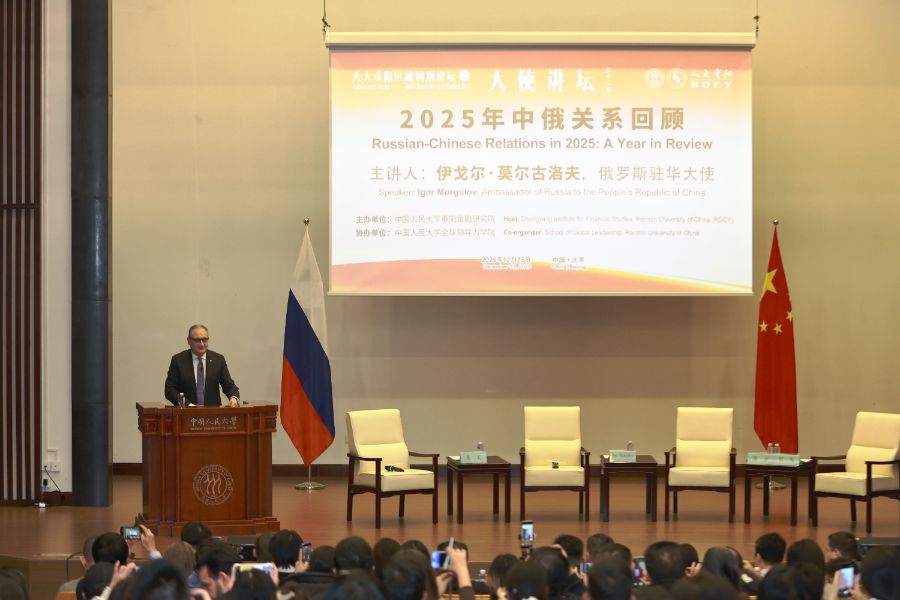
俄驻华大使:今年两国贸易或至2200亿美元,农业领域潜力巨大
2 1 Shi Ji Jing Ji Bao Dao· 2025-12-23 13:05
Core Viewpoint - The comprehensive strategic partnership between China and Russia is maintaining a high level of operation, showcasing strong resilience and vitality in practical cooperation [2] Economic Cooperation - China has been Russia's largest trading partner for 15 consecutive years, with bilateral trade growing by nearly $100 billion over the past three years, reaching a projected $245 billion in 2024 [3] - As of November this year, bilateral trade has surpassed $203 billion, with analysts predicting it could reach $220 billion by the end of the year [3] - The two countries are currently working on over 80 large joint projects across key industries such as automotive manufacturing, steel, non-ferrous metallurgy, chemicals, and wood processing [3] Energy Cooperation - Energy cooperation is the most significant area of practical collaboration, with Russia being China's largest supplier of oil and natural gas, meeting about 20% of China's coal import needs [4] - Ongoing discussions are taking place regarding a new gas pipeline through Mongolia, which will secure China's gas supply for decades [4] - Collaboration in decarbonization and renewable energy is expected to become a growth point in the energy sector [4] Agricultural Cooperation - The agricultural sector presents significant potential for cooperation, with Russian high-quality green agricultural products gaining popularity in the Chinese market [5] - In 2025, Russian grain exports to China are expected to grow by 10%, with total agricultural trade increasing by 14% [5] Technological Collaboration - Cooperation in science and high technology is steadily deepening, with joint research in fields such as medicine, biotechnology, ecology, and new materials [5] - Collaborative projects include the construction of a heavy ion superconducting synchrotron accelerator at the Dubna Joint Institute for Nuclear Research [5] Cultural Exchange - The two countries will host the "Russia-China Education Year" in 2026-2027, with approximately 56,000 Chinese students currently studying in Russian universities [5] - The number of Chinese citizens applying for study visas to Russia is expected to increase by 25% in 2025 [5]
投资近千万!安徽量子巨头杀入EDA!
Xin Lang Cai Jing· 2025-12-23 12:09
Core Viewpoint - Keda Guandun Quantum Technology Co., Ltd. announced its entry into the quantum chip design tool sector by developing "Guandun Quantum EDA Software," with an investment of 8.7 million yuan in collaboration with Ququan (Wuhan) Technology Co., Ltd. [2] Group 1: Company Developments - Keda Guandun is expanding its business from quantum communication to quantum computing hardware, marking a strategic shift [2] - The company was founded in May 2009 and is recognized as one of the earliest enterprises in China to engage in the commercialization of quantum information technology [2] - Keda Guandun became the first A-share listed company in the quantum technology sector in July 2020 [3] Group 2: Financial Performance - In the first half of 2025, Keda Guandun's quantum computing business revenue reached 55.96 million yuan, surpassing its quantum communication revenue of 51.74 million yuan for the first time, with a year-on-year growth of 283.92% [4][11] - This revenue growth is attributed to the delivery of superconducting quantum computing systems and core components, as well as the launch of a cloud platform for its self-developed 176-bit quantum computer [4][11] Group 3: Industry Trends - The quantum EDA software sector is heating up as companies aim to accelerate the production cycle of quantum chips [6][12] - McKinsey predicts that quantum computing could generate $2 trillion in economic value by 2035, with China expected to invest over $2 billion in quantum technology by 2024, leading globally [6][12] - Major international players like Keysight Technologies have introduced integrated toolchains to significantly shorten design cycles, while domestic quantum leaders are also entering the market [6][12] Group 4: Competitive Landscape - In the traditional EDA field, three major players—Synopsys, Cadence, and Siemens—dominate over 70% of the market through bundled solutions and long-term service agreements [7][12] - The question remains whether domestic companies can establish a foothold in the new quantum EDA ecosystem with their "quasi-industrial-grade" software [7][13]


重大进展!量子计算机,有新消息!
Xin Lang Cai Jing· 2025-12-23 11:52
Core Insights - The research team led by Academician Pan Jianwei at the University of Science and Technology of China has made significant progress in quantum error correction, achieving a milestone of "below threshold, the more correction, the more accurate" with the superconducting quantum processor "Zuchongzhi 3.2" [1][2] - The new "full microwave quantum state leakage suppression architecture" proposed in 2025 enhances the performance of the "Zuchongzhi 3.2" processor in single and two-qubit gate manipulation accuracy and readout fidelity compared to previous generations [1] - The successful implementation of surface code logical qubits with a code distance of 7 demonstrates that the system operates below the error correction threshold, validating the goal of "the more correction, the more accurate" [1] Industry Implications - Achieving "below threshold" quantum error correction is a long-sought core objective in the global quantum computing field and represents a critical milestone for transitioning quantum computing systems from prototypes to practical applications [2] - This new technological approach provides a more advantageous solution for constructing million-qubit level quantum computers in the future [2]
天融信:云计算业务收入五年复合增长率44.76%
Zheng Quan Ri Bao Wang· 2025-12-23 09:13
Core Viewpoint - The company, Tianrongxin, identifies intelligent computing cloud (智算云) as a strategic development direction with significant market potential, expected to become a new growth engine for its performance [1] Group 1: Cloud Computing Business - The company launched its cloud computing products in 2019, with revenue from this segment maintaining rapid growth, achieving a five-year compound annual growth rate (CAGR) of 44.76% [1] - By 2024, cloud computing is projected to account for 9.06% of the company's total revenue [1] - In February 2025, the company will upgrade its cloud computing business to intelligent computing cloud, launching 17 integrated machines to meet various performance needs across different sectors [1] Group 2: Applications and Collaborations - The intelligent computing cloud has already been applied in various fields, including government, education, healthcare, and scientific research [1] - Since 2018, the company has invested in quantum computing, establishing a strategic partnership with Anhui Wentiang Quantum [1] - In 2025, the company will collaborate with Xintong Quantum to promote the innovation and application of "quantum + security" technologies [1] Group 3: Financial Performance - The company emphasizes high-quality development and revenue, with a continuous improvement in gross margin [1]
