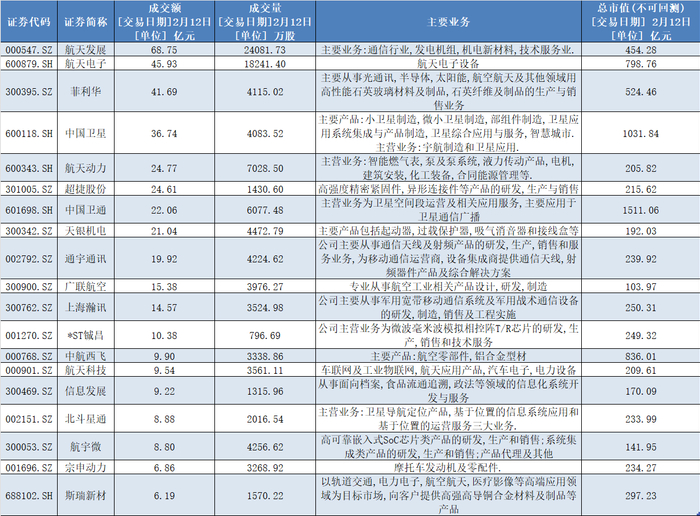
商业航天

Search documents
收评:沪指跌1.26% 航空、船舶板块领涨 石油、有色金属板块领跌
Xin Hua Cai Jing· 2026-02-13 07:52
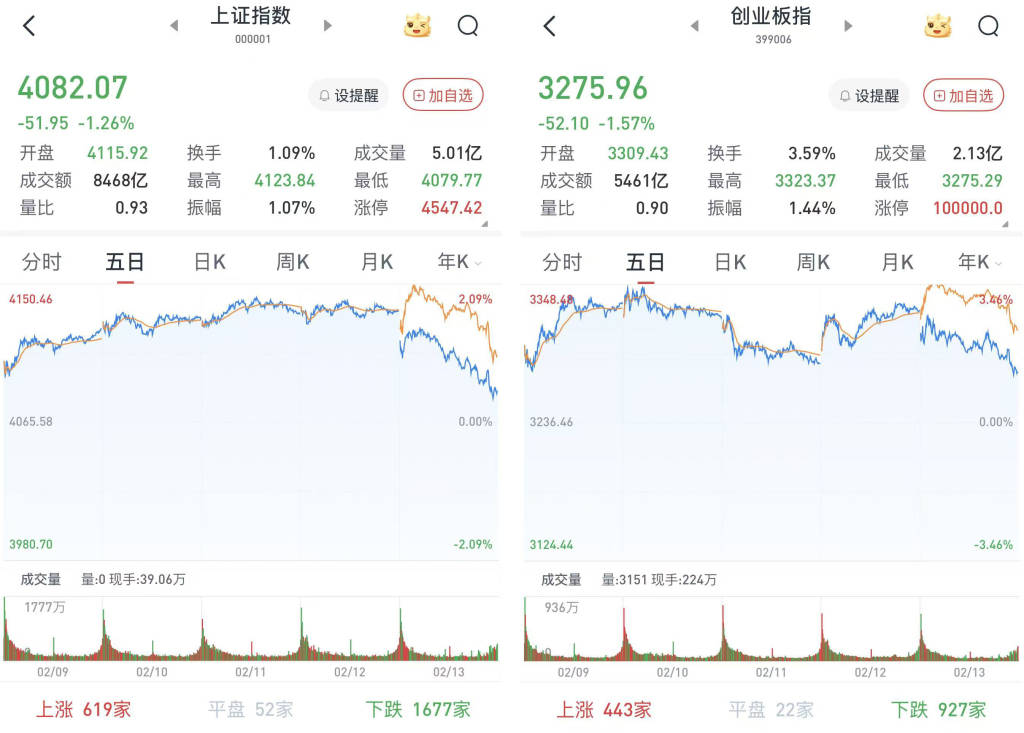
Market Overview - The Shanghai and Shenzhen stock markets opened lower on February 13, with the Shanghai Composite Index down 1.26% to 4082.07 points and a trading volume of approximately 846.8 billion yuan [1] - The Shenzhen Component Index fell 1.28% to 14100.19 points, with a trading volume of about 1135.9 billion yuan [1] - The ChiNext Index decreased by 1.57% to 3275.96 points, with a trading volume of around 546.1 billion yuan [1] - The STAR Market Index dropped 0.38% to 1809.18 points, with a trading volume of approximately 213 billion yuan [1] - The North Star 50 Index fell 0.22% to 1529.77 points, with a trading volume of about 16.44 billion yuan [1] Sector Performance - The aviation and shipbuilding sectors showed notable gains, while sectors such as military trade, media and entertainment, semiconductor, and information security experienced declines after initial gains [1] - The oil, non-ferrous metals, building materials, and coal sectors were among the worst performers [1] Institutional Insights - According to Jifeng Investment Advisors, the overall market trend remains upward, with sectors like AI applications, military, and semiconductors showing potential for growth [2] - Huatai Securities highlighted the increasing demand for phosphoric acid iron due to rapid growth in energy storage and downstream production, predicting improved profitability for domestic phosphoric acid iron companies [2] Regulatory Developments - The National Tobacco Monopoly Administration issued a notice on February 13 to enforce electronic cigarette industry policies, aiming to balance market supply and demand and regulate production scale [3] Technological Advancements - The "Three-Body Computing Constellation" achieved a breakthrough in inter-satellite networking, deploying and validating 10 AI models for applications in deep space exploration and smart city construction [4] Lithium Market Update - The Lithium Industry Association reported a significant increase in lithium carbonate prices in January 2026, with battery-grade lithium carbonate rising by 28.15% to 152,500 yuan per ton [6] - Industrial-grade lithium carbonate prices increased by 26.69% to 149,500 yuan per ton, driven by stable production and rising demand in the new energy vehicle market [6]
西南证券:商业航天为2026年最具确定性核心主线 投资逻辑切换至以网络建设为核心
Zhi Tong Cai Jing· 2026-02-13 07:28
Group 1 - The core viewpoint of the report is that commercial aerospace has officially entered a construction phase, marking the beginning of a new cycle of "constellation-level Capex" in the communications industry, which is expected to be the most certain core theme in 2026 [1] - The investment logic in commercial aerospace has shifted from thematic-driven to network construction-focused Capex cycle, driven by the strategic importance of low Earth orbit satellites as key infrastructure for the 6G "integrated space-ground" network [1] - The construction phase's industrial logic should focus on three key nodes: faster, cheaper, and more frequent satellite launches, with the gradual removal of constraints such as rocket capabilities, launch facilities, and ground communication systems [1][2] Group 2 - A clear causal loop in commercial aerospace investment is necessary, transitioning from "cost reduction and efficiency improvement" to "application expansion," which will drive sustainable satellite deployment and enhance satellite communication quality and coverage [2] - The demand for high-speed optical connections is increasing as the scale of computing clusters expands and communication bandwidth requirements rise, making optical modules a critical component in AI computing infrastructure [3] - Liquid cooling is becoming a key structural increment in AI computing infrastructure upgrades due to the rising power density of AI servers, with traditional air cooling solutions reaching efficiency and space constraints [4]

商业航天投资人上车了
投资界· 2026-02-13 07:28
Core Viewpoint - The article highlights the significant financing achievement of the private rocket company, Galactic Glory, which has completed a D++ round of financing amounting to 5.037 billion yuan, marking the largest single financing in China's private rocket sector [2][9]. Financing Details - The latest financing round was led by Tongchuang Weiye and Jingming Capital, with support from numerous existing shareholders and over ten new investors [2][6]. - This financing brings Galactic Glory's total funding rounds to approximately ten, positioning it among the "six small dragons" of China's commercial rocket industry [6][12]. Company Background - Galactic Glory was founded in 2016 by Peng Xiaobo, a veteran in rocket design with extensive experience in China's rocket technology research [3][4]. - The company has a strong technical team, with an average of over 14 years of experience in rocket development [4]. Technological Milestones - In 2019, Galactic Glory successfully launched its SQX-1Y1 small solid rocket, marking the first successful launch and precise orbit insertion by a private Chinese company [4]. - The company is currently developing the reusable liquid oxygen-methane rocket, SQX-3, which is expected to significantly reduce costs and is seen as a key to large-scale space economy [5][12]. Market Context - The commercial space sector is experiencing a surge in IPO activities, with Galactic Glory among several companies preparing for public offerings [11][12]. - The article notes a growing FOMO (Fear of Missing Out) among investors as they seek opportunities in the commercial space sector, particularly as the market approaches a potential IPO boom in 2026 [10][12]. Strategic Positioning - Galactic Glory has established a broad industrial presence across multiple regions in China, including Beijing and Sichuan, with a focus on leveraging local industrial resources for rocket production [8][9]. - The company has faced challenges in its development timeline, particularly with delays in its IPO process, but remains a key player in the competitive landscape of commercial rockets [12].


“第三疆土”开启,太空旅行不再遥不可及,一场空间革命正在到来
Huan Qiu Wang Zi Xun· 2026-02-13 07:26
Core Viewpoint - The rapid development of commercial space is seen as a technological revolution, marking the transition into the space age, akin to the semiconductor revolution [1] Group 1: Commercial Space Development - 2026 is anticipated to be a significant year for commercial space, with at least 24 spacecraft launches globally in January alone, including 8 from China and 25 satellites placed into orbit [1] - The commercial space sector is entering a phase of scaled development, with a focus on satellite communication technologies that require broader application scenarios for sustainable business models [1][2] Group 2: 6G and Low-Earth Economy - The transition from 5G to 6G is expected to be a key application point for commercial space, with 6G integrating ground networks, satellite broadband, and direct mobile connections [2] - Low Earth orbit satellite constellations are essential for achieving global coverage and low-latency communication, which are critical for the realization of 6G [2] - The integration of commercial space technology with low-altitude economy is seen as mutually beneficial, enhancing safety and operational efficiency for low-altitude vehicles [4] Group 3: Space Tourism - Commercial space tourism is evolving, with companies like Beijing Chuanqiu and Ziwei Technology planning to offer suborbital flights by 2028, targeting high-net-worth individuals initially [5][6] - The ticket price for suborbital flights is currently set at 3 million yuan (approximately 450,000 USD), with expectations for prices to decrease as technology matures and operational costs decline [6] - The global space tourism market is projected to reach 300 billion USD by 2030, with China expected to capture over 30% of this market [6] Group 4: Challenges and Recommendations - The commercial space industry faces challenges such as high costs, slow application processes, and a lack of unified standards and regulations [7][8] - Recommendations include enhancing policy support for early-stage investments, fostering a diverse talent pool, and shifting focus from pure research to market-oriented applications [8]
A股三大股指跌超1.2%:周期股全线回调,两市成交不足2万亿元
Sou Hu Cai Jing· 2026-02-13 07:24
Market Overview - The A-share market experienced a collective decline on February 13, with the Shanghai Composite Index falling by 1.26% to 4082.07 points, the ChiNext Index down by 1.57% to 3275.96 points, and the Shenzhen Component Index decreasing by 1.28% to 14100.19 points [2] - The total trading volume in the Shanghai and Shenzhen markets was 198.27 billion yuan, a decrease of 15.91 billion yuan from the previous trading day [2] Sector Performance - The defense and military sector led the market gains, with stocks like Andavere and Yaxing Anchor Chain hitting the daily limit or rising over 10% [3] - Semiconductor stocks initially surged, with companies such as Micro导纳米 and Shengke Communication seeing increases of over 10% [3] - Conversely, the oil and gas sector faced significant declines, with major companies like China Petroleum and Sinopec dropping over 3% [3] - The materials sector, particularly non-ferrous metals, was the worst performer, with stocks like Hesheng and Xianglu Tungsten falling over 9% [3] Investor Sentiment - As the Spring Festival holiday approaches, investor sentiment is shifting towards either "holding stocks over the holiday" or "holding cash and waiting," with many brokerages suggesting a strategy of holding stocks [4] - Financial analysts noted that trading activity has decreased as the holiday nears, indicating a potential phase of consolidation in the market [5] - There is a consensus among brokerages that the market is experiencing structural differentiation, with some sectors showing strength while others lag behind [5]
A股收评:三大指数集体下挫!全市场成交额不足2万亿,商业航天逆市走高
Ge Long Hui· 2026-02-13 07:07
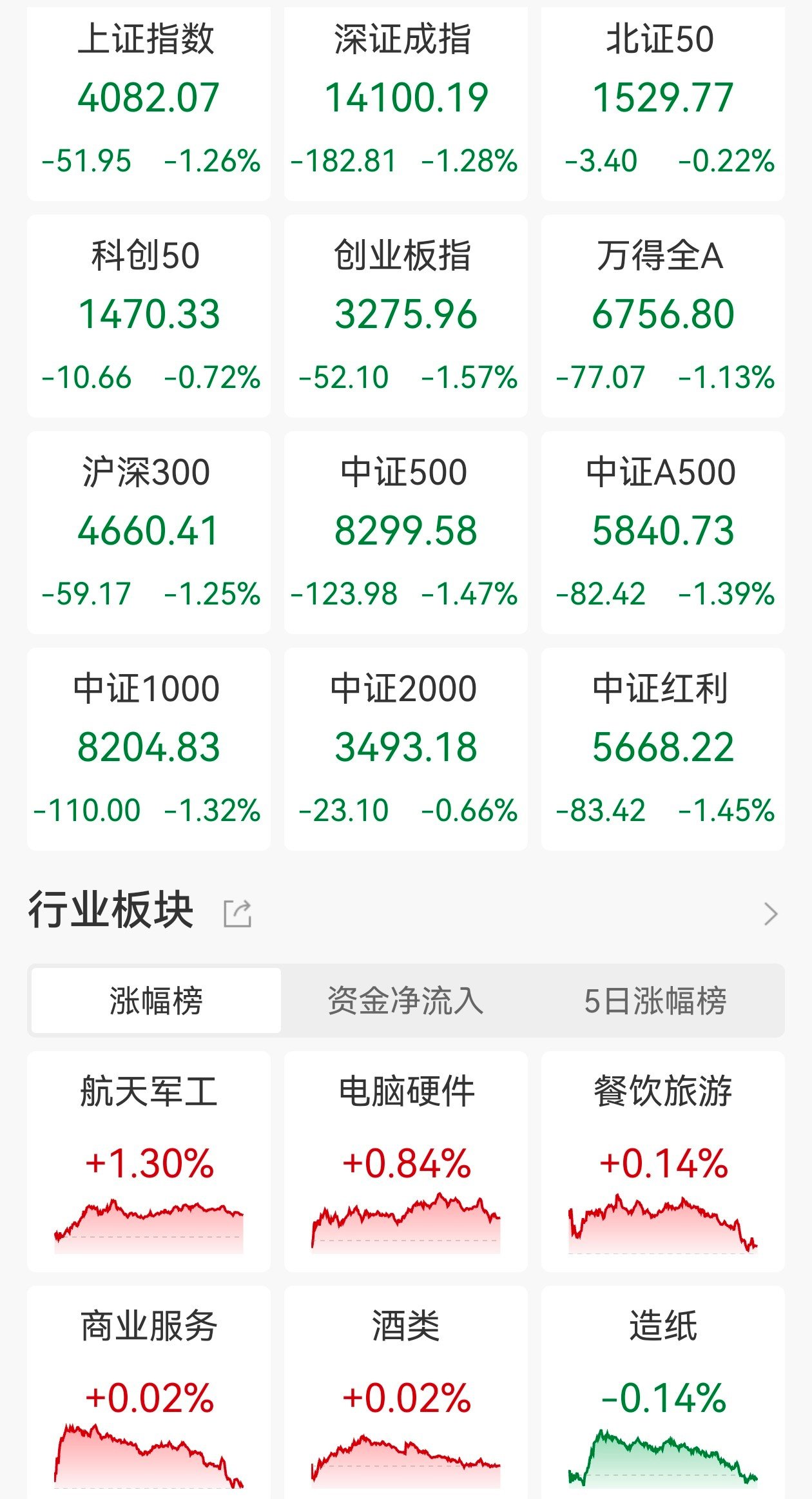
Market Performance - On the last trading day before the holiday, all three major A-share indices fell collectively, with the Shanghai Composite Index down 1.26% to 4082 points, the Shenzhen Component Index down 1.28%, and the ChiNext Index down 1.57% [1] - The total market turnover approached 2 trillion yuan, a decrease of 161.8 billion yuan compared to the previous trading day, with over 3800 stocks declining [1] Sector Performance - The CPO concept saw a significant decline, with Changxin Bochuang dropping over 11% [1] - The photovoltaic equipment sector weakened, with Shuangliang Energy hitting the daily limit down [1] - The small metals sector experienced widespread declines, with Yunlu Co. and Longci Technology both falling over 5% [1] - The glass and fiberglass sector also weakened, led by Shandong Pharmaceutical Glass [1] - The shipping and port, F5G concept, titanium dioxide, and Kimi concept sectors had notable declines [1] - Conversely, the shipbuilding sector rose, with Yaxing Anchor Chain hitting the daily limit up [1] - The commercial aerospace sector surged following the successful completion of China's first rocket first-stage body sea recovery mission, with Hangfa Power hitting the daily limit up [1] - The robotics sector was active, led by Wuzhou New Spring [1] - The aquaculture, motor, and reducer sectors showed notable gains [1] Index Performance - Shanghai Composite Index: 4082.07, down 51.95 points (-1.26%) [1] - Shenzhen Component Index: 14100.19, down 182.81 points (-1.28%) [1] - ChiNext Index: 3275.96, down 52.10 points (-1.57%) [1] - Other indices such as the CSI 300, CSI 500, and others also reported declines [1]
双良节能因信息披露不当被上交所警示
Jing Ji Guan Cha Wang· 2026-02-13 06:56
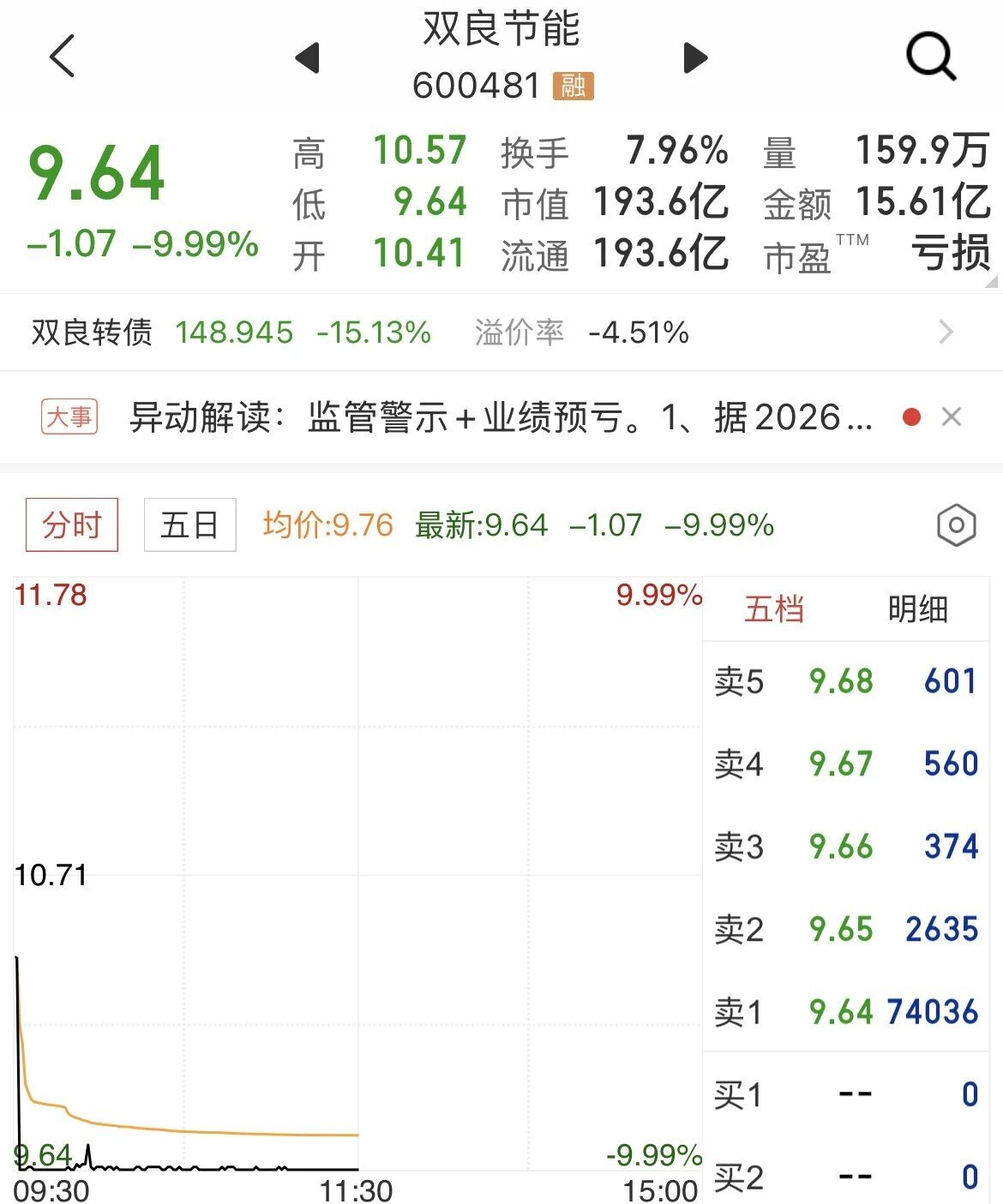
Core Viewpoint - Shuangliang Energy (600481) received a regulatory warning from the Shanghai Stock Exchange due to inaccurate and incomplete information disclosure regarding overseas orders related to SpaceX [1][2] Group 1: Company Information Disclosure - On February 12, Shuangliang Energy announced via its WeChat account that it secured three overseas orders for a total of 12 high-efficiency heat exchangers for SpaceX's Starship launch site expansion [1] - Following regulatory scrutiny, the company clarified that the orders were signed on October 25, 2025, and January 9, 2026, with a total value of approximately 13.92 million yuan, representing only 0.11% of the company's audited revenue for 2024, thus having no significant impact on its operating performance [1] - The company stated that commercial aerospace is not its primary application area and that it is participating as a non-exclusive indirect supplier, indicating a high level of uncertainty regarding future order acquisition [1] Group 2: Regulatory Response and Industry Context - The Shanghai Stock Exchange issued a regulatory warning to Shuangliang Energy and its then-secretary of the board, Yang Likang, requiring the company and its executives to implement effective measures for compliance and improve information disclosure practices [2] - Shuangliang Energy's main business includes energy-saving and water-saving products, new energy equipment, and photovoltaic products, primarily applied in sectors such as renewable energy generation, steel, and coal chemical industries [2] - The company is projected to incur a loss of 780 million to 1.06 billion yuan in 2025, with operating profits expected to be negative, pending the official disclosure of the 2025 annual report [2] - The rapid development of the commercial aerospace sector has increased market attention, but some listed companies have been found to engage in misleading disclosures to guide market expectations, highlighting the urgency of regulatory oversight in the current market environment [2]

刚刚,跌停!突遭监管警示,只因自曝或涉“SpaceX订单”?
Mei Ri Shang Bao· 2026-02-13 06:53
Core Viewpoint - The stock of Shuangliang Energy experienced significant volatility, initially surging to a limit up due to a self-reported "SpaceX order," but subsequently faced a regulatory warning leading to a limit down situation [3][10]. Group 1: Company Announcement and Stock Movement - On February 12, Shuangliang Energy announced via WeChat that it had secured three overseas orders for a total of 12 high-efficiency heat exchangers, intended for use in the SpaceX Starship launch facility expansion [5][8]. - Following this announcement, the stock price surged to its limit up within ten minutes, closing the day with a trading volume of 1.762 billion yuan and a total market capitalization of 21.5 billion yuan [8]. - However, the company later clarified that it does not have a direct partnership with SpaceX and is merely a non-exclusive indirect supplier for the project, which raised concerns about the accuracy of the initial announcement [10]. Group 2: Regulatory Response - The Shanghai Stock Exchange issued a regulatory warning to Shuangliang Energy and its responsible personnel, emphasizing the need for accurate and complete disclosures, especially regarding high-interest topics like "commercial aerospace" [11]. - The exchange noted that the company failed to adequately disclose the nature of the orders, their impact on overall operations, and the uncertainties surrounding future orders, which could mislead investors [11]. - As a result, the company was required to implement corrective measures and submit a report within one month [11]. Group 3: Financial Outlook - Shuangliang Energy previously forecasted a net loss of 780 million to 1.06 billion yuan for the year 2025, indicating ongoing financial challenges [14]. - The company primarily operates in energy-saving and water-saving systems, as well as new energy systems, with key products including heat exchangers and high-efficiency photovoltaic modules [13].
“第三疆土”开启 太空旅行不再遥不可及 一场空间革命正在到来
Yang Shi Wang· 2026-02-13 06:36
Core Viewpoint - The rapid development of commercial space is seen as a technological revolution, marking the transition into the space age, akin to the semiconductor revolution [1] Group 1: Commercial Space Development - 2026 is anticipated to be a significant year for commercial space, with at least 24 spacecraft launches globally in January alone, including 8 from China and 25 satellites placed into orbit [1] - The commercialization of space is entering a phase of scaled development, with a focus on satellite communication technologies that require broader application scenarios for sustainable business models [1][2] Group 2: 6G and Low-Earth Economy - The transition from 5G to 6G is expected to be a key application point for commercial space, with 6G integrating ground networks, satellite broadband, and direct mobile connections [2] - Low Earth orbit satellite constellations are essential for achieving global coverage and low-latency communication, which are critical for the realization of 6G [2] - The integration of commercial space technology with low-altitude economy is seen as mutually beneficial, providing reliable positioning and communication for low-altitude vehicles [4] Group 3: Space Tourism - The first commercial manned spacecraft in China, "Chuan Yue Zhe Yi Hao," is expected to achieve its first manned flight by 2028, with a ticket price set at 3 million yuan [6] - The global space tourism market is projected to reach $300 billion by 2030, with China expected to account for over 30% of this market [7] - The cost of space travel is anticipated to decrease over time due to advancements in technology and increased operational efficiency, potentially making it accessible to a broader audience by 2035 [7] Group 4: Challenges and Recommendations - The commercial space industry faces challenges such as high costs, limited application scenarios, and a mismatch between policy support and industry development speed [9] - Recommendations include enhancing policy support for early-stage investments, fostering a diverse talent pool, and improving the integration of commercial space with low-altitude applications [10]
从双良节能蹭热点被罚到赛道股走势分化,商业航天正在“降温”?
Xin Lang Cai Jing· 2026-02-13 06:25
Core Viewpoint - The commercial aerospace sector in China is experiencing a critical phase characterized by policy benefits and technological advancements, but there is a growing trend of differentiation among companies, prompting a reevaluation of valuation logic in the capital market [1][5]. Group 1: Regulatory Actions and Market Reactions - On February 12, 2023, the Shanghai Stock Exchange issued a regulatory warning to Shuangliang Energy for information disclosure violations, highlighting the need for transparency in the commercial aerospace sector [2]. - Shuangliang Energy's stock surged to a limit up after announcing overseas orders related to SpaceX, but the subsequent regulatory warning revealed that the company is not a direct partner of SpaceX and that the orders have significant uncertainties [2][3]. - Another company, JiuLi Sogou, faced a similar situation where its stock price increased by 206% before a clarification announcement led to a limit down, indicating market volatility driven by speculative trading [3][5]. Group 2: Market Sentiment and Performance Differentiation - The commercial aerospace sector has seen a shift from broad speculative trading to a focus on companies with real performance and core technologies, as evidenced by the contrasting performances of concept stocks and core aerospace companies [5][6]. - On February 12, 2023, while concept stocks like JiuLi Sogou and Shuangliang Energy faced limit downs, core aerospace companies such as China Satellite and Aerospace Development showed only minor declines, indicating a market preference for established players [5][6]. - The differentiation in funding reflects a revaluation of the commercial aerospace industry's fundamentals, with the current lack of a mature business model and uncertain profit timelines influencing investor decisions [6][7]. Group 3: Industry Outlook and Profitability Challenges - Industry insiders suggest that while the long-term outlook for the commercial aerospace sector remains positive, short-term market sentiment is overheated, driven by speculative investments rather than solid business fundamentals [5][7]. - Companies in the sector face significant profitability pressures due to new technologies and the need for established commercial applications, with many relying on financing rather than immediate revenue generation [7][8]. - The timeline for profitability in the commercial aerospace sector is uncertain, with some companies potentially needing five years or more to achieve sustainable profits, although there are indications that the realization of earnings may occur sooner than expected [6][7].