
量化投资

Search documents
精彩回顾 | 从宏观到多资产,彭博与中信专家谈量化投资与风险管理
彭博Bloomberg· 2025-11-25 06:05
Core Insights - The Bloomberg Investment Management Forum in Shanghai highlighted the rapid transformation of the asset management industry through quantitative research strategies, emphasizing Bloomberg's commitment to this field over the past 30 years [1][4]. Group 1: Macro Quantitative Scenario Analysis - Bloomberg has developed a factor-based macro quantitative scenario analysis model that integrates macroeconomic variables with underlying drivers such as credit risk and demand changes, utilizing a large covariance matrix updated daily to detail asset correlations and risk transmission [4][6]. - Users can customize macro variable impacts and driver weight distributions to simulate investment portfolio performance under various economic conditions [6]. Group 2: Risk Budgeting in Equity Allocation - The application of risk budgeting strategies in global and A-share markets can help mitigate losses during market volatility by adjusting allocations based on low correlation and volatility differences among A-share stocks [7][9]. - This approach aims to create a more balanced and resilient investment portfolio by ensuring each asset contributes equally to overall portfolio risk rather than focusing solely on weight [9]. Group 3: Cross-Asset Investment and Strategy Index Development - The discussion on cross-asset investment strategies highlighted the increasing demand for diversified asset allocation and risk premium management among institutions, with a focus on innovation to inspire investors and reduce risks [10][12]. - Bloomberg supports quantitative teams with data integration, risk analysis, and scenario simulation to enhance strategy development and risk management efficiency [12]. Group 4: Risk Management in Investment Decisions - Effective risk management is crucial in investment decision-making, with strategies based on risk perspectives aiding in capturing alpha and facilitating quantitative backtesting [13][15]. - The use of risk parity methods combined with asset correlations can enhance portfolio robustness, addressing the challenges of return forecasting [15]. Group 5: Factor Investment and Alternative Data - The exploration of factor investment frameworks and the use of alternative data and machine learning to tackle the "factor zoo" challenge were discussed, with innovative factors developed from Bloomberg's supply chain data [17][19]. - The application of deep learning models for dynamic beta estimation shows significant performance improvements over traditional methods, enhancing the predictive capabilities for future volatility and variance [19].



量化新锐争霸!正定、睿量、磐松等速进百亿!京盈智投、海南盛丰跻身前十!
私募排排网· 2025-11-25 03:31
Core Insights - The article highlights the rapid growth of quantitative private equity firms, with 852 firms established by November 14, 2025, and 135 new firms founded in the last five years, representing approximately 16% of the total [2][3] - New quantitative private equity firms have shown impressive average returns of 21.11% over the past six months and 36.05% over the past year, significantly outperforming older firms established before November 14, 2020 [2][3] Group 1: Market Overview - As of November 14, 2025, the majority of the 135 new quantitative private equity firms were established between 2021 and 2022, accounting for nearly 90% of the total [2] - The largest segment of private equity firms falls within the 0-5 billion range, with 88 firms, while only 5 firms have surpassed the 100 billion mark [3][4] Group 2: Performance Metrics - Among the new firms, the top 10 in terms of performance over the past six months include 京盈智投, 龙吟虎啸, and 海南磊喧私募, with a minimum return threshold of ***% to qualify for the ranking [9][12] - 京盈智投 has been particularly notable, leading both the six-month and one-year performance rankings with returns of ***% [10][12] Group 3: Strategy and Location - The majority of new quantitative private equity firms focus on stock strategies, with 82 firms, while futures and derivatives strategies have 28 firms, and multi-asset strategies have 17 firms [4] - Most of these firms are located in major cities like Shanghai (57 firms), Beijing (28 firms), and Shenzhen (18 firms), indicating a concentration in key financial hubs [4] Group 4: Notable Firms and Management - The top five firms with over 100 billion in assets under management, all established in 2022, include 齐家私募, 北京正定私募, 上海睿量私募, 磐松资产, and 上海波克私募 [3][6] - 京盈智投, founded in April 2021, is led by谢黎博, who has extensive experience in quantitative investment, and focuses on futures and derivatives strategies [10][12]

听了很多大佬的话,还是学不会投资
集思录· 2025-11-24 14:15
Core Viewpoint - The article discusses the investment philosophies of various individuals, particularly focusing on the insights shared by Duan Yongping, highlighting the subjective nature of investment strategies and the importance of aligning them with personal circumstances [1][3][6]. Group 1: Investment Strategies - Duan Yongping emphasizes the importance of investing in companies with a competitive moat, such as Apple, Moutai, and Tencent, but does not provide specific criteria for identifying such companies [1][3]. - The article mentions various successful investment strategies from different individuals, including quantitative rotation, value investing, and asset allocation, suggesting that there are multiple paths to success in the capital markets [2][3]. - It is noted that Duan's investment approach may not be suitable for everyone, particularly for those without the same level of financial security or understanding of market dynamics [3][4]. Group 2: Personalization of Investment - The article stresses that each investor must find a strategy that matches their own conditions, as not everyone can adopt the same methods successfully [3][7]. - It highlights the importance of personal experience and understanding in investment, suggesting that what works for one individual may not work for another [6][7]. - The discussion includes the notion that investment is a highly personalized endeavor, and individuals should absorb wisdom from various sources to refine their own investment frameworks [7][8]. Group 3: Market Insights - The article reflects on the current market environment, indicating that while broad investment principles may hold true, the application of these principles can vary significantly based on market conditions [5][9]. - It mentions the potential for significant returns in the stock market, but also acknowledges the challenges and risks involved in identifying future successful companies [5][11]. - The discussion includes references to the financial performance of companies like OPPO and VIVO, suggesting that strong cash flow from these businesses can support investment strategies [9][10].

音频龙头上市前,量化数据透露关键信号
Sou Hu Cai Jing· 2025-11-24 13:11
Group 1 - The core viewpoint is that the upcoming listing of Kunshan Haifiman Technology on the Beijing Stock Exchange raises questions about the true nature of high-profile IPOs, which often appear attractive but may have underlying issues [1] - Haifiman aims to raise 430 million yuan, and its net profit growth of 29.49% in the first three quarters, along with 216 patents, highlights its technological barriers [4] - The article reflects on the paradox of bull market crashes, suggesting that significant market corrections often serve as a cover for institutional investors to manipulate stock prices [4][7] Group 2 - The discussion includes a case study of a stock that exhibited a "boiling frog" pattern, where the price fluctuated significantly, causing retail investors to lose patience [7] - Quantitative data revealed that institutional inventory remained active during price fluctuations, indicating that these movements were orchestrated by major players [9] - A cautionary example of a false breakout is presented, where a stock appeared to be breaking out but lacked institutional support, leading to losses for inexperienced investors [10] Group 3 - The article emphasizes the importance of understanding the essence of market dynamics rather than chasing trends, drawing a parallel to Haifiman's innovations in wireless audio technology [10] - It concludes that while markets evolve, human behavior remains constant, and investors should focus on long-term value rather than short-term fluctuations [10] - Recommendations for ordinary investors include utilizing quantitative tools, understanding behavioral finance, focusing on long-term value, and maintaining independent thinking amidst market noise [13]

量化迭代永无止境!博道基金杨梦:均衡之道助力“指数+”产品穿越周期
Sou Hu Cai Jing· 2025-11-24 08:47
近期,博道基金量化投资总监杨梦在接受中国证券报记者采访时表示,尽管公募量化行业已取得长足进 步,但未来发展空间依然广阔。无论是因子挖掘、策略迭代,还是人工智能(AI)技术的深化应用, 都蕴藏着巨大潜力。她表示,博道基金量化团队的核心目标并非追求短期爆发力,而是致力于寻找能够 穿越不同市场周期的、可持续的超额收益来源。"均衡"是团队重要的指导思想,通过方法论与因子来源 的均衡配置,力求让投资者获得波动更小的持有体验,帮助投资者真正"拿得住、赚到钱"。 杨梦,经济学硕士。专注量化领域14年,其中4年量化研究、10年量化投资管理经验。现任博道基金量 化投资总监兼量化投资部总经理。 从AI量价到AI全流程的进化之路 博道基金对AI量化的探索起步很早,2017年就开始使用GP算法去挖掘因子,2019年,受彼时私募领域 对AI应用的启发,博道基金量化团队开始研究AI量价因子,这一前瞻性的布局在2020年得以实盘落 地,并为博道基金"指数+"产品在2020年和2021年带来了相对亮眼的业绩。 然而,量化团队并未止步于此。随着AI技术在量化领域的普及,杨梦敏锐地意识到,要想保持领先, 必须进行更深层次的变革。2023年一季度 ...

ETF策略指数跟踪周报-20251124
HWABAO SECURITIES· 2025-11-24 07:17
Report Overview - The report is a weekly tracking report on public - offering funds' ETF strategy indices, dated November 24, 2025 [1] Report Core View - By leveraging ETFs, it is convenient to transform quantitative models or subjective views into practical investment strategies. The report presents several ETF - based strategy indices and tracks their performance and positions on a weekly basis [12] Summary by Relevant Catalog 1. ETF Strategy Index Tracking - **Overall Performance**: The table shows the performance of various ETF strategy indices last week. For example, the Huabao Research Small - Large Cap Rotation ETF Strategy Index had a last - week index return of - 3.74%, a benchmark of CSI 800 with a return of - 4.31%, and an excess return of 0.57%. The data is as of November 21, 2025, and the last - week return calculation period is from November 14 to November 21, 2025 [13] 1.1. Huabao Research Small - Large Cap Rotation ETF Strategy Index - **Strategy Principle**: It uses multi - dimensional technical indicator factors and a machine - learning model to predict the return difference between the Shenwan Large - Cap Index and the Shenwan Small - Cap Index. The model outputs weekly signals to predict the strength of the indices in the next week and determines positions accordingly to obtain excess returns relative to the market [4][14] - **Performance**: As of November 21, 2025, the excess return since 2024 was 20.10%, the excess return in the recent month was 0.51%, and the excess return in the recent week was 0.57% [4][14] - **Position**: As of November 21, 2025, it held 100% of the CSI 300 ETF [18] 1.2. Huabao Research SmartBeta Enhanced ETF Strategy Index - **Strategy Principle**: It uses price - volume indicators to time self - built Barra factors and maps timing signals to ETFs based on the exposure of ETFs to 9 major Barra factors to achieve returns exceeding the market. The selected ETFs cover mainstream broad - based index ETFs and some style and strategy ETFs [4] - **Performance**: As of November 21, 2025, the excess return since 2024 was 19.67%, the excess return in the recent month was 4.56%, and the excess return in the recent week was 1.02% [4] - **Position**: As of November 21, 2025, it held 25.19% of the Dividend Low - Volatility ETF, 25.06% of the Dividend ETF, 24.92% of the CSI Dividend ETF, and 24.83% of the High - Dividend ETF [22] 1.3. Huabao Research Quantitative Windmill ETF Strategy Index - **Strategy Principle**: It starts from a multi - factor perspective, including the grasp of medium - and long - term fundamental dimensions, the tracking of short - term market trends, and the analysis of the behaviors of various market participants. It uses valuation and crowding signals to indicate industry risks and multi - dimensionally excavates potential sectors to obtain excess returns relative to the market [5][22] - **Performance**: As of November 21, 2025, the excess return since 2024 was 35.64%, the excess return in the recent month was 4.56%, and the excess return in the recent week was 0.09% [5][22] - **Position**: As of November 21, 2025, it held 20.69% of the Oil and Gas ETF, 20.60% of the Bank ETF, 19.80% of the New Energy ETF, 19.54% of the Securities and Insurance ETF, and 19.37% of the Power ETF [26] 1.4. Huabao Research Quantitative Balance ETF Strategy Index - **Strategy Principle**: It adopts a multi - factor system including four major categories of factors: economic fundamentals, liquidity, technical aspects, and investor behavior. It constructs a quantitative timing system to judge the trend of the equity market, establishes a prediction model for the market's small - and large - cap styles, and adjusts the position distribution in the equity market. It comprehensively uses timing and rotation to obtain excess returns relative to the market [5][26] - **Performance**: As of November 21, 2025, the excess return since 2024 was - 8.44%, the excess return in the recent month was 2.51%, and the excess return in the recent week was 1.83% [5][26] - **Position**: As of November 21, 2025, it held 9.35% of the 10 - Year Treasury Bond ETF, 5.96% of the 500ETF Enhanced, 5.86% of the CSI 1000ETF, 32.40% of the Enhanced 300 ETF, 23.27% of the Policy Financial Bond ETF, and 23.15% of the Short - Term Financing ETF [29] 1.5. Huabao Research Hot - Spot Tracking ETF Strategy Index - **Strategy Principle**: It tracks and excavates hot - spot index target products in a timely manner based on strategies such as market sentiment analysis, industry major event tracking, investor sentiment and professional views, policy and regulatory changes, and historical deduction. It constructs an ETF portfolio that can capture market hot - spots in a timely manner, providing investors with references for short - term market trends and helping them make more informed investment decisions [6][29] - **Performance**: As of November 21, 2025, the excess return in the recent month was 3.13%, and the excess return in the recent week was 0.17% [6][29] - **Position**: As of November 21, 2025, it held 36.17% of the Non - Ferrous Metals 50ETF, 24.13% of the Bosera Hong Kong Stock Dividend ETF, 21.12% of the Hong Kong Stock Connect Pharmaceutical ETF, and 18.57% of the Short - Term Financing ETF [33] 1.6. Huabao Research Bond ETF Duration Strategy Index - **Strategy Principle**: It uses bond market liquidity indicators and price - volume indicators to screen effective timing factors and predicts bond yields through machine - learning methods. When the expected yield is lower than a certain threshold, it reduces the position of long - duration bonds in the bond investment portfolio to improve the portfolio's long - term returns and drawdown control ability [6][33] - **Performance**: As of November 21, 2025, the excess return in the recent month was 0.00%, and the excess return in the recent week was 0.11% [6][33] - **Position**: As of November 21, 2025, it held 49.99% of the 10 - Year Treasury Bond ETF, 25.02% of the Policy Financial Bond ETF, and 24.99% of the 5 - to 10 - Year Treasury Bond ETF [36]
金融工程专题研究:博时中证500增强策略ETF投资价值分析:量化赋能中盘宽基,精筑稳健超额Alpha
Guoxin Securities· 2025-11-24 05:19
Quantitative Models and Construction Methods 1. Model Name: Bosera CSI 500 Enhanced Strategy ETF (159678.SZ) - **Model Construction Idea**: The fund aims to achieve returns exceeding the target index (CSI 500) through strict investment procedures and quantitative risk management while closely tracking the benchmark index [3][48][51] - **Model Construction Process**: - The fund employs quantitative enhancement strategies to actively manage the index portfolio and control risks - It ensures the net value growth rate of the fund and the daily tracking deviation from the performance benchmark is less than 0.35%, with an annual tracking error not exceeding 6.5% [51] - The fund's portfolio is constructed with a focus on high-growth, high-profitability stocks, and it maintains a strict control over individual stock deviations relative to the CSI 500 index [56][58] - The fund's holdings are primarily composed of CSI 500 constituent stocks, with an average weight of 84.64% within the index [56][58] - The fund employs the Brinson attribution model to decompose excess returns into industry allocation and stock selection contributions, with most excess returns derived from stock selection within industries [66] - **Model Evaluation**: The fund demonstrates stable excess returns, strong risk-adjusted performance, and effective tracking of the benchmark index. It has a preference for high-growth and high-profitability stocks, with significant stock selection capabilities in industries like computing, electronics, and new energy [3][66][68] --- Model Backtesting Results 1. Bosera CSI 500 Enhanced Strategy ETF - **Annualized Excess Return**: 7.76% [3][85] - **Tracking Error**: 3.84% [3][85] - **Maximum Drawdown**: 6.66% [3] - **Information Ratio (IR)**: 1.79 [3][85] - **Excess Calmar Ratio**: 1.16 [3] - **Monthly Win Rate**: 65.63% [54] - **Annual Performance**: - 2023: Excess return of 3.63%, IR of 1.33, tracking error of 3.68%, monthly win rate of 70% [55] - 2024: Excess return of 7.64%, IR of 1.73, tracking error of 3.95%, monthly win rate of 66.67% [55] - 2025 (up to October 31): Excess return of 9.42%, IR of 2.31, tracking error of 3.84%, monthly win rate of 60% [55] --- Quantitative Factors and Construction Methods 1. Factor Name: High Growth and Profitability - **Factor Construction Idea**: The fund emphasizes stocks with high growth potential and strong profitability metrics [68] - **Factor Construction Process**: - Positive exposure to growth, long-term momentum, and profitability factors - Negative exposure to non-linear size and liquidity factors [68][73] - **Factor Evaluation**: The fund's preference for high-growth and high-profitability stocks aligns with its strategy to achieve excess returns over the benchmark index [68] --- Factor Backtesting Results 1. High Growth and Profitability Factor - **Performance**: The fund's stock selection based on this factor has shown strong excess returns in industries such as computing, electronics, and new energy [66][68] - **Industry Allocation**: Positive exposure to sectors like electronics, machinery, and automobiles, while underweighting sectors like defense, coal, and basic chemicals [63][65] - **Stock Selection**: Strong selection capabilities in computing, electronics, and new energy sectors, contributing significantly to excess returns [66][67]
主动管理的价值发现与被动策略的配置升维
Yin He Zheng Quan· 2025-11-24 05:08
Group 1 - The report highlights that active equity funds are expected to experience a value reassessment due to favorable market conditions and policy support, despite previous underperformance [4][6][10] - The active equity funds have shown significant excess returns in a structural bull market, particularly those focused on advanced manufacturing themes [4][5][6] - The report suggests a "core + satellite" investment strategy to capitalize on the current market environment, emphasizing the importance of thematic investments in state-owned enterprises, technology, and consumption sectors [4][5][6] Group 2 - The ETF market has seen a substantial breakthrough in both quantity and scale, with the total ETF size surpassing 1 trillion yuan, indicating a shift towards high-quality development [4][5][10] - The report notes that the growth of passive products is driven by policy support, technological advancements, and increased demand, particularly in the non-ferrous metals and TMT sectors [4][5][10] - The report anticipates a continued trend of strong performance in popular sectors, with a focus on technology and financial real estate, as well as the potential for expansion in niche ETFs [4][5][10] Group 3 - The report outlines a multi-dimensional ETF quantitative allocation strategy that leverages macro timing, momentum, and advanced modeling techniques to capture diverse returns [4][5][10] - It emphasizes the importance of asset allocation to achieve stable risk-adjusted returns, particularly in a "slow bull" market [4][5][10] - The report suggests that the focus should be on sectors with strong momentum and lower crowding, especially in technology, to capture excess returns [4][5][10]
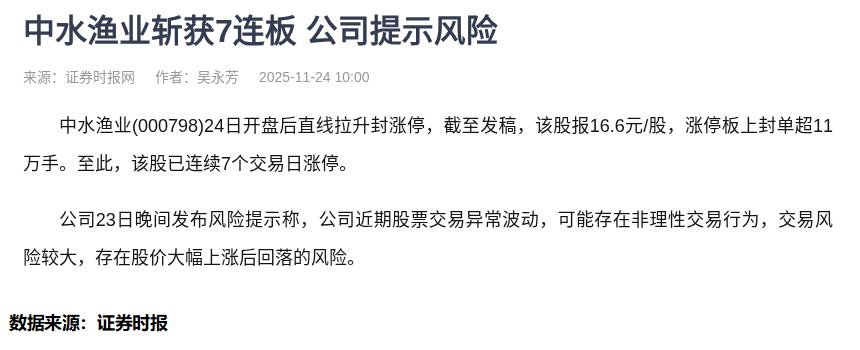
7连板背后:散户狂欢时机构在做什么?
Sou Hu Cai Jing· 2025-11-24 04:13
Group 1 - The core viewpoint of the article highlights the recurring pattern of institutional selling while retail investors buy into rising stocks, exemplified by Zhongshui Fishery's recent performance [1][10]. - Zhongshui Fishery's current price-to-earnings ratio stands at 77.53, significantly higher than the industry average of 21, raising concerns about overvaluation [3][11]. - The article draws parallels between Zhongshui Fishery and past market phenomena, suggesting that high valuations often precede significant corrections, as seen in previous cases like lithium stocks [3][11]. Group 2 - The article discusses the behavior of institutional investors, noting that they often accumulate positions during sideways market periods, as evidenced by the banking sector from 2022 to 2025 [5][7]. - It emphasizes the importance of monitoring institutional activity, as a lack of institutional participation in sectors like liquor indicates potential pitfalls for retail investors [9][10]. - The author suggests that retail investors should adopt quantitative tools to better understand market dynamics and avoid being misled by superficial price movements [11][12]. Group 3 - The article warns that the recent surge in Zhongshui Fishery's stock price, characterized by a seven-day consecutive rise, may be a classic case of retail investors being lured into a trap while institutions exit [10][11]. - It highlights that 83% of companies that issued similar high P/E ratio warnings in the past five years experienced a decline of over 20% within a month [11][12]. - The piece concludes with a reminder that market conditions are ever-changing, but human behavior remains constant, often leading to poor investment decisions when consensus forms around a stock [12].

博道基金杨梦:打造公募量化“指数+”特色矩阵
Shang Hai Zheng Quan Bao· 2025-11-23 13:51
博道基金杨梦: 打造公募量化"指数+" 特色矩阵 ◎记者 聂林浩 指数化投资大浪潮下,公募量化赛道逐步获得市场青睐,一些中小型公募基金公司则凭借先发优势在量 化管理规模上"弯道超车"。数据显示,截至三季度末,博道基金主动量化管理规模超270亿元,在这一 领域的行业排名跃居前三。 事实上,早在2013年,还是私募形态的博道已开启量化实盘,其量化投资的发展历程与国内量化行业的 成熟过程高度契合。如今是博道基金量化投资总监的杨梦,2011年从浙江大学毕业后即进入公募体系从 事量化研究,早期便因对编程与数理的兴趣而建立起模型化思维,这段经历为她后来主导博道量化体系 建设打下基础。 "我热爱这份工作,投身于市场和量化投研,每次攻克难题和模型迭代,对我来说都充满乐趣。"杨梦 说。 传统多因子与AI全流程"双框架并行" 杨梦于2014年加入博道投资,当年12月,银行、券商等市场权重股集体大涨,这被视作中国量化史上首 次大级别"黑天鹅"。彼时,一些量化策略依靠小市值暴露获取超额收益,在极端行情中遭遇巨大压力。 而博道量化在早期即采用基于Barra风险模型的多因子组合体系,风险暴露更为均衡,其核心的市场中 性产品经受住考验,并 ...