
反垄断

Search documents
Meta提议控制广告数据使用 欧盟认为还不够
Xin Lang Ke Ji· 2025-11-26 08:15
Core Viewpoint - Meta is attempting to resolve disputes with the EU antitrust authority by proposing policy adjustments, but these proposals have been met with skepticism from the EU [1] Group 1: Proposed Adjustments - Meta's proposal includes limiting the use of competitors' advertising data for Facebook Marketplace classified ads [1] - The proposal also suggests moderation in using advertising data to develop products that compete with rivals [1] Group 2: Regulatory Context - Since June of last year, the EU has been investigating Meta, which has been seeking a resolution [1] - In December, the EU antitrust authority accused Meta of abusing market power by bundling Facebook Marketplace with the Facebook social network [1] - Concerns were raised by UK authorities regarding Meta's proposals, indicating that further measures may be necessary to address EU dissatisfaction [1]

借隐私政策获取广告业务优势?波兰对苹果启动反垄断调查
Nan Fang Du Shi Bao· 2025-11-26 08:01
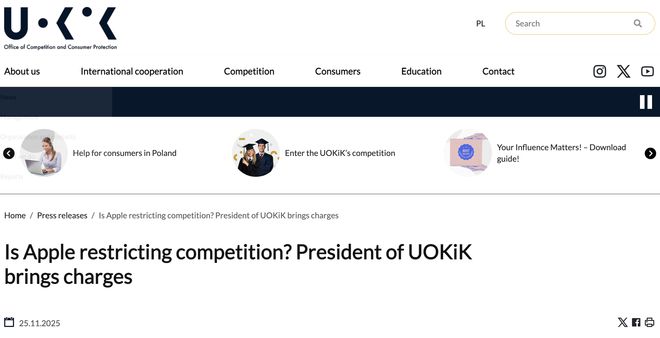
Core Points - The Polish Office of Competition and Consumer Protection (UOKiK) has initiated an antitrust investigation against Apple regarding its App Tracking Transparency (ATT) mechanism, which is suspected of providing Apple with an asymmetric advantage in its advertising business [1][3] - UOKiK's investigation is part of a broader scrutiny of Apple's ATT policy by antitrust authorities in Germany, Italy, and Romania, following a €150 million fine imposed by French regulators for Apple's abuse of its market dominance in distributing mobile applications on iOS and iPadOS [3] - UOKiK's chairman, Tomasz Chróstny, emphasized that while ATT claims to protect user data, it may discriminate against third-party developers, as Apple operates as a hardware manufacturer, operating system owner, app publisher, and advertising platform [3][4] Summary by Sections Investigation Details - UOKiK suspects that Apple's custom definition of "tracking" only considers cross-app data sharing as tracking, while data collection within its own apps is labeled as "personalized advertising," which does not trigger the same permission prompts [3] - The prompts for third-party apps are designed with negative connotations, while those for Apple's pre-installed apps are more neutral, potentially misleading users into granting data access to Apple over third-party applications [3][4] Impact on Developers - UOKiK is concerned that this unequal authorization mechanism will limit independent developers' access to user data, reduce the value of their advertising space, and weaken their negotiating power with advertisers, particularly affecting local Polish businesses [4] - The investigation highlights that even though operating system owners can set rules, they must not violate competition laws, raising suspicions that ATT misleads users about privacy protection while reinforcing Apple's dominance in the advertising market [4] Potential Consequences - If found guilty of abusing its market dominance, Apple could face fines up to 10% of its annual revenue in Poland [4]


消息称欧盟下周对微软Office捆绑Teams展开反垄断调查
Xin Lang Ke Ji· 2025-11-26 08:01
Core Points - The European Union is set to launch a formal antitrust investigation into Microsoft's bundling of the Teams application with the Office suite, marking Microsoft's first such investigation by the EU in 15 years [1][3] - Despite Microsoft's attempts to address competition concerns, insiders indicate that these concessions have not been sufficient, and formal charges could be brought as early as this fall [1][4] Group 1: Background and Context - In July 2020, Slack Technologies filed a complaint with the EU, accusing Microsoft of unfair competition by bundling Teams with its popular Office software, which allegedly eliminated competition for Teams [3] - Microsoft Teams is a chat-based collaboration tool that offers document sharing and instant communication features, including voice and video conferencing, similar to products offered by Slack Technologies [3] Group 2: Current Developments - Negotiations between the EU and Microsoft have reportedly stalled, with disagreements over Teams' pricing and insufficient concessions from Microsoft [4] - Microsoft has stated its willingness to cooperate with the EU and seek practical solutions to address concerns, while the EU continues to evaluate the complaint [4] Group 3: Historical Context - Over the past decade, Microsoft has faced fines totaling €2.2 billion (approximately $2.6 billion) from the EU for bundling practices [4] - Other companies that offer similar products to Microsoft Teams include Zoom Video Communications, Google, Meta, and Cisco [4]

美监管机构要求法院暂时禁止微软收购动视暴雪
Xin Lang Ke Ji· 2025-11-26 07:35
Core Points - The Federal Trade Commission (FTC) has filed for a preliminary injunction to block Microsoft's $69 billion acquisition of Activision Blizzard, citing potential harm to competition in various markets, including gaming consoles, subscription services, and cloud gaming [1][2] - The FTC argues that if the merger is completed, Microsoft’s Xbox could gain exclusive access to Activision's games, limiting access for competitors like Nintendo and Sony [1] - Microsoft disputes the FTC's claims, asserting that the acquisition would benefit players and game companies, and has proposed a legally binding agreement to provide the game "Call of Duty" to competitors for ten years [2] Group 1 - The FTC's hearing is expected to last five days, with key Microsoft executives, including Xbox Game Studios head Matt Booty and Bethesda Softworks' senior vice president Pete Hines, testifying [1] - Microsoft’s legal representative argues that the merger would allow for broader access to Activision's games across multiple platforms, countering the FTC's concerns [1] - The FTC believes that the merger could lead to Microsoft having the ability and incentive to withhold or diminish Activision's content, thereby reducing competition in the gaming industry [2] Group 2 - The acquisition is noted as Microsoft's largest in history and the biggest in the gaming industry [2] - The outcome of the merger hinges on winning several antitrust lawsuits globally, with the U.S. being a critical battleground [2] - The hearing is set to continue until June 29, with Microsoft CEO Satya Nadella and Activision Blizzard CEO Bobby Kotick also expected to testify [2]

德国指控谷歌汽车服务垄断:将禁止捆绑行为
Xin Lang Ke Ji· 2025-11-26 07:35
Core Points - The German Federal Cartel Office (FCO) has identified unfair competition practices by Google Automotive Services and plans to prohibit these practices [1] - Google Automotive Services offers a range of services to car manufacturers, including Google Maps, Google Play Store, and Google Assistant [1] - The FCO is concerned that Google's bundling of services may hinder market competition and further entrench Google's dominant position in other markets [1] Group 1 - The FCO criticizes Google's bundling of infotainment system services, as it reduces opportunities for competitors to sell their services independently [1] - Google claims that the connected car market is highly competitive, with thousands of applications compatible with Google Automotive Services [1] - Google intends to engage in constructive dialogue with German regulators to address their concerns [1] Group 2 - In addition to bundling practices, Google's revenue-sharing agreements with car manufacturers may also violate German antitrust laws [2] - The FCO states that default settings for Google services could make alternative services less noticeable and rarely used, a strategy previously successful for Google in mobile devices [2] - The FCO is reviewing terms related to Google Maps that prohibit users from integrating the service with competing services, which could hinder the development of alternatives [2]

苹果、Epic双双要求美法庭重新考虑反垄断裁决
Xin Lang Ke Ji· 2025-11-26 07:32
Core Viewpoint - Apple and Epic Games are requesting the court to reconsider its antitrust ruling, which allows developers to place links in their apps but does not oppose Apple's 30% commission on App Store sales [1][2]. Group 1: Legal Proceedings - Both Apple and Epic submitted independent court documents challenging the ruling made by a three-judge panel of the Ninth Circuit Court of Appeals [1]. - The companies are seeking either a rehearing by the three-judge panel or a hearing by all 11 judges of the appeals court [1][2]. - The original lawsuit dates back to 2021 when a federal district court in California ruled that Apple's 30% commission on developers' sales was illegal [1]. Group 2: Arguments from Apple and Epic - Apple argues that its commission structure promotes fair market competition and does not violate any antitrust laws, opposing a nationwide injunction against this policy [1]. - Epic contends that Apple's commission policy directly impacts the core mission of federal antitrust laws to promote market competition, claiming the appeals court did not adequately balance the effects of the commission on consumers and competition [2]. Group 3: Current Status of the Case - The district court's ruling is currently on hold and not enforced as the case is in the appeals process [5]. - The presiding judge, Yvonne Gonzalez Rogers, indicated that Apple cannot prevent third-party developers from providing alternative payment links to consumers [5]. - However, Rogers did not provide detailed guidance on how the App Store should accommodate external payment links or buttons [6]. Group 4: Global Context - Apple's enforcement of its in-app payment system has sparked controversy globally, with antitrust regulators in countries like South Korea, the Netherlands, and Japan demanding that Apple open up payment channels for third-party applications [6].
波兰对苹果(AAPL.US)发起反垄断调查,指控ATT隐私政策限制广告市场竞争
智通财经网· 2025-11-25 11:16
Core Viewpoint - The Polish Office of Competition and Consumer Protection (UOKiK) has initiated an investigation into whether Apple is restricting competition in the mobile advertising market through its privacy policy, specifically the App Tracking Transparency (ATT) framework introduced in 2021 [1][2] Group 1: Investigation Details - UOKiK is examining Apple's ATT policy, which applies to iOS and iPadOS versions 14.5 and above, to determine its impact on competition in the mobile advertising sector [1] - The agency highlights that Apple's definition of "tracking" may lead to different consent requests for personalized ads, potentially giving Apple an advantage over independent app publishers [1][2] Group 2: Implications and Reactions - UOKiK's chairman Tomasz Chróstny expressed concerns that the wording and design of consent information may mislead users regarding privacy protection, thereby enhancing Apple's competitive position in the advertising market [2] - Apple claims that the ATT framework is designed to empower consumers to control whether companies can track their activities, asserting that opposition from the data tracking industry is expected [2] - UOKiK noted that similar investigations are ongoing in Germany, Italy, and Romania, and that a French regulatory body previously fined Apple €150 million for related issues [2]
谷歌广告帝国命悬一线?生死裁决倒计时
财联社· 2025-11-22 23:51
Core Viewpoint - The article discusses the ongoing antitrust case against Google in the digital advertising market, highlighting the potential for a landmark ruling that could lead to the forced breakup of the tech giant's advertising business [1][2]. Group 1: Antitrust Case Developments - The U.S. Department of Justice (DOJ) and Google recently concluded a three-hour hearing regarding remedies for Google's alleged monopoly in the digital advertising market [1]. - Federal Judge Leonie Brinkema is expected to make a final ruling next year on whether Google should be split up, which could set a precedent for breaking up tech giants in the internet era [1][2]. - The DOJ is advocating for the divestiture of Google's core advertising trading platform and the public disclosure of certain advertising tool source codes [1]. Group 2: Google's Response and Legal Arguments - Google is willing to open more auction data and make some business model adjustments to facilitate competition but firmly opposes asset divestiture, arguing that the government's demands are extreme and lack sufficient legal precedent [1][2]. - Judge Brinkema raised concerns about the potential delays in the divestiture process, noting that Google would likely appeal any breakup decision, which could prolong the timeline and alter the competitive landscape [2]. Group 3: Timeline and Industry Implications - DOJ attorney Matthew Hooper stated that the sale of Google's advertising trading platform could be completed within two years, which he believes would not hinder the restoration of competition [2]. - In contrast, Google's chief litigation attorney, Karen Dunn, argued that the timeline proposed by the DOJ is overly optimistic, citing the complexities of data and technology migration [2]. - The article notes that Google recently avoided divestiture in a separate antitrust case related to online search, where only limited data sharing and business adjustments were mandated [2].
谷歌(GOOGL.US)反垄断诉讼迎收官 力求避免广告业务被拆分
Zhi Tong Cai Jing· 2025-11-21 13:04
Core Viewpoint - The final defense by Google in the antitrust lawsuit led by the U.S. Department of Justice (DOJ) is aimed at preventing the breakup of its advertising technology business, with the outcome dependent on the ruling of Judge Leonie Brinkema [1][2]. Group 1: Legal Proceedings - The lawsuit has reached the final debate stage after years of litigation, focusing on Google's monopoly in online advertising and search [2]. - Judge Brinkema previously ruled in April that Google holds two illegal monopolies in the advertising technology sector and is now considering measures to restore market competition [1]. - The DOJ and a coalition of states have requested the court to mandate the sale of Google's advertising trading platform, AdX, which charges publishers a 20% fee for real-time ad auctions [1]. Group 2: Google's Defense - Google argues that splitting its advertising technology business would be technically challenging and could lead to a lengthy transition process that ultimately harms consumer interests [1]. - The DOJ's lawyers are attempting to convince the court that only a forced sale of AdX can prevent Google from implementing new strategies that hinder competition [1]. Group 3: Future Proceedings - Following the final debate, the case will move to the appellate court, a process that may take several years [3]. - Google has indicated plans to appeal Judge Brinkema's ruling on monopolistic practices and challenge a previous ruling regarding data sharing with competitors [3]. - Ongoing antitrust lawsuits against other major tech companies, including Meta Platforms, Amazon, and Apple, are still in progress [3].

新指南新在哪?平台反垄断新指南发布:AI定价、生态封禁等八大场景划出合规红线
3 6 Ke· 2025-11-20 07:33
Core Viewpoint - The release of the "Internet Platform Antitrust Compliance Guidelines (Draft for Comments)" marks a significant step in China's regulatory framework for platform economies, particularly following the "Double Eleven" shopping festival, addressing new competitive issues that emerged during this period [1][10]. Group 1: Regulatory Positioning - The new guidelines and the previously issued "Price Behavior Rules" form a comprehensive regulatory system, with the former focusing on platforms with significant market power while the latter applies to all operators [2][3]. - The "Price Behavior Rules" aim to maintain basic price order and transparency, while the new guidelines specifically target monopolistic risks and behaviors of dominant platforms [3]. Group 2: Key Breakthroughs in the New Guidelines - The new guidelines introduce an "ecological" perspective, emphasizing the responsibility of platform managers in maintaining healthy platform ecosystems [6]. - The guidelines require platforms to conduct self-examinations of their algorithms, addressing risks associated with algorithmic collusion and ensuring compliance through dynamic monitoring [7][8]. - Eight specific risk scenarios are provided in the guidelines, enhancing operational clarity for platforms and addressing potential anti-competitive behaviors [9]. Group 3: Addressing Issues from "Double Eleven" - The guidelines prohibit irrational price wars initiated by dominant platforms, establishing boundaries for competitive practices during promotional events [11]. - The use of AI for price discrimination and customer profiling is restricted, ensuring that platforms cannot justify differential pricing based on user data [12]. - The guidelines protect merchants' pricing autonomy, preventing platforms from coercing them into participating in promotional activities or bearing costs that should be the platform's responsibility [13][14]. - Restrictions on "blocking and shielding" behaviors are detailed, promoting interconnectivity and reducing operational costs for merchants [15]. Group 4: Conclusion - The "Internet Platform Antitrust Compliance Guidelines" establish a more refined and forward-looking compliance framework, guiding platform economies towards high-quality development driven by technology and ecological cooperation [16].