
美元走弱

Search documents
翁富豪:5.22多空因素交织下的走势研判 ,黄金日内操作策略
Sou Hu Cai Jing· 2025-05-22 11:28
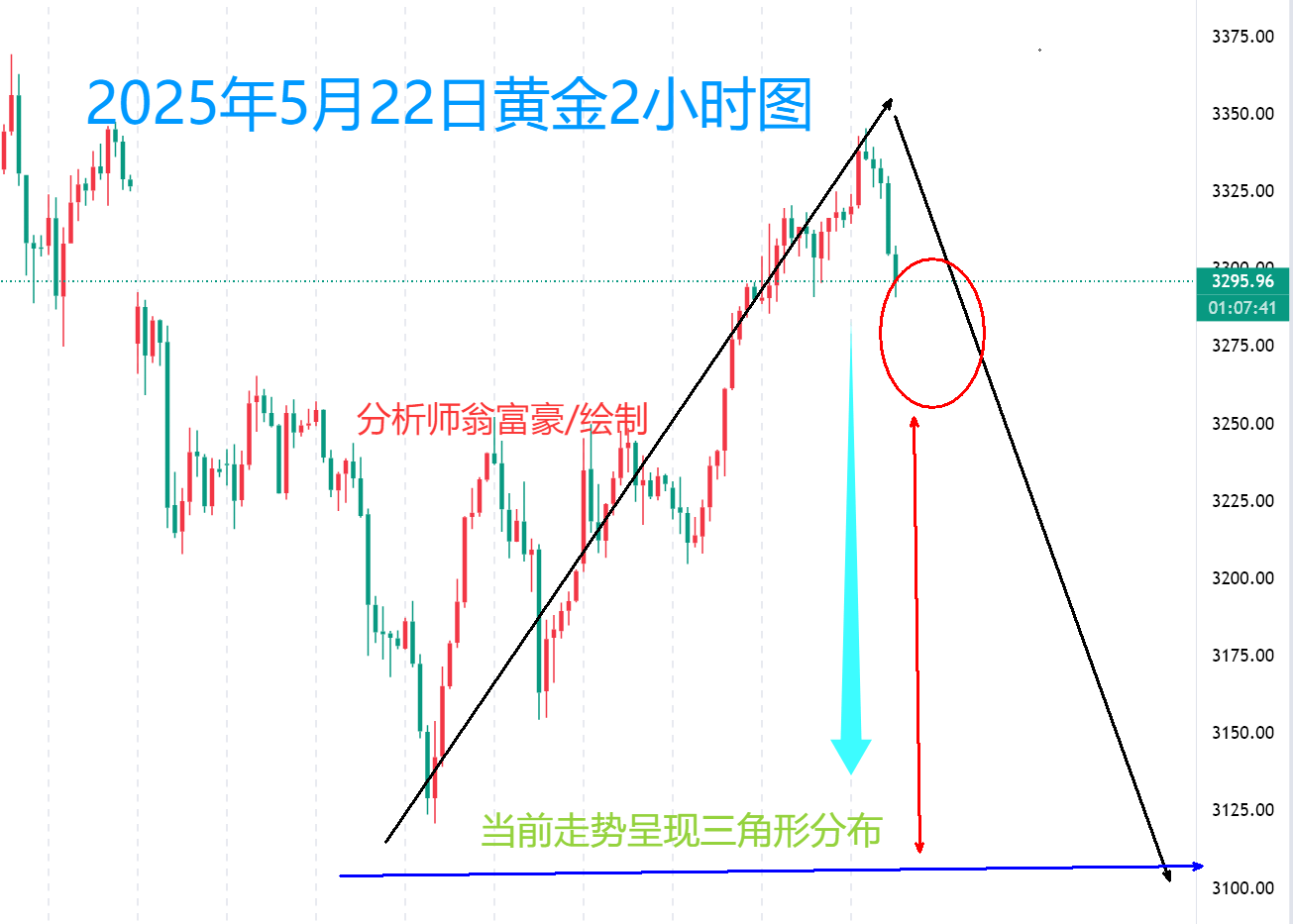
Group 1 - The core viewpoint of the articles indicates that gold prices are experiencing fluctuations, currently reported around $3,295 per ounce, with significant attention on upcoming U.S. PMI data that could lead to notable market volatility [1] - Gold prices have seen a four-day consecutive rise, reaching a two-week high of $3,350 per ounce, but the upward momentum is slowing down due to market digestion of previous positive news and upcoming economic data releases [1] - Factors supporting gold prices include rising geopolitical risks, deteriorating U.S. fiscal conditions, and a weakening dollar, with Moody's downgrading the U.S. sovereign credit rating and warning of potential increases in U.S. debt by $3 to $5 trillion [1] Group 2 - Technical analysis shows that gold prices have recently rebounded to a one-week high, but there is a need to be cautious of short-term correction risks, with a high point of $3,345 noted for the day [3] - The 5-day moving average shows a slight golden cross, while MACD indicates a dead cross with an upward turn, suggesting a mixed technical outlook for gold prices [3] - The suggested trading strategy includes shorting gold around the current price of $3,290, with a stop loss at $3,298 and a target range of $3,275 to $3,255, indicating a bearish sentiment for the evening [3]

【期货热点追踪】铜价在美元走弱和美国债务问题的背景下小幅上涨,分析师表示,如果宏观经济短期内没有出现重大的负面意外,铜价的目标是……
news flash· 2025-05-22 00:55
相关链接 期货热点追踪 铜价在美元走弱和美国债务问题的背景下小幅上涨,分析师表示,如果宏观经济短期内没有出现重大的 负面意外,铜价的目标是…… ...
新兴市场股票或迎“下一个牛市”,投资者目光转向
Huan Qiu Wang· 2025-05-20 02:05
Core Viewpoint - Major investment firms are shifting their focus towards emerging market stocks, anticipating a favorable turn in market conditions for these assets [1][3]. Group 1: Investment Firms' Perspectives - Morgan Stanley, AQR Capital Management, Bank of America, and Franklin Templeton are betting on emerging markets as the next investment opportunity [1]. - Bank of America's Michael Hartnett describes emerging markets as the "next bull market" [3]. - AQR predicts that emerging market stocks will yield an annual return of nearly 6% in local currency over the next 5 to 10 years, surpassing the 4% expected return from U.S. stocks [3]. Group 2: Market Performance and Trends - The S&P 500 index has remained flat year-to-date, while emerging market indices have risen by 10%, suggesting a potential end to a 15-year period of underperformance for these markets [3]. - Over the past 15 years, U.S. stocks have surged over 400%, while emerging market stocks have only increased by 7% [3]. Group 3: Factors Influencing Investment Shifts - Factors such as trade wars, the dollar's challenges, S&P volatility, and doubts about U.S. Treasury bonds' safe-haven status are prompting investors to look beyond the U.S. [3]. - Moody's recently downgraded the U.S. credit rating due to concerns over rising debt and deficits, adding pressure to U.S. equities [3]. - Franklin Templeton's Christy Tan warns of dollar depreciation risks and suggests that the "American exceptionalism" narrative may be temporarily over, viewing emerging market bonds as alternatives to U.S. Treasuries [3]. Group 4: Investment Focus Areas - Morgan Stanley's Jitania Kandhari is focusing on stocks in banking, electrification, healthcare, and defense sectors within emerging markets [4]. - AQR's Chris Doheny is targeting smaller market capitalization companies in emerging markets that are expected to perform well in the medium to long term [4]. Group 5: Capital Flows and Economic Conditions - As of the week ending May 9, inflows into U.S.-listed emerging market and specific country ETFs reached $1.84 billion, more than double the previous week [4]. - Despite the positive outlook, inherent characteristics of emerging markets, such as political instability and local crises, may hinder this year's growth [4]. - Franklin Templeton's Tan highlights that major emerging markets have strong fundamentals, low external debt, and favorable debt-to-GDP ratios, making them attractive [4].

美元持续走弱,黄金多空震荡加剧!美盘资金如何抉择,短线如何做好布局?立即观看超V推荐官Jason的讲解,直播间可领取超V美盘短线分析>>>
news flash· 2025-05-19 13:08
美元持续走弱,黄金多空震荡加剧!美盘资金如何抉择,短线如何做好布局?立即观看超V推荐官Jason 的讲解,直播间可领取超V美盘短线分析>>> 相关链接 ...
2025五道口金融论坛 |波兰前总理马雷克·贝尔卡:使美元走弱是美国的单边政策
Bei Jing Shang Bao· 2025-05-17 04:29
对于欧洲而言,马雷克·贝尔卡认为,欧洲面临着几方面的长期挑战。主要是由于生产力低下以及GDP 增长疲弱,这一点在欧洲显而易见。欧洲已经进入老龄社会,中国也进入老龄社会,但欧洲老龄社会进 程已持续很长一段时间,与任何其他世界的地区进行对比,欧洲增长会比较慢。眼前欧洲最大的挑战是 不平衡、不稳定。我们已进入不稳定的世界,欧洲目前在不稳定的国际经济之下会显得更加脆弱。如果 中美打"关税战",欧洲既不是赢家也不是输家,会变成两国相交的直接战场,对欧洲来讲没有任何好 处。欧洲一直希望可以进入和平合作的时代,但现在正面临着变革。 "我们在全球范围内看到非常危险的关税游戏正在进行中。"马雷克·贝尔卡提到,"短期来看,美国关税 的错误实施带来了几方面结果。首先是其不确定性,不仅是对于全球经济,而且对于美国经济带来了直 接的不确定性。" 马雷克·贝尔卡还提到,使美元走弱是美国的单边政策。同时,作为全球储备货币,美国在某种程度 上,又不希望美元走弱。当前可以看到资本开始流出美国美元市场,即美元已经走弱了,美元作为全球 货币以及全球储备货币位置也会逐步地走弱。美国新政府做法的危机在于其国内非常深入和深刻的社会 问题。作为科技和经济 ...
HTFX外汇:美元随美债收益率下跌 美国数据疲软是主因
Sou Hu Cai Jing· 2025-05-16 11:56
Group 1 - The core viewpoint is that the US dollar has declined alongside US Treasury yields due to weak economic data, reinforcing market expectations for multiple rate cuts by the Federal Reserve this year [1] - The majority of fluctuations in the forex market this week were driven by the USD/KRW exchange rate, with the dollar trading at 1394.70 KRW after a significant drop over two days [1] - Market speculation suggests that President Trump may favor a weaker dollar to pressure other governments during trade negotiations, which could benefit Asian exporters [3] Group 2 - Federal Reserve Chairman Jerome Powell indicated that policymakers need to reconsider the roles of employment and inflation in the current monetary policy framework, suggesting that inflation risks may raise the threshold for rate cuts [4] - Despite expectations for three rate cuts this year, if inflation rises, the number of cuts may be reduced [4] - The euro rose by 0.1% to 1.1197 USD, while the pound stabilized at 1.3309 USD, with the dollar index down 0.1% to 100.70, but still on track for a slight weekly gain of 0.3% [5]
瑞讯银行:美元走弱与波动性上升同步,成为投资者痛点
news flash· 2025-05-16 07:37
Core Viewpoint - The weakening of the US dollar, coupled with rising market volatility, is becoming a significant concern for investors, prompting a need for increased hedging against dollar depreciation risks [1] Group 1: Dollar Weakness - Investors may need to enhance their hedging strategies against the risks associated with a weakening dollar due to the high concentration of global portfolios in US companies [1] - Historically, investors were reluctant to hedge against dollar depreciation risks, as the dollar typically strengthened during periods of increased market volatility due to safe-haven inflows [1] Group 2: Market Volatility - Recent trends show that despite rising market volatility, the dollar has continued to weaken, creating an unusual negative correlation between the dollar and volatility [1] - The increase in volatility has raised the costs of hedging, complicating the investment landscape for market participants [1]
柏瑞投资:料美联储2026年立场变宽松 对风险资产保持中性
Zhi Tong Cai Jing· 2025-05-09 07:38
Group 1 - The core viewpoint is that despite pressure from Trump for interest rate cuts, the Federal Reserve is expected to maintain its current strategy, with a forecast of three rate cuts in the next 12 months, bringing the policy rate down to 3.75% [1] - The U.S. economy is projected to slow down by 2026, with inflation expected to stabilize after a one-time spike, leading to a potential shift in the Federal Reserve's stance towards easing [1] - The attractiveness of U.S. dollar assets is diminishing, prompting a shift towards global diversification, with the euro expected to benefit from favorable European policies and Germany's growth potential starting in 2026 [1] Group 2 - The euro to U.S. dollar exchange rate forecast has been raised from 1.0750 to 1.1500, while the dollar to yen forecast has been lowered from 150.00 to 140.00, reflecting the overall weakening of the dollar [1] - In the current uncertain market environment, a neutral stance on risk assets is maintained, with a preference for sectors with long-term structural advantages, including select European and emerging market bonds, as well as mispriced industrial stocks [1] - Emerging market banking sectors are noted for their strong risk resilience, with local economic prospects supporting loan quality and liquidity despite potential profitability impacts from interest rate cuts [1] Group 3 - Gold continues to rise as a safe-haven asset due to deteriorating economic relations and increasing geopolitical risks, with the potential for further monetary easing in China if U.S.-China relations do not improve [2] - The increase in global M2 money supply growth surpassing nominal GDP growth is identified as a key driver for the sustained rise in gold prices [2]
【高盛上调美国通胀预期】5月8日讯,高盛经济学家预计美国核心PCE通胀到2025年底增长3.8%(此前预测为3.5%),2026年底2.7%(此前预测2.3%)。与这些预测相比,最新公布的核心PCE数据仅为2.6%。高盛表示,美元因关税消息而走弱,这种走弱放大了关税对价格的直接影响,而非抵消这种影响。
news flash· 2025-05-07 23:11
Core Insights - Goldman Sachs has raised its forecast for U.S. core PCE inflation to 3.8% by the end of 2025, up from a previous estimate of 3.5% [1] - The forecast for the end of 2026 has also been increased to 2.7% from 2.3% [1] - The latest core PCE data stands at 2.6%, indicating a discrepancy between current data and future projections [1] Economic Factors - The weakening of the U.S. dollar, attributed to tariff news, has amplified the direct impact of tariffs on prices rather than offsetting it [1]

亚洲货币纷纷走强 减配美元资产成趋势
Zheng Quan Shi Bao· 2025-05-07 17:53
Group 1 - The article highlights the impact of U.S. tariff policies on global trade and financial markets, leading to a significant appreciation of Asian currencies against the U.S. dollar and a shift in investment strategies away from dollar assets [1][3]. - Asian currencies, including the Hong Kong dollar and New Taiwan dollar, have seen substantial gains, with the Hong Kong Monetary Authority intervening multiple times to maintain its currency peg, and the New Taiwan dollar experiencing a notable rise of over 10% against the dollar in just two trading days [2][3]. - There is a growing trend of foreign investors reducing their exposure to U.S. assets, with a reported decline of over 10% in the U.S. dollar index this year, indicating a shift in market sentiment towards the dollar [3][4]. Group 2 - The article discusses the weakening of the "American exceptionalism" narrative, as U.S. tariff policies create uncertainty and diminish the dollar's safe-haven status, prompting capital outflows from the dollar [4]. - Notable investors, including Warren Buffett, have expressed concerns about the future value of the dollar, warning of potential risks associated with U.S. fiscal policies that could lead to a depreciation of currency assets [4].