资产荒

Search documents
“1时代”债市:交易员追逐0.25BP的波段收益
Jing Ji Guan Cha Wang· 2025-07-11 06:45
Core Insights - The bond market is experiencing a significant decline in yields, with "AAA" rated credit bonds reaching historical lows, prompting traders to engage in frequent wave trading to capture small profit margins [1][4][5] - The overall investment environment is shifting towards low-risk assets due to increased volatility in stocks and funds, leading to a preference for stable, low-risk investments [3][12] Bond Market Trends - The issuance rates for "AAA" rated credit bonds have dropped significantly, with examples such as Huadian International's bond at 1.89% and Zhongshan Public's bond at 1.66%, marking record lows for similar ratings and terms [1][4] - The yield for 1-year "AAA" rated city investment bonds has decreased to as low as 1.67%, down from approximately 2.5%-2.8% in the same period last year, indicating a drop of 80-110 basis points [4][5] Trading Strategies - The importance of wave trading has increased as the yield spread narrows, with traders aiming for small gains of 1-2 basis points per transaction [1][2] - Institutions are increasingly adopting high-frequency trading strategies to capitalize on short-term market fluctuations, with a notable rise in participation from public funds, insurance asset management, and bank wealth management subsidiaries [7][12] Investment Challenges - The low yield environment presents challenges for institutions, as they struggle to meet liability requirements while facing limited profit margins [8][9] - The scarcity of high-yield assets is becoming more pronounced, with banks unable to invest in the stock market due to regulatory constraints, leading to a focus on the bond market for asset allocation [9][10] Future Outlook - The bond market is expected to continue experiencing downward pressure on yields due to monetary policy shifts and economic challenges, with the potential for further interest rate cuts [5][6] - Institutions are advised to diversify their portfolios by incorporating longer-duration bonds, industry bonds, and equity assets to enhance yield potential in a low-rate environment [12][14]
打破产业企业融资壁垒 上交所着力推动高成长产业债发行
Zheng Quan Shi Bao· 2025-07-10 22:58
Core Viewpoint - The Shanghai Stock Exchange (SSE) has successfully launched 53 high-growth industrial bonds, totaling 37.3 billion yuan, with over 80 non-bank institutions participating, indicating a growing interest in these bonds as a means to enhance investment returns [1] Group 1: Market Context - High-growth industrial bonds emerged last year due to a long-standing disconnect between market financing parties, with a notable decline in investment yields amid falling interest rates, leading to a structural asset shortage [1] - The need for funding among industrial enterprises remains critical, as they face challenges in accessing financing, resulting in high costs and limited channels [1] Group 2: Solutions and Initiatives - SSE aims to create a "high-yield bond" market that aligns with China's bond market investment habits and regulatory requirements, encouraging credit differentiation to facilitate financing for various industrial enterprises [1] - A full-chain service team for high-growth industrial bonds has been established by SSE to assist enterprises with good repayment intentions and credit records in overcoming financing barriers [2] Group 3: Market Perception and Challenges - Many industrial enterprises face difficulties in their initial bond issuance due to a lack of confidence from brokers and investment institutions, leading to challenges in selling bonds [2] - Concerns about the risks associated with high-yield bonds persist among market participants, stemming from previous experiences of credit contraction in the bond market [2] Group 4: Future Developments - SSE's high-growth industrial bond team has created a dynamic project database to provide tailored services and is planning to promote regular issuance of these bonds, aiming for a scale of 100 bonds by the end of the year [3] - The SSE will conduct market-wide training and project collection to enhance the understanding of investment value in industrial enterprises [3]
直面债券市场难题 上交所打造高成长产业债市场
Zheng Quan Shi Bao Wang· 2025-07-10 12:34
Core Viewpoint - The Shanghai Stock Exchange (SSE) has introduced high-growth industry bonds to address the financing challenges faced by industrial enterprises and to provide a reliable investment product for institutions amid declining interest rates [1][2]. Group 1: Market Context and Product Introduction - High-growth industry bonds were created in response to a long-standing disconnect between investment and financing parties, exacerbated by a structural asset shortage and declining yields for investment institutions [1][2]. - As of June 30, 2024, the SSE has successfully launched 53 high-growth industry bonds, totaling 37.3 billion yuan, with over 80 non-bank institutions participating in these investments [1][2]. Group 2: Support for Enterprises - The issuance of high-growth industry bonds has been positively influenced by policy support and market demand, with notable examples such as the successful issuance by Guangxi Modern Logistics Group [2]. - The SSE has established a comprehensive service team to assist enterprises with good credit records in overcoming barriers to bond issuance, promoting a "market主体唱戏" model [2]. Group 3: Addressing Investor Concerns - Concerns regarding high-yield bonds are prevalent due to past experiences with credit contractions, leading to a cautious approach from investors [3]. - The SSE aims to clarify the positioning of high-growth industry bonds, encouraging a tiered credit system to facilitate financing for various industrial enterprises while maintaining regulatory standards [3]. Group 4: Investor Protection and Market Mechanisms - High-growth industry bonds include investor protection clauses, encouraging issuers to understand potential investor intentions and establish performance commitments [4]. - The SSE is enhancing secondary market liquidity by guiding underwriters to provide market-making services for these bonds, ensuring investors can enter and exit the market effectively [4]. Group 5: Future Development and Challenges - The SSE aims to normalize the issuance of high-growth industry bonds, targeting a total of 100 bonds by the end of the year, while addressing challenges such as credit risk management and the role of intermediary institutions [5]. - A dynamic project database has been established to provide tailored services to enterprises, with plans for market-wide training and collective roadshows to promote the bonds [5].
日度策略参考-20250710
Guo Mao Qi Huo· 2025-07-10 06:47
Report Summary 1. Investment Ratings The report does not explicitly provide an overall industry investment rating. However, it offers specific outlooks and trading suggestions for various commodities. 2. Core Views - **Macro Environment**: Market uncertainties persist across different sectors, influencing the price movements of various commodities. The economic situation, policy changes, and geopolitical factors all play significant roles in shaping market trends [1]. - **Commodity - Specific Trends**: Different commodities have distinct price trends based on their supply - demand fundamentals, cost factors, and external influences such as tariffs and geopolitical events. For example, some metals are expected to face downward pressure due to factors like supply increases or cost - related issues, while others may see price rebounds or stabilizations [1]. 3. Summary by Commodity Categories **Macro - Financial** - **Equity Index**: In the short term, with limited domestic and international positive factors, but decent market sentiment and liquidity, the equity index may show a relatively strong oscillatory pattern [1]. - **Treasury Bonds**: Asset shortage and a weak economy are favorable for bond futures, but the central bank's short - term warning about interest - rate risks restricts upward movement [1]. **Precious Metals** - **Gold**: Given market uncertainties, the gold price is expected to mainly oscillate in the short term [1]. - **Silver**: Similar to gold, the silver price is likely to oscillate due to market uncertainties [1]. **Base Metals** - **Copper**: The potential implementation of US copper tariffs may lead to a back - flow of non - US copper, posing a risk of price correction for Shanghai and London copper [1]. - **Aluminum**: With the cooling of the Fed's interest - rate cut expectations and high prices suppressing downstream demand, the aluminum price faces a risk of decline. However, the domestic anti - involution policy boosts the expectation of supply - side reform, causing the alumina price to stabilize and rebound [1]. - **Zinc**: Tariff disturbances are increasing, and the expected inventory build - up is still pressuring the zinc price. Traders are advised to look for short - selling opportunities [1]. - **Nickel**: With macro uncertainties and a slight decline in the premium of Indonesian nickel ore, the nickel price is expected to oscillate weakly. Short - term short - selling is recommended, and in the long - term, the oversupply of primary nickel will continue to exert downward pressure [1]. - **Stainless Steel**: After a rebound, the sustainability of the stainless - steel price is uncertain. Short - term trading is advised, and selling hedges can be considered at high prices, while keeping an eye on raw - material changes and steel production [1]. - **Tin**: With increasing tariff disturbances, the tin price is mainly priced based on macro factors. In the short term, the supply - demand situation is weak, and the driving force for price movement is limited [1]. - **Industrial Silicon**: The supply shows a pattern of decrease in the north and increase in the south. Although the demand for polysilicon has a marginal increase, there are expectations of future production cuts. After the price rally, market divergence is likely to emerge [1]. - **Polysilicon**: There are expectations of supply - side reform in the photovoltaic market, and market sentiment is high [1]. - **Carbonate Lithium**: The supply side has not seen production cuts, downstream replenishment is mainly by traders, and there is capital - based gaming in the market [1]. **Black Metals** - **Rebar and Hot - Rolled Coil**: The strong performance of furnace materials provides cost support, but the spot market for hot - rolled coils has a risk of marginal weakening. Both are expected to oscillate [1]. - **Iron Ore**: In the short term, production has increased, demand is decent, supply - demand is relatively balanced, but cost support is insufficient, and the price is under pressure [1]. - **Manganese Silicon**: The price is under pressure due to short - term production increases, relatively balanced supply - demand, and insufficient cost support [1]. - **Silicon Iron**: Production has slightly increased, demand is okay, and supply - demand is relatively balanced [1]. - **Glass**: There is an improvement in the supply - demand margin in the short term, with stable supply and resilient demand. However, in the medium - term, oversupply may make it difficult for the price to rise [1]. - **Soda Ash**: Supply has been disrupted, direct and terminal demand is weak, cost support has weakened, and the price is under pressure [1]. - **Coking Coal and Coke**: For coking coal, short - term short - selling opportunities can be considered, and for coke, focus on selling hedges when the futures price has a premium [1]. **Agricultural Products** - **Palm Oil**: OPEC +'s unexpected production increase causes a decline in crude oil prices, and palm oil is expected to follow suit. In the long run, international oil - fat demand is expected to increase, so a bullish view is taken on far - month contracts [1]. - **Soybean Oil**: The near - month fundamentals are weak, but it may show a relatively strong performance due to the influence of palm oil [1]. - **Cotton**: In the short term, there are disturbances such as trade negotiations and weather premiums for US cotton. In the long - term, macro uncertainties are high. The domestic cotton - spinning industry is in the off - season, and downstream inventories are starting to accumulate. Overall, the domestic cotton price is expected to show a weakly oscillatory downward trend [1]. - **Sugar**: Brazil's 2025/26 sugar production is expected to reach a record high, but if crude oil prices continue to be weak, it may affect the sugar - production ratio and lead to higher - than - expected sugar output [1]. - **Corn**: Short - term policy - driven grain releases and a low wheat - corn price difference have a negative impact on the corn market. The futures price is expected to oscillate, and for the far - month CO1 contract, short - selling opportunities at high prices can be considered [1]. - **Soybean Meal**: In the US, the supply - demand balance sheet is expected to tighten. If Sino - US trade policies remain unchanged, there is an expectation of inventory reduction in the fourth quarter for soybean meal, and the far - month contract price is expected to rise. If an agreement is reached, the overall decline in the futures price is expected to be limited [1]. **Energy and Chemicals** - **Crude Oil and Fuel Oil**: With the cooling of the Middle - East geopolitical situation, the market returns to being dominated by supply - demand logic. OPEC +'s unexpected production increase and strong short - term consumption in Europe and the US during the peak season are the main influencing factors [1]. - **Natural Rubber**: The downstream demand is showing a weakening trend, the supply - side production is expected to increase, and inventory has slightly increased [1]. - **BR Rubber**: There have been recent device disturbances stimulating the price increase, OPEC's unexpected production increase, the fundamentals of synthetic rubber are under pressure, and attention should be paid to the price adjustments of butadiene and cis - butadiene and the de - stocking progress of synthetic rubber [1]. - **PTA**: The PTA basis continues to weaken, but the crude - oil price remains strong. The polyester downstream load remains at 90% despite the expectation of reduction, and the PTA spot market is becoming more abundant, with low replenishment willingness from polyester manufacturers due to profit compression [1]. - **Ethylene Glycol**: The coal price has slightly increased, the future arrival volume of ethylene glycol is large, and the concentrated procurement due to improved polyester sales has an impact on the market [1]. - **Short - Fiber**: The short - fiber warehouse - receipt registration volume is low, and factory maintenance has increased. With a high basis, the cost of short - fiber is closely related to the market [1]. - **Styrene**: The pure - benzene price has slightly recovered, the import volume has decreased, the styrene device load has increased, the styrene inventory is concentrated, and the styrene basis has significantly weakened [1]. - **Urea**: Domestic demand is average, the summer agricultural demand is coming to an end, but the export expectation in the second half of the year is improving [1]. - **PE**: With good macro - sentiment, many maintenance activities, and mainly rigid demand, the price is expected to oscillate strongly [1]. - **PP**: The maintenance support is limited, orders are mainly for rigid demand, and the anti - involution policy has boosted market sentiment, causing the price to oscillate strongly [1]. - **PVC**: The price of coking coal has increased, the market sentiment is good, the number of maintenance activities has decreased compared to the previous period, but the downstream has entered the seasonal off - season, and the supply pressure has increased. The price is expected to oscillate strongly [1]. - **Caustic Soda**: Maintenance is nearly over, the spot price has dropped to a low level, the decline in liquid chlorine has eroded the comprehensive profit of the chlor - alkali industry, and the number of current warehouse receipts is low. Attention should be paid to the change in liquid chlorine [1]. - **LPG**: The July CP prices of propane and butane have both decreased, OPEC + has unexpectedly increased production, the combustion and chemical demand for LPG is in the seasonal off - season, and the spot price decline is slow, so the PG price still has room to fall [1]. **Shipping** - **Container Shipping (European Route)**: There is a pattern of stable current situation and weak future expectations. The freight rate is expected to reach its peak in mid - July, showing an arc - top trend, and the peak - reaching time is advanced. The subsequent weeks will have sufficient capacity deployment [1].
逾4000亿元,“抢筹”!
中国基金报· 2025-07-09 15:27
Core Viewpoint - The public REITs market in China has seen a significant surge in fundraising, with two products raising over 400 billion yuan in a single day, indicating strong investor interest and market recovery [2]. Group 1: Fundraising Results - The 华夏华电清洁能源REIT attracted approximately 171.1 billion yuan in subscriptions before the allocation process, with a total of 35 million shares allocated to strategic investors, representing 70% of the total offering [4][5]. - The 创金合信首农REIT raised around 229.1 billion yuan, with strategic investors also taking 70% of the total shares, reflecting robust demand [6][8]. Group 2: Market Performance - As of July 9, the number of public REITs successfully issued this year reached 12, all of which sold out on the first day, with a total fundraising amount exceeding 1.7 trillion yuan [2]. - The 中证REITs index has increased by 14.20% year-to-date, although a recent market correction has been observed, with declines of 1.71% and 1.81% from peak levels [11]. Group 3: Future Outlook - The market is expected to continue seeing demand for REITs, particularly in new project launches and sectors with strong fundamentals, such as affordable rental housing [12].

A股,新信号!
天天基金网· 2025-07-09 05:05
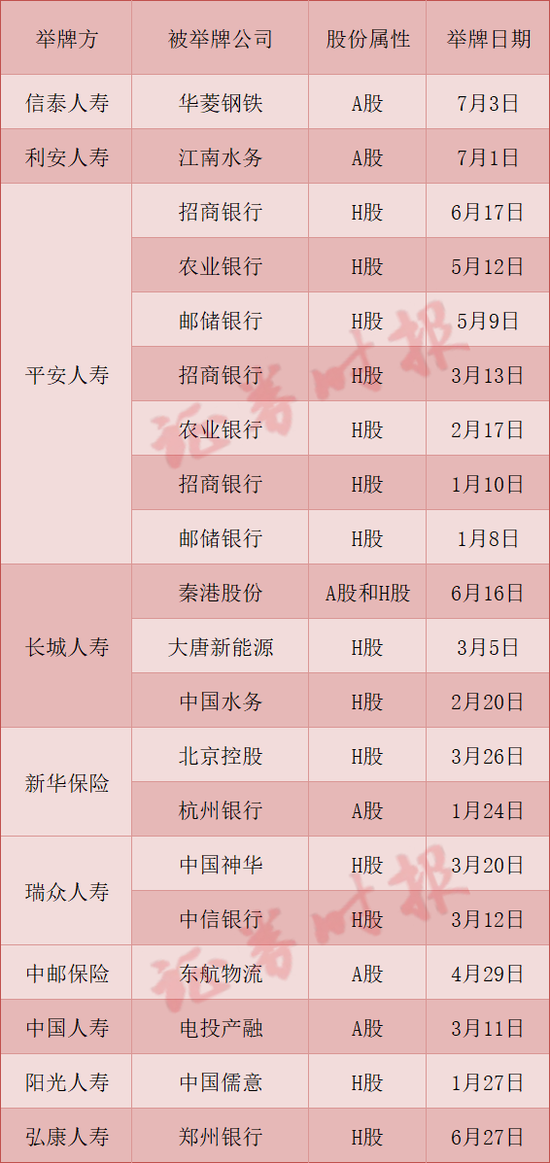
Core Viewpoint - Insurance capital has become a significant force in the capital market, actively acquiring shares in A-share and Hong Kong-listed companies, particularly in stable dividend-paying sectors like banking and public utilities [2][3][7]. Group 1: Insurance Capital Activity - Insurance capital has made at least 20 acquisitions of listed companies this year, focusing on sectors with stable cash flows and dividends [3][4]. - Notable acquisitions include Li'an Life increasing its stake in Jiangnan Waterworks by 46.99 million shares (5.03%) and Xintai Life acquiring 343 million shares (5.00%) of Hualing Steel [3][4]. - Hongkang Life increased its stake in Zhengzhou Bank to 6.68% after multiple acquisitions, highlighting the trend of insurance capital in the market [3][4]. Group 2: Market Environment and Strategy - The current low-interest-rate environment has led to an "asset shortage," prompting insurance capital to seek high-dividend equities to enhance returns [7][8]. - Regulatory changes, such as adjustments to the equity asset ratio for insurance funds, have facilitated greater participation of insurance capital in equity investments [7][8]. - The focus on high-dividend assets, particularly those yielding over 5%, is seen as a strategy to mitigate the impact of low fixed-income returns [7][8]. Group 3: Broader Market Implications - The increase in acquisitions by financial and industrial capital, as well as private equity, reflects a positive outlook on the long-term development of the capital market [10]. - The rise in acquisition activities serves as a market confidence booster, potentially attracting more capital and fostering a healthier market cycle [10][11]. - There is a need for insurance capital to balance the pursuit of returns with risk management, especially given the concentration in banking stocks which may amplify systemic risks [10][11].

A股,新信号!
Zheng Quan Shi Bao· 2025-07-08 11:39
Group 1 - Insurance capital has become a significant force in the capital market, with at least 20 instances of shareholding increases in A-shares and H-shares this year, primarily targeting stable dividend-paying assets like banks and public utilities [1][2] - Recent announcements indicate that Li'an Life and Xintai Life have increased their holdings in Jiangnan Water and Hualing Steel, respectively, with Li'an Life acquiring 46.99 million shares (5.03% of total shares) and Xintai Life acquiring 343 million shares (5.00% of total shares) [2][3] - The trend of insurance capital actively participating in shareholding increases is attributed to a low interest rate environment, leading to a search for stable cash flow and strong performance companies [1][6] Group 2 - The increase in shareholding by insurance capital is seen as a response to "asset scarcity," with a focus on high-dividend equities to enhance returns and offset the pressure from low fixed-income asset yields [6][7] - Regulatory changes, such as adjustments to the equity asset ratio for insurance funds, have facilitated greater participation of insurance capital in the equity market, creating favorable conditions for shareholding increases [6][7] - The rise in shareholding activities is viewed as a positive signal for the long-term development of the capital market, potentially enhancing investor confidence and attracting more capital [7][8] Group 3 - The participation of various capital types, including financial capital, industrial capital, and private equity, in shareholding increases reflects a positive outlook on the long-term performance of the companies involved [7][8] - The concentration of insurance capital in high-dividend sectors, particularly banks, raises concerns about potential systemic risks due to high industry concentration [7][8] - Future strategies for insurance capital may involve diversifying into less cyclical and more diversified high-dividend sectors to balance returns and risks [8]



A股,新信号!
证券时报· 2025-07-08 11:28
Core Viewpoint - Insurance capital has become a significant force in the capital market, actively acquiring shares in A-share and H-share listed companies, particularly in stable dividend-paying sectors like banking and public utilities [1][5][12]. Group 1: Insurance Capital Activity - Insurance capital has made at least 20 acquisitions of listed companies this year, focusing on stable cash flow and dividend-yielding assets [1][5]. - Recent notable acquisitions include Li'an Life increasing its stake in Jiangnan Waterworks by 46.99 million shares (5.03%) and Xintai Life acquiring 343 million shares (5.00%) of Hualing Steel [4][5]. - Hongkang Life has also increased its stake in Zhengzhou Bank, reaching 6.68% after multiple acquisitions [4]. Group 2: Market Environment and Strategy - The current low-interest-rate environment has led funds to seek companies with stable cash flows and strong performance as optimal investment choices [2][14]. - The "asset shortage" phenomenon has intensified, pushing insurance capital to invest in high-dividend equities to enhance returns and offset the pressure from fixed-income assets [14][20]. - Regulatory changes, such as adjustments to insurance capital investment ratios, have facilitated greater participation of insurance funds in equity markets [13][12]. Group 3: Broader Participation - Besides insurance capital, other entities like Asset Management Companies (AMCs) and private equity firms have also engaged in share acquisitions [7][8][9]. - The involvement of various capital types, including financial and industrial capital, reflects a positive outlook on the long-term development of the capital market [17]. Group 4: Market Impact and Future Outlook - Increased share acquisitions serve as a market confidence booster, attracting more capital and promoting a virtuous cycle in the market [19]. - The concentration of insurance capital in specific sectors, particularly banking, raises concerns about potential systemic risks due to high industry concentration [20][21]. - Future strategies may involve diversifying investments into less cyclical and higher-dividend sectors to balance risk and return [21].

日度策略参考-20250708
Guo Mao Qi Huo· 2025-07-08 08:41
Report Investment Ratings - **Bullish**: Palm oil (long - term) [1] - **Bearish**: Copper, Aluminum, Alumina, Zinc, Iron ore (short - term), Crude oil, Fuel oil, Asphalt, BR rubber, PTA, Ethylene glycol, Logs, Crude oil, Fuel oil, Bitumen, Shanghai stocks, BR rubber, PTA, Ethylene glycol, Short fiber, Styrene, Cotton (domestic, long - term), Corn (near - term), Soybean (far - month C01) [1] - **Neutral (Oscillating)**: Stock index, Treasury bond, Gold, Silver, Nickel, Stainless steel, Steel, Coke, Coking coal, Coke breeze, Rapeseed oil, Cotton (domestic, short - term), Sugar, Pulp, Live pigs, PE, PVC, Caustic soda, LPG, Container shipping secondary line [1] Core Views The report provides trend judgments and logical analyses for various commodities in different sectors. Market conditions are influenced by multiple factors such as macroeconomic data (e.g., US non - farm payrolls), geopolitical situations (e.g., Middle East tensions), supply - demand relationships, and policy changes. Different commodities show different trends, including upward, downward, and oscillating movements, and investors are advised to pay attention to relevant factors for each commodity [1]. Summary by Industry Macroeconomic and Financial - **Stock Index**: In the short term, market trading volume gradually shrinks slightly, and with mediocre domestic and international positive factors, there is resistance to upward breakthrough, and it may show an oscillating pattern. Follow - up attention should be paid to macro - incremental information for direction guidance [1] - **Treasury Bond**: Asset shortage and weak economy are beneficial to bond futures, but the central bank has recently warned of interest - rate risks, suppressing the upward space [1] - **Precious Metals (Gold and Silver)**: Market uncertainties remain. Gold and silver prices are expected to oscillate mainly. Attention should be paid to tariff developments [1] Non - ferrous Metals - **Base Metals**: Due to factors such as the cooling of the Fed's interest - rate cut expectations, high prices suppressing downstream demand, and inventory changes, copper, aluminum, alumina, zinc, etc., have downward risks. Nickel prices oscillate, and attention should be paid to supply and macro - changes [1] - **Stainless Steel**: After an oscillating rebound, the sustainability needs to be observed. Attention should be paid to raw material changes and actual steel - mill production [1] - **Industrial Silicon and Polysilicon**: Industrial silicon has a downward risk, and polysilicon is affected by supply - side reform expectations and market sentiment [1] - **Lithium Hydroxide**: Supply has not been reduced, downstream replenishment is mainly by traders, and there is capital gaming. The price oscillates [1] Ferrous Metals - **Steel and Related Products**: Macro uncertainties remain. With raw material price weakening, social inventory slightly declining, and steel - mill production reduction news boosting confidence, the market situation is complex. The sustainability of stainless - steel rebound needs to be observed [1] Agricultural Products - **Oils and Fats**: OPEC +'s unexpected production increase causes oils to follow the decline of crude oil. In the long term, international oil demand increases, and the far - month contracts of palm oil are bullish [1] - **Cotton**: In the short term, there are disturbances such as trade negotiations and weather premiums. In the long term, macro uncertainties are strong. Domestic cotton prices are expected to oscillate weakly [1] - **Sugar**: Brazil's sugar production is expected to reach a record high. If crude oil continues to be weak, it may affect Brazil's sugar - making ratio and production [1] - **Corn and Soybeans**: Corn is affected by policy - based grain releases and price differences. Soybeans have different trends for near - and far - month contracts, depending on factors such as supply - demand and trade policies [1] - **Pulp and Logs**: Pulp has low valuation and macro - positive factors. Logs are in the off - season, and supply decline is limited [1] - **Live Pigs**: With the continuous repair of pig inventory, the market shows a certain stability [1] Energy and Chemicals - **Crude Oil and Related Products**: Due to the cooling of the Middle East geopolitical situation and OPEC +'s unexpected production increase, crude oil, fuel oil, etc., have downward risks [1] - **Petrochemical Products**: PTA, ethylene glycol, etc., are affected by factors such as cost, supply - demand, and production - reduction expectations [1] - **Synthetic Rubber**: BR rubber is under pressure due to factors such as OPEC's production increase and high basis [1] - **Plastics and Chemicals**: PE, PVC, caustic soda, etc., show different trends due to factors such as maintenance, demand, and market sentiment [1] - **LPG**: Affected by factors such as price cuts, production increases, and seasonal demand, it has downward space [1] Other - **Container Shipping**: It is expected that the freight rate will reach its peak in mid - July and show an arc - top trend from July to August. The subsequent shipping capacity is relatively sufficient [1]
见证历史! 300亿份额全部“一日售罄”,科创债ETF究竟有何魔力?
Sou Hu Cai Jing· 2025-07-08 07:38
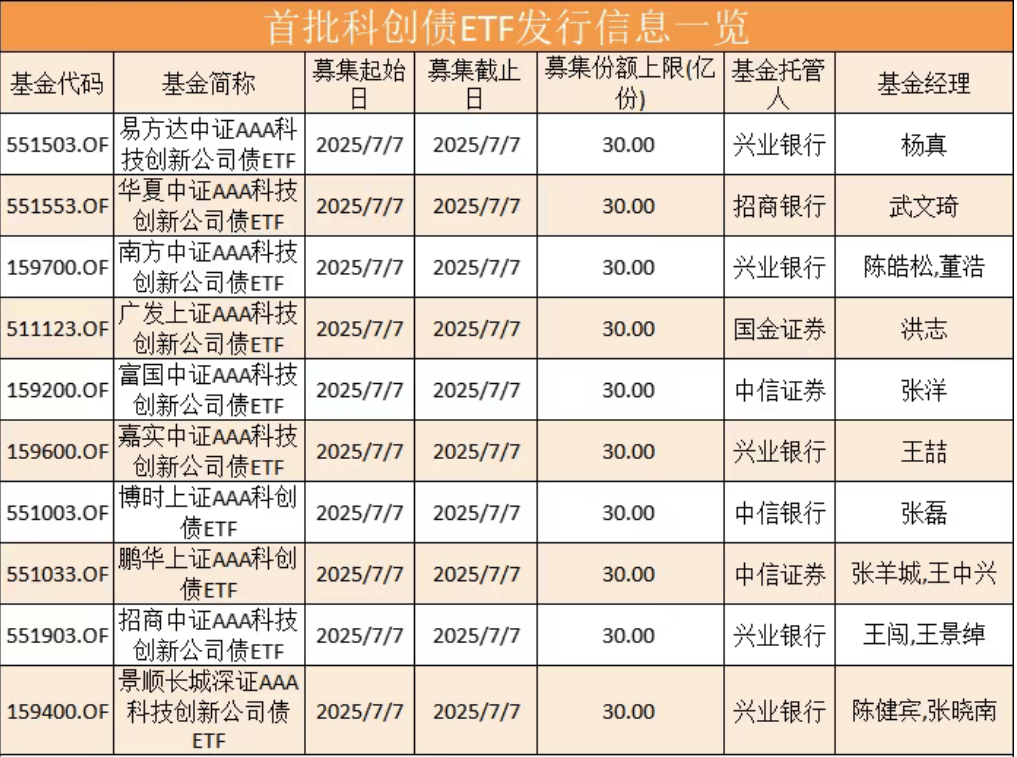
在市场中首日就完成募集目标的基金,我们给它一个特有的称号叫做"日光基"。通常是指一日之内就卖完的基金。 日光基的出现往往意味着市场对这类基金的认可度极高,投资者对其投资价值和未来表现有较高预期。 要知道在如今持续震荡的市场行中, "日光基"并不常见。即使2025年2月,首批13只科创综指ETF开启发行伊始,也仅有建信科创综指ETF成为"日光基"。 而如今"日光基"却扎堆出现了! 7月7日,首批10只科创债ETF集体开启首发,短短一天时间,全部宣布结束募集,成为10只"日光基"。按照单只基金30亿元募集上限计算,首批科创债ETF 单日"吸金"300亿元,引爆基金发行市场。 | | | | 首批科创债ETF发行信息一览 | | 171 | | | --- | --- | --- | --- | --- | --- | --- | | 基金代码 | 基金简称 | 募集起始 | 募集截止 | 募集份额上限(亿 基金托管 | | 基金经理 | | | | ■ | н | 份) | | | | 551503.OF | 易方达中证AA科 | 2025/7/7 | 2025/7/7 | 30.00 | 兴业银行 | 杨真 | ...