
供应紧张

Search documents
澳新银行:供应紧张担忧持续 亚洲早盘铜价小幅上涨
Ge Long Hui· 2025-10-07 02:01
Core Viewpoint - Concerns over supply tightness continue to impact copper prices, leading to a slight increase during early Asian trading sessions [1] Group 1: Supply Concerns - Recent months have seen multiple disruptions in major copper mining operations in Indonesia and Chile [1] - The Grasberg copper mine in Indonesia experienced an accident last month, resulting in the confirmed deaths of all missing workers [1]
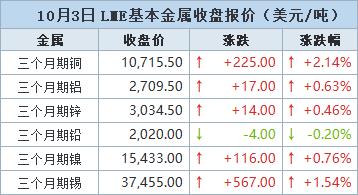
期铜创逾16个月新高,并录得逾一年来最佳周度表现【10月3日LME收盘】
Wen Hua Cai Jing· 2025-10-05 07:11
Core Insights - LME copper prices reached a 16-month high on October 3, driven by supply tightness and a weakening dollar [1][4] - The three-month copper price increased by $225, or 2.14%, closing at $10,715.5 per ton, marking a weekly gain of 5.2%, the strongest since September 2024 [1][5] Price Movements - Three-month copper: $10,715.50, up $225.00 (+2.14%) [2] - Three-month aluminum: $2,709.50, up $17.00 (+0.63%) [2] - Three-month zinc: $3,034.50, up $14.00 (+0.46%) [2] - Three-month lead: $2,020.00, down $4.00 (-0.20%) [2] - Three-month nickel: $15,433.00, up $116.00 (+0.76%) [2] - Three-month tin: $37,455.00, up $567.00 (+1.54%) [2] Supply Dynamics - LME copper inventory dropped to 140,475 tons, the lowest level since early August [5] - Supply risks and potential delays in restoring supply have been highlighted as key market drivers [4]

九月最新铜价迎来开门红
Sou Hu Cai Jing· 2025-09-01 09:39
Core Viewpoint - The arrival of the traditional consumption peak season "Golden September and Silver October" is expected to support copper prices, which are likely to maintain a strong trend due to multiple factors including macroeconomic conditions and supply-demand dynamics [1] Group 1: Price Trends - As of September 1, 2025, the spot copper recycling price is 73,700 yuan per ton [1] - The main copper futures contract on the Shanghai Futures Exchange has reached 79,680 yuan per ton [1] - The London Metal Exchange (LME) copper price closed at 9,906 USD per ton, marking a 0.68% increase and setting a new high [1] Group 2: Market Drivers - Expectations of interest rate cuts by the Federal Reserve and tight supply conditions are driving the upward movement of copper prices [1] - According to SMM's monthly analysis, copper prices are anticipated to continue fluctuating with a strong upward bias due to multiple supporting factors [1] Group 3: Investment Recommendations - Investors are advised to keep a close watch on market dynamics and relevant policy changes as copper prices are expected to maintain an upward trend supported by macroeconomic and supply-demand factors [1]
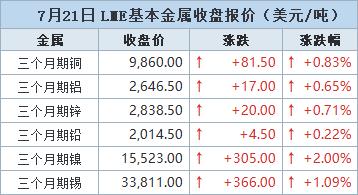
金属全线上涨 期锌创四个月新高,因市场担忧供应吃紧【7月21日LME收盘】
Wen Hua Cai Jing· 2025-07-22 00:44
Group 1 - LME zinc prices reached a four-month high due to concerns over supply tightness, with over 50% of the registered warehouse inventory marked as canceled warrants [1][3] - As of July 21, LME three-month zinc closed at $2,838.50 per ton, up $20 or 0.71% [1][2] - Total zinc inventory in LME warehouses is 118,225 tons, with 50% or 59,900 tons available for delivery, raising questions about the actual movement of zinc from warehouses [3] Group 2 - The increase in nickel prices is attributed to expectations of rising demand from China, leading to short covering by traders [4] - Industrial metal prices are supported by stable growth plans in China's machinery, automotive, and electrical equipment sectors [3]
伦交所新规限制持仓,豪赌铝期货的Mercuria被迫减仓
Hua Er Jie Jian Wen· 2025-06-21 07:50
Core Points - The London Metal Exchange (LME) has implemented new regulations requiring traders with large positions to reduce their holdings, particularly affecting energy trading giant Mercuria, which has been forced to cut its aluminum futures positions [1][2] - The new rule is a response to significant market disruptions caused by large energy traders entering the metal market, with Mercuria's aluminum position exceeding 1 million tons while LME's inventory dropped below 350,000 tons [2][3] - The LME's intervention aims to prevent market distortion due to traders holding positions several times larger than the available deliverable inventory [3] Group 1 - The LME's new regulation mandates that any trader holding positions in near-month contracts exceeding the total available inventory must reduce their positions [1][2] - The regulation applies to all market participants and is intended to address the recent influx of energy traders into the metal market [1][2] - The LME has indicated that this rule is temporary but may consider making it permanent in the future [3] Group 2 - Recent market conditions have shown signs of supply tightness, with the copper price spread reaching its highest spot premium since 2021, indicating significant market pressure [3] - The ongoing decline in inventory levels has amplified the impact of large positions on market pricing mechanisms, prompting the LME to take action [3] - The LME is set to take over the responsibility for market position limits from the Financial Conduct Authority (FCA) in July next year, with considerations for implementing restrictions on traders' positions in near-month contracts [3]
豆粕生猪:通关持续扰动,豆粕再创新高
Jin Shi Qi Huo· 2025-04-24 15:25
Report Industry Investment Rating - Not provided in the content Core Viewpoints - The supply of domestic soybean meal is tight in the short - term, with high spot prices, but the supply pressure will appear in the medium - term as the import volume increases and the oil mill's operating rate recovers. The price of soybean meal futures may be under pressure when the operating rate recovers and the downstream buying sentiment cools down. [5][17] - The supply of live pigs is expected to increase in the future, with the number of newborn piglets reaching a high level and the slaughter weight rising. The future rebound space of the live pig futures market is limited, and the price will be under pressure in the medium - term. [18] Summary by Relevant Catalogs 1. Market Overview - DCE soybean meal主力 2509 contract rose 0.36% to 3059 yuan/ton. Coastal mainstream oil mills' quotations increased by 200 - 300 yuan/ton, with Tianjin at 4300 yuan/ton (up 220 yuan/ton), Jiangsu at 3950 yuan/ton (up 250 yuan/ton), and Guangdong at 3930 yuan/ton (up 310 yuan/ton). [2] - DCE live pig主力 2509 contract fell 0.83% to 14135 yuan/ton. The national average ex - factory price of outer ternary live pigs was 14.89 yuan/kg, down 0.06 yuan/kg. [2] - Overnight CBOT US soybean主力 contract rose 0.5% to 1052 cents/bushel. [2] 2. Main Producing Area Weather - In the US Midwest, precipitation is expected to be active on weekends, and the wet conditions in the south may delay sowing. From last Friday to this Monday, there were local sporadic showers in both the west and the east. The temperature conditions varied in different periods and regions. The 6 - 10 - day outlook shows local sporadic showers and temperatures close to or higher than normal from Tuesday to Saturday. The dry weather at the beginning of last week promoted planting and field operations, but more rainfall systems are expected to appear over the weekend and this week. [4] 3. Macroeconomic and Industry News - The inventory reconstruction of soybeans takes time, and the short - term supply shortage situation remains. The pre - May Day stocking supports the price, but the import volume of soybeans in May - June is expected to be 23 million tons, and the oil mill's operating rate will recover to over 50%, along with the release of state - reserve soybeans, which will bring supply pressure and may lead to price decline. [5] - On April 23, the national major oil mills' soybean meal trading volume was 1.805 million tons, a decrease of 2.474 million tons compared with the previous day. The operating rate of all - sample oil mills was 42.4%, an increase of 3.11% compared with the previous day. [5] - On April 24, the import cost of US soybeans was 3869 yuan/ton (up 3 yuan), the cost after tariff was 7316 yuan/ton (unchanged), the import cost of Brazilian soybeans was 3664 yuan/ton (up 4 yuan), and the import cost of Argentine soybeans was 3690 yuan/ton (down 11 yuan). [5] - On April 24, the daily slaughter volume of key live pig breeding enterprises increased by 1.23%, and the daily slaughter volume of key slaughtering enterprises increased by 0.92%. [5][6] - As of April 17, the expected net sales of US soybeans in the 2024/25 market year were between 200,000 - 600,000 tons, and in the 2025/26 market year were 0 - 200,000 tons; the expected net sales of US soybean meal in the 2024/25 market year were between 150,000 - 350,000 tons, and in the 2025/26 market year were 0 - 50,000 tons. [6] - Due to the heavy rain in March and early April, the soybean harvesting rate was lower than the five - year average, and the output was at risk. The exchange expected the soybean output to be 48.6 million tons. The slow - down of soybean sales was also affected by the harvest delay. As of April 16, farmers had sold 23.4% of the 2024/25 crops, the slowest rate in ten years. [6] - In March, Argentina's soybean crushing volume was 3.228968 million tons, soybean oil output was 644,820 tons, and soybean meal output was 2.387321 million tons. [6] - Brazil's expected soybean export volume in April was 14.3 million tons, a decrease of 200,000 tons compared with last week's forecast, and the expected soybean meal export volume remained at 2.4 million tons. [7] - In mid - April 2025, compared with early April, among 50 important production materials, 10 products' prices rose, 32 decreased, and 8 remained unchanged. The price of live pigs (outer ternary) was 14.9 yuan/kg, an increase of 0.2 yuan/kg (1.4%). [7] 4. Data Charts - The report includes charts such as the price of soybean meal in Zhangjiagang and DCE soybean meal futures, soybean meal basis, the price of rapeseed meal in Nantong and CZCE rapeseed meal futures, rapeseed meal basis, the price of live pigs in Henan and DCE live pig futures, live pig basis, China's soybean inventory, and China's soybean meal inventory. [10][12][13][15] 5. Analysis and Strategies - For soybean meal, US soybean futures rose due to the expected easing of global trade tensions. The domestic soybean meal spot price increased by an average of 200 yuan/ton per day, with a serious vehicle - pressing situation in oil mills and a tight supply. The customs clearance problem will continue, but a large amount of soybeans will arrive in the second quarter, and the oil mill's operating rate is gradually recovering. There is a risk of chasing high prices in the short - term. [17] - For live pigs, the number of breeding sows has recovered, and the future theoretical slaughter volume of live pigs will increase. The number of newborn piglets in March reached a high level, and the slaughter weight has been rising. The future rebound space of the live pig futures market is limited, and the price will be under pressure in the medium - term. [18]
气候干燥引发供应紧张的担忧 可可期货势将创四个月来最长连涨
news flash· 2025-04-23 12:43
Core Viewpoint - Cocoa futures have risen for the fifth consecutive day, marking the longest streak since December of the previous year, driven by concerns over prolonged drought in West Africa leading to tight global supply [1] Group 1: Market Trends - The cocoa market is experiencing significant upward movement, with New York cocoa futures rising by 2.2% on Wednesday, reducing the year-to-date decline to approximately 20% [1] - In the London market, the most actively traded futures increased by 3.4% [1] Group 2: Weather Impact - Vaisala, a meteorological forecasting agency, reported that regions producing the majority of the world's cocoa are expected to see localized sporadic rainfall over the next five days [1] - While this rainfall may support the flowering period, additional precipitation is necessary to replenish soil moisture [1]