保险资金入市

Search documents
30次举牌、6400亿新增入市 保险资金在买什么?
Jing Ji Guan Cha Wang· 2025-08-21 11:16
Core Viewpoint - The A-share market has seen significant inflows from insurance funds, with a total trading volume exceeding 2 trillion yuan for seven consecutive trading days, and the Shanghai Composite Index reaching a ten-year high of 3787.98 points, contributing to a total market capitalization surpassing 100 trillion yuan [2][4]. Group 1: Insurance Fund Inflows - In the first half of 2025, insurance funds added over 640 billion yuan to the stock market, significantly higher than previous years, marking a historical high [3][4]. - The stock investment balance of insurance funds reached 3.07 trillion yuan, accounting for 8.47% of total assets, the highest since 2022 [3][4]. - The inflow of insurance funds has provided substantial support for the recovery of the A-share market, with a net inflow of 390 billion yuan in Q1 and 250 billion yuan in Q2 [4][12]. Group 2: Investment Trends and Preferences - Insurance funds have been actively participating in a "shareholding wave," with 30 instances of shareholding increases recorded in 2025, second only to 62 instances in 2015 [2][8]. - The focus of insurance funds has shifted towards high-dividend sectors, particularly in the banking industry, with 12 instances of shareholding increases in banks and a notable interest in Hong Kong-listed banks [9][10]. - The investment preferences of insurance funds are reflected in their significant holdings in over 220 stocks, with new purchases in 70 stocks and increased holdings in 58 stocks, primarily in sectors like pharmaceuticals, chemicals, and telecommunications [11][12]. Group 3: Regulatory and Market Environment - Recent regulatory changes have encouraged insurance funds to increase equity investments, with adjustments to risk factors for equity assets and a push for long-term capital market participation [15][16]. - The insurance industry is facing pressure to meet return requirements due to low interest rates on traditional fixed-income assets, leading to a greater allocation towards equity investments [12][16]. - The average duration mismatch between insurance liabilities and assets has prompted a shift towards equities, as traditional investments fail to meet yield expectations [13][14].


李大霄的投资智慧:远离“妖股” 坐稳“好轿子” 静待牛市腾飞
Xin Lang Zheng Quan· 2025-08-18 03:06
Core Viewpoint - The article emphasizes the importance of prudent investment strategies, particularly in the current market environment, where investors are cautioned against chasing high-priced stocks and should focus on quality investments instead [1][2][3]. Investment Strategy - Investors should avoid blindly chasing stocks above 3700 points and refrain from using leverage for such pursuits [2]. - It is advised to steer clear of poorly rated stocks and those that are overvalued, as these pose significant risks [2][3]. - The recommended approach is to buy quality stocks at market lows and hold them patiently for appreciation, rather than engaging in high-risk trading behaviors [3]. Institutional Investment - Attention should be given to stocks favored by foreign investors, as institutional funds such as insurance, social security, and pension funds are actively entering the market, providing essential support [2]. - The article highlights that these institutional investments are the "good vehicles" for investors to consider, contrasting them with less favorable opportunities [2]. Cautionary Advice - Investors are reminded to maintain a rational and value-oriented investment philosophy, using idle funds for investments to ensure long-term success [2]. - The article suggests that those unfamiliar with stock investments might start with mutual funds or ETFs focused on quality assets before moving to individual stocks [3].
招商证券:保险资金加速入市 上半年股票投资净增量超6400亿
智通财经网· 2025-08-17 07:33
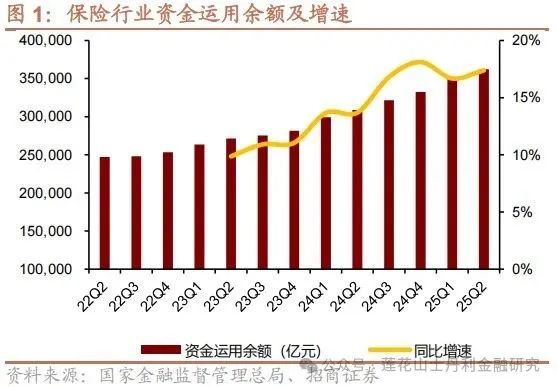
Core Viewpoint - The insurance industry is experiencing significant growth in fund utilization, driven by policy guidance and investment environment changes, with a notable increase in equity investments and a stable bond allocation structure [1][2][3]. Fund Utilization Overview - As of the end of Q2 2025, the total fund utilization of insurance companies reached 36.23 trillion, marking an 8.9% increase from the beginning of the year and a 3.7% increase from Q1 [2]. - The balance of life insurance companies' fund utilization was 32.60 trillion, also up 8.9% year-to-date, while property insurance companies held 2.35 trillion, a 5.7% increase [2]. - In H1 2025, the net increase in fund utilization was 2.98 trillion, with Q2 alone contributing 1.30 trillion, influenced by premium growth and asset value appreciation [2]. Investment Allocation - The bond balance reached 17.87 trillion, with a net increase of 1.94 trillion in H1, and Q2 saw a net increase of 896.1 billion, pushing the bond allocation to 51.1%, the highest in recent years [3]. - Bank deposits totaled 3.02 trillion, with a net increase of 111.3 billion in H1, while other investments (mainly non-standard) decreased by 1.87 trillion [3]. - The allocation to bank deposits and non-standard investments has reached new lows, attributed to declining asset yields and new accounting standards [3]. Equity Investment Trends - Regulatory measures are accelerating the long-term entry of insurance funds into the stock market, with equity allocation reaching a new high [4]. - In April, the regulatory authority adjusted the equity asset allocation ratio for insurance funds, increasing it by 5% for certain solvency levels [4]. - By mid-2025, the total approved amount for long-term investment trials by insurance funds reached 222 billion, indicating a strong push for stable long-term investments [4]. Recent Market Activity - Insurance companies have been actively increasing their stakes in other firms, with 27 instances of stake increases reported in 2025, surpassing the total for the previous year [10]. - The focus of these investments has been on high-dividend sectors such as banks and public utilities, reflecting a strategic shift towards stable returns [10]. - The recent stake increases by China Ping An in China Pacific Insurance and China Life demonstrate confidence in the recovery and long-term value of the insurance sector [10].

2025Q2保险业资金运用数据点评:保险资金加速入市,上半年股票投资净增量超6400亿
CMS· 2025-08-17 04:34
Investment Rating - The report maintains a "Recommended" rating for the insurance industry, indicating a positive outlook for the sector's fundamentals and expected performance relative to market benchmarks [2][6][7]. Core Insights - The insurance industry's fund utilization scale surpassed 36 trillion yuan in Q2 2025, with a net increase of over 1.3 trillion yuan in the quarter, reflecting strong growth driven by premium income and asset value appreciation [5][7]. - The allocation structure of insurance funds has become more pronounced, with bond and stock proportions reaching new highs, indicating a shift towards a "barbell" investment strategy [5][7]. - Regulatory measures have accelerated the entry of insurance funds into the stock market, with the stock allocation reaching a record high of 8.8% by the end of Q2 2025, supported by policy adjustments aimed at promoting long-term investments [5][7]. Summary by Sections Industry Scale - As of Q2 2025, the total market capitalization of stocks held by insurance companies is approximately 670.62 billion yuan, with a circulating market value of about 641.38 billion yuan [2]. Fund Utilization - The total fund utilization balance for insurance companies reached 36.23 trillion yuan by the end of Q2 2025, marking an 8.9% increase year-to-date and a 3.7% increase from Q1 2025 [5][7]. - The bond allocation exceeded 51%, the highest level in recent years, while bank deposits and non-standard investments were reduced [5][7]. Equity Investment - The stock balance for life and property insurance companies reached 3.07 trillion yuan, with a net increase of 640.6 billion yuan in the first half of 2025, indicating a strong commitment to equity investments [5][7]. - The report highlights a resurgence in insurance companies' stake acquisitions in peer firms, with 27 instances recorded in 2025, reflecting confidence in the sector's recovery and long-term value [5][7]. Investment Recommendations - The report suggests individual stock recommendations including China Pacific Insurance, New China Life Insurance, and Ping An Insurance, while also advising attention to China Life Insurance, China Taiping Insurance, and China Property & Casualty Insurance for their long-term investment value [7].




超2000亿元险资加速入市
2 1 Shi Ji Jing Ji Bao Dao· 2025-08-11 13:52
Core Viewpoint - The recent approval for China Taiping's subsidiary to establish a private equity fund management company marks a significant advancement in the long-term investment reform pilot for insurance funds, indicating an acceleration in insurance capital entering the market [2][4]. Group 1: Investment Reform Pilot - The long-term investment reform pilot for insurance funds has seen three batches of approvals, with a total scale of 222 billion yuan (approximately 31.5 billion USD) [4][5]. - The first batch was approved in October 2023, with China Life and Xinhua Life jointly investing 50 billion yuan [4]. - The second batch, initiated in January 2025, allowed several insurance companies to participate with a total scale of 520 billion yuan [5]. - The third batch, approved in March 2025, included additional participants with a total scale of 600 billion yuan [5]. Group 2: Investment Strategies and Trends - Insurance funds are increasingly favoring large-cap blue-chip stocks and high-dividend yielding companies, reflecting a shift towards stable and well-governed investment targets [7][9]. - The types of funds being established are diversifying, with both company-type and contract-type funds being utilized, enhancing the flexibility and standardization of fund management [7][8]. - The investment focus includes sectors such as finance, energy, public infrastructure, and new energy transitions, aligning with national economic development goals [9]. Group 3: Market Participation and Trends - Insurance capital has been actively participating in the stock market, with a notable increase in stock holdings, reaching a market value of 2.65 trillion yuan (approximately 375 billion USD) in the first quarter of 2024 [2][12]. - The number of equity stakes taken by insurance funds has surged, with 22 instances recorded in 2024 alone, surpassing the total for the previous year [11][12]. - The sectors attracting the most investment include public utilities and banking, characterized by stable returns and high dividend yields [11][12].



要盯紧保险资金动向了
Ge Long Hui· 2025-08-09 12:00
Market Overview - Since July, the A-share market has shown strong performance, recovering from a dip and reaching new highs for the year, approaching the previous peak of 3674 points from October 8, 2022 [3] - There are mixed sentiments among investors, with some optimistic about breaking through 3674 points and potentially reaching 4000 points, while others are concerned about high valuations and overly optimistic economic growth expectations [3] Fund Flows and Market Dynamics - The direction of the market is ultimately determined by the flow of funds, with net inflows driving market uptrends [4] - In 2017, the A-share market experienced a significant rally led by blue-chip stocks, with the Shanghai Stock Exchange 50 Index rising nearly 30% [4] - In 2020-2021, the A-share market saw extreme volatility, with the CSI 300 Index reaching a historical high of 5930 on February 18, 2021, with a PE ratio of 17.5, significantly above the 10-year average of 12.3 [5] Institutional Investment Trends - The expansion of actively managed public funds has been a key driver of the recent market rally, with public funds' share of A-share free float market value increasing from 11.6% in 2020 to 13.6% in 2021 [7] - As of 2024, the banking sector has shown strong performance, with the Shanghai Composite Index and other indices posting gains of 22.2%, 19.6%, 16.5%, and 16.2% respectively [7] - The A-share ETF market has grown significantly, with a total market size of 3.7 trillion yuan, reflecting an 83% increase since the beginning of the year [8] Future Fund Inflows - Insurance funds are expected to become a major source of incremental capital in the market, with their holdings in stocks increasing from over 2 trillion yuan to nearly 3 trillion yuan [9] - The potential for insurance funds to drive market trends is supported by recent policy changes encouraging long-term investments in A-shares [18] - The shift in focus towards high-dividend stocks is anticipated, particularly in the banking sector, as insurance funds seek stable returns [9][10] Sector Performance and Outlook - The market may see a shift back to conservative styles, focusing on dividend-related sectors, particularly banks, utilities, and cyclical stocks [20][21] - The cyclical dividend stocks are viewed as a better investment choice due to their potential for recovery and growth, especially in light of ongoing economic reforms [22] - Recent performance has shown significant gains in cyclical sectors, with steel up 20.8% and construction materials up 17.9%, while utilities and banks have lagged behind [22]

方正富邦基金吴昊:保险指数回调 低估值板块藏有大机会
Zhong Guo Jing Ji Wang· 2025-07-31 08:53
Core Viewpoint - The insurance sector is experiencing a significant adjustment, with the insurance theme index declining by 2.35% as of the report's deadline, despite having increased over 22% since the low point on April 7, 2025. The recent decline is attributed to market sentiment shifting towards risk-free assets following the release of July's manufacturing PMI data and profit-taking behavior after previous gains [1][2]. Summary by Sections Market Performance - On July 31, A-share indices collectively adjusted, with the Shanghai Composite Index leading the decline. Cyclical stocks such as metals and coal were the hardest hit, while insurance stocks, which had previously led the bull market, faced a notable drop [1]. Regulatory and Economic Factors - A key positive factor for the insurance sector is the recent regulatory change, which has lowered the standard interest rate for ordinary life insurance from 2.34% at the beginning of the year to 1.99%. This reduction in rates for traditional, universal, and participating insurance products directly decreases the liability costs for insurance companies, particularly mitigating long-term interest rate risk [1][2]. - The China Banking and Insurance Regulatory Commission reported strong growth in the life insurance sector, with a 5.4% year-on-year increase in original premium income for the first half of 2025, and a 15.2% increase in Q2 alone. Property insurance premiums reached 964.5 billion yuan, also reflecting a 5.1% year-on-year growth [2]. Investment Opportunities - The insurance sector's valuation remains low, with the insurance theme index's price-to-earnings ratio at 7.88, which is at a historical 30.53% percentile level. This suggests a safety cushion for trading, and the sector is expected to benefit from market recovery and a favorable policy environment, potentially improving both ends of the investment spectrum [3].
研究值公布在即 人身险预定利率有望调降
Shang Hai Zheng Quan Bao· 2025-07-24 18:58
Core Viewpoint - The expected reduction in the predetermined interest rate for ordinary life insurance products is becoming a consensus in the industry due to the continuous decline in market interest rates [1][2]. Group 1: Predetermined Interest Rate Adjustment - The upcoming second quarter meeting of the expert advisory committee may lead to a further reduction in the predetermined interest rate research value for ordinary life insurance products, which is currently at 2.13%, down from 2.34% at the beginning of the year [1][2]. - If the research value is announced to be below 2.25%, it will trigger the adjustment mechanism for the maximum predetermined interest rates of life insurance products [2]. - The anticipated research value for the second quarter of 2025 is estimated to be around 2.01%, a decrease of 12 basis points from the previous value [2]. Group 2: Key Interest Rates Impact - The expected reduction in the predetermined interest rate is primarily driven by the decline in three key interest rates: the 5-year Loan Prime Rate (LPR) at 3.5%, the 5-year fixed deposit rate at 1.3%, and the 10-year government bond yield at approximately 1.72% [3]. - The maximum predetermined interest rates for ordinary life insurance products are expected to decrease by 0.5 percentage points, with new limits projected at 2.0% for ordinary products, 1.5% for participating products, and 1.0% for universal products [3][4]. Group 3: Impact on Insurance Companies - The reduction in predetermined interest rates is expected to optimize the liability costs for insurance companies, allowing for increased market entry of insurance funds due to lower liability costs and a rising preference for equity investments [5][6]. - The shift towards floating yield products is encouraged to enhance asset-liability management and achieve high-quality development in the industry [6]. - The long-term outlook suggests that traditional insurance predetermined rates may reach their lowest levels since the 1990s, providing more growth opportunities for floating yield products [6]. Group 4: Market Reactions - The anticipated reduction in predetermined interest rates may boost product sales, although the "炒停售" phenomenon (speculative buying and selling) is expected to be less pronounced compared to previous years [7].
吸引保险资金更多流入股市应从四方面入手
Guo Ji Jin Rong Bao· 2025-07-14 05:12
Group 1 - The Ministry of Finance issued a notice to guide insurance funds towards long-term stable investments, adjusting performance evaluation indicators for state-owned commercial insurance companies to include a combination of annual, 3-year, and 5-year indicators with respective weights of 30%, 50%, and 20% [1] - The adjustment means that long-term investment returns will account for 70% of the evaluation, allowing insurance funds to act as a stabilizing force in the market and facilitating their entry into the stock market [1] - The notice addresses the issue of short-term investment by insurance funds, enabling them to focus on long-term investment strategies for maximizing returns [1] Group 2 - Following the notice, insurance funds are expected to become true long-term capital, but the ultimate direction of these investments remains a concern [2] - To attract more insurance funds into the A-share market, a profitable market environment must be established, as the current stagnation around 3000 points hinders long-term investment [2] - Improving the quality of listed companies is crucial for investment returns, necessitating strict controls on IPOs to prevent low-quality companies from entering the market [2] - Addressing shareholder reduction issues is essential, including limiting major shareholders' holdings and reducing the impact of compliant reductions on the market [2] - Systematic barriers must be cleared, such as the contradiction between encouraging long-term investments and allowing short-selling, which undermines market stability [2]
险企考核“指挥棒”改革 打通险资入市堵点
Shang Hai Zheng Quan Bao· 2025-07-11 18:02
Core Viewpoint - The recent notification from the Ministry of Finance aims to guide state-owned commercial insurance companies towards long-term stable investments, adjusting performance evaluation metrics to include longer-term indicators, thereby promoting a more sustainable investment approach [2][3][4]. Group 1: Changes in Evaluation Metrics - The Ministry of Finance has adjusted the performance evaluation metrics for state-owned commercial insurance companies, combining annual indicators with 3-year and 5-year cycle indicators for "net asset return rate" and "capital preservation and appreciation rate" [3][4]. - The new evaluation weights are set at 30% for the annual indicator, 50% for the 3-year cycle indicator, and 20% for the 5-year cycle indicator, significantly increasing the emphasis on long-term performance [3][4]. Group 2: Impact on Investment Strategy - The adjustments are expected to alleviate short-term performance pressures on insurance companies, allowing them to increase their long-term stock investment capabilities [5][6]. - Insurance companies are encouraged to shift their investment strategies from short-term gains to long-term value creation, focusing on high-quality stocks with stable cash flows and reasonable valuations [6][8]. Group 3: Asset-Liability Management - The notification emphasizes the need for improved asset-liability management, requiring insurance companies to align their investment strategies with long-term goals and enhance their internal management mechanisms [7][8]. - Companies are urged to consider various factors such as customer needs, cash flow matching, and liability cost constraints in their operational strategies to optimize capital allocation [8]. Group 4: Support for Innovation - The notification is expected to enhance the ability of insurance funds to support technology innovation by identifying stable, low-risk investment opportunities, particularly in promising small and medium-sized tech enterprises [8]. - This approach aims to ensure that insurance funds play a significant role in providing long-term capital to support national strategic initiatives and the development of the real economy [8].