公平竞争

Search documents
【这样改,为什么】破除隐性壁垒,让各类经营主体竞相发展——优化营商环境系列述评之三
Sou Hu Cai Jing· 2026-01-13 01:56
Group 1 - The market environment is essential for the survival and growth of market entities, with large enterprises benefiting from scale effects and resource reserves, while small and medium-sized enterprises (SMEs) face more challenges due to limited resources and weaker risk resistance [1] - Optimizing the business environment requires eliminating discriminatory practices and creating a fair and orderly market, treating all types of enterprises equally to foster a competitive development landscape [1][10] - There are still existing barriers to equal competition in areas such as market access and public resource transactions, which can lead to a vicious cycle of protectionism and hinder high-quality development [1] Group 2 - The integration of AI technology in fair competition reviews in Jinzhou has improved the efficiency of identifying unfair clauses in policies and bidding documents, addressing issues of low efficiency and inconsistent standards in manual reviews [3] - The use of smart warning mechanisms in government procurement has enhanced the ability to detect collusion and irregularities, allowing for more effective oversight and ensuring fair competition [3] - The construction of a unified platform to streamline resource allocation and improve logistics efficiency has led to significant growth in international sea-rail intermodal container business, with a 142% year-on-year increase projected for 2025 [4][6] Group 3 - The production factors that constitute the business environment directly impact the market competitiveness of enterprises, necessitating improved resource allocation efficiency [4] - Reforms in various sectors, including electricity market transactions and flexible land leasing methods, aim to enhance investment efficiency and address financing challenges for enterprises [6] - There is a need for a shift in mindset among local officials to better support SMEs and emerging industries, recognizing their importance in the economic landscape [7][10] Group 4 - SMEs are crucial for economic vitality and innovation, often having the potential to become industry leaders despite their smaller size [10] - Government services must reach beyond large enterprises to support SMEs effectively, requiring officials to understand local enterprises and facilitate partnerships [10][8]


“反内卷”十大制度硬核护航 全链条筑基市场公平竞争
Chang Jiang Shang Bao· 2026-01-12 01:20
Core Viewpoint - The "involution" competition disrupts market signals, reduces resource allocation efficiency, and undermines long-term competitiveness of enterprises, affecting industrial structure optimization and high-quality development [1][2] Regulatory Developments - The National Market Regulation Administration has announced ten institutional achievements for the comprehensive rectification of "involution" competition by 2025, covering aspects such as unfair competition, platform governance, and standard leadership [1][2] - The ten institutions form a governance loop that covers pre-event, in-event, and post-event stages, providing a solid institutional guarantee for innovative development of various business entities [3] Implementation and Impact - The new regulations include the revised Anti-Unfair Competition Law, guidelines for internet platform anti-monopoly compliance, and standards for product and service quality on online trading platforms [3][4] - Initial effects show a positive trend in regulating improper interventions, leading to more rational and orderly market competition, and curbing phenomena like "subsidy wars" and "lowest price" strategies [4] Future Directions - The regulatory bodies will continue to strengthen the implementation of new regulations to ensure they translate into effective governance, supporting the deepening of a unified national market and achieving high-quality development [4][5] - A new round of "anti-involution" efforts is set to begin in 2026, with ongoing discussions in industries such as power and energy storage batteries to address irrational competition behaviors [5][6] Platform Economy Regulations - Recent regulations for the platform economy include the Network Trading Platform Supervision Management Measures and the Live E-commerce Supervision Management Measures, aimed at creating a fair and transparent online trading ecosystem [7] - These new rules are expected to enhance platform governance responsibilities and ensure compliance with legal standards, thereby protecting consumer rights and maintaining competitive order [7]
服务提速 竞争促优 品牌赋能
Xin Lang Cai Jing· 2026-01-10 22:40
Group 1 - The core objective of the Heilongjiang Provincial Market Supervision Administration is to enhance service efficiency for enterprises, focusing on the "three breakthrough years" action plan set by the provincial government, aiming to stimulate business vitality and ensure fair competition [1] - The implementation of the "efficient handling of one matter" system has reduced the average processing time for high-frequency business matters by 83.5%, with some cases being completed in as little as 10 minutes [2][3] - The introduction of the "AI Huiqi Name" application has improved the efficiency of business name registration, achieving a recommendation success rate of over 90% for 14,000 names [3] Group 2 - The provincial market supervision authority has actively removed barriers to competition, correcting over 100 policies that violated fair competition standards and handling four administrative monopoly cases in 2025 [4] - The proactive approach includes conducting "fair competition policy" seminars and collecting enterprise feedback, resulting in 590 resolved issues for businesses [5][6] - The "Longjiang Quality" certification program has significantly enhanced brand credibility for certified companies, leading to a 10% increase in revenue and profit for participating enterprises [6][7] Group 3 - The provincial market supervision bureau has established a strategic partnership with Shenzhen's market supervision authority to integrate "Longjiang Quality" with high-end market certification systems, facilitating access to the Guangdong-Hong Kong-Macao Greater Bay Area [7] - The implementation of a reward policy for newly certified "Longjiang Quality" enterprises has resulted in 1.8 million yuan in total rewards distributed, with a one-time incentive of 100,000 yuan for each new certification [6][7]
三大外卖平台内卷加剧接受调查
Bei Jing Wan Bao· 2026-01-10 06:17
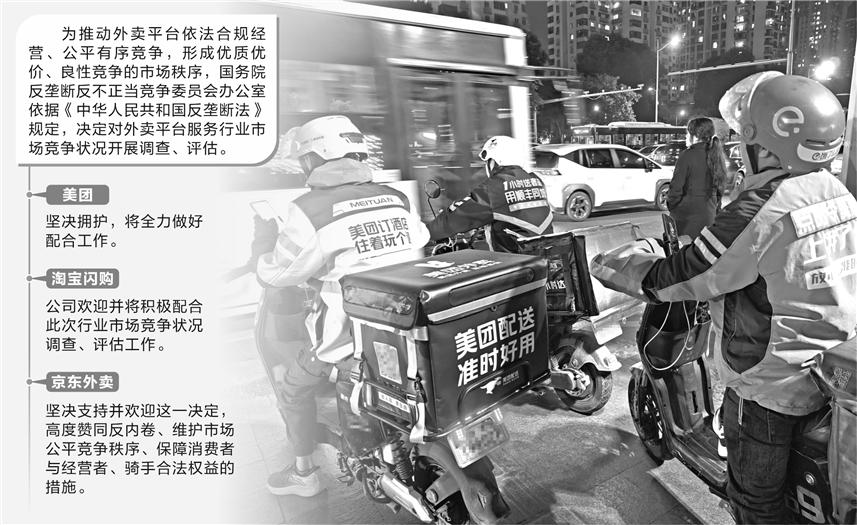
Core Viewpoint - The State Administration for Market Regulation has initiated an investigation into the competitive conditions of the food delivery platform service industry due to issues such as excessive subsidies, price wars, and traffic control, which are negatively impacting the real economy and intensifying "involution" competition [1][2]. Group 1: Investigation and Regulatory Actions - The investigation aims to assess the competitive behavior of food delivery platforms and gather opinions from various stakeholders, including operators, new employment groups, and consumers, to ensure fair competition and compliance with antitrust laws [2]. - The investigation will utilize methods such as on-site verification, face-to-face interviews, and surveys to comprehensively understand the market competition status and propose regulatory measures [2]. Group 2: Industry Response - Major food delivery platforms, including Meituan, Taobao Shanguo, and JD Delivery, have expressed strong support for the government's decision and committed to cooperating with the investigation [3][4]. - Meituan has emphasized its long-standing opposition to "involution" and aims to work with other platforms to fulfill market responsibilities and ensure fair competition [3]. - Taobao Shanguo highlighted the importance of fair competition as a core principle of the market economy and pledged to collaborate with various stakeholders to maintain a healthy market environment [3]. - JD Delivery expressed its commitment to supporting measures that uphold market fairness and protect the rights of consumers, operators, and delivery personnel, while also focusing on quality development through supply chain innovation [4].


美团、淘宝闪购、京东外卖发文表态
新华网财经· 2026-01-10 01:34
Core Viewpoint - The State Council's Anti-Monopoly and Anti-Unfair Competition Committee Office has initiated an investigation into the competitive landscape of the food delivery platform service industry, with major players like Meituan, Taobao Flash Purchase, and JD Delivery expressing their willingness to cooperate [2][4][6]. Group 1: Meituan's Position - Meituan highlights the prevalence of irrational competition characterized by price wars, subsidies, and traffic control in the food delivery market [2]. - The company advocates for a return to rational competition and opposes "involution-style" competition, aiming to promote innovation and healthy development within the industry [2]. Group 2: Taobao Flash Purchase's Commitment - Taobao Flash Purchase emphasizes the importance of fair competition as a core principle of market economy and a foundation for sustainable innovation and healthy development in the food delivery sector [4]. - The platform commits to adhering to relevant laws and regulations, including the Anti-Monopoly Law and the Anti-Unfair Competition Law, while actively participating in the investigation [4]. Group 3: JD Delivery's Support - JD Delivery expresses strong support for the investigation and agrees with measures aimed at combating involution and maintaining fair competition [6]. - The company plans to innovate its supply chain model to promote high-quality food delivery services, thereby better serving consumers, partner merchants, and delivery personnel [6].

三大外卖平台集体表态:积极配合市场竞争状况调查
Xin Lang Cai Jing· 2026-01-09 23:50
Core Viewpoint - The State Administration for Market Regulation of China has announced an investigation into the competitive landscape of the food delivery platform service industry, with major platforms expressing their support and commitment to cooperate with the investigation [1][2][3]. Group 1: Company Responses - Meituan has publicly stated its support for the investigation and aims to use this opportunity to collaborate with other platforms to fulfill market responsibilities and promote fair competition [1]. - Taobao Shanguo emphasized the importance of fair competition as a core principle of market economy and expressed its commitment to cooperate with the investigation while enhancing service quality [1]. - JD.com also expressed strong support for the investigation, advocating for fair competition and the protection of consumer and operator rights, while focusing on high-quality development in the food delivery sector [2]. Group 2: Industry Context - The investigation comes amid ongoing issues in the food delivery industry, including aggressive subsidy wars and price competition, which have been criticized for harming the real economy and intensifying "involution" competition [3]. - Despite previous regulatory discussions aimed at fostering fair competition, the competitive dynamics among platforms remain intense, with ongoing market battles and subsidy strategies [2]. - The investigation will involve various methods such as on-site verification, interviews, and surveys to gather comprehensive insights into competitive behaviors and stakeholder opinions within the industry [3].

国家将开展外卖行业市场竞争状况调查三大平台积极回应并呼吁公平竞争
Zheng Quan Shi Bao· 2026-01-09 22:58
Core Viewpoint - The State Administration for Market Regulation has initiated an investigation into the competitive landscape of the food delivery platform service industry in China, aiming to address issues of irrational competition, such as price wars and excessive subsidies, which have negatively impacted the real economy and intensified "involution" within the industry [1] Group 1: Investigation and Regulatory Actions - The investigation will utilize methods such as on-site verification, face-to-face interviews, and surveys to gather comprehensive insights into competitive behaviors within the food delivery platforms [1] - The goal is to promote lawful and compliant operations among food delivery platforms, ensuring fair competition and a healthy market order [1] Group 2: Responses from Major Food Delivery Platforms - Meituan expressed strong support for the investigation and emphasized the need for rational competition, advocating for a return to responsible market practices [2] - Taobao Shanguo welcomed the investigation and committed to cooperating fully, highlighting the importance of fair competition as a core principle of the market economy [2] - JD Delivery also supported the decision, focusing on resisting "involution" and promoting high-quality development through supply chain innovations [2] Group 3: Financial Impact and Industry Challenges - The intense competition has led to significant financial losses for major platforms, with Meituan reporting an adjusted net loss of 16 billion yuan in Q3 2025, compared to a profit of 12.8 billion yuan in the same period last year [3] - Alibaba's net profit for the same period fell by 52% to 20.99 billion yuan, while JD's net profit decreased by 55% to 5.3 billion yuan [3] - The high subsidy costs have created a vicious cycle affecting the quality of food services, as restaurants face pressure to lower quality to maintain profitability [3][4] Group 4: Underlying Issues of Subsidy Mechanisms - There is a need to scrutinize the subsidy cost transfer mechanisms, questioning whether the platforms or the merchants bear the burden of these costs [4] - Platforms may impose hidden costs on merchants through algorithms that dictate pricing and traffic distribution, leading to a situation where merchants must subsidize their own promotions [5]
三大外卖平台:全力配合竞争调查
Xin Lang Cai Jing· 2026-01-09 22:52
转自:北京日报客户端 近段时间以来,外卖平台服务行业拼补贴、拼价格、控流量等问题突出,挤压实体经济,加剧行业"内 卷式"竞争,社会各方面反映强烈。国家市场监督管理总局昨天发布公告,近日,国务院反垄断反不正 当竞争委员会办公室决定对外卖平台服务行业市场竞争状况开展调查、评估。 淘宝闪购发文称,深知公平竞争是市场经济的核心原则,也是推动外卖平台服务行业持续创新与健康发 展的基石。淘宝闪购欢迎并将积极配合此次行业市场竞争状况调查、评估工作,严格落实合规主体责 任,持续与商户、生态合作伙伴等各方携手,提供更多元化、更高质量的服务,共同维护好公平有序的 市场环境,合力推动外卖服务行业进一步繁荣发展。 京东外卖官微发文表示,坚决支持并欢迎这一决定,高度赞同反内卷、维护市场公平竞争秩序、保障消 费者与经营者、骑手合法权益的措施。"作为数实融合的新型实体企业,我们将通过供应链模式创新, 大力推动品质外卖的高质量发展,更好地服务广大消费者、合作商家与骑手,促进外卖平台服务行业创 新和健康发展。"京东外卖在公告中表示。 监管 传导监管压力 提出处置措施 2025年初,京东、阿里巴巴高调宣布进军外卖,外卖大战风起云涌。2025年5 ...
市场监管总局发布十大制度成果 完善整治“内卷式”竞争政策工具
Shang Hai Zheng Quan Bao· 2026-01-09 18:39
Core Viewpoint - The article discusses the release of ten institutional achievements aimed at addressing "involution" competition by the State Administration for Market Regulation, which provides a comprehensive governance framework to ensure fair competition and promote high-quality economic development [1][2][3]. Group 1: Institutional Achievements - The ten institutional achievements include new laws and regulations, such as the Anti-Unfair Competition Law, guidelines for improving product and service quality on online trading platforms, and basic requirements for food delivery platform services [1][2]. - These achievements form a governance loop that covers preemptive, ongoing, and post-event measures to address issues in market competition, particularly focusing on the prevalent "involution" behaviors [2][3]. Group 2: Sector-Specific Strategies - The institutional design employs a categorized governance strategy tailored to different sectors, emphasizing rigid constraints in safety-critical areas and compliance guidance in innovative sectors [3]. - For instance, the regulations on the quality safety supervision of key industrial products sold online implement a list management approach to ensure product safety [3]. Group 3: Long-term Goals and Implementation - The long-term vision includes enhancing fair competition through standards and quality improvement policies, which are expected to guide industry upgrades [4]. - The State Administration for Market Regulation plans to intensify efforts to implement these new regulations effectively, transforming good laws into effective governance [5].
国家将开展外卖行业市场竞争状况调查 三大平台积极回应并呼吁公平竞争
Zheng Quan Shi Bao· 2026-01-09 17:41
Core Viewpoint - The State Administration for Market Regulation has initiated an investigation into the competitive landscape of the food delivery platform service industry in China, aiming to address issues of irrational competition, such as price wars and excessive subsidies, which have negatively impacted the real economy and intensified "involution" within the industry [2] Group 1: Government Actions - The investigation is based on the Anti-Monopoly Law of the People's Republic of China and aims to promote lawful and fair competition within the food delivery platform service sector [2] - The investigation will involve on-site verification, face-to-face interviews, and surveys to gather insights from various stakeholders, including platform operators, new employment groups, and consumers [2] Group 2: Company Responses - Major food delivery platforms, including Meituan, Taobao Shanguo, and JD Delivery, have expressed their support for the investigation and committed to cooperating fully [3] - Meituan has called for a return to rational competition and has emphasized the importance of fulfilling market responsibilities to foster innovation and healthy development in the industry [3] - Taobao Shanguo has highlighted the significance of fair competition as a core principle of market economy and aims to provide diverse and high-quality services in collaboration with partners [3] - JD Delivery has voiced strong support for measures against "involution" and is focused on promoting high-quality development through supply chain innovations [3] Group 3: Industry Challenges - The intense competition among food delivery platforms has led to significant financial losses, with Meituan reporting a net loss of 16 billion yuan in Q3 2025, compared to a profit of 12.8 billion yuan in the same period last year [4] - Alibaba's net profit for the same period fell by 52% to 20.99 billion yuan, while JD's net profit decreased by 55% to 5.3 billion yuan [4] - The high subsidies offered by platforms have created a vicious cycle for the restaurant industry, leading to profit erosion and quality compromise, as businesses face high fixed costs and low demand elasticity [5] Group 4: Expert Insights - An expert has pointed out that the burden of high subsidies is often shifted to restaurants, creating a dilemma where businesses must either participate in subsidy programs or risk losing customer traffic [5] - The expert emphasized the need to scrutinize the mechanisms behind subsidy costs, questioning whether they are borne by the platforms or passed down to merchants through pricing algorithms [5]