南向资金流入

Search documents
外资加仓中国,资金为什么爆买港股
21世纪经济报道· 2025-08-18 15:16
Core Viewpoint - Foreign capital is continuously increasing its investment in China, with significant inflows into the Hong Kong stock market, indicating a strong bullish sentiment despite recent market fluctuations [1][5]. Group 1: Southbound Capital Inflows - As of August 18, southbound capital has seen a record net inflow of over 940 billion HKD this year, marking a historical high [1][5]. - Analysts predict that the total net inflow for the year could exceed 1.2 trillion HKD, which is expected to support the upward trend of the Hong Kong stock market [1][6]. Group 2: Market Performance Comparison - The Hong Kong stock market has underperformed compared to the A-share market since mid-June, with the Hang Seng Index and Hang Seng Tech Index experiencing maximum gains of 33% and 49% respectively in the first half of the year [4]. - Despite the recent downturn in the Hong Kong market, southbound capital has accelerated its buying pace, with a record single-day net purchase of 358.76 billion HKD on August 15 [4][5]. Group 3: Investment Strategies - Current investment strategies among southbound capital focus on two main areas: undervalued, high-dividend assets and technology-related assets [10][12]. - Institutional investors are generally optimistic about high-dividend stocks in the Hong Kong market, emphasizing the importance of value and growth expectations in their investment principles [11][12]. Group 4: Sector Preferences - The preference for low-valuation, high-dividend assets is evident among insurance funds, while retail and private equity investors are leaning towards short-term improvement stocks, such as new consumption sectors [10][12]. - The technology sector, particularly in AI and innovative pharmaceuticals, is also gaining attention due to its growth potential and scarcity in the market [12].


南向资金,单日狂扫359亿元!
证券时报· 2025-08-17 12:48
Core Viewpoint - The article highlights the significant role of ETFs in reshaping the pricing system of Hong Kong stocks, driven by substantial inflows of southbound capital, particularly through thematic ETFs focused on sectors like internet, non-bank finance, and innovative pharmaceuticals [1][2][4]. Group 1: ETF Inflows and Performance - As of August 15, southbound capital has net purchased HKD 358.76 billion in Hong Kong stocks in a single day, marking a record high since the launch of the Stock Connect mechanism, with total net purchases reaching HKD 938.9 billion this year [1]. - Thematic ETFs have attracted over HKD 100 billion in net inflows, with six out of nine top-performing stock ETFs being Hong Kong-themed [5]. - Notable ETFs include the Fuqun CSI Hong Kong Internet ETF, which has seen a net increase of HKD 469.18 billion this year, and the E Fund CSI Hong Kong Securities Investment Theme ETF, which has increased by HKD 186.11 billion [3][4]. Group 2: Sector-Specific Insights - The internet, non-bank finance, and innovative pharmaceuticals sectors have shown particularly strong performance, with the E Fund CSI Hong Kong Securities Investment Theme ETF achieving a year-to-date return of 64.89% [4][5]. - The performance of Hong Kong-listed brokerages has been notably strong, with companies like GF Securities and China Galaxy Securities seeing year-to-date gains of 93.34% and 80.23%, respectively [7]. Group 3: Changing Pricing Dynamics - The influence of southbound capital, especially through ETFs, is increasingly evident in the pricing dynamics of Hong Kong stocks, shifting the pricing power from foreign capital to domestic investors [8][9]. - The total growth of ETFs linked to Hong Kong stocks has exceeded HKD 200 billion this year, indicating a significant shift in the market's pricing mechanism [8]. Group 4: Future Outlook - Analysts believe that the current valuation recovery in the Hong Kong market is far from over, with ETFs being seen as a prime vehicle for investors to engage in the evolving pricing system [10]. - The long-term outlook suggests that the Hong Kong market, as a major offshore RMB market, will continue to attract both domestic and foreign capital, enhancing its investment appeal [11].

国泰海通:港股资金流出压力有限 南向全年增量或达1.2万亿护航流动性
智通财经网· 2025-08-10 02:48
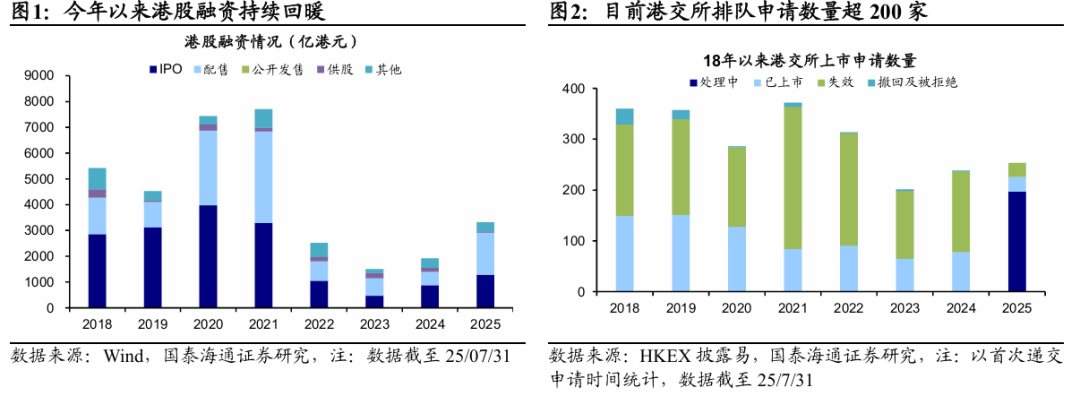
Core Viewpoint - The Hong Kong stock market is expected to continue its bullish trend in the second half of the year, driven by incremental capital inflows and structural asset advantages [1] Financing Overview - The total financing scale for the Hong Kong stock market is projected to be around 300 billion HKD for the year, with 127.88 billion HKD from IPOs, making it the highest globally [2] - The anticipated follow-up IPO scale for the year is estimated to be around 150 billion HKD, with over 80 A-share companies planning to list in Hong Kong [3] - The follow-up refinancing scale is expected to remain active, with an estimated 120 billion HKD for the year, reflecting a 211% increase compared to the same period last year [4][5] Market Dynamics - The peak of the stock unlock period has passed, with the total unlock amount for Q2 being 444.8 billion HKD, accounting for 50% of the annual total [14] - Despite the significant unlock amount, overall shareholder behavior did not reflect net selling, indicating a stable market environment [14] - The new consumption sector may face some selling pressure due to high valuations and concentrated unlocks, while other sectors may experience reduced unlock pressure [15] Capital Inflows - The net inflow of southbound funds is expected to exceed 1.2 trillion HKD for the year, providing a continuous source of capital for the Hong Kong market [18] - Southbound funds have already accumulated a net inflow of over 830 billion HKD this year, surpassing the total inflow for the previous year [18] - The increasing scarcity of assets in the Hong Kong market is likely to attract foreign capital back into the market [19]

港股盘整,资金逆势抢筹港股通科技ETF南方(159269)
Sou Hu Cai Jing· 2025-08-08 10:44
Core Viewpoint - The Hong Kong stock market experienced a slight decline, but the Southbound Technology ETF (Southern, 159269) saw a net subscription of 12 million shares, indicating continued capital inflow despite the market downturn [1] Group 1: Market Trends - As of August 7, the cumulative net inflow of Southbound funds reached 894.528 billion HKD, significantly surpassing the total net buying amount for the entire previous year [1] - Recent U.S. non-farm payroll data indicated signs of economic slowdown, reinforcing market expectations for the Federal Reserve to lower interest rates to "stabilize growth," which has improved global risk appetite [1] - Economists predict that the historic influx of Northern funds into the South will suggest further highs for the Hong Kong stock market in the second half of the year, especially with potential synchronized interest rate cuts by the Federal Reserve [1] Group 2: Company Performance - Tencent, the largest weighted stock in the Southbound Technology ETF, is set to disclose its mid-2025 performance on August 13, with institutions generally optimistic about its second-quarter results [1] - The latest Price-to-Earnings (P/E) ratio for the index tracked by the Southbound Technology ETF is 23.84 times, which is at the 40.31% historical percentile over the past decade [1] Group 3: Economic Outlook - According to Founder Securities, the driving factors behind the recent strength in the Hong Kong stock market have not reversed, with strong resilience in the underlying economy and the current phase nearing the end of a profit decline cycle [1] - A series of favorable policies have been introduced, contributing to a friendly liquidity environment, which is expected to further accelerate capital inflow into the Hong Kong stock market, enhancing the market outlook [1]
大摩:外资7月加速流入中国股市,主动资金增持腾讯、网易等股
智通财经网· 2025-08-06 05:28
大摩称,本季以来,主动基金增持最多的板块是传媒与娱乐、制药和保险,减持最多的是消费服务、耐 用消费品与服装。从个股看,腾讯(00700)、网易(09999)、恒瑞医药(01276)和药明康德(02359)获增持最 多,美团(03690)和小米(01810)减持最多。 大摩报告表示,7月外资净流入达27亿美元,高于6月的12亿美元。截至7月31日,今年以来境外被动型 资金累计流入达110亿美元,超过2024年全年70亿美元的水平,境外主动型资金累计流出达110亿美元, 也低于2024年全年。 智通财经APP获悉,大摩表示,外资基金7月加速净流入中国股市,其中被动型基金流入39亿美元,主 动型基金则流出12亿美元。被动型基金主要集中在月底入场,恰逢多项"反内卷"政策发布。 大摩表示,7月南向资金流入港股进一步提速至170亿美元,高于6月的100亿美元。今年前7个月累计净 流入达1100亿美元,超过2024年全年的1030亿美元。 ...




刷新纪录!年内南向8200亿扫货,阿里美团最吸金
天天基金网· 2025-07-28 11:43
Group 1 - The core viewpoint of the article highlights the significant inflow of southbound capital into the Hong Kong stock market, with a net purchase of 201.84 billion HKD on July 25, and a total net purchase exceeding 820 billion HKD for the year, setting a new record for 2024 [1][2]. - Alibaba is the most favored stock by southbound capital, with a net purchase of 720 billion HKD this year, although it has seen a net sell-off of over 150 billion HKD in the past two months, reducing its year-to-date gain from 56% to 46% [1][2]. - Meituan has also attracted significant southbound capital, with a net purchase of 506 billion HKD, but its stock price has dropped by 14% due to the impact of a delivery subsidy war, with Goldman Sachs predicting a reduction of 25 billion RMB in EBIT over the next year [1][2]. Group 2 - China Construction Bank has seen a net purchase of 453 billion HKD this year, with its shareholding increasing by nearly 25% from the beginning of the year, and its stock price has risen approximately 37% [2]. - Other companies such as SMIC, China Mobile, China Merchants Bank, Tencent, and Bank of China have also received substantial net purchases exceeding 200 billion HKD this year [2]. - CICC forecasts that the total inflow of southbound capital will exceed 1 trillion HKD this year, with a relatively certain incremental inflow of about 200 to 300 billion HKD [2].


港股通50ETF(159712)涨超1.2%,市场关注结构性机会与流动性变化
Mei Ri Jing Ji Xin Wen· 2025-07-28 03:13
Group 1 - The core viewpoint is that the Hong Kong stock market is expected to have a strong start in the first half of 2025, driven by AI technology revaluation and supported by sectors such as new consumption, innovative pharmaceuticals, and non-bank financials [1] - Financial and technology sectors are the most favored by the market, with southbound funds focusing on financials, particularly banks, and diversifying into information technology and communication services [1] - Foreign investment preferences lean towards financials, discretionary consumption, and information technology, indicating a structural bull market resilience in the second half of the year [1] Group 2 - The appreciation of the RMB and continuous inflow of southbound funds are crucial supports for the market, with the financial sector being attractive to insurance capital due to its low volatility and high dividend characteristics [1] - The technology growth sector benefits from reduced financing costs, suggesting a favorable environment for growth [1] - Long-term, Hong Kong stocks are seen as core assets in RMB, with significant potential for narrowing the "country risk premium" and increasing domestic pricing power, which will amplify revaluation heights [1] Group 3 - The Hong Kong Stock Connect 50 ETF (159712) tracks the Hong Kong Stock Connect 50 Index (930931), which consists of 50 large companies listed in Hong Kong that meet Stock Connect eligibility, reflecting the performance of quality Hong Kong stocks available for investment through the Stock Connect mechanism [1] - The index covers multiple industries, focusing on key areas such as finance, information technology, and consumption, demonstrating strong market representation and liquidity [1] - Investors without stock accounts can consider the Cathay CSI Hong Kong Stock Connect 50 ETF Initiated Link A (014689) and Link C (014690) [1]
港股投资周报:资源行业领涨,港股精选组合年内上涨50.61%-20250726
Guoxin Securities· 2025-07-26 07:38
Quantitative Models and Construction Methods - **Model Name**: Hong Kong Stock Selection Portfolio **Model Construction Idea**: This model is based on a dual-layer selection process that integrates fundamental and technical analysis. It aims to identify stocks with both fundamental support and technical resonance from an analyst-recommended stock pool[13][14]. **Model Construction Process**: 1. **Analyst Recommendation Pool**: Constructed using three types of analyst recommendation events: upward earnings revisions, initial analyst coverage, and positive surprises in research report titles. 2. **Dual-Layer Screening**: - **Fundamental Screening**: Select stocks with strong fundamental support. - **Technical Screening**: Identify stocks with technical resonance. 3. **Portfolio Backtesting**: The backtesting period spans from January 1, 2010, to June 30, 2025. The portfolio assumes a fully invested position and accounts for transaction costs. **Model Evaluation**: The model demonstrates strong performance, with an annualized return of 19.11% and an excess return of 18.48% relative to the Hang Seng Index over the backtesting period[14]. - **Model Name**: Stable New High Stock Screening **Model Construction Idea**: This model leverages momentum and trend-following strategies, focusing on stocks that have recently reached a 250-day high. The approach emphasizes the effectiveness of momentum effects in the Hong Kong market[19]. **Model Construction Process**: 1. **250-Day High Distance Calculation**: $ 250\text{-Day High Distance} = 1 - \frac{\text{Close}_{\text{latest}}}{\text{ts\_max}(\text{Close}, 250)} $ - $\text{Close}_{\text{latest}}$: Latest closing price - $\text{ts\_max}(\text{Close}, 250)$: Maximum closing price over the past 250 trading days - A value of 0 indicates a new high, while positive values represent the percentage drop from the high[21]. 2. **Screening Criteria**: - **Analyst Attention**: At least five "Buy" or "Overweight" ratings in the past six months. - **Relative Strength**: Top 20% in 250-day price change within the stock universe. - **Price Stability**: Stocks are ranked based on price path smoothness and new high persistence over the past 120 days. The top 50% (minimum 50 stocks) are selected. - **Trend Continuation**: Stocks are ranked based on the average 250-day high distance over the past five days, with the top 50 selected[22]. **Model Evaluation**: The model effectively identifies stocks with stable upward trends, making it a useful tool for momentum-based strategies[19][22]. Model Backtesting Results - **Hong Kong Stock Selection Portfolio**: - **Annualized Return**: 19.11% - **Excess Return (vs. Hang Seng Index)**: 18.48% - **Information Ratio (IR)**: 1.22 - **Tracking Error**: 14.55% - **Maximum Drawdown**: 23.73%[18] Quantitative Factors and Construction Methods - **Factor Name**: 250-Day High Distance **Factor Construction Idea**: This factor measures the proximity of a stock's latest closing price to its 250-day high, capturing momentum and trend-following characteristics[21]. **Factor Construction Process**: - Formula: $ 250\text{-Day High Distance} = 1 - \frac{\text{Close}_{\text{latest}}}{\text{ts\_max}(\text{Close}, 250)} $ - $\text{Close}_{\text{latest}}$: Latest closing price - $\text{ts\_max}(\text{Close}, 250)$: Maximum closing price over the past 250 trading days - Interpretation: A value of 0 indicates a new high, while positive values represent the percentage drop from the high[21]. **Factor Evaluation**: This factor is effective in identifying stocks with strong momentum, particularly in the Hong Kong market[19][21]. Factor Backtesting Results - **250-Day High Distance Factor**: - **Top Performing Sector**: Healthcare (16 stocks identified) - **Other Sectors**: Financials (11 stocks), Consumer (9 stocks), Technology (9 stocks), Cyclical (4 stocks)[22][27]
AH溢价持续缩窄 南向资金年内净买入额超2024年全年
Shang Hai Zheng Quan Bao· 2025-07-25 18:21
Group 1 - Southbound funds recorded a net purchase of 201.84 billion HKD on July 25, with 114.74 billion HKD from the Shanghai-Hong Kong Stock Connect and 87.1 billion HKD from the Shenzhen-Hong Kong Stock Connect. Year-to-date, the total net purchase reached 8200.28 billion HKD, surpassing last year's total of 8079 billion HKD, marking a historical high for the same period [1][2] - Southbound funds have been net buyers of Hong Kong stocks for 25 consecutive months, with expectations of exceeding 1 trillion HKD in net inflows for the year. The focus of these investments has been on internet leaders, pharmaceuticals, banks, and insurance companies [1][2] - The Hang Seng Index has risen by 26.56% year-to-date, leading global major indices, driven by active market conditions and abundant liquidity. Southbound funds now account for approximately 35% of the total trading volume in the Hong Kong stock market [2][3] Group 2 - Recent purchases by southbound funds have included significant stakes in internet companies like Kuaishou-W and Meitu, with Kuaishou-W holdings increasing by 23.47 million shares since early July. Goldman Sachs has noted Kuaishou-W's strong fundamentals in advertising and e-commerce, along with its leading AI capabilities [3] - The AH premium index fell to 123.4 points on July 25, the lowest since June 2020, with a year-to-date decline of over 13%. The continuous inflow of southbound funds is a key factor driving the Hong Kong stock market and influencing sector trends [3] - The narrowing of the AH premium is attributed to the revaluation of Hong Kong stocks by southbound funds, particularly the preference of southbound insurance capital for high dividend stocks, indicating a potential continuation of this trend [3]
“赚钱效应”持续!港股,两大资金共振→
证券时报· 2025-07-24 13:31
Core Viewpoint - The Hong Kong stock market is experiencing significant inflows from southbound capital, with a year-to-date increase of nearly 28% in the Hang Seng Index, driven by foreign investors reassessing the value of Chinese assets [1][3][4]. Group 1: Foreign Capital Reassessment - Foreign capital is returning to China, with a net increase of $10.1 billion in domestic stocks and funds in the first half of the year, reversing a two-year trend of net selling [3]. - South Korean investors have traded over $5.4 billion in A-shares and Hong Kong stocks this year, making China their second-largest overseas investment destination after the U.S. [3]. - The shift in global capital allocation is influenced by uncertainties in U.S. trade policies and rising debt burdens, prompting investors to move funds from traditional safe-haven assets to Asian markets [4]. Group 2: Southbound Capital Inflows - Southbound capital has reached a net inflow of approximately 7998.45 billion HKD this year, nearing the total for the entire year of 2024 [6]. - Since the launch of the Stock Connect program, cumulative net inflows from southbound capital into the Hong Kong market have approached 4.5 trillion HKD [6]. - The increasing demand from mainland investors for Hong Kong stocks is supported by narratives around AI, new consumption, and innovative pharmaceuticals [6]. Group 3: Market Dynamics and Performance - The Hang Seng Index, Hang Seng Tech Index, and Hang Seng China Enterprises Index have recorded year-to-date increases of 27.95%, 28.53%, and 26.99%, respectively [11]. - Key sectors such as healthcare, finance, and communication services have seen significant gains, with increases of 62.10%, 51.28%, and 48.01% respectively [11]. - Individual stocks like China Biologic Products and Chow Tai Fook have surged over 100% this year, indicating strong market performance [13]. Group 4: Future Market Outlook - Analysts suggest that despite the current gains, many companies in the Hong Kong market still exhibit low price-to-book (PB) and price-to-earnings (PE) ratios, indicating potential for further growth [13]. - The influx of capital, supportive policies, and a strong "profit-making effect" are expected to drive the market upward [14]. - Potential opportunities in the second half of the year include sectors focused on domestic demand, technological innovation, and industries with strong comparative advantages in exports [14].