
数字监管

Search documents
卢拉在《纽约时报》撰文 强调巴西民主与主权不容谈判
Xin Hua Wang· 2025-09-15 03:13
Core Points - Brazil is open to negotiating mutually beneficial topics with the U.S., but emphasizes that its democracy and sovereignty are non-negotiable [1] - Lula criticizes the Trump administration's imposition of a 50% tariff on Brazilian goods, labeling it as misguided and illogical [1] - The U.S. has had a cumulative trade surplus of $410 billion with Brazil over the past 15 years, with nearly 75% of U.S. products entering Brazil tariff-free [1] - Lula suggests that the U.S. actions are politically motivated, referencing the use of tariffs and the Magnitsky Act to seek exemptions for former Brazilian President Bolsonaro [1] - Lula defends Brazil's digital regulations against U.S. accusations, stating that all digital platforms in Brazil are subject to the same laws aimed at protecting families from fraud and misinformation [1][2] - Lula dismisses U.S. claims of unfair practices in digital trade and environmental law enforcement as baseless [2] - Emphasizes that abandoning the long-standing relationship between the U.S. and Brazil would harm all parties involved [2]
他还觉得冤枉?美联储111年历史上首次!特朗普质疑上诉法院判决
Sou Hu Cai Jing· 2025-09-04 23:20
Group 1 - The conflict between President Trump and Federal Reserve Governor Lisa Cook marks a significant political event, as it is unprecedented for a sitting president to attempt to dismiss a Federal Reserve official [1][3] - The legal basis for Trump's action hinges on allegations of "mortgage fraud," which raises questions about the independence of the Federal Reserve and the legitimacy of political interference in its operations [3][6] - The market is reacting to these political tensions, with a notable inversion in the yield curve indicating concerns over short-term interest rate cuts versus long-term inflation risks [4][9] Group 2 - The independence of central banks is crucial for macroeconomic stability, and any perceived erosion of this independence could have severe implications for both the U.S. and global economies [6] - The legal proceedings initiated by Cook could set a precedent regarding what constitutes "just cause" for dismissing Federal Reserve officials, potentially impacting future political interactions with the central bank [6][7] - Trump's dual strategy of applying pressure both domestically on the Federal Reserve and internationally on the EU reflects a broader approach to economic management, aiming for favorable outcomes in trade and monetary policy [9]

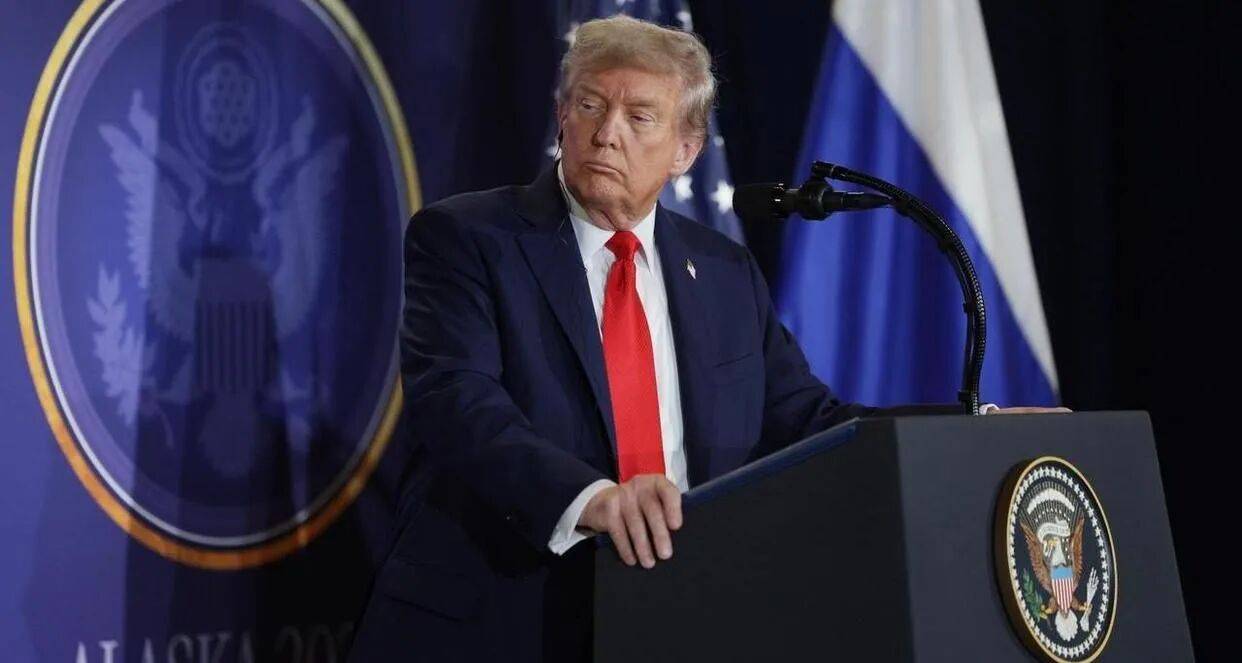
特朗普得偿所愿,欧盟主动递脖子?最新立法推进,或取消所有美国工业品关税,引发内部强烈反对
Sou Hu Cai Jing· 2025-09-02 06:25
Group 1 - The EU plans to rapidly pass legislation to eliminate all tariffs on U.S. industrial goods, responding to pressure from President Trump, who demands the EU remove tariffs on U.S. products in exchange for lowering auto tariffs to 15% [1][3] - The EU's automotive exports to the U.S. face a 27.5% tariff, with Germany's exports projected to reach €38.4 billion in 2024, highlighting the significant impact on the European automotive industry [3][4] - The EU's decision-making process has been criticized for lacking thorough impact assessments, with the European Parliament's ability to block the agreement remaining uncertain [4][6] Group 2 - The EU's trade negotiations reflect a long-standing structural weakness and dependency on the U.S., with significant capital outflows from Germany and increased reliance on U.S. investments and energy [7][9] - The U.S. has leveraged its influence over the EU through various means, including media and social organizations, creating a network of influence within European decision-making [9] - The EU's internal divisions and the complexity of its multi-party system have allowed for deeper U.S. penetration into its political and economic structures [9]
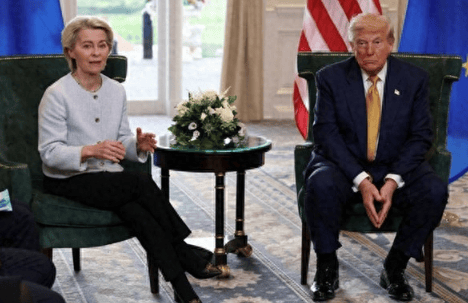
特朗普终于得偿所愿,欧盟主动递出脖子,最新立法推进,或取消所有美国工业品关税
Sou Hu Cai Jing· 2025-09-02 03:05
Group 1 - The EU is rapidly advancing legislation to eliminate all tariffs on U.S. industrial goods and is also preparing to reduce tariffs on certain U.S. seafood and agricultural products, with a focus on meeting a timeline set by Trump [1][3] - The agreement appears to favor the U.S. more than the EU, as the EU acknowledges that the deal is intended to provide "stability" and "predictability," but this stability aligns with the U.S. agenda [1][5] - There is internal backlash within the EU, with 55% of surveyed companies believing the agreement places an excessive burden on Europe, and concerns about the lack of a predictable tariff ceiling [3][5] Group 2 - The U.S. strategy involves leveraging tariffs and export controls to compel the EU to negotiate on digital regulations, which the EU insists are sovereign rights and not subject to trade negotiations [3][7] - The automotive sector is particularly affected, as the U.S. is the largest export market for European cars, with a significant portion of exports at risk due to potential tariff increases [7][8] - The EU's decision to eliminate tariffs on U.S. industrial goods may weaken its negotiating position, as it risks losing leverage in future discussions [7][8] Group 3 - The EU's approach to trade negotiations is characterized by a lack of clear boundaries and tools, which may lead to an escalation of trade tensions rather than resolution [8] - The potential for the U.S. to reinterpret or ignore the terms of the agreement poses a significant risk for the EU, as it may lead to renewed tariff increases [7][8] - The EU's legislative process may face challenges, as there are concerns about the symmetry and legality of the agreement, which could result in delays or rejections by the European Parliament [7][8]
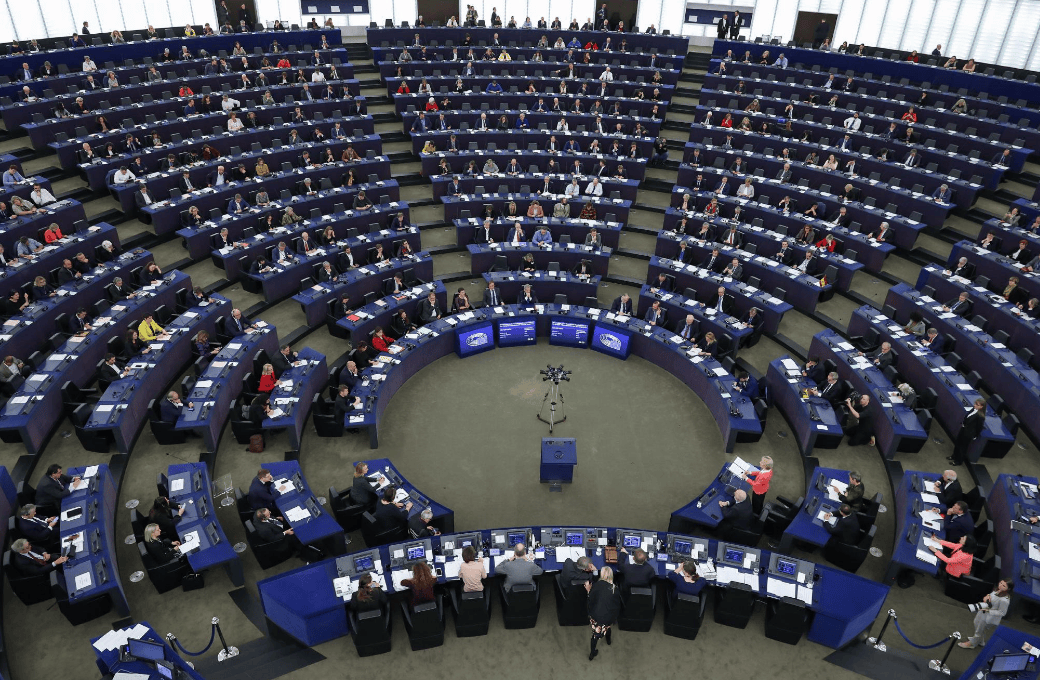
欧盟回应美方施压:将继续执行数字相关立法
Yang Shi Xin Wen· 2025-09-02 02:13
Core Viewpoint - The European Commission's Executive Vice President for Technology Sovereignty, Hanna Vainio, emphasized that the Digital Services Act and the Digital Markets Act are considered "sovereign legislation" of the EU, which will continue to be enforced [2] Group 1: Digital Legislation - The Digital Services Act and Digital Markets Act are non-discriminatory and apply to all online platforms operating within the EU [2] - The EU digital legislation does not have extraterritorial effect; however, any services provided within the EU will be subject to EU regulations, regardless of the company's headquarters location [2] Group 2: International Relations - Former U.S. President Trump warned on social media that countries implementing digital taxes, legislation, or regulations against U.S. companies could face high additional tariffs on goods exported to the U.S. unless they withdraw "discriminatory measures" [2]
特朗普警告,欧盟“硬刚”
Shang Hai Zheng Quan Bao· 2025-09-02 01:03
Core Viewpoint - The European Union (EU) will continue to enforce its digital legislation, specifically the Digital Services Act and the Digital Markets Act, despite pressure from the United States [1] Group 1: EU Digital Legislation - The EU's digital laws are described as "sovereign legislation" and are applicable to all online platforms operating within the EU [1] - The digital laws are non-discriminatory and do not have extraterritorial effect; they apply to any service provided within the EU, regardless of the company's headquarters [1] Group 2: US Response - U.S. President Trump warned countries implementing digital taxes or regulations against U.S. companies, threatening high additional tariffs on goods imported from those countries unless they withdraw discriminatory measures [1]
欧委会副主席:如有必要,欧盟应准备放弃欧美贸易协议
Sou Hu Cai Jing· 2025-08-29 12:40
Group 1 - The European Union (EU) is urged to respond firmly to threats from U.S. President Trump regarding digital regulation, emphasizing the need to protect its tech regulatory framework [2] - French President Macron suggested that Europe should consider retaliatory measures against U.S. tech companies in response to Trump's threats on tech regulation [2] - The EU is prepared to abandon trade agreements with Trump if it means safeguarding its technology regulations [2] Group 2 - The U.S. and EU have reached an agreement on a framework for a trade deal, covering 19 key areas including agricultural products, automobiles, aircraft, semiconductors, energy, and digital trade barriers [3] - The U.S. imposes tariffs of up to 15% on most goods imported from the EU, including automobiles, pharmaceuticals, semiconductors, and timber [3] Group 3 - Trump threatened high tariffs on countries implementing digital regulations and taxes, warning of restrictions on high-tech exports to those nations [4] - The EU asserts its right to regulate its own economic activities, stating that this issue is separate from the U.S.-EU trade agreement framework [4]

欧委会副主席:如有必要 欧盟应准备放弃欧美贸易协议
Yang Shi Xin Wen· 2025-08-29 07:55
Group 1 - The European Union (EU) is urged to respond firmly to threats from the Trump administration regarding digital regulation, emphasizing the need to protect its own tech regulatory framework [1] - French President Macron suggested that Europe should consider retaliatory measures against American tech companies in response to Trump's threats [1] - The EU is prepared to abandon trade agreements with the Trump administration to safeguard its digital policies [1] Group 2 - The United States and the EU reached an agreement on a trade framework that includes 19 key points covering various sectors such as agriculture, automobiles, aircraft, semiconductors, energy, and digital trade barriers [2] - The trade agreement framework indicates that the U.S. imposes tariffs of up to 15% on most goods imported from the EU, including automobiles, pharmaceuticals, semiconductors, and timber [2] Group 3 - President Trump warned countries implementing digital regulations and taxes that they would face high tariffs on exports to the U.S. unless discriminatory measures against American companies are lifted [3] - The EU maintains that regulating its domestic economic activities is a matter of sovereignty and is separate from the U.S.-EU trade agreement discussions [3]
特朗普又抱怨欧盟:针对美企,放行中企,请尊重美国
Sou Hu Cai Jing· 2025-08-27 14:22
Group 1 - The core viewpoint of the article is that former President Trump is vocally opposing foreign digital regulations that he perceives as discriminatory against American tech companies while favoring Chinese firms [1][2] - Trump threatens to impose high tariffs and export controls on countries that enact digital taxes and regulations targeting U.S. tech companies [2][5] - The European Union (EU) has introduced the Digital Markets Act and Digital Services Act since 2022 to regulate the digital market and limit unfair competition from tech giants [5][12] Group 2 - EU officials have denied accusations that their regulations target any specific country, asserting that their laws apply equally to all companies operating within the EU [6][12] - The EU emphasizes that its regulatory measures are non-discriminatory and are based on democratic values, not subject to negotiation with other countries [6][12] - There is increasing pressure within the EU to activate the "anti-coercion" mechanism in response to Trump's threats, with some member states expressing support for this action [12][13]
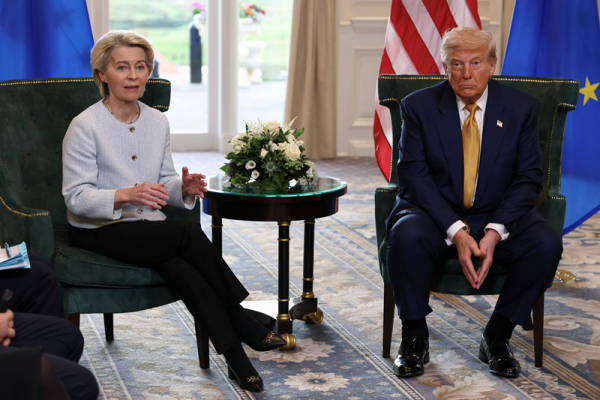
美欧数字监管对抗或将升级
Xin Lang Cai Jing· 2025-08-27 07:19
Core Viewpoint - The article discusses President Trump's warning to countries implementing digital regulations and taxes against U.S. companies, threatening high tariffs and export restrictions on high-tech products if discriminatory measures are not revoked [1] Group 1: U.S. Government Actions - President Trump announced potential high tariffs on goods exported to the U.S. from countries that impose digital regulations and taxes on American companies [1] - The Trump administration is considering sanctions against EU officials promoting the EU Digital Act, which may include visa restrictions [1] Group 2: Impact on U.S.-EU Relations - The potential sanctions could escalate tensions between the U.S. and EU regarding digital regulatory policies, adding new pressure to transatlantic relations [1] - EU Commission spokesperson Paula Pinho stated that regulating domestic economic activities is a sovereign right of the EU and its member states, separate from U.S.-EU trade agreements [1]