氛围编程

Search documents
全球Top 100 AI应用最新榜单:ChatGPT居首,谷歌大幅追赶位居次席,阿里夸克冲到第9
硬AI· 2025-08-31 17:14
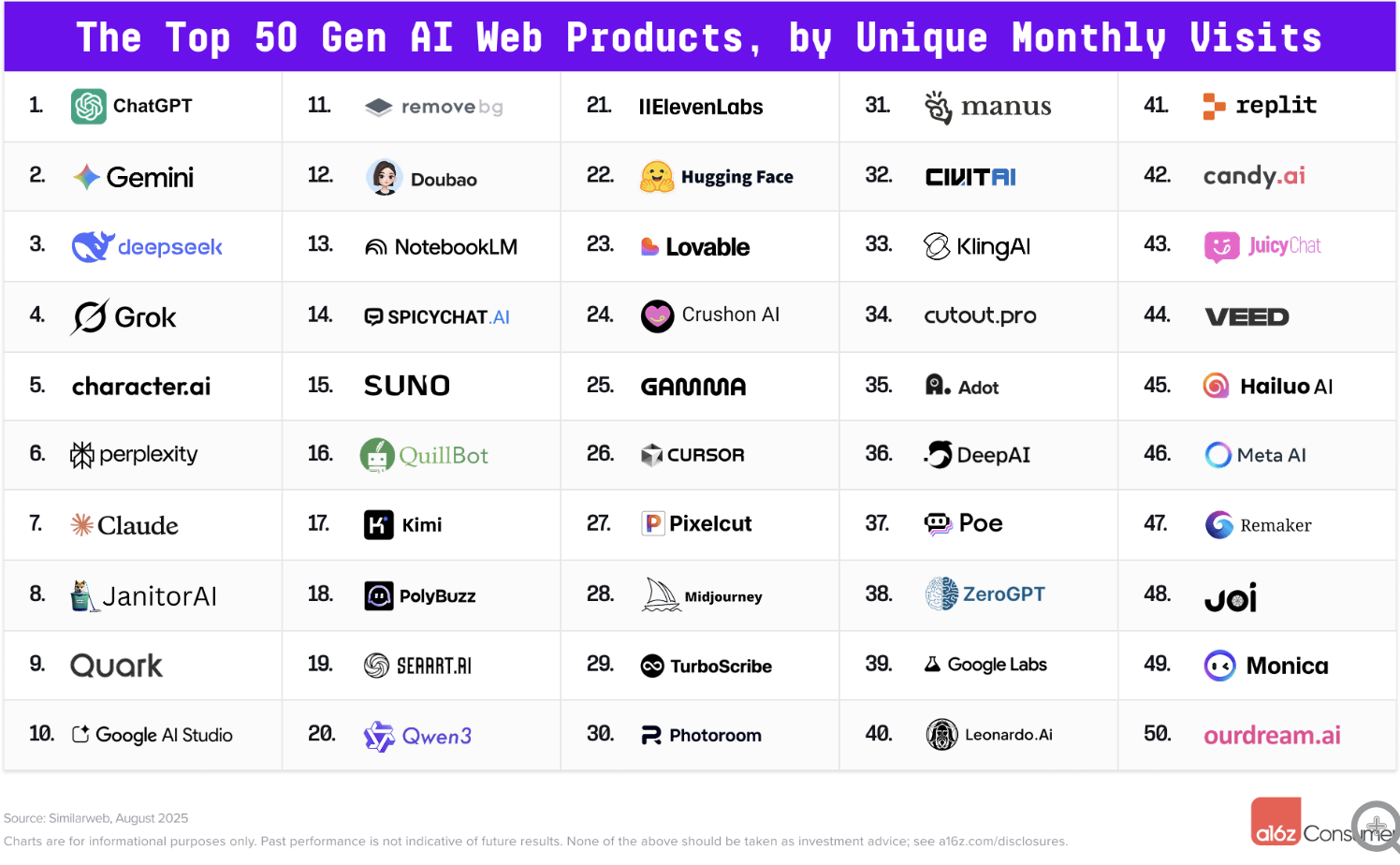
Group 1 - ChatGPT remains the top generative AI application, while Google's Gemini has significantly narrowed the gap, capturing approximately 12% of ChatGPT's web traffic, ranking second [2][3][6] - Chinese AI products are performing strongly in the global market, with Alibaba's Quark AI assistant rising to 9th place and ByteDance's Doubao ranking 12th [2][3][12] - Among the top 50 web applications, three major products serving Chinese users are in the top 20, and seven Chinese-developed products primarily target overseas markets [3][12] Group 2 - Google's multi-product matrix strategy has allowed it to independently track and rank its AI products, with Gemini showing strong growth in both web and mobile user engagement [6][8] - AI Studio, aimed at developers, has successfully entered the top 10, while NotebookLM, an academic research tool, ranks 13th, indicating steady growth despite a slight decline during the summer [8][11] - Google Labs ranks 39th, hosting various AI experimental projects, with a notable traffic surge of over 13% following the release of the video model Veo 3 [11] Group 3 - The globalization of Chinese AI products is evident, with Alibaba's Quark and ByteDance's Doubao generating over 75% of their traffic from China [13][16] - In the mobile application sector, nearly half of the top 50 apps are developed by Chinese teams, with only three primarily serving the Chinese market [16] - The competition among general-purpose assistants is intensifying, with Grok from X platform rapidly gaining traction, reaching over 20 million monthly active users [17] Group 4 - AI-assisted programming tools are emerging as a new growth area, with Lovable and Replit entering the main rankings, indicating a rapid rise in AI application generation [20] - User retention data shows that certain "ambient programming" platforms have exceeded 100% revenue retention rates in the U.S., suggesting expanding user engagement [20]

全球Top 100 AI应用最新榜单:ChatGPT居首 谷歌大幅追赶位居次席 阿里夸克冲到第9
智通财经网· 2025-08-30 10:01
Core Insights - The global landscape of consumer AI applications is stabilizing, but competition among leading players is intensifying. ChatGPT remains the top application, while Google's Gemini has significantly narrowed the gap, capturing approximately 12% of ChatGPT's web traffic, ranking second [1][4]. Group 1: AI Application Rankings - ChatGPT continues to lead the global Top 100 generative AI consumer applications, with Gemini from Google following closely in second place [1]. - Alibaba's Quark AI assistant ranks 9th, while ByteDance's Doubao is 12th, showcasing strong performance of Chinese AI products in the global market [1][11]. - Google's product matrix strategy is evident as it occupies four distinct positions in the rankings, with AI Studio entering the top 10 and NotebookLM at 13th [1][7]. Group 2: Mobile Application Landscape - The competition in mobile applications is particularly fierce, with Gemini's monthly active users nearing half of ChatGPT's [2]. - Grok, developed by X platform, has rapidly gained over 20 million monthly active users since its launch, ranking 23rd in mobile applications [2][15]. - Chinese-developed mobile applications dominate the rankings, with an estimated 22 out of 50 applications created by Chinese teams [2][14]. Group 3: Growth of Chinese AI Products - Chinese AI products are increasingly globalized, with several applications primarily serving overseas markets, including DeepSeek and SeaArt [11][14]. - Among products serving Chinese users, over 75% of traffic for Alibaba's Quark and ByteDance's Doubao comes from China [11]. Group 4: Intensifying Competition Among General Assistants - While ChatGPT maintains its lead, competitors like Grok are rapidly closing the gap, with Grok's user base growing significantly after the release of its new model [15]. - Meta's AI assistant has seen slower growth, ranking 46th on the web and failing to make the mobile top 50 [15]. Group 5: Emergence of "Ambient Programming" - AI-assisted programming tools are emerging as a new growth area, with Lovable and Replit entering the main rankings, indicating a rapid rise in AI application generation [16]. - User retention data suggests that this trend is sustainable, with some platforms showing over 100% revenue retention among users in the U.S. [19].

全球Top 100 AI应用最新榜单:ChatGPT居首,谷歌大幅追赶位居次席,阿里夸克冲到第9
Hua Er Jie Jian Wen· 2025-08-30 09:17
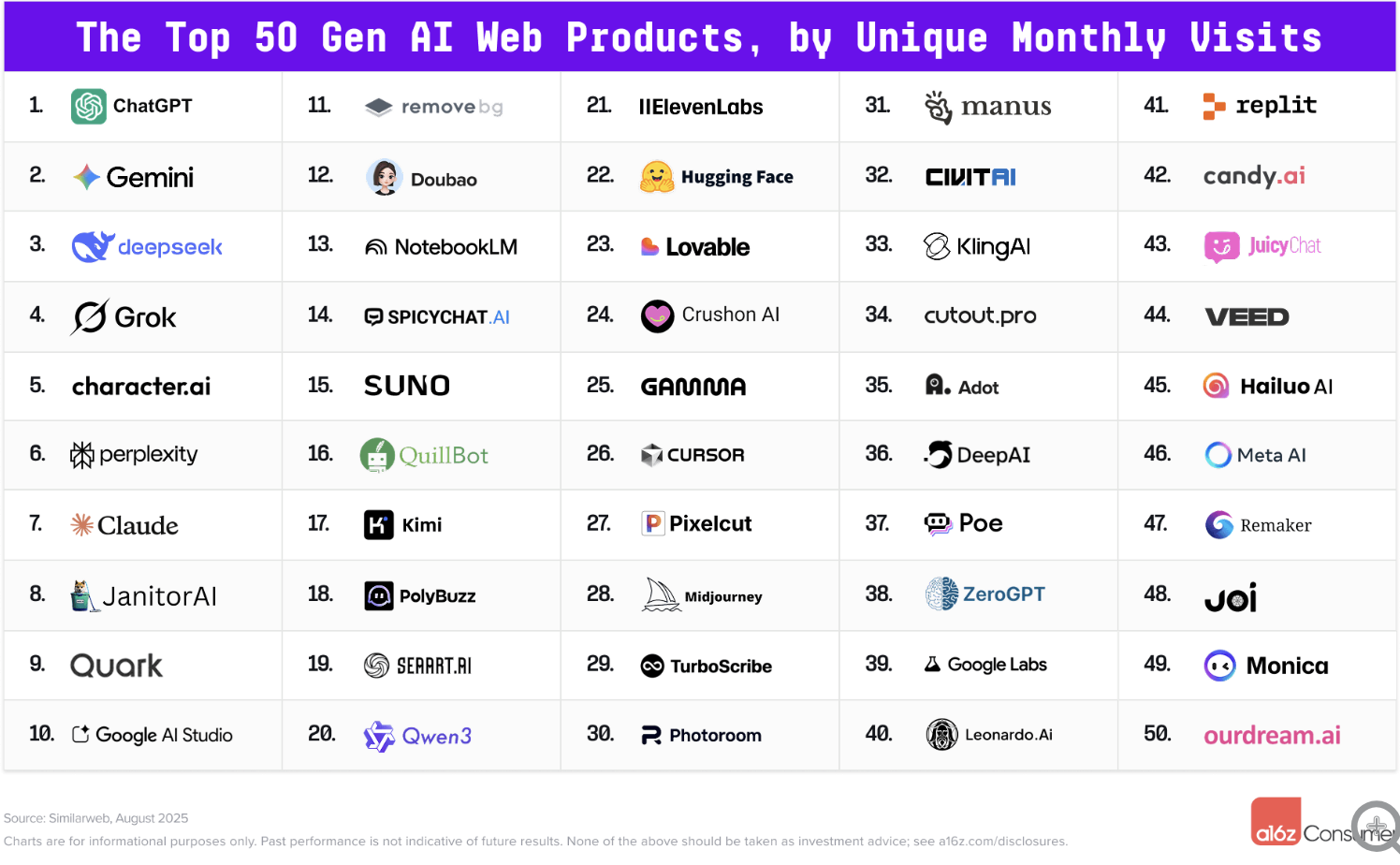
Core Insights - The global landscape of consumer AI applications is stabilizing, but competition among leading players is intensifying. ChatGPT remains the top application, while Google's Gemini has significantly narrowed the gap, capturing approximately 12% of ChatGPT's web traffic [1][4]. Group 1: Market Positioning - ChatGPT continues to lead the global ranking of generative AI applications, with Gemini in second place, showcasing Google's effective multi-product strategy [1][4]. - Chinese AI products are performing strongly in the global market, with Alibaba's Quark AI assistant ranking 9th and ByteDance's Doubao at 12th. Three products primarily serving Chinese users are in the top 20, and seven Chinese-developed products target overseas markets [1][11][14]. Group 2: Google's Product Matrix - Google has successfully established a matrix of AI products, with Gemini ranking second on the web and close to half of ChatGPT's monthly active users on mobile. AI Studio, aimed at developers, has entered the top 10, while NotebookLM ranks 13th [4][7]. - Google Labs, which hosts various AI experimental projects, ranks 39th, with a notable traffic increase of over 13% following the release of the video model Veo 3 [10]. Group 3: Competitive Dynamics - The competition among general assistants is heating up, with Grok from X platform showing remarkable growth, accumulating over 20 million monthly active users since its launch. Grok's usage surged nearly 40% after the release of its new model [15]. - Meta's AI assistant has seen slow growth, ranking 46th on the web and failing to make the mobile top 50, while DeepSeek has experienced a significant decline in traffic [15]. Group 4: Emerging Trends - AI-assisted programming tools are emerging as a new growth area, with Lovable and Replit entering the main rankings, indicating rapid growth in AI application generation [16]. - User retention data suggests that this trend is sustainable, with a leading "ambient programming" platform in the U.S. showing over 100% revenue retention rate within months of user registration [19].
刚刚,全球 AI 百强榜发布!ChatGPT 稳坐第一,DeepSeek 第三,前 50 有 22 个来自中国
程序员的那些事· 2025-08-29 09:54
Core Insights - The latest a16z report reveals a stable competitive landscape for consumer-grade GenAI applications, with significant Chinese players emerging in the top rankings [1][2]. Group 1: Top Web Products - ChatGPT leads the web product rankings with 11 million unique monthly visits, followed by Gemini with 15 million and deepseek at 13 million [2]. - Chinese applications such as DeepSeek (3rd), Quark (9th), and Doubao (12th) are making significant impacts, with five Chinese companies in the global top 20 [7][10]. - The overall trend indicates a diversification in the AI product ecosystem, with new entrants like Lovable gaining traction [5][44]. Group 2: Top Mobile Apps - ChatGPT also dominates the mobile app space with 11 million monthly active users, followed closely by Gemini at 12 million [3]. - Doubao ranks 4th, Baidu AI Search 7th, and deepseek 8th in the mobile app category, showcasing the strength of Chinese applications [10]. - The mobile app landscape is seeing a notable increase in new entrants, attributed to the crackdown on "copycat" applications, allowing original apps to thrive [45]. Group 3: Competitive Dynamics - The competition among general-purpose language model assistants remains fierce, with ChatGPT maintaining its lead while Google, Grok, and Meta are narrowing the gap [28][30]. - Grok has shown remarkable growth, achieving over 20 million monthly active users after launching new features [30]. - The report highlights the emergence of "vibe coding" platforms, indicating a shift in user engagement and retention strategies within the AI space [49][55]. Group 4: Notable Trends - The report identifies 14 "evergreen" companies that have consistently ranked in the top lists, reflecting their strong market presence and consumer engagement [66]. - The rise of video models in China is noted, with a concentration of research efforts leading to superior products compared to international counterparts [13]. - The report emphasizes the increasing globalization of AI applications, with a diverse range of companies from various countries making significant contributions to the market [69].

这就是大厂的AI「氛围编程」:老工程师现身说法后,大家绷不住了
机器之心· 2025-08-25 04:13
Core Viewpoint - Vibe coding, popularized by Andrej Karpathy, has gained traction in the tech industry, particularly among FAANG companies, although its definition and implementation remain contentious [1][5]. Group 1: Vibe Coding Popularity - A Reddit post suggests that vibe coding may be more prevalent than expected, with many employees at FAANG companies engaging in this practice [1][5]. - The post's author, an AI software engineer with over 15 years of experience, highlights the integration of AI in coding processes [3][4]. Group 2: Coding Process and Methodology - The coding process begins with reliable design documents and architecture, followed by writing tests before development [4][6]. - Key steps in the process include design reviews, task planning, software development using Test Driven Development (TDD), code review, and pre-release testing [6][13]. - Despite the involvement of AI, the process still requires significant human input, leading to debates about whether it truly qualifies as vibe coding [9][11]. Group 3: Perspectives on the Process - Some developers see value in the structured approach, advocating for detailed technical specifications and pre-development reviews [14][15]. - Others argue that the complexity of the process can hinder development speed, which may benefit independent founders [13][14].



OpenAI掌门人曝GPT-6瓶颈,回答黄仁勋提问,几乎为算力“抵押未来”
3 6 Ke· 2025-08-16 04:04
Group 1 - The core observation made by Greg Brockman is that as computational power and data scale rapidly expand, foundational research is making a comeback, and the importance of algorithms is once again highlighted as a key bottleneck for future AI development [1][21][22] - Brockman emphasizes that both engineering and research are equally important in driving AI advancements, and that OpenAI has always maintained a philosophy of treating both disciplines with equal respect [3][6][8] - OpenAI has faced challenges in resource allocation between product development and research, sometimes having to "mortgage the future" by reallocating computational resources originally intended for research to support product launches [8][9][10] Group 2 - The concept of "vibe coding" is discussed, indicating a shift towards serious software engineering practices, where AI is expected to assist in transforming existing applications rather than just creating flashy projects [11][12] - Brockman highlights the need for a robust AI infrastructure that can handle diverse workloads, including both long-term computational tasks and real-time processing demands, which is a complex design challenge [16][18][19] - The future economic landscape is anticipated to be driven by AI, with a diverse model library emerging that will create numerous opportunities for engineers to build systems that enhance productivity and efficiency [24][25][27]
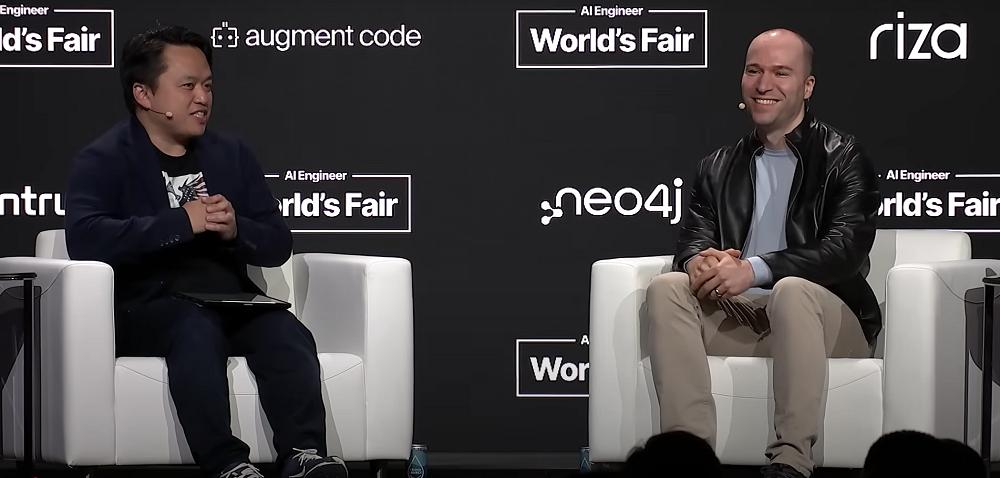
OpenAI联合创始人Greg Brockman:对话黄仁勋、预言GPT-6、我们正处在一个算法瓶颈回归的时代
AI科技大本营· 2025-08-13 09:53
Core Insights - The article emphasizes the importance of focusing on practical advancements in AI infrastructure rather than just the theoretical discussions surrounding AGI [1][3] - It highlights the duality of the tech world, contrasting the "nomadic" mindset that embraces innovation and speed with the "agricultural" mindset that values order and reliability in large-scale systems [3][5] Group 1: Greg Brockman's Journey - Greg Brockman's journey from a young programmer to a leader in AI infrastructure showcases the evolution of computing over 70 years [3][5] - His early experiences with programming were driven by a desire to create tangible solutions rather than abstract theories [9][10] - The transition from academia to industry, particularly his decision to join Stripe, reflects a commitment to practical problem-solving and innovation [11][12] Group 2: Engineering and Research - The relationship between engineering and research is crucial for the success of AI projects, with both disciplines needing to collaborate effectively [27][29] - OpenAI's approach emphasizes the equal importance of engineering and research, fostering a culture of collaboration [29][30] - The challenges faced in integrating engineering and research highlight the need for humility and understanding in team dynamics [34][35] Group 3: AI Infrastructure and Future Directions - The future of AI infrastructure requires a balance between high-performance computing and low-latency responses to meet diverse workload demands [45][46] - The development of specialized accelerators for different types of AI tasks is essential for optimizing performance [47][48] - The concept of "mixture of experts" models illustrates the industry's shift towards more efficient resource utilization in AI systems [48]
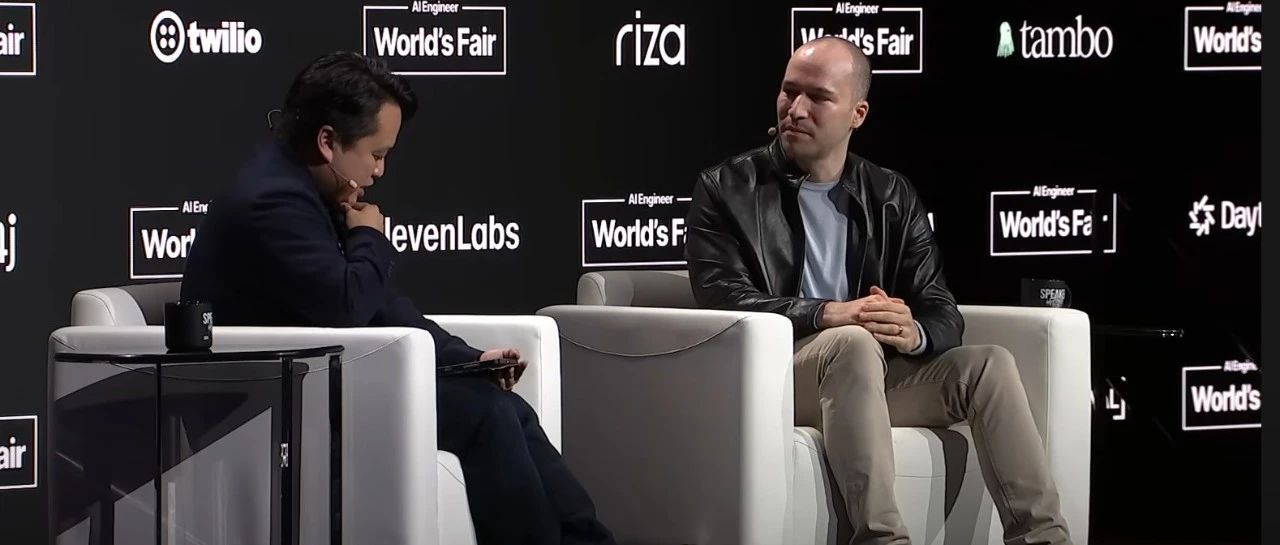
半年研发、1周上线,1秒200行代码爆发?美团研发负责人:靠小团队奇袭,模型和工程能力突破是核心
AI前线· 2025-08-09 05:32
Core Viewpoint - AI programming tools are reshaping software development with a focus on "development democratization," evolving from simple code completion assistants to collaborative partners capable of understanding natural language requirements and generating runnable code frameworks [2] Group 1: Product Development and Features - Meituan launched its first AI Coding Agent product, NoCode, on June 10, 2023, aiming to establish its core competitiveness in the AI programming market [2] - The NoCode project started in October 2024 and was released in May 2023, with a focus on internal support and rapid product prototype delivery [3] - The AI Coding efficiency is complex to measure, with current observations focusing on AI-generated code's incremental proportion and adoption rate [2][3] Group 2: Model Optimization and Performance - The team optimized smaller models to balance performance and output quality, as larger models tend to have lower throughput speeds [4] - The self-generated code by NoCode indicates a low investment in development, with a small team achieving significant results [3][4] Group 3: User Experience and Target Audience - NoCode targets non-technical users, aiming to help them create functional products without extensive programming knowledge, while also being usable by technical users [6][7] - The product's design considers the needs of both novice users and experienced developers, focusing on creativity and continuous learning [7] Group 4: Future Directions and Challenges - The future of AI programming tools may shift from traditional IDE extensions to more autonomous agents capable of handling complex tasks [11] - The integration of various technologies and backend capabilities is essential for addressing complex product development challenges [10][12]
GPT-5来了
盐财经· 2025-08-08 09:43
Core Viewpoint - OpenAI has launched its most advanced large language model, GPT-5, which features significant improvements in speed, intuition, and reasoning capabilities, and introduces "vibe coding" for natural language software generation [2][3][5]. Group 1: Product Features - GPT-5 utilizes an integrated model architecture that autonomously determines the complexity of tasks and allocates computational resources accordingly for deeper reasoning [5]. - The model can generate complete, runnable software applications based on simple text prompts, showcasing its advanced capabilities in software development [5]. - Future updates will enhance the naturalness and intelligence of voice interactions, making them more akin to real conversations [5]. Group 2: Market Strategy - OpenAI plans to offer GPT-5 for free to a majority of users, including free, Plus, Pro, and team versions, aiming to rapidly expand its user base and stimulate secondary innovations in AI applications [5]. - The model is positioned to perform at near-expert levels in various professional tasks, including writing, health consulting, and financial analysis, providing a unique experience akin to consulting a PhD expert [5]. Group 3: Financial Implications - OpenAI is currently negotiating a round of equity sales and internal equity transfers, with the company's valuation rising to approximately $500 billion from a previous $300 billion [6]. - Major tech companies, including Alphabet, Meta, Amazon, and Microsoft, are expected to spend nearly $400 billion on AI data centers this year, reflecting the industry's competitive investment landscape [8]. Group 4: Challenges and Future Outlook - Despite the enthusiasm for AI among consumers, converting this interest into enterprise-level revenue remains a critical challenge for OpenAI [9]. - OpenAI faces technical bottlenecks in training GPT-5, including limitations in high-quality human text data and the increasing complexity of model training, which may delay performance evaluations [9]. - The CEO believes that global investments in AI infrastructure are still insufficient and views GPT-5 as a significant step towards developing more powerful and general AI [9].
所谓“氛围编程”,不过是“技术债”的新马甲
AI科技大本营· 2025-08-06 06:12
Core Viewpoint - The article discusses the evolving role of human programmers in the age of artificial intelligence, emphasizing that "Vibe Coding" essentially leads to legacy code, which is often misunderstood and can accumulate technical debt [1][11][13]. Group 1: Concept of Vibe Coding - "Vibe Coding" is defined as a new programming approach where programmers immerse themselves in the "vibe" and embrace exponential possibilities, often neglecting the actual code [6][10]. - The term was coined by Andrej Karpathy, who illustrated that programmers may not even look for specific lines of code but instead instruct AI to perform tasks [6][10]. - This approach is suitable for one-off projects but is not considered true programming, as it results in code that is difficult to understand and maintain [10][11]. Group 2: Technical Debt and Legacy Code - The article argues that code produced through "Vibe Coding" is essentially legacy code, which is often viewed negatively due to its lack of clarity and maintainability [11][13]. - Programming should focus on building a deep, operable theoretical model in the programmer's mind, rather than merely producing lines of code [11][20]. - Accumulating technical debt through "Vibe Coding" can lead to significant challenges, especially when untrained individuals attempt to manage long-term projects [13][16]. Group 3: The Role of AI and Tools - The article highlights the importance of using AI as a tool rather than delegating thought processes to AI agents, advocating for a balance between human creativity and AI assistance [17][22]. - It emphasizes that effective tools should enhance human capabilities rather than replace human thought, likening programming to a collaborative process between the programmer and the tool [18][20]. - The conclusion stresses that the human brain remains central to programming, and the goal should be to leverage AI to strengthen this core capability [23].