
高阶智驾

Search documents
机器人板块震荡调整,机器人ETF易方达(159530)逆势获7500万份净申购
Sou Hu Cai Jing· 2025-12-02 11:22
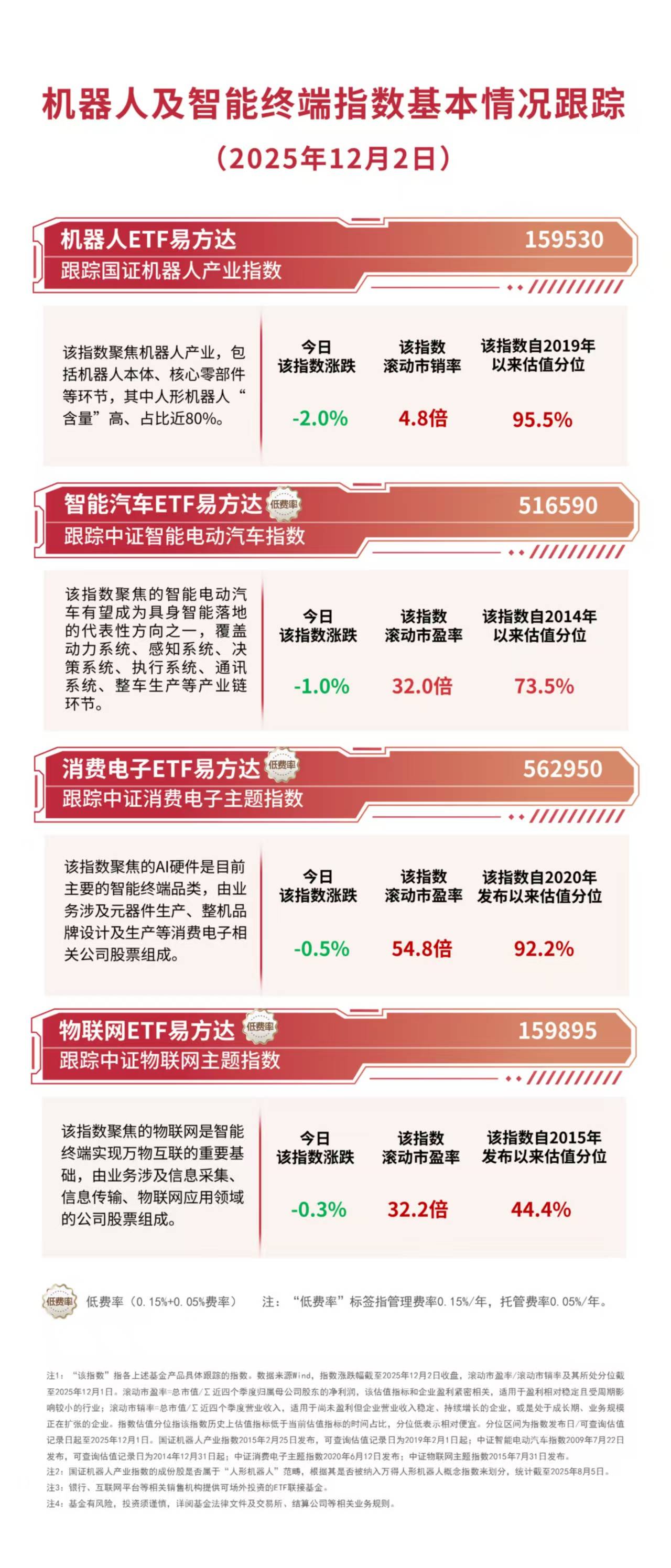
Group 1 - The core indices related to robotics, smart electric vehicles, consumer electronics, and IoT have experienced declines, with the National Robotics Industry Index down by 2.0% and the China Securities Smart Electric Vehicle Index down by 1.0% [1] - Despite the overall market decline, there has been a significant inflow into ETFs, with the E Fund Robotics ETF (159530) seeing a net subscription of 75 million units throughout the day [1] - Huatai Securities expresses optimism regarding the growth momentum of edge AI chips, citing that competition in smart vehicles may lead to advanced intelligent driving becoming a standard feature, thereby increasing demand for mid-to-high computing power chips [1] Group 2 - The future penetration of robots into various sectors such as home, healthcare, industry, commerce, and education is expected to drive long-term demand for AI chips in robotics [1] - The index performance shows a slight decrease of 0.3% with a rolling price-to-earnings ratio of 32.2 times and a valuation increase of 44.4% since its release [5]


理想汽车-W(2015.HK):销量、业绩暂承压 L系列亟待重振
Ge Long Hui· 2025-12-02 03:59
Core Viewpoint - The company reported a significant decline in revenue and net loss for Q3 2025, indicating ongoing challenges in sales and profitability [1][3]. Group 1: Q3 2025 Performance - The company achieved a revenue of 27.4 billion yuan in Q3 2025, representing a year-on-year decrease of 36.2% and a quarter-on-quarter decrease of 9.5% [1]. - The net loss for the quarter was 620 million yuan, highlighting financial difficulties [1]. - Vehicle deliveries for Q3 2025 totaled 93,000 units, down 39.0% year-on-year and 16.1% quarter-on-quarter [1]. Group 2: Revenue and Margin Analysis - Automotive sales revenue reached 25.9 billion yuan in Q3 2025, reflecting a year-on-year decline of 37.4% and a quarter-on-quarter decline of 10.4% [1]. - The average selling price (ASP) per vehicle was 278,000 yuan, which increased by 7,000 yuan year-on-year and 17,000 yuan quarter-on-quarter [1]. - The gross margin for the automotive business was 15.5%, down 5.4 percentage points year-on-year and 3.9 percentage points quarter-on-quarter, primarily due to estimated recall costs associated with the MEGA model [1]. Group 3: Future Guidance and Product Strategy - The company provided a delivery guidance for Q4 2025 of 100,000 to 110,000 units, with October deliveries at 32,000 units, suggesting an average monthly delivery of 34,000 to 39,000 units for November and December [1]. - The L series model upgrades are deemed crucial for reversing the current sales decline, with expectations for significant enhancements in 2026 [2]. - The anticipated upgrades for the L series include high-level autonomous driving features, larger battery capacity, and potential design changes [2]. Group 4: Profit Forecast and Investment Outlook - The net profit forecasts for 2025 to 2027 have been adjusted to 900 million, 3.6 billion, and 6 billion yuan, respectively, reflecting a downward revision from previous estimates [3]. - Despite the pressures on sales and performance in 2025, the company maintains strong foundational capabilities, including cash reserves of 98.9 billion yuan and a leading self-built charging network [3]. - The company retains a "recommended" rating, anticipating improvements in fundamentals driven by the L series upgrades and advancements in smart technology [3].

理想汽车-W(02015):销量、业绩暂承压,L系列亟待重振
Ping An Securities· 2025-12-01 07:21
Investment Rating - The report maintains a "Recommended" investment rating for the company [1]. Core Views - The company is currently facing pressure on sales and performance, particularly with the L series needing revitalization. The anticipated product upgrades in 2026 are seen as crucial for overcoming current challenges [4][7][8]. Summary by Sections Financial Performance - In Q3 2025, the company reported revenue of 27.4 billion yuan, a decrease of 36.2% year-on-year and 9.5% quarter-on-quarter, with a net loss of 6.2 billion yuan [4]. - The company delivered 93,000 vehicles in Q3 2025, down 39.0% year-on-year and 16.1% quarter-on-quarter. The automotive sales revenue was 25.9 billion yuan, reflecting a decline of 37.4% year-on-year and 10.4% quarter-on-quarter [7]. - The gross margin for automotive business in Q3 was 15.5%, down 5.4 percentage points year-on-year and 3.9 percentage points quarter-on-quarter. Excluding the impact of the MEGA recall, the gross margin would have been 19.8% [7]. Future Projections - Revenue projections for 2025 to 2027 have been adjusted to 9 billion, 36 billion, and 60 billion yuan respectively, reflecting a significant downward revision from previous estimates [8]. - The company expects Q4 2025 deliveries to be between 100,000 and 110,000 units, with October's deliveries at 32,000 units [7]. Product Strategy - The L series product upgrades are deemed essential for the company to navigate its current difficulties, with expectations for enhancements in features such as high-level autonomous driving capabilities and battery technology [7][8]. - The report highlights that the L9 model, which has been on the market for over three years, requires significant upgrades to improve its competitiveness [7]. Valuation Metrics - The company’s estimated P/E ratio for 2025 is 154.2, indicating a high valuation relative to earnings, while the P/B ratio is projected to be 2.0 [6][12].
警惕!假便利暗藏真风险,“智驾神器”身披马甲,网上大肆售卖
证券时报· 2025-11-27 00:20
Core Viewpoint - The article highlights the emergence of "smart driving gadgets" that undermine vehicle safety by circumventing driver monitoring systems, raising concerns about road safety and regulatory responses [1][5]. Group 1: Product Overview - "Smart driving gadgets" are being sold under various names like "smart driving companion" and "steering wheel decoration," allowing users to bypass safety features [3][4]. - These products include two main types: capacitive straps for brands like AITO and Xiaomi, and weighted rings for brands like BYD and Tesla [3][4]. Group 2: Regulatory Response - A draft national standard titled "Motor Vehicle Operation Safety Technical Conditions" has been proposed, aiming to enhance safety requirements for driver monitoring systems [1][5]. - The effectiveness of this regulation is questioned, as these gadgets continue to be sold online despite the impending regulations [5]. Group 3: Responsibility and Liability - Sellers of "smart driving gadgets" may face civil liability for promoting products that circumvent vehicle safety systems, potentially leading to indirect infringement if accidents occur [8][9]. - E-commerce platforms could also bear joint liability if they fail to monitor and regulate the sale of these illegal products [9]. Group 4: Technical Insights - Current vehicle technology relies on torque sensors and capacitive sensors to detect driver engagement, which these gadgets can deceive [4][11]. - The proliferation of these gadgets is partly due to consumer misconceptions about the capabilities of Level 2 (L2) autonomous driving systems, which are often misrepresented by manufacturers [11][12]. Group 5: Recommendations for Improvement - To combat the issue, a multi-faceted approach is suggested, including the use of AI for monitoring sales, stricter regulations on production, and enhanced consumer education [12].
“智驾神器”身披马甲大肆售卖 谁该为风险买单?
Zheng Quan Shi Bao· 2025-11-26 22:34
Core Viewpoint - The rise of "smart driving gadgets" poses a significant threat to road safety, as they allow drivers to bypass safety features in advanced driver assistance systems (ADAS) [1][2][3] Group 1: Product Overview - "Smart driving gadgets" are being sold under various names such as "smart driving companions" and "steering wheel decorations" to evade platform scrutiny [2] - These products include two main types: capacitive straps for brands like AITO and Xiaomi, and weighted rings for brands like BYD and Tesla [2] - The gadgets deceive the vehicle's sensors, rendering the hand detection feature of ADAS ineffective [3] Group 2: Regulatory Response - The Ministry of Public Security has proposed a new national standard that includes stricter safety requirements for ADAS, focusing on hand and gaze detection [1][4] - Despite the proposed regulations, the sale of "smart driving gadgets" continues on e-commerce platforms, indicating a need for collaborative efforts to address the issue [4] Group 3: Legal Responsibility - Sellers of "smart driving gadgets" may face civil liability for selling products that knowingly circumvent vehicle safety systems [6][7] - E-commerce platforms could also be held liable if they fail to monitor and control the sale of these illegal products [6][7] Group 4: Market Dynamics - The misconception that current autonomous driving technology is sufficiently advanced for hands-free driving is a significant factor in the demand for "smart driving gadgets" [8][9] - Misleading marketing by car manufacturers has contributed to consumer confusion regarding the capabilities of Level 2 (L2) autonomous driving systems [8][9] Group 5: Recommendations for Improvement - A multi-faceted approach is needed to combat the proliferation of "smart driving gadgets," including enhanced monitoring by e-commerce platforms, stricter regulations from authorities, and better consumer education [9]
假便利背后暗藏真风险—— “智驾神器”身披马甲大肆售卖 谁该为风险买单?
Zheng Quan Shi Bao· 2025-11-26 22:00
Core Viewpoint - The emergence of "smart driving gadgets" poses a significant risk to road safety, as they undermine the functionality of vehicle assistance systems, prompting the need for stricter regulations and standards to address these issues [1][4]. Group 1: Product Overview - "Smart driving gadgets" are being sold under various names such as "smart driving companions" and "steering wheel decorations" to evade platform scrutiny [2]. - These products include two main types: capacitive straps for brands like AITO, Xiaomi, and Zeekr, and weighted rings for brands like BYD, Tesla, and Li Auto [2]. - Some sellers explicitly state that these gadgets can bypass the steering wheel's hand detection alerts, demonstrating their functionality through videos [2]. Group 2: Technical Insights - Current vehicle manufacturers rely on torque sensors and capacitive sensors to detect driver engagement, but these gadgets can deceive these systems, rendering hand detection ineffective [3]. - Experts indicate that even with the implementation of new regulations, the misuse of these gadgets may persist due to the ability of users to interfere with monitoring systems [3][4]. Group 3: Responsibility and Legal Implications - Sellers of "smart driving gadgets" may face civil liability for promoting products that circumvent vehicle safety systems, potentially leading to indirect infringement if accidents occur [5][6]. - E-commerce platforms are also at risk of shared liability if they fail to monitor and control the sale of these illegal products [6]. Group 4: Market Dynamics and Consumer Perception - The demand for "smart driving gadgets" is partly driven by consumer misconceptions about the capabilities of L2-level autonomous driving systems, which are often overstated by manufacturers [7][8]. - The widespread belief that L2 systems can allow drivers to "let go" of the steering wheel contributes to the market for these gadgets, despite their intended function being merely assistive [7][8]. Group 5: Recommendations for Mitigation - To effectively combat the proliferation of "smart driving gadgets," a multi-faceted approach is necessary, involving e-commerce platforms, regulatory bodies, and vehicle manufacturers to enhance monitoring, enforcement, and consumer education [8].
假便利背后暗藏真风险——“智驾神器”身披马甲大肆售卖 谁该为风险买单?
Zheng Quan Shi Bao· 2025-11-26 18:35
Core Viewpoint - The emergence of "smart driving gadgets" poses a significant risk to road safety, as they undermine the functionality of vehicle assistance systems, prompting the need for stricter regulations and collaborative efforts to address this issue [1][4]. Group 1: Product Overview - "Smart driving gadgets" are being sold under various names such as "smart driving companions" and "steering wheel decorations" to evade platform scrutiny [2]. - These products include two main types: capacitive straps for brands like AITO and Xiaomi, and weighted rings for brands like BYD and Tesla [2]. - Some sellers explicitly state that these gadgets can bypass the steering wheel's hand detection alerts, demonstrating their functionality through videos [2]. Group 2: Technical Insights - Current vehicle manufacturers rely on torque sensors and capacitive sensors to detect driver engagement, but these gadgets deceive the sensors, rendering the hand detection feature ineffective [3]. - Experts indicate that even with the implementation of new regulations, the misuse of these gadgets may persist due to the challenges in monitoring and enforcement [4]. Group 3: Responsibility and Legal Implications - Sellers of "smart driving gadgets" may face civil liability for promoting products that circumvent vehicle safety systems, potentially leading to indirect infringement if accidents occur [5][6]. - E-commerce platforms are also at risk of shared liability if they fail to monitor and manage the sale of these illegal products effectively [6]. Group 4: Market Dynamics and Consumer Perception - The demand for "smart driving gadgets" is partly driven by consumer misconceptions about the capabilities of L2-level autonomous driving technology, which is often misrepresented by manufacturers [7][8]. - The widespread belief that L2 vehicles can operate without driver intervention has led to increased usage of these gadgets, posing further safety risks [8]. Group 5: Recommendations for Mitigation - To combat the proliferation of "smart driving gadgets," a multi-faceted approach is necessary, including enhanced monitoring by e-commerce platforms, stricter regulations from authorities, and improved consumer education regarding the limitations of autonomous driving technology [9].
广州车展“东道主”霸屏,小米展台热度不再
Guo Ji Jin Rong Bao· 2025-11-23 15:08
Core Insights - The 2025 Guangzhou International Auto Show serves as a significant indicator for the Chinese automotive market, showcasing local giants like GAC and BYD while highlighting the absence of over 10 car manufacturers, indicating a potential industry reshuffle [2][4][8] Industry Transition - The Chinese automotive market is undergoing a transition from "scale expansion" to "value competition," reflecting the industry's growing pains during this shift [4][8] Event Significance - The Guangzhou Auto Show is positioned as a strategic anchor in the automotive industry, with its location in the Pearl River Delta housing major manufacturers and a complete automotive ecosystem [6][8] Market Trends - In the first ten months of 2025, domestic new energy vehicle sales reached 12.94 million units, with a market penetration rate of 46.7%, indicating a rapid shift towards a "new energy-dominated" market [8] Exhibition Highlights - The show featured 1,085 vehicles, including 93 global debuts, with new energy vehicles making up 57.9% of the total, an increase of 11 percentage points from the previous year [8][10] Attendance and Participation - The number of participating car manufacturers decreased by over 10 compared to last year, including both joint venture brands and new entrants, reflecting the intense competition in the market [8][14] Brand Strategies - BYD showcased its dominance in the South China market with a 35% market share in the region, emphasizing user experience in its exhibition design [10][14] Technological Focus - Huawei's innovative display at the show attracted significant attention, highlighting its advanced driving systems and partnerships with various brands [10][12] Competitive Landscape - The absence of brands like Beijing Hyundai and Genesis, along with reduced participation from luxury brands, underscores the challenges faced by traditional automakers in the current market [14][18]


交银国际:维持小鹏汽车-W“买入”评级 综合毛利率创历史新高
Zhi Tong Cai Jing· 2025-11-18 08:23
Core Viewpoint - Company maintains a "Buy" rating for XPeng Motors (09868) with a target price of HKD 134.69, citing robust revenue growth and improved gross margins in Q3 [1][3] Financial Performance - XPeng's Q3 revenue reached RMB 20.38 billion, a quarter-on-quarter increase of 11.5%, aligning with market expectations [2] - Vehicle sales totaled 116,000 units, reflecting a 12.4% quarter-on-quarter growth [2] - The average selling price (ASP) per vehicle was RMB 156,000, a slight decrease of RMB 800 compared to the previous quarter [2] - The overall gross margin hit a historical high of 20.1%, driven by increased service and technology revenue, although the automotive gross margin slightly declined to 13.1% due to model structure changes [2] Future Outlook - The company projects Q4 revenue between RMB 21.5 billion and RMB 23 billion, indicating a potential quarter-on-quarter growth of approximately 9.2% [2] - Expected vehicle deliveries for Q4 are between 125,000 and 132,000 units, suggesting a quarter-on-quarter increase of around 10.8% [2] - The company anticipates continued improvement in profitability, supported by the ramp-up of new platforms and advanced driving technology [2] Strategic Initiatives - The introduction of the self-developed Turing chip is expected to enhance high-level autonomous driving penetration in Q3 and Q4 [2] - The "Kunpeng Super Electric System," which features dual energy capabilities (pure electric and range-extended), is set to enter mass production in Q4, contributing positively to ASP and overall cost structure [2] - The company plans to launch seven range-extended models and three new vehicles overseas in the coming year [2] Investment Recommendation - The company is viewed as one of the clearest paths to profitability among new energy vehicle manufacturers, with expectations for sustained high sales growth and improved ASP and margins in 2025-2026 [3] - The ongoing investments in AI chips, autonomous driving, low-altitude economy, RoboTaxi, and humanoid robots are expected to enhance long-term growth potential and valuation [3]
禾赛科技第三季度营收同比增长47.5% 净利润创历史新高
Zheng Quan Ri Bao Wang· 2025-11-12 03:47
Core Viewpoint - Heisai Technology reported record earnings in Q3 2025, demonstrating significant growth in revenue and net profit, driven by strong demand for its lidar products in both the ADAS and robotics sectors [1][2][3] Financial Performance - In Q3 2025, Heisai Technology achieved revenue of 800 million yuan, a year-on-year increase of 47.5%, marking six consecutive quarters of growth [1] - The net profit reached 260 million yuan, setting a new historical high and allowing the company to meet its annual profit target one quarter ahead of schedule [1] - The annual profit guidance has been raised to between 350 million and 450 million yuan [1] Product Delivery and Market Position - Heisai Technology delivered a total of 441,000 lidar units in Q3, with ADAS product deliveries reaching 381,000 units, reflecting a year-on-year growth of 193.1% [1] - The company maintained the leading position in the automotive lidar installation for seven consecutive months, with a market share rising to 46% in August [1] - Heisai Technology secured partnerships with its top two ADAS clients for full model cooperation by 2026, achieving 100% standard configuration [1] Robotics Sector Growth - In the robotics sector, Heisai Technology's product delivery reached 61,000 units, showing a substantial year-on-year increase of 1311.9% [1] - The company has secured lidar orders from leading autonomous driving companies globally, including Motional and others in North America, Asia, and Europe [2] Strategic Developments - Heisai Technology has made significant strides in the Robotaxi market, collaborating with major domestic companies like Pony.ai, Hello, and JD Logistics, with plans for some models to feature up to eight lidar units [2] - The company has been providing core perception solutions for Motional's all-electric IONIQ 5 Robotaxi for two consecutive years, with each vehicle equipped with four lidar units [2] Market Trends and Future Outlook - The market for lidar is expected to expand due to the increasing penetration of high-level autonomous driving and robotics applications, with a focus on cost reduction and efficiency [3] - Heisai Technology's recent IPO raised approximately 4.16 billion HKD, with funds allocated for R&D and capacity expansion, including the development of the fourth-generation ASIC chips and new lidar products [3] - The dual listing is anticipated to enhance Heisai Technology's capital base, supporting global R&D and production expansion, thereby solidifying its leading position in the industry [3]