AI硬件

Search documents
AI 硬件的上半场:失败、共识与进行中的探索
芯世相· 2026-02-26 07:06
Core Viewpoint - The article discusses the evolution of the AI hardware market in China, highlighting the shift from being a follower in global consumer electronics to taking a proactive role in defining future AI hardware products. This transformation is driven by the collaboration between model vendors and traditional hardware manufacturers, as well as elite entrepreneurs with backgrounds in large companies seeking to create native AI hardware solutions [6][20]. Group 1: Market Dynamics - Historically, Chinese companies have played a "follower" role in global consumer electronics, waiting for demand validation before leveraging manufacturing capabilities [6]. - The emergence of DJI has demonstrated that Chinese engineers can lead in new categories by solving novel problems, marking a shift in confidence and capability in AI hardware [6]. - The AI hardware market in China has seen a surge of interest, with two main forces shaping it: alliances between model vendors and traditional hardware, and elite entrepreneurs aiming to create original AI hardware [6][8]. Group 2: Initial Drivers - The initial push in the AI hardware sector was sparked by model vendors seeking commercialization pathways, particularly ByteDance, which catalyzed interest in integrating AI with hardware [8]. - By the end of 2024, ByteDance's model token costs dropped significantly, leading to collaborations with chip manufacturers and hardware solution providers to explore AI integration [8][12]. - The first product to gain traction was an AI toy, which was chosen due to its lower technical requirements and existing market validation [9][12]. Group 3: Market Challenges - Despite initial excitement, the AI toy market faced rapid decline after a peak during the 618 shopping festival, revealing high return rates and low consumer interest beyond initial novelty [14]. - The average usage time for AI toys was found to be less than two months, indicating a lack of sustained demand [14]. - The market quickly became saturated, leading to intense competition and diminishing returns for many companies involved [14][16]. Group 4: Investment Trends - A significant shift occurred in 2025, with investors increasingly favoring AI hardware startups over traditional software projects, driven by the perceived potential for quicker commercialization [20][22]. - Notable investments included Looki and Odyss, which attracted significant funding as investor interest in hardware surged [22][24]. - The consensus among investors is that AI hardware can provide more contextual data in the physical world compared to purely software solutions, leading to a renewed focus on hardware investments [24]. Group 5: Entrepreneurial Exploration - Entrepreneurs in the AI hardware space are divided on whether to focus on AI as a physical carrier or to create smarter consumer hardware with AI capabilities [26]. - Companies like Looki and Lightwear are exploring diverse applications of AI, while others like Odyss focus on specific, practical problems to justify consumer purchases [26][28]. - The challenge remains for these products to establish clear value propositions to consumers, as many current offerings lack compelling reasons for purchase [27][31].



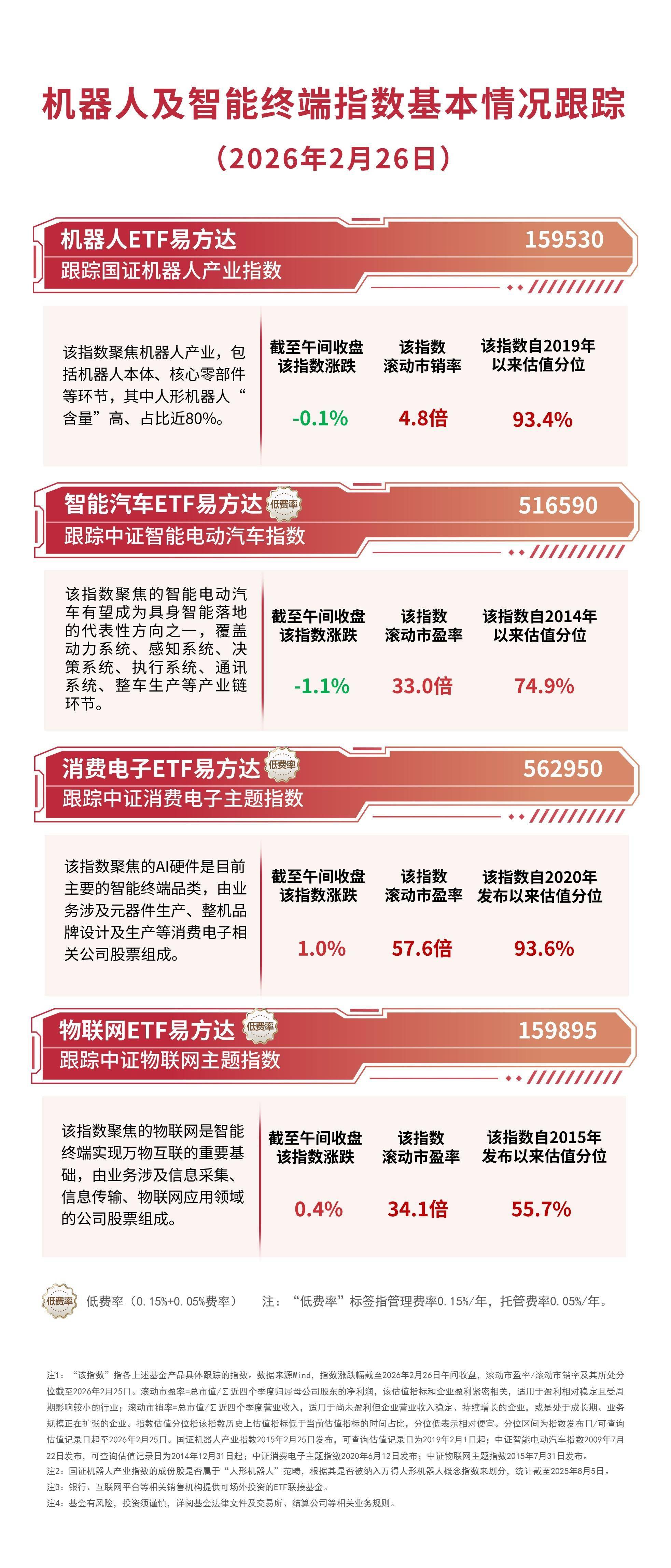
人形机器人板块震荡整理,机器人ETF易方达(159530)助力布局板块龙头企业
Sou Hu Cai Jing· 2026-02-26 05:25
Group 1 - The core viewpoint of the news highlights the performance of various indices in the technology sector, with the China Securities Consumer Electronics Theme Index rising by 1.0% and the China Securities Internet of Things Theme Index increasing by 0.4%, while the National Securities Robotics Industry Index fell by 0.1% and the China Securities Smart Electric Vehicle Index decreased by 1.1% [1][5] Group 2 - The China Securities Smart Electric Vehicle Index focuses on the smart electric vehicle sector, which is expected to become a representative direction for embodied intelligence, covering various industry chain segments including power systems, perception systems, decision systems, execution systems, communication systems, and vehicle production [4] Group 3 - The China Securities Consumer Electronics Theme Index emphasizes AI hardware, which is currently a major category of smart terminal products, consisting of stocks from companies involved in component production, complete machine brand design, and production related to consumer electronics [6]

ETF午评 | 沪指微跌0.08%,电力板块领涨,电网ETF、电网设备ETF均涨3%
Xin Lang Cai Jing· 2026-02-26 04:14
Market Overview - The Shanghai Composite Index fell by 0.08% and the ChiNext Index decreased by 0.39% [1] - Sectors such as AI applications, lithium batteries, fintech, photovoltaic, gold, and innovative pharmaceuticals showed weakness, while real estate and insurance industries experienced significant declines [1] Sector Performance - The storage chip sector continued to rise, with the South Korea-China semiconductor ETF increasing by 4.82% [1] - The AI hardware sector strengthened, with the 5G ETF from Bosera rising by 3.28%, and the communication ETFs from Huaxia and others increasing by 2.79% and 2.49% respectively [1] - The electric grid sector performed well, with both the electric grid ETF and electric grid equipment ETF rising by 3% [1] - The machinery sector also saw gains, with the Jiashan technology machinery ETF and industrial mother machine ETF increasing by 2.94% and 2.48% respectively [1] Declining Sectors - Oil and gas stocks declined, with the S&P oil and gas ETF from Jiashan dropping by 2.8% [1] - The real estate sector faced a pullback, with the real estate ETF and the real estate ETF from Yinhua falling by 2.74% and 2.71% respectively [1] - Automotive stocks were also down, with the Hong Kong automotive ETF and the Hong Kong Stock Connect automotive ETF from Fuguo decreasing by 2.38% and 2.09% respectively [1]
A股主要股指显著上涨 超3700股飘红
Mei Ri Shang Bao· 2026-02-25 22:21
Market Overview - A-shares continued their strong performance, with the Shanghai Composite Index rising over 1% during the session and closing at 4147.23 points, up 0.72% [1] - The total trading volume in the Shanghai, Shenzhen, and North markets reached approximately 2.48 trillion yuan, an increase of over 260 billion yuan compared to the previous day [1] Resource Sector - The resource sector, particularly metals, showed strong performance, with over 3700 stocks in the A-share market gaining, and more than 100 stocks hitting the daily limit [1] - Notable stocks included Shenghong Technology, which surged over 10% with a total trading volume of 17.49 billion yuan, leading the A-share market in transaction value [1] Nonferrous Metals - The nonferrous metals sector exhibited remarkable strength, with cobalt, nickel, and rare earth concepts performing well. For instance, Hanrui Cobalt surged nearly 14% [2] - Several companies, including Huaxi Nonferrous and Yunnan Zinc Industry, reached their daily limit, indicating strong investor interest [2] - Prices for tungsten products have been on the rise, with black tungsten concentrate increasing by 53.26% year-to-date, and ammonium paratungstate up by 56.72% [2] Tungsten and Rare Earths - The tungsten supply side is facing continuous contraction, with environmental regulations and rising operational costs limiting capacity release. The demand surge, particularly in new energy and photovoltaic sectors, is driving tungsten prices higher [3] - Rare earth prices have also increased, with neodymium oxide averaging 882,000 yuan per ton, up 4.16 million yuan from before the Spring Festival [3] Commercial Aerospace - The commercial aerospace sector saw significant gains, with companies like Xinghuan Technology and Okoyi rising over 16%. Aerospace Development reached its daily limit [4] - The announcement of the recovery test for the reusable Zhuque-3 rocket in the second quarter of this year has generated positive sentiment in the market [4] - Analysts predict that 2026 will be a pivotal year for commercial aerospace, with advancements in reusable rocket technology and the acceleration of satellite constellation construction [5] Real Estate Sector - The real estate sector became active following the release of new policies in Shanghai aimed at optimizing housing regulations, which included adjustments to purchase limits and public fund policies [6] - A-share real estate stocks such as I Love My Home and Hualian Holdings reached their daily limit, while others like Zhujiang Shares and Teifa Services saw increases of over 5% [7] - The Hong Kong real estate market also performed well, with stocks like Beike-W and Country Garden showing significant gains [8] - Data from the National Bureau of Statistics indicates a narrowing decline in housing prices in major cities, suggesting a stabilizing market [8]
稀土ETF走强 港股ETF成香饽饽
Zhong Guo Zheng Quan Bao· 2026-02-25 20:22
Market Overview - On February 25, the A-share market saw all major indices close in the green, with the ChiNext Index rising over 1.4% in a single day [1] - More than 1,000 out of over 1,400 ETFs in the market recorded gains, with rare earth and rare metal-themed ETFs performing particularly well [1] ETF Performance - On February 25, all eight industry-themed ETFs focused on rare earth and rare metals closed higher, with four products linked to the CSI Rare Earth Industry Index rising over 6% and reaching historical highs during trading [1][2] - The CSI Rare Earth Industry Index includes 43 constituent stocks, with only one stock declining by the close, while several stocks like Baotou Steel and Northern Rare Earth hit the daily limit [1][2] Fund Flows - On February 24, the ETF market experienced a net inflow of over 11 billion yuan, marking the highest single-day net inflow in six trading days [1] - ETFs focused on the Hong Kong market attracted significant capital, with seven of the top ten products by net inflow, totaling over 7 billion yuan [2] Investment Directions - The seven Hong Kong ETFs primarily target the Hang Seng Technology and Hong Kong Internet sectors, with four linked to the Hang Seng Technology Index [3] - Despite a strong performance in the Hong Kong market post-Chinese New Year, the Hang Seng Technology Index is still down over 4% year-to-date as of February 25 [3] Sector Insights - Analysts suggest that the strong performance of the rare earth sector is due to improved supply-demand dynamics, with demand driven by rapid developments in industries like robotics and low-altitude economy [2] - In contrast, energy-related ETFs have seen some pullback, with two S&P Oil & Gas ETFs experiencing the largest declines in the market [2] Future Investment Focus - Investment institutions are focusing on three main directions: technology, consumption, and resources, with emerging technology expected to be a key theme [3][4] - There is an emphasis on sectors with high growth potential, such as AI hardware, commercial aerospace, and smart driving, as well as undervalued sectors like food and beverage, construction materials, and renewable energy [4][5]
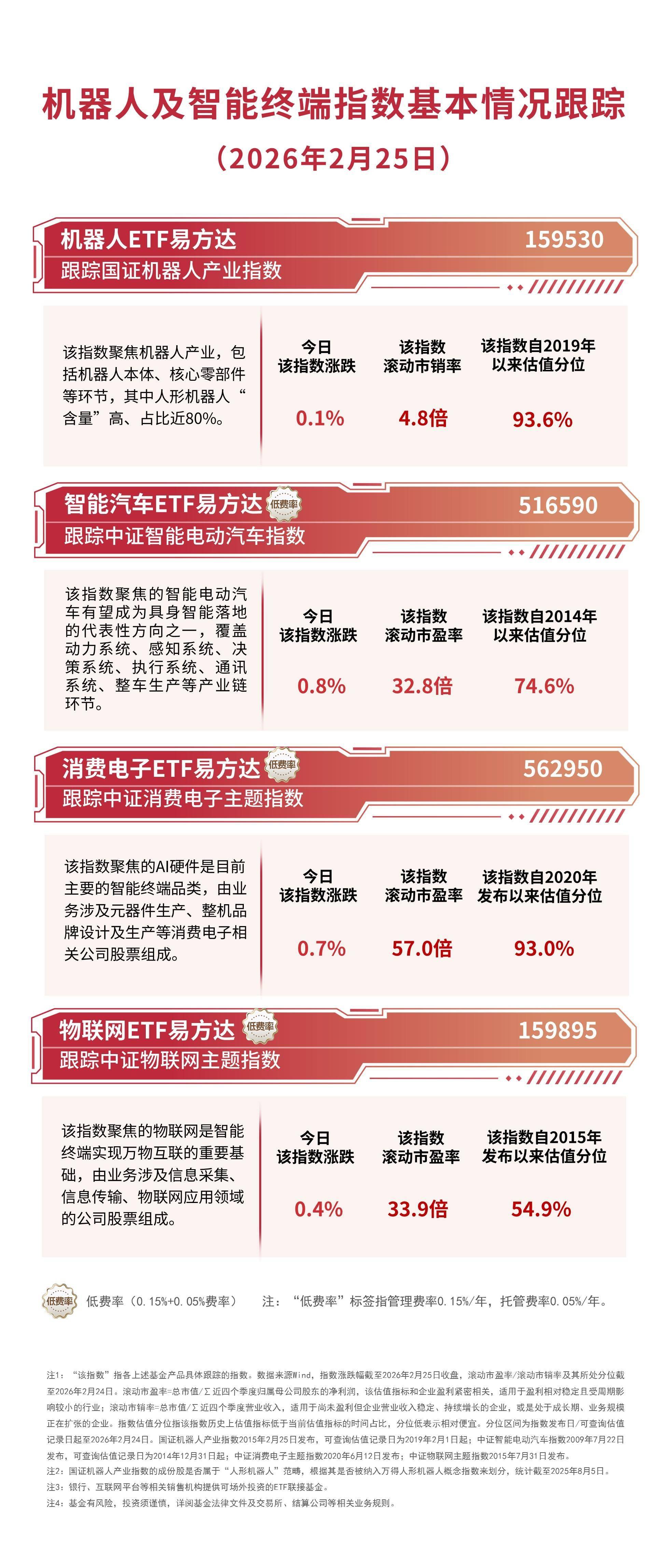
机器人产业指数尾盘翻红,机器人ETF易方达(159530)全天净申购超6000万份
Sou Hu Cai Jing· 2026-02-25 11:41
Group 1 - The core viewpoint of the news highlights a positive trend in various indices related to smart electric vehicles, consumer electronics, and robotics, with significant capital inflow into these sectors [1][5][9] - The CSI Smart Electric Vehicle Index rose by 0.8%, the CSI Consumer Electronics Theme Index increased by 0.7%, and the CSI IoT Theme Index saw a 0.4% rise, indicating strong market performance [1][5][9] - The E Fund Robotics ETF (159530) experienced a net subscription of over 60 million units throughout the day, with a total of over 1.2 billion yuan invested over the past 11 trading days [1] Group 2 - Huatai Securities reports that the smart driving and robotics sectors have shown strong performance before and after the Spring Festival, particularly due to the exposure of four major domestic robotics companies during the Spring Festival Gala, leading to increased orders and capital interest [1] - The phenomenon of robots being featured prominently in the Spring Festival Gala is pushing the technology from an "industry hotspot" to "public consumer awareness," with significant capital investment in the sector [1] - The upcoming release of Tesla's Gen3 is expected to further catalyze developments in the robotics industry [1]
雷神科技2025年业绩快报:营收破30亿 利润总额同比大增24.64%
Quan Jing Wang· 2026-02-25 10:01
Core Viewpoint - Raytheon Technology (920190) reported a strong performance for the year 2025, with total revenue reaching 3.042 billion yuan, marking three consecutive years of year-on-year growth, and a profit of 27.98 million yuan, a significant increase of 24.64%, the highest growth rate since its listing [1] Group 1: Financial Performance - The company achieved a total revenue of 3.042 billion yuan and a profit of 27.98 million yuan, reflecting a 24.64% year-on-year increase [1] - The financial indicators improved significantly due to optimized sales structure, collaboration across three business segments, and deepened global layout [1] Group 2: E-sports Sector - The e-sports equipment segment remains the core foundation for the company, maintaining a leading advantage across all scenarios [1] - The company has signed over 225 e-sports hotel locations nationwide, demonstrating initial scale effects [1] - The self-owned IP event "Raytheon Cup.ACL" has attracted over 100,000 participants across more than 1,000 universities, expanding the company's industry influence [1] Group 3: Trust and Innovation Sector - The trust and innovation sector is positioned as the second growth curve for the company, entering a phase of scale and high-quality development [2] - The company has won over 300 projects in key industries such as government, finance, energy, education, and healthcare [2] - The company's "Double Hundred Plan" aims to establish 100 top agents and 100 leading industry users, laying a solid foundation for continued growth in the trust and innovation business [2] Group 4: AI Hardware Sector - The AI hardware sector is rapidly emerging as a new growth engine for the company, with products like AI PCs and smart glasses gaining significant market traction [3] - The AI smart glasses series launched in early 2025 sold out multiple times, indicating strong market demand for "AI + hardware" [3] - The company has established a core raw material reserve and dynamic management mechanism to mitigate risks associated with component price fluctuations [3] Group 5: Future Outlook - In 2026, the penetration rate of AI PCs is expected to accelerate, and smart glasses are becoming a high-potential consumer electronics segment [4] - The demand for trust and innovation is extending to state-owned enterprises and local state-owned enterprises, continuously expanding market space [4] - The e-sports industry's sportsification and industrialization processes are accelerating, leading to a more complete ecosystem [4]
稀土永磁概念盘中走强,稀土ETF嘉实(516150)一键布局稀土产业链,备受资金关注
Xin Lang Cai Jing· 2026-02-24 02:49
Core Viewpoint - The rare earth permanent magnet sector is experiencing significant growth, driven by the increasing demand for high-performance materials in AI hardware and energy transition technologies [1][2]. Group 1: Market Performance - As of February 24, 2026, the China Securities Rare Earth Industry Index rose by 2.53%, with key stocks such as Placo New Materials up by 7.77%, Goldwind Technology up by 6.14%, and China Rare Metals up by 6.13% [1]. - The top ten weighted stocks in the rare earth sector account for 61.43% of the index, including Northern Rare Earth, Goldwind Technology, and Xiamen Tungsten [2]. Group 2: Industry Drivers - AI hardware is identified as a key beneficiary of current AI applications, with sales of AI glasses increasing by 70%-80% during the Spring Festival and AI toy transactions surging by 500 times year-on-year [1]. - The global energy transition is moving from policy-driven initiatives to actual equipment deployment, with India planning to ease restrictions on Chinese power equipment imports and a projected 37.9 GW of new wind power installations in 2025 [1]. - Core equipment such as wind turbine generators and nuclear control rods require substantial amounts of high-performance sintered neodymium-iron-boron magnets, indicating a strategic value for rare earth permanent magnet materials [1]. Group 3: Investment Opportunities - Investors can access rare earth investment opportunities through the Jiashi Rare Earth ETF (516150), which closely tracks the China Securities Rare Earth Industry Index [2]. - The Jiashi Rare Earth ETF Connect Fund (011036) offers an additional avenue for investors to capitalize on rare earth market trends [3].
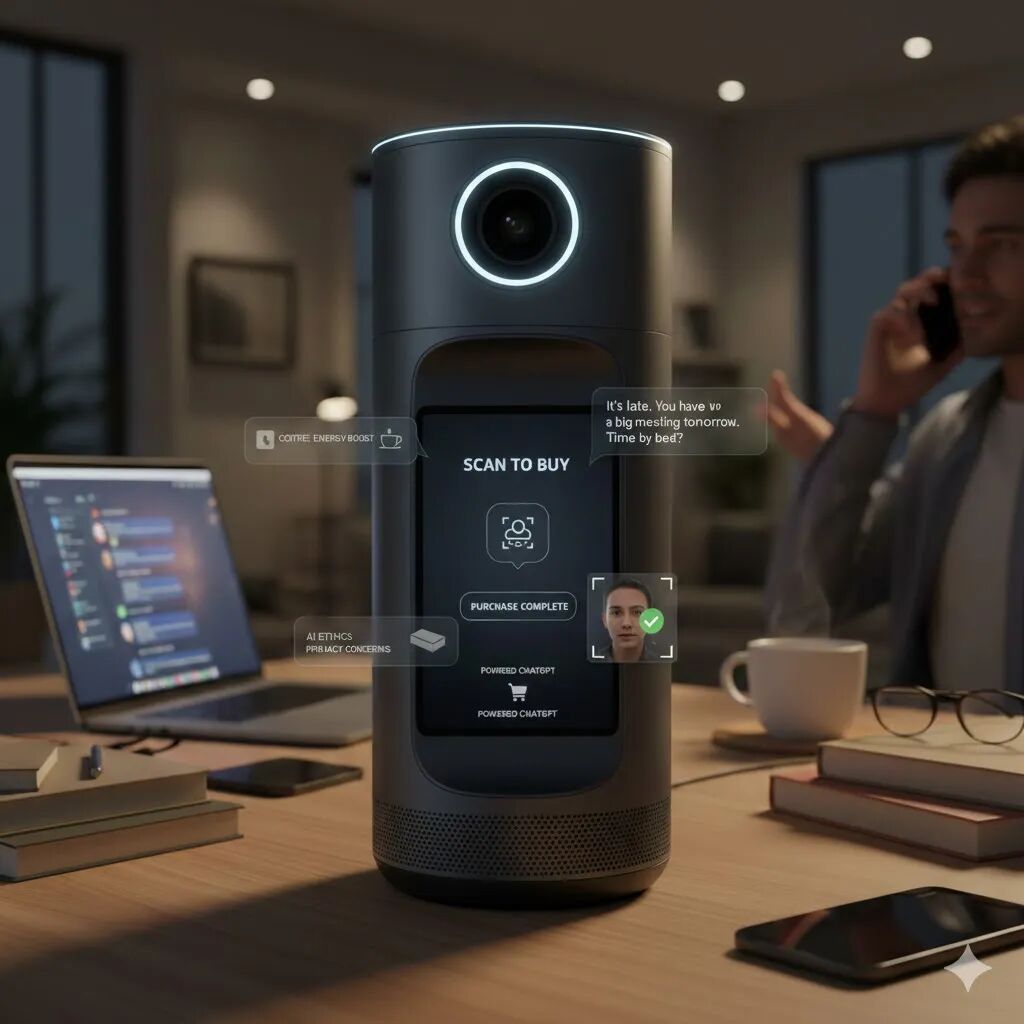
刚刚,OpenAI 硬件全家桶曝光:智能音箱内置摄像头+刷脸购物,ChatGPT 要住进你家了
3 6 Ke· 2026-02-21 02:05
Core Insights - OpenAI is developing a smart speaker equipped with a camera and facial recognition capabilities similar to Apple's Face ID, aiming to enhance user interaction and shopping experiences through visual recognition [1][2][4] Product Overview - The smart speaker is expected to be priced between $200 and $300 (approximately 1450-2200 RMB) and is projected to be released as early as February 2027 [3][22] - Key features include environmental perception through the camera, Face ID-level facial recognition, and voice shopping capabilities [3][4] - The product is part of a broader hardware strategy that includes future developments in smart glasses and smart lamps [3][16] Market Implications - The introduction of this smart speaker could disrupt existing e-commerce and advertising models by inserting a new decision-making layer between consumers and traditional platforms like Google and e-commerce sites [4][25] - OpenAI's hardware ambitions are supported by a team of 200 people, including notable figures from Apple, indicating a strong design and engineering foundation [7][12][26] Competitive Landscape - OpenAI's strategy appears to be a response to the competitive pressures from major tech companies like Apple and Meta, which are also investing in AI-integrated wearable devices [16][25] - The company is facing challenges in proving that AI hardware can deliver a qualitatively different user experience compared to existing devices [26][25] Development Challenges - OpenAI's hardware team operates separately from the main company, indicating a focused approach to hardware development [12] - The company has adjusted its product strategy due to supply chain issues, opting for a simplified version of its AI headphones before launching more advanced models [19][21]

对话 Vinyl 乙烯创意创始人:为什么 Makera 与 NestWorks 能在同一年划破千万美元大关?
雷峰网· 2026-02-20 03:33
Core Insights - The desktop CNC market is experiencing rapid growth, with significant crowdfunding success for projects like Makera Z1 and NestWorks C500, both exceeding $10 million in funding [2][10][16] - The competition in the desktop CNC space is intensifying, with new brands expected to emerge by 2026, leading to a crowded market [3][32] - The Maker category is highlighted as having a higher potential for large-scale crowdfunding success compared to other consumer goods [5][71] Group 1: Market Dynamics - Historically, there have been very few crowdfunding projects exceeding $10 million globally, but China is projected to have four such projects by 2025, all from the Maker category [2] - The desktop CNC industry is characterized by a rapid influx of new players following the success of initial projects, leading to increased competition [3][32] - The success of crowdfunding projects is often linked to the ability to create a strong marketing narrative that resonates with potential users [8][26] Group 2: Project Success Factors - Successful projects like Makera and NestWorks achieved over $1 million in their first day of crowdfunding due to extensive pre-launch customer engagement and marketing strategies [24][25] - The projects benefited from a clear understanding of their target audiences, with Makera appealing to individual creators and NestWorks targeting professional engineers [13][17] - The importance of hardware delivery experience is emphasized, as successful teams have a proven track record in product delivery, which is crucial for gaining consumer trust [11][21] Group 3: Future Opportunities and Challenges - The desktop CNC market is still considered to have room for growth, but the window for new projects to capitalize on this opportunity is narrowing [44][55] - The ease of use and precision of CNC machines remain significant challenges that need to be addressed for broader market acceptance [35][21] - The competition is expected to escalate quickly, with many new brands likely to enter the market, making timing and differentiation critical for success [32][44] Group 4: Trends in Crowdfunding - The trend towards AI integration in hardware products is becoming more prevalent, with many new projects incorporating AI features to enhance functionality [62][63] - The Maker category is expected to continue dominating the crowdfunding landscape due to its potential for high-value products and consumer interest [71][70] - The focus on creating a robust ecosystem around products, rather than just the hardware itself, is seen as a key factor for long-term success [50][51]