
ASIC芯片

Search documents
这一战,谷歌准备了十年
3 6 Ke· 2025-09-15 10:06
Core Insights - Google has begun selling its Tensor Processing Units (TPUs) to small cloud service providers, aiming to compete with NVIDIA in the AI computing market [1][2] - The competition between Google and NVIDIA is intensifying, with analysts predicting a significant reduction in NVIDIA's GPU sales due to the rise of TPUs [2] - Google has been developing TPUs since 2013, initially to address increasing computational demands for AI tasks [3][4] TPU Design and Features - TPUs are specialized ASIC chips designed for AI computing, focusing on high matrix multiplication throughput and energy efficiency [4] - The architecture of TPUs utilizes a "Systolic Array" design, allowing for high data reuse and reduced memory access latency [4] - Google has developed a series of TPU versions, with the latest, Ironwood, achieving peak performance of 4614 TFLOPs and supporting advanced computing formats [9][10] Market Position and Future Projections - By 2025, Google is expected to ship 2.5 million TPUs, with a total projected sales exceeding 3 million by 2026 [8] - The growing acceptance of TPUs reflects a shift in the market as companies seek alternatives to NVIDIA's GPUs for better cost-effectiveness and supply chain stability [15] - Analysts suggest that if Google merges its TPU business with DeepMind and spins it off, it could be valued at up to $900 billion [12] Competitive Landscape - Other tech giants like Meta, Microsoft, and Amazon are also developing their own ASIC chips, indicating a broader trend of moving away from NVIDIA's dominance [15][17] - The competition is not limited to Google; Meta plans to launch its first ASIC chip by late 2025, further intensifying the market rivalry [15][16] - NVIDIA is responding to this competition by introducing technologies like NVLink Fusion, which allows for mixed-use of its GPUs with third-party accelerators [17]


AI算力下半场,具备预期差的方向梳理
Ge Long Hui A P P· 2025-09-12 00:18
Core Insights - The rise of ASIC chip manufacturers, exemplified by Broadcom, is reshaping the technology investment landscape, with ASICs transitioning from a supporting role to a leading position in the market [1] Market Overview - The global ASIC chip market is projected to reach approximately $12 billion in 2024, with expectations to exceed $30 billion by 2027, reflecting a compound annual growth rate (CAGR) of 34% from 2024 to 2027 [1] Company Performance - Broadcom reported a 63% year-over-year increase in AI chip revenue in Q3, driven by a significant $10 billion custom AI chip (XPU) order from a fourth major client [3] - The demand for ASICs is being fueled by cloud service providers (CSPs) favoring ASICs over traditional GPUs due to performance and cost advantages [3] Technological Advancements - ASICs are designed for specific tasks, offering superior efficiency compared to general-purpose GPUs, which are likened to multi-functional tools [4] - Recent innovations have reduced the design cycle for ASICs from 18-24 months to 6-12 months, cutting costs by over 60% [4] Competitive Landscape - Major players in the ASIC design space include IDM giants like Broadcom, cloud companies like Amazon and Google, and specialized design firms such as Cambricon and Rockchip [6] - Broadcom holds a 60% market share in data center interconnect scenarios with its XPU products [6] Manufacturing and Supply Chain - Domestic manufacturers are leveraging advanced manufacturing and packaging technologies to meet ASIC production demands, with companies like SMIC and Changdian Technology playing key roles [7] Supporting Industries - The high power consumption of ASICs has led to increased demand for cooling solutions and optical interconnects, with companies like Invec and Taicheng providing innovative products [8] Investment Opportunities - Investors are advised to focus on companies with visible long-term orders, strong technological barriers, and flexible supply chains in the ASIC ecosystem [9] - The shift towards ASICs represents a significant investment opportunity as the technology landscape evolves, similar to the transition from feature phones to smartphones [9]


AI算力下半场,具备预期差的方向
Ge Long Hui· 2025-09-11 13:53
Core Insights - The rise of ASIC chip manufacturers, exemplified by Broadcom, is reshaping the technology investment landscape, with ASICs transitioning from a supporting role to a leading position in the market [1][3][10] Market Overview - The global ASIC chip market is projected to reach approximately $12 billion in 2024, with expectations to exceed $30 billion by 2027, reflecting a compound annual growth rate (CAGR) of 34% from 2024 to 2027 [1] - Major cloud service providers (CSPs) are increasingly favoring ASICs over traditional GPUs due to their efficiency and cost-effectiveness in AI applications [3][4] Technological Advancements - ASICs are designed for specific tasks, offering superior performance compared to GPUs, which are more generalized [3] - Innovations such as IP core reuse and cloud design platforms have significantly reduced ASIC development cycles from 18-24 months to 6-12 months, cutting costs by over 60% [4] Competitive Landscape - Broadcom's XPU product has captured a 60% market share in data center interconnect scenarios, with a 63% year-over-year increase in AI chip revenue [6] - Major players like Amazon and Google are not only consumers but also producers of ASICs, with self-developed ASICs expected to account for 25% of their computing power procurement by 2024 [6] Manufacturing and Supply Chain - Domestic manufacturers are advancing in ASIC production, with companies like SMIC and Changdian Technology enhancing manufacturing capabilities [7] - The high power consumption of ASICs has led to increased demand for cooling solutions and optical interconnects, creating new market opportunities [8] Investment Considerations - Investors are advised to focus on companies with visible long-term orders, strong technological barriers, and flexible supply chains in cooling and optical interconnects [9][10] - The transition from general-purpose computing to specialized ASICs is likened to the shift from feature phones to smartphones, indicating a significant investment opportunity in this evolving sector [10]

诺安基金邓心怡:走在科技浪潮的前面
点拾投资· 2025-09-11 12:15
Core Viewpoint - Investment is not merely about answering questions, but about making decisions that can improve the lives of individuals [6][10][41] Group 1: Investment Philosophy - The investment philosophy of the company is to resonate with the pulse of the times and to walk alongside industry pioneers [14] - The company believes that the transformative power of information technology and intelligence will create significant long-term industrial opportunities [7] - The core driving force of artificial intelligence is the competition of models, which develops in a stepwise manner rather than gradually [5][19] Group 2: Investment Strategy - The company prefers to invest in areas where there is a discrepancy in market expectations and where valuations have not been fully explored, seeking truly undervalued opportunities with differentiated insights [8][30] - The re-evaluation of business models and changes in commercial delivery methods will lead to greater investment opportunities and significant discrepancies in application [7][36] - The company emphasizes the importance of independent thinking and making judgments that differ from market consensus [25][26] Group 3: Performance and Achievements - The fund managed by the company achieved a return of 128.48% over the past year, with an excess return of 105.07% and a year-to-date return of 65.20% as of August 31 [2] - The company has successfully navigated significant market fluctuations, maintaining positive returns for four consecutive quarters since Q3 2024 [2][41] Group 4: Future Outlook - The company identifies several key areas for future investment, including artificial intelligence chips, applications, terminals, and new consumption trends [34][36] - There is a belief that the demand for domestic chips will increase as they adapt to local models, creating a closed-loop effect in the industry [36] - The company anticipates that the AI industry will continue to evolve, with new applications and software becoming essential for its growth [37][38]

富满微涨2.02%,成交额1.19亿元,主力资金净流入642.47万元
Xin Lang Cai Jing· 2025-09-11 03:23
Core Viewpoint - Fuman Micro's stock has shown a mixed performance in recent months, with a year-to-date increase of 5.12% and a notable rise of 24.00% over the past 60 days, indicating potential growth in the semiconductor sector [2][3]. Group 1: Stock Performance - As of September 11, Fuman Micro's stock price increased by 2.02% to 37.36 CNY per share, with a trading volume of 1.19 billion CNY and a turnover rate of 1.49%, resulting in a total market capitalization of 8.134 billion CNY [1]. - Year-to-date, Fuman Micro's stock has risen by 5.12%, with a 4.74% increase over the last five trading days, an 8.03% decrease over the last 20 days, and a 24.00% increase over the last 60 days [2]. Group 2: Financial Performance - For the first half of 2025, Fuman Micro reported a revenue of 383 million CNY, reflecting a year-on-year growth of 26.42%, while the net profit attributable to shareholders was -35.77 million CNY, showing a year-on-year increase of 25.20% [3]. - The company has distributed a total of 96.54 million CNY in dividends since its A-share listing, with no dividends paid in the last three years [4]. Group 3: Shareholder Information - As of June 30, 2025, Fuman Micro had 42,300 shareholders, an increase of 3.52% from the previous period, with an average of 5,133 circulating shares per shareholder, a decrease of 3.40% [3]. - The top ten circulating shareholders include Hong Kong Central Clearing Limited, which holds 1.2775 million shares, a decrease of 1.1849 million shares from the previous period [4]. Group 4: Business Overview - Fuman Micro, established on November 5, 2001, and listed on July 5, 2017, specializes in the design, research and development, packaging, testing, and sales of high-performance analog and mixed-signal integrated circuits [2]. - The company's main revenue sources include power management chips (38.51%), LED lighting and control chips (32.16%), MOSFET chips (14.56%), and other chips (14.55%) [2].

安凯微涨2.01%,成交额4687.17万元,主力资金净流入199.47万元
Xin Lang Cai Jing· 2025-09-05 04:17
Core Viewpoint - Ankai Microelectronics has experienced a stock price increase of 25.97% year-to-date, but has faced a decline of 10.34% in the last five trading days, indicating volatility in its stock performance [2]. Financial Performance - For the first half of 2025, Ankai Microelectronics reported revenue of 234 million yuan, a year-on-year decrease of 3.02%, and a net profit attributable to shareholders of -49.25 million yuan, a significant decline of 740.87% [3]. - The company has distributed a total of 11.76 million yuan in dividends since its A-share listing [4]. Stock Market Activity - As of September 5, Ankai Microelectronics' stock price was 12.66 yuan per share, with a market capitalization of 4.963 billion yuan. The stock saw a trading volume of 46.87 million yuan and a turnover rate of 1.62% [1]. - The company has appeared on the "Dragon and Tiger List" six times this year, with the most recent appearance on May 26, where it recorded a net purchase of 42.27 million yuan [2]. Shareholder Information - As of June 30, 2025, Ankai Microelectronics had 21,500 shareholders, a decrease of 3.17% from the previous period, with an average of 10,825 circulating shares per shareholder, an increase of 4.95% [3]. - Among the top ten circulating shareholders, Xin'ao New Energy Industry Stock A is the sixth largest, holding 2.87 million shares as a new shareholder [4]. Business Overview - Ankai Microelectronics, established on April 10, 2001, specializes in the research, design, testing, and sales of core SoC chips for IoT smart hardware. Its main revenue sources include IoT camera chips (79.07%) and IoT application processor chips (18.32%) [2].

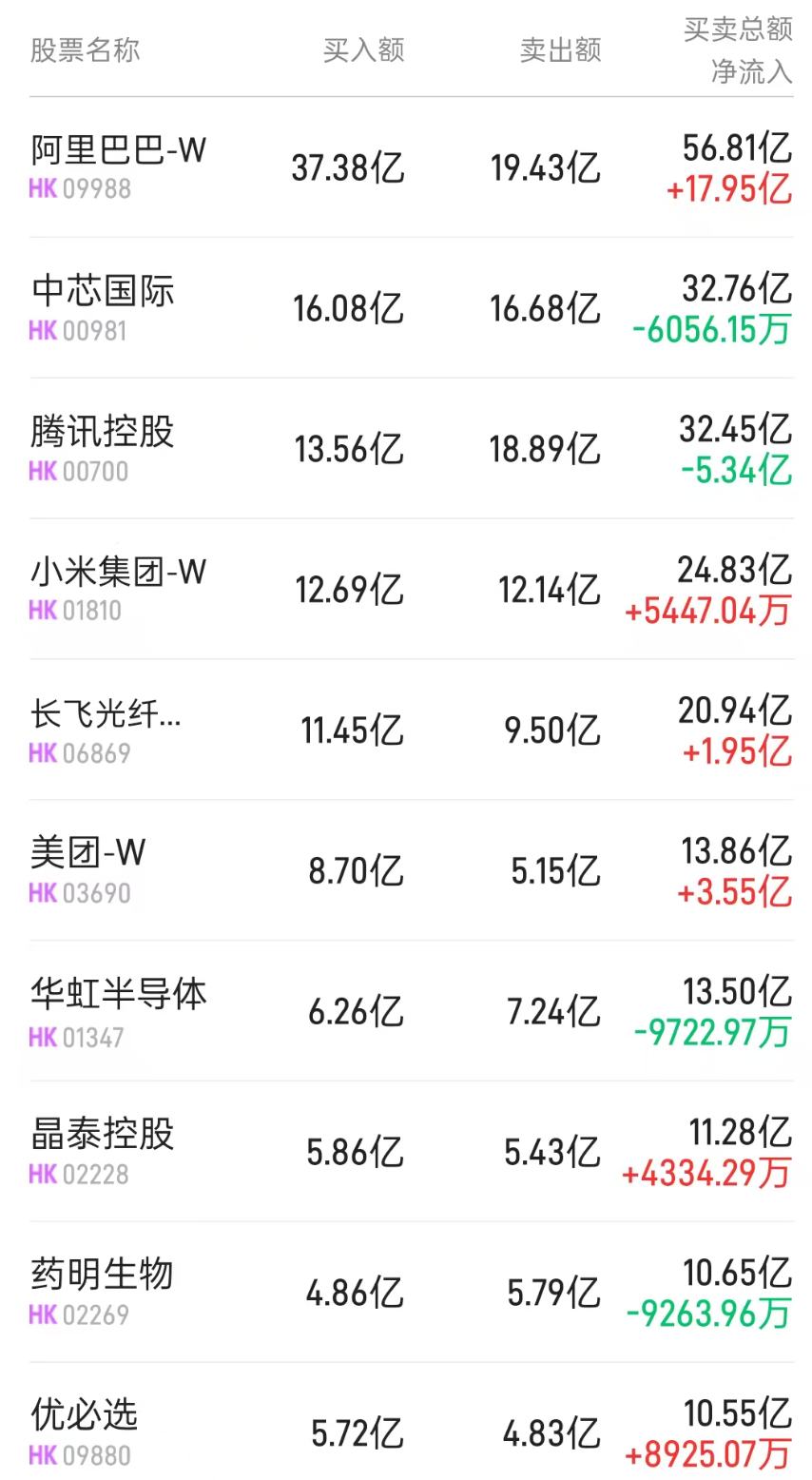
北水动向|北水成交净买入55.08亿 阿里巴巴(09988)再获内资加仓 芯片股继续遭抛售
智通财经网· 2025-09-03 10:00
Summary of Key Points Core Viewpoint - The Hong Kong stock market experienced significant net inflows from northbound capital, totaling HKD 55.08 billion on September 3, with notable net purchases in stocks like Alibaba, Xiaomi, and Meituan, while Tencent and Huahong Semiconductor faced substantial net sell-offs [1][4]. Group 1: Northbound Capital Inflows - Northbound capital recorded a net purchase of HKD 55.08 billion, with HKD 32.02 billion from the Shanghai Stock Connect and HKD 23.07 billion from the Shenzhen Stock Connect [1]. - Alibaba (09988) was the top net buyer, with a net inflow of HKD 17.95 billion, followed by Xiaomi (01810) and Meituan (03690) [2][4]. Group 2: Individual Stock Performance - Alibaba-W (09988) saw a net purchase of HKD 24.88 billion, driven by positive earnings expectations and management's optimistic outlook on core business growth [4][5]. - Xiaomi Group-W (01810) received a net inflow of HKD 6.98 billion, attributed to exceeding delivery targets and strong order demand [5]. - Meituan-W (03690) had a net inflow of HKD 5.7 billion, reflecting ongoing investor interest [8]. Group 3: Notable Sell-offs - Tencent (00700) faced a net sell-off of HKD 4.71 billion, with analysts expressing concerns over its recent performance despite a significant stock price increase [7][8]. - Huahong Semiconductor (01347) experienced a net outflow of HKD 4.05 billion, indicating a shift in investor sentiment [6][8]. Group 4: Market Insights - The market is witnessing a trend where companies like Alibaba and Xiaomi are gaining traction due to strong operational performance and growth prospects, while others like Tencent are facing scrutiny due to overvaluation concerns [6][7].





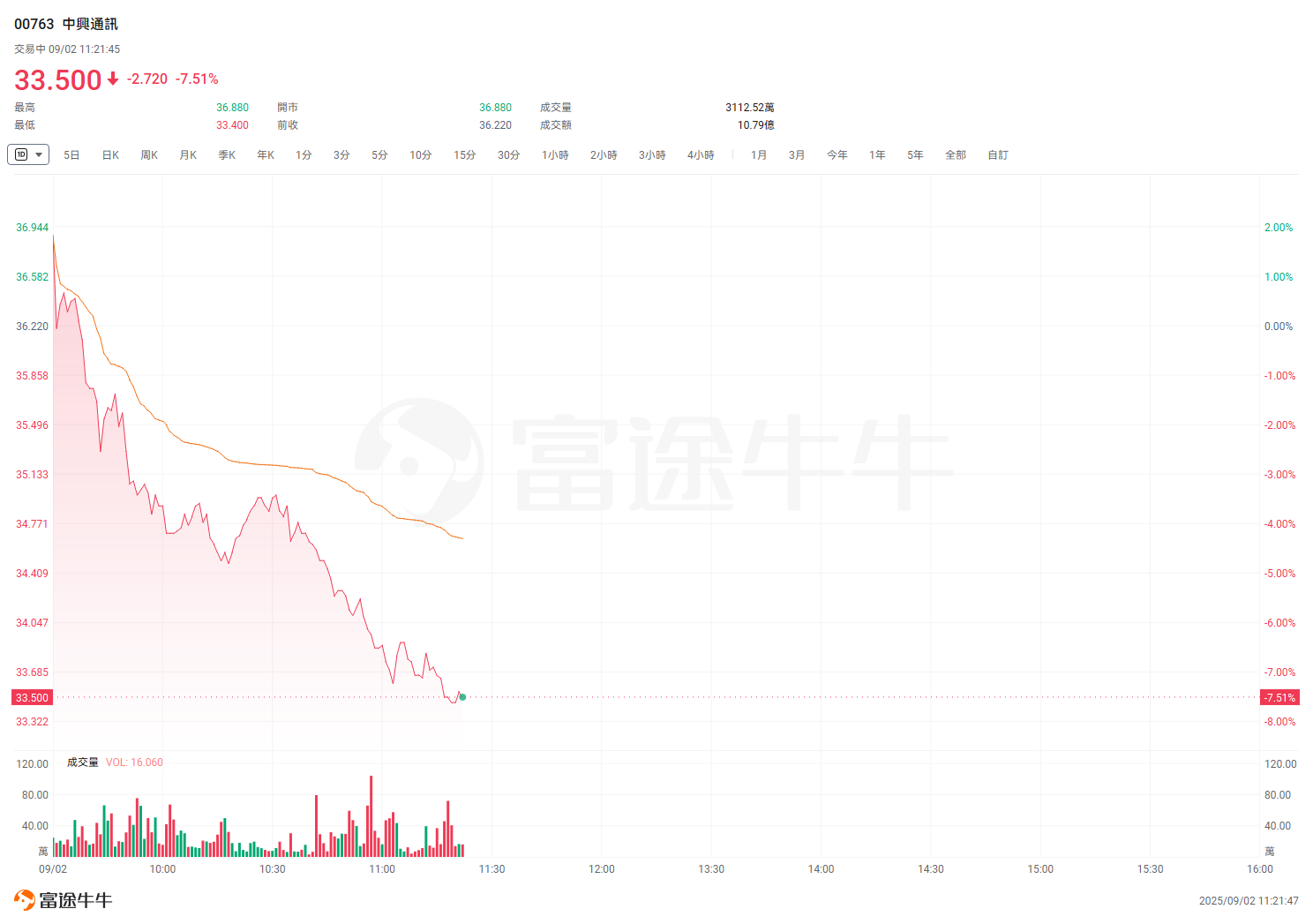
中兴通讯下跌超,中期毛利率显著下滑,富瑞称二季业绩逊预期显示市场过度乐观
Zhi Tong Cai Jing· 2025-09-02 03:57
Core Viewpoint - ZTE Corporation reported a revenue of 71.553 billion yuan for the first half of the year, representing a year-on-year growth of 14.51%, while net profit decreased by 11.77% to 5.058 billion yuan, indicating a mixed performance amid market optimism driven by AI and ASIC chip growth [3]. Financial Performance - Revenue for the first half of the year reached 71.553 billion yuan, up 14.51% year-on-year [3]. - Net profit was 5.058 billion yuan, down 11.77% year-on-year [3]. - Gross margin stood at 32.45%, a decline of 7.99% compared to the previous year [3]. Market Analysis - Jefferies reported that ZTE's stock price has risen approximately 52% over the past three months, fueled by expectations surrounding AI and ASIC chip growth [3]. - The second quarter performance fell short of market expectations, suggesting that the market may have been overly optimistic [3]. - Jefferies has lowered its investment rating from "Hold" to "Underperform" and adjusted the target price to 27.27 HKD, citing a 22x P/E ratio that appears unattractive given projected negative net profit growth over the next three years [3]. Future Outlook - Nomura's report indicates that ZTE is maintaining effective cost management, particularly in R&D, which partially offsets the impact of declining gross margins [3]. - The company is expected to face continued pressure on profit margins in the second half of the year, with a gradual recovery anticipated starting next year due to improved cost optimization [3]. - Nomura has raised its revenue forecasts for ZTE from 2025 to 2027 by 8.5% to 10%, reflecting increased demand for AI servers, but has lowered its profit forecasts for the same period by 4% to 21% due to margin dilution [3].

中兴通讯跌超7% 中期毛利率显著下滑 富瑞称二季业绩逊预期显示市场过度乐观
Zhi Tong Cai Jing· 2025-09-02 03:30
Core Viewpoint - ZTE Corporation's stock has dropped over 7%, reflecting market concerns about its recent financial performance despite previous gains driven by AI and ASIC chip growth [1] Financial Performance - ZTE reported a revenue of 71.553 billion yuan for the first half of the year, representing a year-on-year increase of 14.51% [1] - The net profit for the same period was 5.058 billion yuan, showing a year-on-year decline of 11.77% [1] - The gross margin decreased to 32.45%, down 7.99% year-on-year [1] Market Analysis - Jefferies noted that ZTE's stock had risen approximately 52% over the past three months, driven by optimism around AI and ASIC chips, but the second quarter performance fell short of expectations, indicating market over-optimism [1] - Jefferies has lowered its profit forecasts for ZTE for the next two years by 26% and 31% compared to market predictions, and downgraded its investment rating from "Hold" to "Underperform," while raising the target price to 27.27 HKD [1] Research Insights - Nomura's report highlighted ZTE's effective cost management, particularly in R&D, which partially offset the impact of declining gross margins [1] - Nomura anticipates continued pressure on profit margins in the second half of the year, with a gradual recovery starting next year due to better cost optimization [1] - The firm has raised its revenue forecasts for ZTE from 2025 to 2027 by 8.5% to 10%, reflecting increased demand for AI servers, but has lowered its profit forecasts for the same period by 4% to 21% due to margin dilution [1]
新易盛(300502):Q2云商客户拉货强劲,交付能力优势显著
Changjiang Securities· 2025-09-01 08:41
Investment Rating - The investment rating for the company is "Buy" and is maintained [9] Core Views - The company has experienced strong demand from cloud customers, leading to significant revenue growth in Q2 2025, with a year-on-year increase of 295.4% and a quarter-on-quarter increase of 57.6% [6][12] - The company is benefiting from a robust increase in its ASIC penetration rate, which is expected to enhance its market share [12] - Employee compensation has significantly increased, impacting net profit margins, but the overall growth trajectory remains strong due to capacity expansion and new product launches [12] Summary by Sections Financial Performance - In H1 2025, the company achieved a revenue of 10.44 billion yuan, a year-on-year increase of 282.6%, and a net profit of 3.94 billion yuan, up 355.7% [6][12] - Q2 2025 revenue reached 6.38 billion yuan, with a net profit of 2.37 billion yuan, reflecting a year-on-year increase of 338.4% [6][12] Market Dynamics - The demand for high-speed optical modules remains strong, driven by AI computing investments, with the company’s point-to-point optical module revenue reaching 10.41 billion yuan in H1 2025, a year-on-year increase of 287.4% [12] - The company maintains a competitive edge in core material procurement and capacity expansion, which supports its growth [12] Operational Insights - The company’s production capacity for point-to-point optical modules increased to 15.2 million units in H1 2025, a year-on-year growth of 67% [12] - The successful implementation of stock incentives is expected to further enhance the core team's commitment and performance [12] Profitability Outlook - The company’s gross margin in Q2 2025 was 46.6%, with a notable increase in the gross margin for high-speed optical modules [12] - Future profit forecasts estimate net profits of 7.80 billion yuan, 10.46 billion yuan, and 12.49 billion yuan for 2025, 2026, and 2027 respectively, indicating strong growth potential [12]
