HPC

Search documents
Ready to power AI with next-gen flash?
DDN· 2025-11-24 22:27
Partnership & Collaboration - DDN and Sandisk have a multi-year partnership focused on delivering solutions for both AI and HPC customers [1][2] - The partnership emphasizes agility, flexibility, and collaboration, resulting in solutions that fit well with both DDN and Sandisk offerings [2] Product Development & Strategy - The company is launching a new ultra QLC product line in 2026, offering high capacity options ranging from 32TB to 256TB [3] - The new product line aims to address the high-density needs of emerging data centers and provide balanced performance for AI, HPC, and other workloads [3] Performance & Efficiency - Performance is defined not only by speeds and feeds but also by the overall operational efficiency of the solution [1][2] - Operational efficiency includes form factor perspective and density perspective [2]

Massive AI projects need a platform that actually keeps up. 🦾
DDN· 2025-11-24 17:26
Product Overview - Exoscaler is positioned as a platform for HPC (High-Performance Computing) and AI [1] - The platform is designed for large-scale training [1] - Exoscaler supports multimodal training with a large number of GPUs, ranging from thousands to hundreds of thousands [2] Key Improvements - The company has focused on making Exoscaler easier to use, deploy, and upgrade over the past two years [2] - Exoscaler now features easy online updates [2] - Multi-tenancy has been improved, making Exoscaler fully multi-tenant ready, which is crucial for cloud environments [2]

Our biggest takeaways from #SC25?
DDN· 2025-11-22 00:57
So this year at supercomput was uh was was quite different and very interesting. You know traditionally I heard a lot about how computers are getting better and faster and bigger and more scaling that needs more cooling. But this year I saw a renewed energy around enabling additional supercomput capabilities through GPU acceleration.There's a lot of talk about how Nvidia can help uh supercomput including uh what DDN does for the for the world of HPC and AI in terms of enabling whether it's AI data platform ...

小米手机收入与均价下滑,高管回应内存涨价影响
第一财经· 2025-11-18 14:15
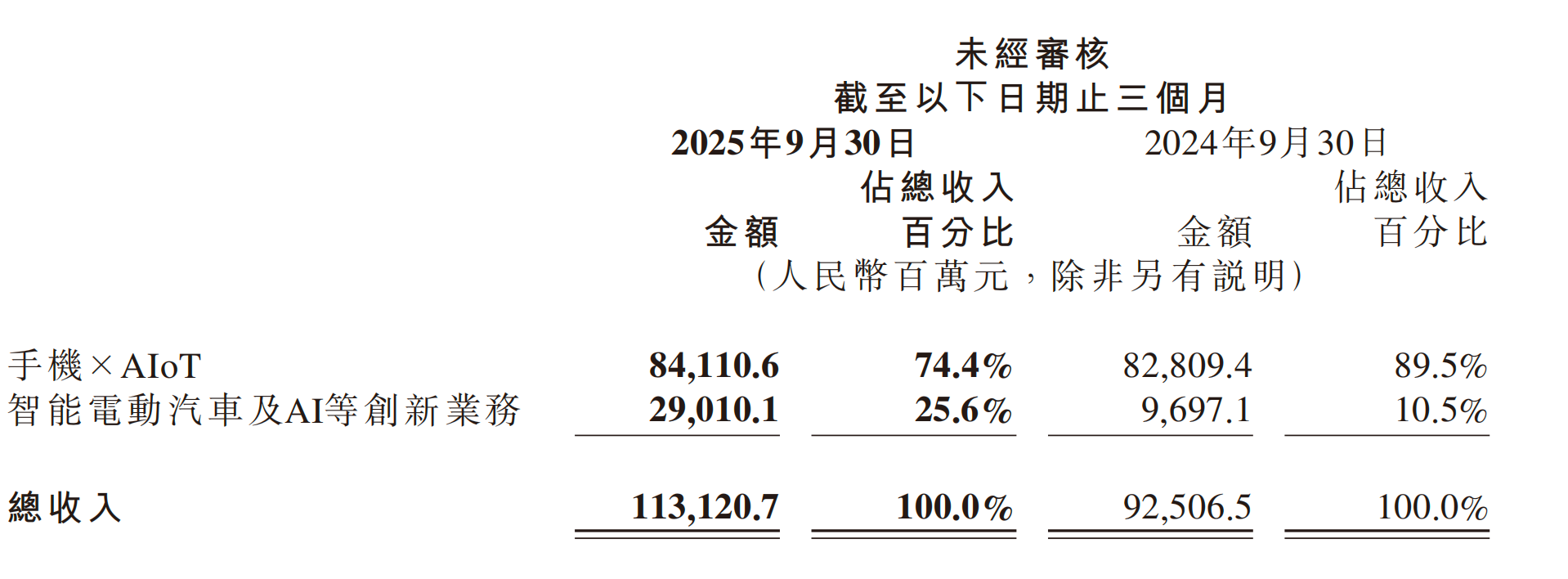
Core Viewpoint - Xiaomi Group reported a strong performance in Q3 2025, with revenue of 113.12 billion RMB, a year-on-year increase of 22.3%, and an adjusted net profit of 11.31 billion RMB, up 80.9% [3]. Revenue Breakdown - The revenue from the smartphone and AIoT segment was 84.11 billion RMB, accounting for 74.4% of total revenue, with a year-on-year growth of 1.6% [4]. - The revenue from the smart electric vehicle and AI innovation segment reached 29.01 billion RMB, representing 25.6% of total revenue, with a significant year-on-year increase of 199.2% [4]. Smartphone Business Insights - The smartphone business generated 46 billion RMB in revenue, a decline of 3.1% year-on-year, primarily due to a decrease in average selling price (ASP) from 1102.2 RMB to 1062.8 RMB, a drop of 3.6% [5]. - Smartphone shipments increased slightly by 0.5% to 43.3 million units, driven by growth in overseas markets [5]. Memory Market Impact - The global memory market has experienced significant price increases across all categories since 2025, affecting the cost structure of the smartphone industry [5]. - The current memory price cycle, driven by AI and high-performance computing (HPC) demand, is expected to have a prolonged impact on industry costs and margins, particularly for products with high storage cost ratios [6]. Industry Dynamics - The memory price surge is anticipated to create volatility in the smartphone industry, with varying impacts on different manufacturers based on their ability to absorb costs [6]. - The domestic smartphone market remains competitive, with the current memory price increase likely to intensify competition among manufacturers, testing their financial strength and supply chain leverage [7].
小米手机收入与均价下滑,高管回应内存涨价影响
Di Yi Cai Jing· 2025-11-18 13:51
Core Insights - Xiaomi Group reported Q3 2025 revenue of 113.12 billion yuan, a year-on-year increase of 22.3%, and an adjusted net profit of 11.31 billion yuan, up 80.9% [2] - The smartphone and AIoT segment generated revenue of 84.11 billion yuan, a 1.6% increase, accounting for 74.4% of total revenue, while the innovative business segment, including smart electric vehicles and AI, saw revenue of 29.01 billion yuan, a 199.2% increase, making up 25.6% of total revenue [2] - Smartphone revenue decreased by 3.1% year-on-year to 46 billion yuan, primarily due to a 3.6% drop in average selling price (ASP) from 1,102.2 yuan to 1,062.8 yuan, despite a slight increase in shipment volume [2] Business Segment Analysis - The smartphone segment's shipment volume increased by 0.5% year-on-year to 43.3 million units, driven by growth in overseas markets [2] - The global memory market has experienced significant price increases across all categories since 2025, affecting the smartphone industry due to high storage costs [2][3] - The current memory price cycle is driven by AI-related high-performance computing (HPC) demand, leading to prolonged and substantial price increases, with expectations for further increases in Q4 [3] Market Dynamics - The memory price increases are expected to impact industry costs and gross margins, particularly for products with high storage cost components like smartphones, tablets, and laptops [3] - Xiaomi's president indicated that if retail prices for smartphones rise, the overall smartphone market will likely decline, although quantifying the exact impact is challenging [3] - The domestic smartphone market remains unsettled, with the current memory price increases intensifying competition among manufacturers, testing their financial strength and supply chain influence [4]
Perma-Pipe: AI, HPC, And Middle East Tailwinds Coupled With An Attractive Valuation
Seeking Alpha· 2025-11-18 04:42
Group 1 - The focus is on leveraging technical and analytical skills to understand the energy sector and global markets [1] - The investment strategy centers around "Growth at a Reasonable Price," emphasizing fundamental analysis and identifying catalysts for medium-term alpha [1] - Options are utilized, primarily on the short side, to generate income and align with the risk-reward profile [1]

X @The Block
The Block· 2025-11-13 16:33
Bitfarms stock tumbles as miner posts $46 million loss, plans AI/HPC pivot with Washington site https://t.co/7sKXDTTqlK ...

Bitfarms drops 4% as Bitcoin miner announces complete pivot to AI/HPC: Q3 Earnings
Yahoo Finance· 2025-11-13 15:29
Core Insights - Bitfarms announced plans to completely wind down its Bitcoin mining operations, leading to a 17% drop in shares before a partial recovery, with the stock down 3.8% from morning open prices as of publication [1] Financial Performance - Bitfarms reported $69 million in revenue for Q3 2025, with $55 million from Bitcoin mining and $14 million from discontinued operations [3] - Adjusted EBITDA increased to $20 million, representing 28% of revenue, compared to $2 million a year earlier [3] - Operating losses were $29 million, and net loss widened to $46 million, or $0.08 per share, compared to a net loss of $24 million in the prior-year quarter [3] Strategic Transition - The company is evaluating a GPU-as-a-Service model for its Washington site as part of a long-term shift away from Bitcoin mining, expected to wind down in 2026 and 2027 [2] - Bitfarms plans to convert its Washington State site to support Nvidia GB300 GPUs with advanced liquid cooling, marking its first fully converted AI site [4] - The Panther Creek campus in Pennsylvania is set to expand its capacity to over 500 MW after further load studies, supported by a $300 million credit facility [5] Infrastructure and Capacity - Bitfarms completed the acquisition of its Sharon, Pennsylvania property, transitioning its 30 MW mining capacity to AI infrastructure, with an additional 80 MW substation expected by the end of 2026 [6] - The company's total energy portfolio now includes 2.1 gigawatts of infrastructure in the U.S. and Canada, with 341 MW energized, 440 MW contracted, and 1,360 MW under application [6] Liquidity and Bitcoin Holdings - Bitfarms has $814 million in liquidity, including $637 million in cash and $177 million in unencumbered Bitcoin [7] - The company mined 520 Bitcoin in the quarter at a direct cost of $48,200 per Bitcoin and sold 185 Bitcoin at an average price of $116,500 for proceeds of $22 million [7] - As of November 12, Bitfarms held 1,827 Bitcoin [7] Share Buyback Program - Bitfarms launched a share buyback program in July, allowing purchases of up to 10% of its public float through July 2026, having repurchased 7.8 million shares at an average price of $1.27 for about $10 million [8] - Despite a 94% year-to-date appreciation in share price over 2025, the stock has dropped nearly 44% over the last month [8]
Meet DDN at SC25!
DDN· 2025-11-11 17:29
[Music] The countdown is on. SC25 is almost here and DDN is heading to St. Louis this November 17th through the 20th.Here's a sneak peek at what's in store. [Music] [Applause] DDN is the exclusive IO sponsor at Supercomputing 25. Find us at booth 1527, that's 1527, for live demos, our booth theater, and book a one-on-one meeting with our experts building tomorrow's AI and HPC infrastructure.[Music] And don't miss BDN's Beyond Artificial Data Summit, supported by NVIDIA and sponsored by Google Cloud and Supe ...

BITDEER(BTDR) - 2025 Q3 - Earnings Call Presentation
2025-11-10 13:00
Financial Performance - Total revenue for Q3 2025 was $169.7 million[9, 11], a significant increase compared to $62.0 million in Q3 2024[9] - Adjusted EBITDA for Q3 2025 reached $43.0 million[9, 11], a substantial improvement from $(7.9) million in Q3 2024[9] - The company reported a net loss after tax of $266.7 million for Q3 2025[11] - Cash and cash equivalents stood at $196.3 million, with a crypto balance of $246.2 million[11] Operational Highlights - Self-mining operations saw a significant increase, with the number of BTC mined rising from 565 in Q2 2025 to 1,109 in Q3 2025[13], a roughly 96% increase - The company achieved a hash rate of 41.2 EH/s as of October 31, 2025[11], compared to 14.2 EH/s in October 2025[13], a roughly 190% increase - Sales of SEALMINERs contributed $11.4 million in revenue from 0.8 EH/S of mining rigs sold in Q3 2025[15] Strategic Initiatives and Infrastructure - The company is expanding its HPC/AI strategy across multiple initiatives[11, 22] - The Clarington, Ohio site with 570 MW electrical capacity is expected to be available by Q3 2026[11, 32] - The company has a global scale with a strong power pipeline, aiming to have 2.1 GW of power capacity online by Q4 2026[60]