
AI数据中心

Search documents
白银市值骤减千亿!巨头疯狂吸纳金属,背后操盘信号曝光
Sou Hu Cai Jing· 2026-02-12 07:46
Core Viewpoint - The silver market experienced a dramatic collapse on January 30, 2026, which was merely a surface-level event, as the underlying financial storm had been brewing since 2025 [1] Group 1: Silver Price Surge - In 2025, silver prices surged by an astonishing 175%, reaching a peak of $121.64 on January 29, 2026, up from $45 at the beginning of the year [3] - This unprecedented increase was driven by strong industrial demand, particularly from the photovoltaic industry, electric vehicles, and AI data centers [5] Group 2: Industrial Demand - The photovoltaic sector saw a doubling in silver paste consumption due to advancements in technology, with silver paste accounting for over half of the non-silicon costs in solar cells [5] - In the electric vehicle sector, the silver requirement for a single electric vehicle is two to three times that of a traditional gasoline vehicle, with major players like BYD potentially needing thousands of tons annually [5] Group 3: Supply Constraints - Global silver supply has been constrained, primarily sourced as a byproduct from copper, lead, and zinc mining, making it difficult to quickly increase production despite rising prices [7] - In 2025, the silver market faced a significant shortfall, with global inventories only able to sustain one to two months of consumption [9] Group 4: Market Dynamics and Speculation - Speculators entered the market amid rumors of mysterious buyers in London purchasing silver, leading to a "short squeeze" atmosphere that attracted retail investors [9] - JPMorgan Chase, previously known for manipulating silver prices, transitioned to a bullish stance, accumulating over 750 million ounces of physical silver, surpassing the holdings of the largest silver ETF [9] Group 5: Margin Changes and Retail Impact - At the end of 2025, the Chicago Mercantile Exchange raised margin requirements three times in two weeks, severely impacting retail investors who had leveraged their positions [10] - Large banks benefited from liquidity support through the Federal Reserve, creating a disparity in treatment between institutional and retail investors [10] Group 6: Aftermath and Market Realities - Following the price collapse, silver prices plummeted from over $120 to the $70 range, with highly leveraged investors facing immediate liquidation [14] - Despite the ongoing industrial demand for silver, the market's pricing logic has shifted, emphasizing silver's dual role as both a financial asset and an industrial commodity [14] Group 7: Lessons from the Market - The events highlight the harsh realities of financial markets, where high expectations and excessive leverage can lead to rapid downturns [16] - Understanding the underlying rules and dynamics of the market is crucial for investors to avoid being exploited in such competitive environments [16]


再创新高:国际银价突破95美元!白银为何突然狂飙?普通人该不该跟风入场?
Sou Hu Cai Jing· 2026-01-20 14:02
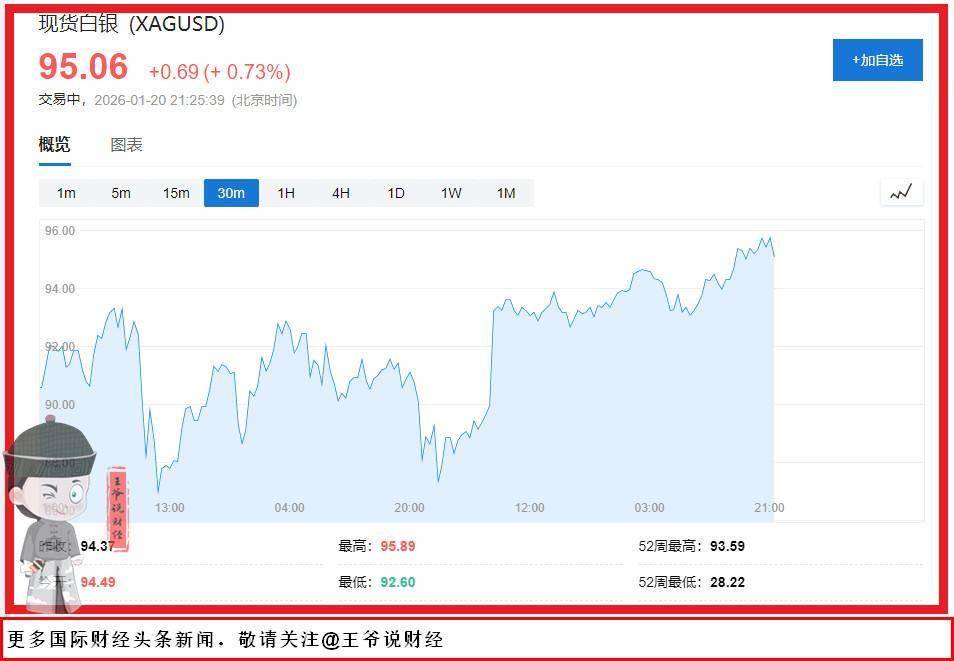
Core Viewpoint - The recent surge in silver prices, reaching a historic high of over $95 per ounce with a single-day increase of nearly 7%, is attributed to multiple converging factors, including trade tensions, monetary policy expectations, and supply-demand imbalances [1][10]. Market Background - Global silver inventories are critically low, with London vaults only sufficient for 1.2 months of global usage, indicating a severe supply crunch [3]. - The largest silver ETF, iShares Silver Trust, has been aggressively accumulating silver, increasing its holdings by 11.28 tons on January 16, raising total holdings to 16,073.06 tons, signaling strong demand [3]. Factors Driving Price Surge - **Trade Risk Aversion**: Heightened trade tensions, particularly due to U.S. tariffs on European countries and geopolitical statements from the U.S., have led to increased demand for silver as a safe-haven asset [3]. - **Federal Reserve Rate Cut Expectations**: Recent dovish signals from Federal Reserve officials suggest potential rate cuts in 2026, weakening the U.S. dollar and making silver more expensive in dollar terms [5]. - **Industrial Demand Growth**: Silver's role has expanded beyond jewelry to critical applications in the renewable energy sector, particularly in solar energy, where demand is projected to exceed 5,000 tons in 2026, representing over 55% of total global demand [6]. Market Reactions and Future Outlook - The surge in silver prices has prompted some industries to explore alternatives to silver, such as copper and aluminum, potentially reducing industrial demand [8]. - While short-term gains are significant, there are warnings of a potential 20%-30% price correction due to speculative trading and overbought conditions in the market [8]. - Long-term prospects remain positive, with expected annual price increases of 10%-15% driven by ongoing demand from the solar and electric vehicle sectors, alongside supportive monetary policies [8][10].
高铜价加速铜产业发展出现阶段性分化
Xin Lang Cai Jing· 2026-01-13 11:54
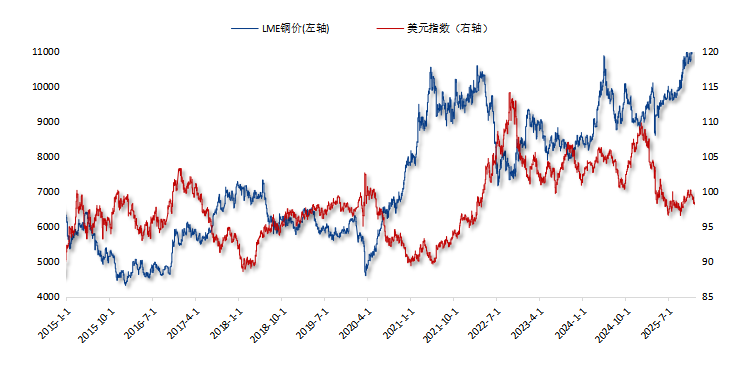
Core Viewpoint - The recent surge in copper prices on the London Metal Exchange and the Shanghai Futures Exchange reflects a fundamental transformation in the global copper industry, driven by long-term supply constraints and structural demand growth from new economic sectors such as electric vehicles, photovoltaic energy storage, and AI data centers [1][20]. Group 1: Copper Price Trends - From 2015 to 2025, copper prices transitioned from a bear market to a structural bull market, influenced by macroeconomic cycles and global monetary policy adjustments [2][21]. - The year 2021 marked a turning point for copper prices, as the global economy shifted from recovery to growth, supported by new technologies and expansive monetary policies [2][22]. - The current price increase is characterized by a dual support of macroeconomic conditions and structural industry changes, with significant demand growth from new sectors [3][22]. Group 2: Supply Constraints - The global copper supply system is facing a long-term dilemma of declining stock and limited incremental supply, exacerbated by deteriorating resource quality, extended development cycles, and increased geopolitical risks [5][24]. - The average grade of global copper mines is declining, leading to higher extraction costs, while new resource discoveries have significantly decreased [7][26]. - Geopolitical risks, such as nationalization discussions in Chile and labor strikes in Peru, have increased supply disruptions, contributing to a long-term unstable supply situation [8][27]. Group 3: Demand Growth from Emerging Sectors - The demand for copper is increasingly driven by the electric vehicle industry, with each electric vehicle requiring 80-100 kg of copper, significantly more than traditional vehicles [10][28]. - Renewable energy and energy storage sectors are forming a second growth curve for copper demand, with wind and solar energy applications expanding rapidly [11][29]. - The AI data center revolution is expected to significantly increase copper demand, with projections indicating a substantial rise in copper usage in clean energy sectors by 2030 [11][29]. Group 4: Industry Chain Differentiation and Value Reconstruction - The high copper prices are reshaping the value distribution logic within the copper industry, concentrating value towards resource-rich and high-value segments [12][30]. - Upstream mining companies are benefiting the most, with firms like Glencore and Freeport-McMoRan seeing profit increases of over 50% [12][30]. - The midstream smelting sector is facing challenges, with some companies forced to reduce production due to tight copper concentrate supplies and low processing fees [12][30]. Group 5: Future Trends in the Copper Industry - The structural transformation of the copper industry is irreversible, with copper evolving from a traditional industrial metal to a critical resource for energy transition [14][32]. - Future trends will focus on optimizing existing resources, increasing industry concentration, and emphasizing green transformation and technological innovation as core competitive advantages [14][32].
标普全球发布2026年展望:全球能源化工发展面临结构性分化
Zhong Guo Hua Gong Bao· 2026-01-04 02:51
Core Insights - The S&P Global report highlights a structural divergence in the global energy and chemical industries, driven by the collision of AI revolution, energy transition, and geopolitical factors, indicating that while the industry shows resilience, the circumstances across different segments will vary significantly [1] Supply Chain Challenges - The report emphasizes the geopolitical-driven restructuring of supply chains and demand mismatches in the energy and commodities markets, with a notable shift in the global propane import market, where the U.S. market share has declined while the Middle East and Canada have gained advantages [2] - The global PVC industry faces dual pressures of production cuts and trade flow reversals, reshaping the supply chain due to high energy costs in Europe and potential overcapacity in Asia [2] - In the energy transition sector, the demand for stable electricity from AI data centers is prompting tech giants to reassess the strategic value of nuclear power, while outdated transmission networks hinder the large-scale integration of renewable energy [2] Investment Landscape - The macro credit environment shows stark contrasts within the energy and chemical sectors, with strong financing demand in areas like AI data centers, power facilities, critical mineral extraction, and LNG supply chains, while traditional chemical manufacturing faces refinancing pressures and weak demand [3] - The report warns of a "double-edged sword" effect surrounding the investment boom in AI and energy transition, where high market expectations could lead to credit tightening and capital pullback if economic benefits or technological advancements fall short [3] Emerging Market Opportunities and Challenges - Emerging market countries with key mineral resources are positioned to benefit directly from the surge in global electric vehicle and energy storage demand, while some developing economies show growth potential due to lower dependence on the U.S. market [4] - However, emerging markets aiming to develop manufacturing face significant challenges, including the need to invest in automation and AI technologies to enhance industrial competitiveness, as well as navigating external policies like carbon tariffs from developed economies [4] - The report identifies three key areas of opportunity: stable base-load energy supporting AI computing, critical resources driven by energy transition, and regional supply chain opportunities arising from geopolitical restructuring [4] Future Industry Dynamics - The report concludes that the era of universal industry prosperity is over, and future winners will be those who can accurately identify advantageous segments within the supply chain, adapt to changes in geopolitical trade, and effectively manage both energy and capital costs [5] - Understanding and leveraging the "non-uniformity" of the divergence trend will be crucial for capturing genuine growth opportunities in the evolving landscape [5]
马斯克担忧白银暴涨:许多工业生产需要用到白银;今年白银价格已上涨超过170%
Sou Hu Cai Jing· 2025-12-28 03:14
Group 1 - Elon Musk expressed concerns over the rising silver prices, stating that silver is essential in many industrial production processes [1] - On December 26, spot silver surged by 10.07% to $79.1075 per ounce, marking a historical high, with a weekly increase of 17.92% and a year-to-date increase of 174.45% [1] - The World Silver Association highlighted that silver is becoming increasingly critical in driving global economic and technological transformation, particularly in solar energy, electric vehicles, and AI data centers [3] Group 2 - The industrial demand for silver is projected to grow from 15,300 tons in 2016 to 20,400 tons in 2024, an increase of approximately 5,000 tons over eight years [3] - On December 26, gold and silver prices reached new highs due to increased safe-haven demand, with February 2026 gold futures hitting $4,581.30 per ounce and March silver futures approaching $80 per ounce [5] - The relative strength index (RSI) for silver reached 93.86, the highest since January 1980, indicating potential market overextension [5]

工业需求爆发支撑银价 白银上涨动能较强
Jin Tou Wang· 2025-12-28 02:30
Core Insights - The silver market has experienced a strong upward trend, rising for five consecutive days and reaching a new high of $75, driven primarily by robust industrial demand, particularly in the solar energy sector [1] - Industrial consumption accounts for 65% of silver demand, with the solar industry representing 15%. The demand from electric vehicles and AI data centers is also surging, with an electric vehicle requiring an average of 25-50 grams of silver, potentially increasing to 1 kilogram per vehicle with the adoption of solid-state battery technology [1] - By 2025, the global silver supply-demand gap is projected to reach 95 million ounces, exacerbated by a 12% year-on-year decline in production from major producing countries like Mexico and Peru, and a mere 1.2% increase in recycled silver [1] - Global silver inventory distribution is highly uneven, with London silver stocks down approximately 75% from their peak in 2019, and transportation bottlenecks affecting New York COMEX inventories, leading to liquidity issues in the global silver market [1] Technical Analysis - Short-term bullish signals are strong, but caution is advised regarding potential overbought pullbacks, with key support and resistance levels to monitor [3] - The MACD indicator shows bullish signals across multiple time frames (15 minutes, 1 hour, 4 hours, daily), indicating strong short-term upward momentum [3] - The KDJ indicator is signaling bearish trends in the short term, suggesting overbought risks [4] - The RSI indicator shows mixed signals, with bearish indications on the 15-minute and 1-hour levels, while the 4-hour and daily levels indicate bullish trends, reflecting significant market divergence [5] Support and Resistance Levels - Key support level to watch is $72.720 per ounce; a drop below this level may lead to further pullbacks [6] - Key resistance level to monitor is $75.495 per ounce; a breakthrough could initiate a new upward trend [7] - Short-term analysis suggests strong bullish signals from MACD, but KDJ and RSI indicate overbought risks, recommending cautious approaches to buying [7]
自食其果!美囤铜谋制约,铝价逆势飙涨,中国坐庄,他们急着求饶
Sou Hu Cai Jing· 2025-12-20 12:57
Core Viewpoint - The international commodity market in 2025 is experiencing significant volatility, particularly with aluminum prices surging due to increased demand from industries like electric vehicles and AI data centers, while the U.S. faces challenges due to declining aluminum imports and strategic missteps in copper accumulation [1][5][17]. Group 1: Aluminum Price Surge - Aluminum cash prices averaged $2,786 per ton in October and rose to $2,859 per ton in November, marking a new high for the year [3]. - The U.S. imported 303,000 tons of unrefined aluminum in July, the lowest in recent years, with a cumulative import decline of 6.18% from January to July [3][11]. - The surge in aluminum prices is attributed to a demand explosion driven by global industrial upgrades, particularly in the electric vehicle sector, where aluminum usage is 42% higher than in traditional vehicles [7]. Group 2: U.S. Strategic Missteps - The U.S. government's strategy to stockpile copper to elevate international copper prices inadvertently led to a surge in aluminum demand, creating a supply crunch [5][17]. - In June 2025, the U.S. raised aluminum import tariffs to 50%, which resulted in a further decline in imports and a vicious cycle of rising prices due to supply shortages [11]. - The U.S. currently has only four operational aluminum smelters with a total capacity of approximately 2.6 million tons, insufficient to meet domestic demand [12]. Group 3: China's Dominance in Aluminum Industry - China produced 41.2 million tons of primary aluminum in the first 11 months of 2025, a 2.5% increase year-on-year, while global aluminum consumption reached over 77 million tons, 2.8 times that of copper [5][9]. - China's competitive advantage in the aluminum industry is supported by low electricity costs, with prices as low as 0.2-0.3 yuan per kilowatt-hour, significantly reducing production costs compared to the U.S. and Europe [9]. - China's comprehensive control over the aluminum industry is achieved through a full supply chain model, from resource importation to recycling [9]. Group 4: Market Dynamics and Future Outlook - The price of alumina futures fell to 2,500 yuan per ton, down from 5,500 yuan a year earlier, while electrolytic aluminum prices continued to rise, indicating a supply-demand mismatch [14]. - The trend of "aluminum replacing copper" is accelerating, with significant adoption in the air conditioning industry and other sectors, potentially leading to a global aluminum supply shortfall of 292,000 tons by 2026 [15][17]. - The U.S. aluminum inventory was only sufficient for 35 days as of October 2025, forcing manufacturers to hedge risks in the futures market [17].
Mhmarkets迈汇:全球白银紧缺中的价格驱动力
Xin Lang Cai Jing· 2025-12-09 10:25
Group 1 - The core viewpoint is that the long-term supply-demand gap in silver is evolving into a structural price driver, with physical shortages since 2025 being a result of years of declining supply and expanding demand [1] - Silver supply has decreased by approximately 8 million ounces over the past decade, with total supply around 1 billion ounces, indicating a tight market for precious metals [1] - The continuous reduction in mine supply suggests that the industry has failed to discover or bring enough new mines into production, making the scarcity of large silver mines difficult to improve in the coming years [1] Group 2 - Inventory levels are also tightening, with declining stocks in trading centers in London, New York, and Asia, highlighting regional squeeze phenomena [2] - The annual consumption of silver in the solar industry exceeds 200 million ounces, accounting for about 20% of total demand, making regional inventory declines a critical risk point [2] - The ongoing increase in ETF holdings has further compressed available resources in the spot market, with over 100 million ounces absorbed by Western ETFs since the beginning of the year [2] Group 3 - The key questions for the future market include whether the supply chain can secure enough silver imports to maintain manufacturing operations and whether investors will start to reduce positions as prices reach $60 or higher [3] - The market is expected to maintain a combination of tight supply-demand, declining inventories, and rising investment demand in the medium term [3] - Technical analysts have set target price ranges for silver as high as $100–200, indicating a potential continuation of structural market conditions [3]


用AI视角看灿谷,矿企重估的开始
Tai Mei Ti A P P· 2025-11-22 08:16
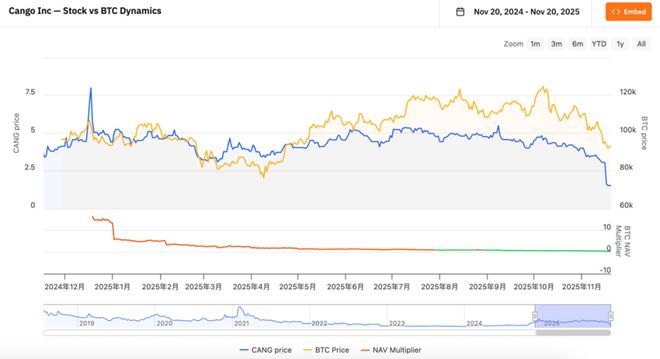
Core Viewpoint - The market perception of the company has shifted from being viewed as a traditional mining enterprise to being recognized as a potential player in the AI and HPC (High-Performance Computing) data center space, with management emphasizing the transition towards energy and AI/HPC business models [1][6][11]. Group 1: Market Position and Valuation - The company's stock price has closely followed Bitcoin's price movements, and its market capitalization of $500 million is currently less than the value of its 6,644 BTC holdings [3]. - The market assigns a NAV (Net Asset Value) multiple of 0.6-1.2 for mining companies, while companies with more owned mining facilities can achieve multiples of 1.5-2.5 [5]. Group 2: AI/HPC Data Center Transition - The company is positioning itself as a future AI data center platform, with a focus on energy and HPC, which is gaining traction in the market [6][11]. - The construction costs for AI data centers have risen to $9.3-15 million per MW, leading developers to relocate to secondary and tertiary markets [9]. - The company has been acquiring assets that align with AI data center requirements, such as large-scale power supply and cooling capabilities, exemplified by its recent acquisition of a 50MW facility in Georgia [14]. Group 3: Operational Advantages - The company possesses operational capabilities that are advantageous for AI/HPC, such as high-density power management and advanced cooling systems, which are critical for AI data centers [12][15]. - The transition to AI data centers is facilitated by the company's existing infrastructure and operational expertise, allowing for a smoother shift from mining to AI applications [18]. Group 4: Strategic Moves and Future Outlook - The company has made strategic moves, including direct listing on the NYSE and restructuring its shareholder base, to enhance its appeal to AI clients and energy funds [17]. - The asset structure is evolving to resemble that of an infrastructure company, positioning the company for long-term contracts in the AI/HPC space [16][18].

A股策略周报20251116:投资与消费,电力与算力-20251116
SINOLINK SECURITIES· 2025-11-16 11:42
Group 1: Overseas Fundamental Contradictions: Investment vs. Consumption, Power vs. Computing Power - Current concerns in overseas markets focus on two main aspects: doubts about the value of AI investments and the disparity between AI-related investments and actual returns [3][4][22] - The recent divergence between U.S. consumer stocks and the S&P 500 reflects market fears of an economic recession, indicating a K-shaped recovery where low-end consumption is weakening [4][24] - The AI industry is driving investment resilience in the U.S., with AI-related investments contributing approximately 1.4 percentage points to GDP growth, surpassing the contribution from private consumption [4][24][29] Group 2: Domestic Demand: A Stabilizing Factor in the Portfolio - Domestic economic data shows weak total consumption, but structural improvements are emerging, particularly in "non-subsidized" sectors, which are showing marginal improvements [5][42] - Two potential scenarios for future domestic demand: one where exporters convert foreign exchange earnings into RMB assets, supporting domestic consumption; the other where financial capital returns in response to global economic risks, enhancing domestic demand resilience [5][47][48] - Key sectors benefiting from domestic demand recovery include food and beverage, textiles, and jewelry, which are showing signs of improvement [5][45][46] Group 3: Style Rebalancing in the Context of U.S.-China Mirror Period - The U.S. economy is transitioning to a "strong investment, weak consumption" model, similar to China's experience from 2022 to 2024, highlighting the importance of power-related assets as a key investment theme [6][56] - Recommendations include focusing on undervalued cyclical assets in the consumer sector, particularly textiles and apparel, which are experiencing improved demand dynamics [6][58] - The ongoing recovery in domestic consumption and the potential return of capital flows are expected to provide continued investment value in domestic assets [6][59]