
财富管理

Search documents
券商发力!公募代销保有增势正猛 多券商将凭“权益类保有规模增量”加分
Zhi Tong Cai Jing· 2025-09-14 22:49
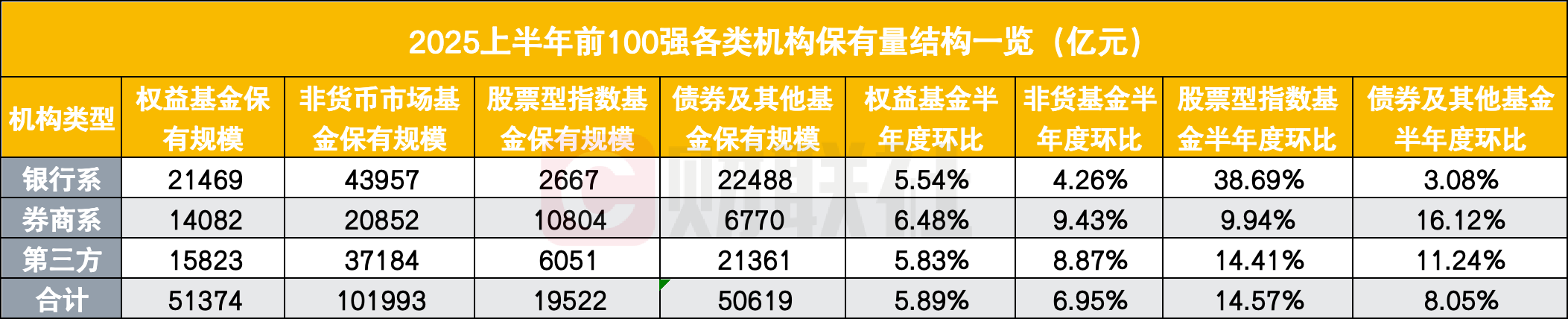
Core Insights - The public fund sales retention scale among the top 100 fund distribution institutions showed a steady growth trend in the first half of 2025, with significant performance differentiation among different types of funds and institutions [1][3][17] Group 1: Fund Performance - As of the end of the first half of 2025, the total retention scale of equity funds among the top 100 fund distribution institutions reached 51,374 billion yuan, a quarter-on-quarter increase of 5.89% [1][3] - The retention scale of non-monetary market funds was 101,993 billion yuan, with a quarter-on-quarter growth of 6.95% [1][3] - The bond and other funds reached 50,619 billion yuan, reflecting a quarter-on-quarter increase of 8.05% [1][3] - Stock index funds performed the best, with a total retention scale of 19,522 billion yuan and a quarter-on-quarter growth rate of 14.57%, becoming the core driver of public fund distribution growth [1][3] Group 2: Institutional Performance - Among the top 100 institutions, brokerage firms stood out with 57 firms listed, accounting for nearly half of the rankings [4][6] - The quarter-on-quarter growth rates for non-monetary funds, equity funds, and stock index funds for brokerage firms were 9.43%, 6.48%, and 9.94%, respectively [4][6] - Brokerage firms dominated the stock index fund market, holding over 55% market share, showcasing their absolute advantage [4][6] Group 3: Regulatory Impact - The revised "Securities Company Classification Evaluation Regulations" introduced on August 27, 2025, added specific indicators for fund advisory and equity fund sales retention scale, guiding brokerages to focus on long-term asset appreciation rather than just initial offerings [2][17] - The new mechanism is expected to shift industry resources towards equity fund sales, accelerating the optimization of wealth management business structures [2][17] Group 4: Competitive Landscape - The competition among leading brokerages remains intense, with notable ranking changes; Guotai Junan and other firms have shown significant improvements in their rankings [7][10] - The differentiation in fund distribution strategies among brokerages reflects their varying preferences and market positioning [7][8] - The retention scale of equity funds for leading brokerages like CITIC Securities and Huatai Securities remains robust, with significant absolute values [10][14]

2025H1基金销售渠道数据点评:蚂蚁、招行和零售型券商高增,行业马太效应加强
KAIYUAN SECURITIES· 2025-09-14 09:04
Investment Rating - The industry investment rating is "Positive" (maintained) [1] Core Viewpoints - The report highlights that the distribution channels are experiencing a Matthew effect, which may intensify due to the recent fee reduction policies [9] - The report indicates that the non-bank financial sector is expected to outperform the overall market, driven by strong performance in fund sales channels [9] - The report emphasizes the increasing concentration in the distribution channels, with top institutions maintaining stable rankings while showing differentiation in performance across active equity, stock index, and bond fund sales [9] Summary by Relevant Sections Distribution Channel Performance - The top 100 distribution institutions' equity and non-cash holdings increased to 51.4 trillion and 102 trillion yuan respectively, reflecting a growth of 6% and 7% year-to-date [4] - The market share of banks in non-cash and equity categories has decreased, while the share of third-party and brokerage firms has increased [4][5] - The report notes that the market concentration (CR5) for equity and non-cash funds has risen to 44.2% and 41.3% respectively [5][9] Fund Performance - As of July 2025, the total AUM for equity and non-cash funds reached 87.5 trillion and 204.6 trillion yuan, marking a year-to-date increase of 9.9% and 6.5% [24] - The report indicates that the net redemption trend for active equity funds has eased, with a 12% increase in unit net value for active equity funds compared to an 8% increase for stock ETFs [5][24] Key Institutions - Ant Group, China Merchants Bank, and retail brokers are noted for their high growth rates in fund sales, with Ant Group's equity AUM reaching 8.229 trillion yuan, a 11% increase [7][12] - China Merchants Bank's equity AUM increased by 20% to 4.920 trillion yuan, driven by successful initiatives [6][12] - The report highlights the performance of top brokerage firms, with CITIC Securities, Huatai Securities, and Guotai Junan showing significant growth in equity AUM [8][12] Regulatory Impact - The report discusses the recent regulatory changes aimed at restructuring the competitive landscape of fund distribution, particularly affecting banks and brokerages that rely on front-end fees [9]




引导信托公司回归本源 《信托公司管理办法》时隔18年首次修订
Zhong Guo Zheng Quan Bao· 2025-09-14 01:37
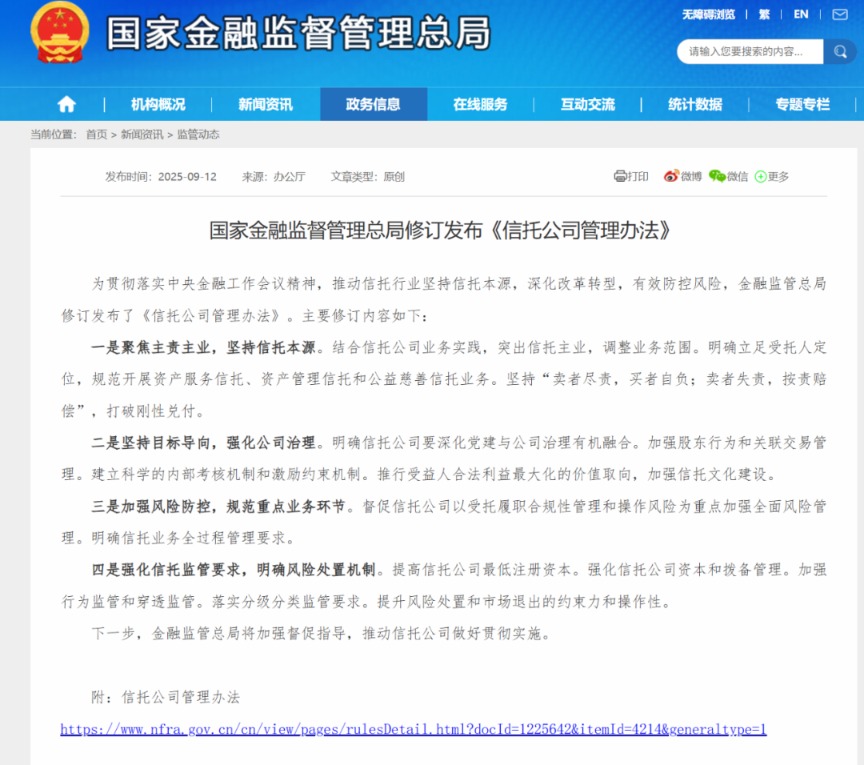
Core Viewpoint - The National Financial Supervision Administration has revised the "Trust Company Management Measures," which will take effect on January 1, 2026, marking the first revision in 18 years, aimed at promoting the trust industry's core functions, deepening reform, and effectively preventing risks [1][4][9] Summary by Sections General Provisions - The revised measures consist of 8 chapters and 75 articles, covering general principles, establishment and changes of institutions, corporate governance, internal control and risk management, business scope and operational rules, supervision and management, risk disposal and market exit, and supplementary provisions [4] Business Scope - The business scope of trust companies has been narrowed to three categories: trust business, asset liability business, and other business [5] - Trust business has been adjusted from five categories to three: asset service trust, asset management trust, and public welfare trust [6] Internal Control and Risk Management - Trust companies are required to strengthen shareholder behavior management and conduct regular evaluations of major shareholders [8] - The board of directors is responsible for compliance management and risk control, and a chief compliance officer must be appointed to oversee internal control and compliance management systems [8] Implementation and Transition - The revised measures will replace the original measures established in 2007, which have become outdated and insufficient for current risk prevention and regulatory needs [9] - Trust companies must develop rectification plans for existing businesses that do not comply with the new measures and gradually reduce their scale [9]
巨头暗战财富管理平台:“AI+投资”开抢C端流量,盈利仍是唯一指标
Hua Xia Shi Bao· 2025-09-13 14:59
Core Insights - The personal financial assets in China, exceeding 200 trillion yuan, are undergoing a significant shift driven by the AI wave, with banks, brokerages, and internet giants competing fiercely for customer traffic through AI-driven wealth management platforms and embedded intelligent advisory services [2][8] Group 1: AI Integration in Wealth Management - Ant Group announced the upgrade of its Wealth Open Platform 3.0, introducing three AI assistants for financial institutions and content creators, which have already been registered by over a hundred financial institutions [2][6] - The "AI + investment" approach has become a key tool for open wealth management platforms, with major brokerages like Guotai Junan launching fully AI-driven apps to enhance content production and real-time interaction [2][8] - The application of AI in investment research is evolving, with firms like E Fund utilizing AI to enhance research efficiency and signal extraction from vast data [5][10] Group 2: Market Trends and Growth Potential - According to McKinsey, China's personal financial assets are projected to reach 205 trillion yuan by the end of 2024, making it the second-largest wealth management market globally, with a compound annual growth rate of around 10% over the next five years [8] - The shift towards AI-driven services is transforming the wealth management landscape, moving from product-centric to customer-centric lifecycle services [8][9] Group 3: Challenges and Opportunities - Despite the growing use of AI tools among institutions, only 7% of users are deeply utilizing these tools, indicating a need for more specialized AI applications [3][10] - The integration of AI in wealth management is expected to enhance efficiency and transparency, addressing traditional limitations in personalized service and post-investment tracking [5][10]

又一家券商市场化选聘,加码财富管理!
Zhong Guo Ji Jin Bao· 2025-09-12 15:17
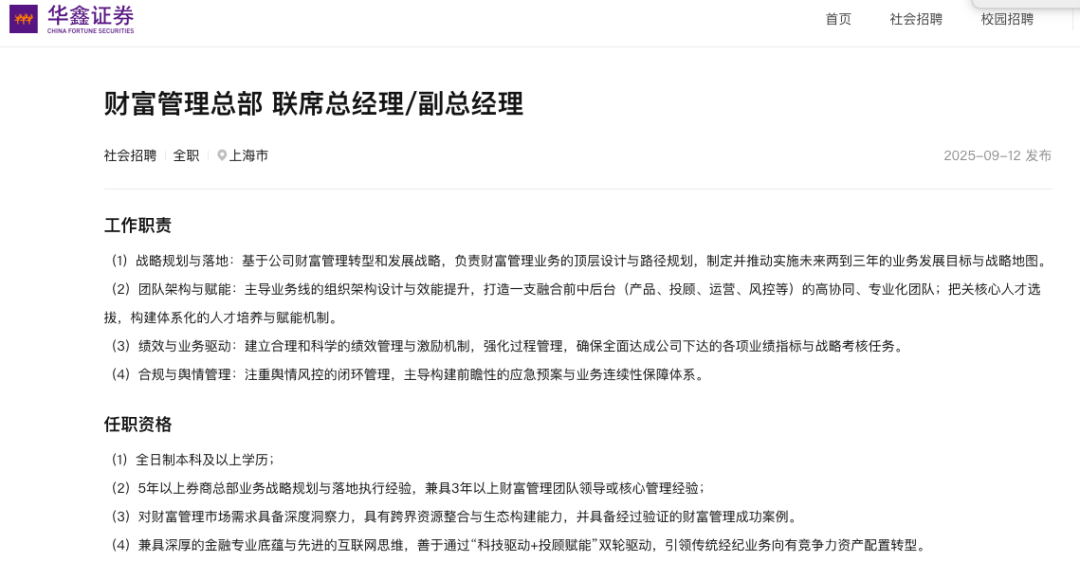
【导读】华鑫证券公开招聘财富管理总部联席总经理/副总经理 9月12日,华鑫证券官网显示,公司正在公开招聘财富管理总部联席总经理/副总经理,岗位职责与任职 要求均紧密围绕财富管理业务升级展开。此外,近期华鑫证券还释放出投顾业务负责人、产品经理等多 个岗位。 9月8日,东兴证券宣布公开招聘首席经济学家。任职资格方面,要求应聘者拥有5年以上知名券商研究 所或公募基金公司等机构工作经验,担任研究团队的主要负责人或核心骨干。 6月17日,国盛金控(002670)发布公告称,为加强新国盛证券经营管理层建设,根据有关部署要求, 公司将公开选聘新国盛证券的总经理。 从岗位职责来看,华鑫证券财富管理总部联席总经理/副总经理需基于公司财富管理转型和发展战略, 负责财富管理业务的顶层设计与路径规划,制定并推动实施未来两到三年的业务发展目标与战略地图。 在团队架构与赋能方面,要主导业务线的组织架构设计与效能提升,打造一支融合前中后台(产品、投 顾、运营、风控等)的高协同、专业化团队;把关核心人才选拔,构建体系化的人才培养与赋能机制。 任职资格方面,要求候选人具备5年以上券商总部业务战略规划及落地经验,并拥有不少于3年的财富管 理团队 ...
又一家券商市场化选聘 加码财富管理!
Zhong Guo Ji Jin Bao· 2025-09-12 15:16
Group 1 - The core focus of Huaxin Securities is on the recruitment of co-general managers and deputy general managers for its wealth management headquarters, emphasizing the upgrade of wealth management business [1][2] - The responsibilities for the positions include top-level design and strategic planning for wealth management, as well as team structure and talent development [2] - Candidates are required to have over 5 years of strategic planning experience in securities firms and at least 3 years of leadership in wealth management teams, with a strong understanding of market demands [2] Group 2 - The investment advisory business head will focus on the execution level, overseeing overall development planning, product service system construction, revenue monitoring, and team management [3] - Huaxin Securities has positioned itself as a "technology-driven securities firm," leveraging its strengths in financial technology to enhance trading volume and net income from securities brokerage [3] Group 3 - The trend in the industry is moving towards market-oriented recruitment to attract high-quality talent, thereby optimizing governance structures and improving management levels [4] - Other firms, such as Dongxing Securities and Guosheng Jinkong, are also publicly recruiting senior management positions, indicating a broader industry trend towards external talent acquisition [5]
谋定而后动 解码邮储银行财富管理的稳健发展体系
Zhong Guo Zheng Quan Bao· 2025-09-12 09:56
Core Viewpoint - China Postal Savings Bank is undergoing a "second upgrade" in retail banking, focusing on wealth management to enhance value and deepen customer engagement, supported by a robust asset base exceeding 18 trillion yuan [2][14]. Wealth Management Strategy - The bank established a wealth management department to enhance its core layout, achieving a personal asset management (AUM) of 17.67 trillion yuan, a 5.87% increase from the previous year [2][14]. - Wealth management has become a crucial link connecting 670 million retail customers, integrating inclusive finance with professional services [2][14]. Intermediate Business Income Growth - The bank's intermediate business income reached 16.918 billion yuan, with a year-on-year growth of 11.59%, outperforming peers [4][5]. - Wealth management-related income, particularly from financial advisory and custody services, saw significant growth, with financial advisory fees increasing by 47.89% [4][5]. High-Value Business Focus - The bank's growth in intermediate business income is driven by high-value sectors such as investment banking and transaction banking, with corporate segment income growing by 42% [5][6]. - The bank's asset quality remains stable, with a non-performing loan ratio of 0.30%, indicating strong credit management [5][6]. Market Opportunities and Growth - The bank capitalized on national policies aimed at boosting consumption and supporting innovation, resulting in a personal loan total of 4.86 trillion yuan, a 1.86% increase [6][7]. - The bank's investment management capabilities have improved, with non-interest income growing by 4.51% [7]. Unique Channel Advantages - The bank's extensive network of nearly 40,000 outlets and a customer base of over 670 million provides a competitive edge in wealth management, enabling precise customer targeting and service delivery [8][9]. - The "self-operated + agency" model creates a strong customer and channel moat, enhancing service capabilities [8][9]. Capital Strength and Efficiency - The bank's capital base was bolstered by a 130 billion yuan injection, raising its core tier one capital adequacy ratio to 10.52% [11][12]. - Cost management initiatives have led to a reduction in agency fees and an improvement in the cost-to-income ratio, allowing for reinvestment in wealth management capabilities [12][13]. Future Directions - The bank is focusing on a lightweight transformation strategy to enhance its non-interest income through improved capabilities rather than relying solely on resources [13][14]. - A clear path for wealth management transformation has been established, emphasizing the importance of customized asset allocation based on customer needs [14].

谋定而后动,解码邮储银行财富管理的稳健发展体系
Zhong Guo Zheng Quan Bao· 2025-09-12 09:03
Core Viewpoint - China Postal Savings Bank is transitioning from a phase of rapid expansion to a focus on deepening existing customer relationships and enhancing value through wealth management, marking a significant upgrade in its retail banking strategy [1] Group 1: Wealth Management Strategy - The bank has established a dedicated wealth management department, achieving a personal asset management (AUM) scale of 17.67 trillion yuan, a 5.87% increase from the previous year [1][7] - Wealth management has become a core link connecting 670 million retail customers, integrating inclusive finance with professional services [1][12] - The bank's wealth management strategy has led to a 47.89% year-on-year increase in wealth management service fee income [2][3] Group 2: Intermediate Business Income - The bank's intermediate business income reached 16.918 billion yuan, with an 11.59% year-on-year growth, outperforming peers [2][3] - Wealth management-related income has been a major contributor, with significant growth in service fees from wealth management and custody services [2][4] - The bank's focus on high-value areas such as investment banking and transaction banking has led to a structural optimization of income [3][4] Group 3: Customer Base and Channel Advantage - The bank serves over 670 million personal customers through nearly 40,000 outlets, providing a unique advantage in reaching rural and urban clients [6][7] - The integration of postal services with banking has allowed the bank to embed wealth management services into everyday life for customers [6][7] - The bank's customer segmentation strategy addresses diverse needs, offering tailored services for different customer groups [7][8] Group 4: Capital Strength and Efficiency - The bank raised 130 billion yuan through a targeted A-share issuance, enhancing its capital adequacy ratio to 10.52% [10][11] - Cost management initiatives have led to a reduction in agency fees and an improvement in the cost-to-income ratio, allowing for reinvestment in wealth management capabilities [11][12] - The bank aims to transition from a reliance on interest income to a diversified income model through enhanced capabilities in wealth management [11][12]
可帮金融机构节省90%生产时长,蚂蚁财富“三大专业AI助手”亮相外滩大会
Sou Hu Cai Jing· 2025-09-12 08:22
Core Viewpoint - The integration of artificial intelligence (AI) into wealth management is creating new paradigms and enhancing service efficiency, as demonstrated by Ant Group's upgraded Ant Wealth Open Platform 3.0, which introduces three specialized AI assistants for financial institutions and content creators [1][6]. Group 1: AI Assistants Overview - Ant Wealth has launched three AI assistants: AI Research Assistant, AI Operations Assistant, and AI Content Creation Assistant, aimed at improving service quality and investor experience [1][6]. - The AI Research Assistant has been registered by 352 financial institutions, helping them gather data and insights quickly [1][9]. - The AI Operations Assistant has reduced service production time by 90% for the first batch of institutions since its trial in March [1][6][9]. - The AI Content Creation Assistant has led to a 203% increase in the production of quality short videos for financial education [1][6][10]. Group 2: Industry Trends and Insights - A recent survey by Tsinghua University's Wudaokou School of Finance indicates that 70% of institutions are using AI tools, but only 7% are utilizing them deeply [4]. - The public fund industry is entering a new phase of high-quality development, with AI technology becoming a key driver for this transformation [5]. - The collaboration between AI and human advisors is expected to enhance the personalization and scientific rigor of wealth management services [5][6]. Group 3: Future Directions - Ant Wealth aims to continuously refine its AI capabilities and build a high-quality service ecosystem in collaboration with partners, enhancing investor experience [7]. - The shift towards AI-driven services marks a significant evolution in the wealth management sector, moving from product and service digitization to intelligent service delivery [6].

可帮金融机构节省90%生产时长,蚂蚁财富“三大专业AI助手”亮相外滩大会
财联社· 2025-09-12 07:11
Core Viewpoint - The article discusses the integration of artificial intelligence (AI) in wealth management, highlighting the launch of Ant Wealth's upgraded platform that offers three AI assistants to enhance efficiency and service quality in the financial sector [1][4][8]. Group 1: AI Assistants and Their Impact - Ant Wealth has introduced three AI assistants: AI Research Assistant, AI Operations Assistant, and AI Content Creation Assistant, aimed at improving service quality and operational efficiency for financial institutions [1][7]. - The AI Research Assistant has been registered by 352 financial institutions, helping them gather data and insights quickly [1][7]. - The AI Operations Assistant has reduced service production time by 90% for the first batch of institutions since its launch in March [1][7][11]. - The AI Content Creation Assistant has led to a 203% increase in the production of quality short videos for financial education [1][7][12]. Group 2: Market Trends and Institutional Adoption - A recent survey by Tsinghua University's Wudaokou School of Finance indicates that 70% of institutions are using AI tools, but only 7% are utilizing them deeply [5]. - The wealth management industry is moving towards higher efficiency, transparency, and inclusivity, with AI expected to play a crucial role in automating research and risk warning processes [5][6]. - The public fund industry is entering a new phase of high-quality development, with AI technology being a key driver for this transformation [5]. Group 3: Future Directions and Collaborations - Ant Wealth aims to continuously refine its AI capabilities and collaborate with partners to build a high-quality service ecosystem, enhancing investor experience [9]. - The evolution of Ant Wealth's platform from version 1.0 to 3.0 reflects a shift towards intelligent service delivery, with a focus on meeting user demands across the entire wealth management chain [8].
