人民币汇率

Search documents
人民币,重大突发!
中国基金报· 2025-12-23 08:01
12月23日,市场全天冲高回落,三大指数小幅上涨。截至收盘, 沪指涨0.07%,深成指涨0.27%,创业板指涨0.41%。 【导读】A股震荡上涨,人民币汇率升 破7.02 中国基金报记者 泰勒 大家好,今天的市场,三大指数震荡上涨,但仍有3800只个股待涨,一起看看发生了什么事情。 震荡上涨 市场共 1512只个股上涨,68只个股涨停,3856只个股下跌。 离岸人民币兑美元升破7.02 | 锂电池产业链拉升,天际股份、多氟多等涨停。 | | --- | | 海南板块延续强势,海南发展、海汽集团均3连板。 | | --- | 液冷服务器概念股活跃,川润股份、英维克等涨停。 | 下跌方面,商业航天概念股下挫,顺灏股份跌停,久之洋、天银机电等跌超10%。 | | --- | 0.95。 中信证券分析,11月下旬以来,美元指数走软叠加央行中间价报价释放的引导信号,人民币汇率逐步升至年内新高并实现" 三价合一 "。 展望后市:1)短期来看,市场对于美联储12月的降息预期已充分定价,同时国内政策对经济的提振效果仍有待显现,央行的稳汇率政策 更多在于防止单边一致性预期,预计年内人民币有望偏强运行,汇率中枢或难突破7.0。但 ...


2026年人民币有望维持温和升值势头 | 界面预言家
Xin Lang Cai Jing· 2025-12-23 06:40
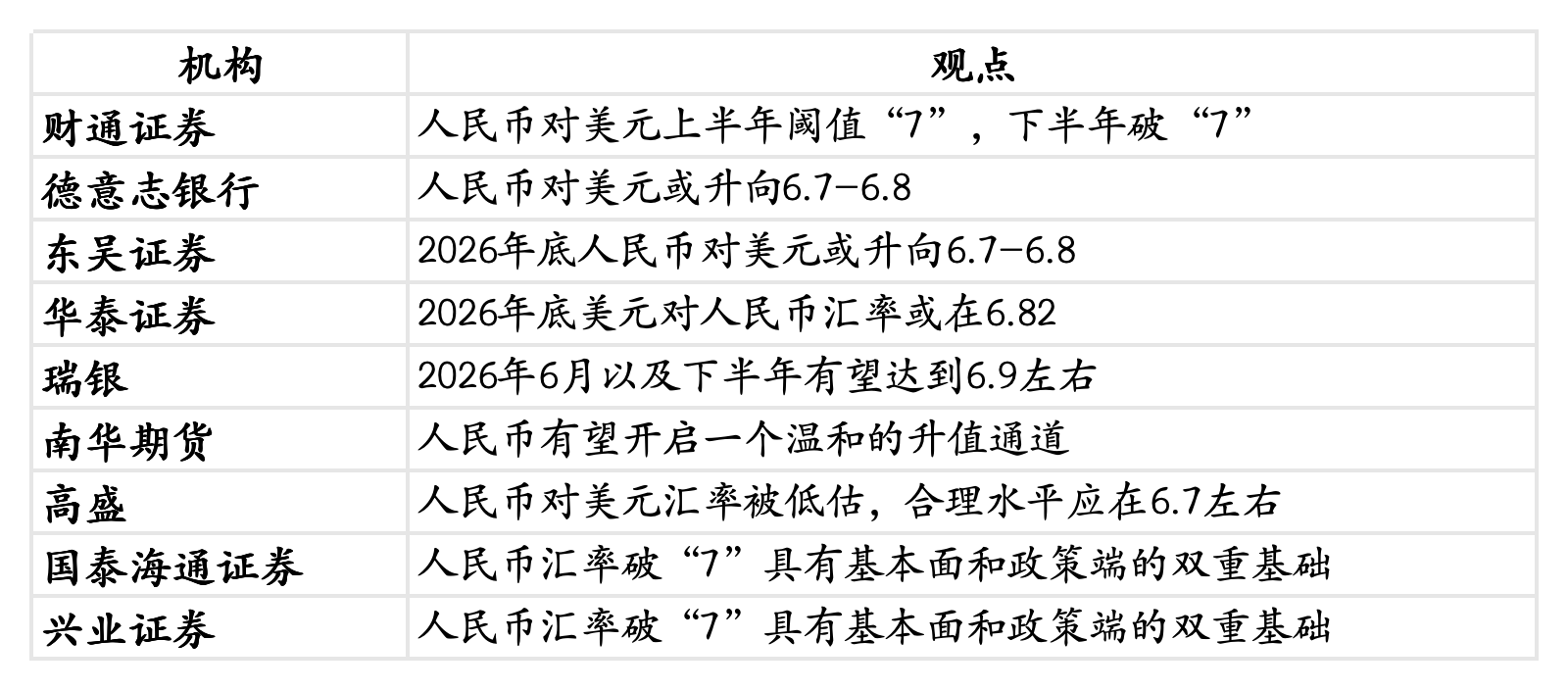
Core Viewpoint - In 2025, the global financial market underwent significant changes, including a shift in monetary policy and economic restructuring, leading to a "weak first, strong later, and narrowing volatility" trend in the RMB exchange rate against the USD [1] Group 1: RMB Exchange Rate Trends - As of December 22, 2025, the RMB appreciated approximately 3.7% against the USD, closing at 7.0382 RMB per USD, an increase of 2606 basis points from the previous year [1] - Predictions for 2026 suggest a continued trend of moderate appreciation for the RMB, with expected exchange rates ranging between 6.7 and 7.2 RMB per USD, and a year-end target of 6.7 to 7.0 RMB per USD [1][2] Group 2: Economic Factors Supporting RMB Strength - Analysts believe that the core factors supporting the RMB's appreciation include the domestic economic fundamentals, the Federal Reserve's monetary policy, and the stance of the People's Bank of China [2] - China's GDP is expected to grow around 5.0% in 2026, with a healthy trade surplus and current account providing a solid foundation for the RMB [2][3] Group 3: Export Dynamics - In 2025, China's exports grew by 5.4% year-on-year, despite challenging trade conditions with the US, indicating resilience in the face of tariffs [2] - Deutsche Bank forecasts a 6% growth in Chinese exports for 2026, supported by China's industrial advantages and diversification into non-US markets [3] Group 4: Capital Flows and Market Sentiment - A significant reversal in the willingness of export enterprises to settle foreign exchange has been a key factor in the RMB's appreciation since September 2025 [4] - Analysts note that the historical accumulation of approximately $1 trillion in unconverted export earnings could lead to increased capital inflows as RMB appreciation expectations solidify [4] Group 5: Monetary Policy and Market Stability - The Federal Reserve's monetary policy and the USD index are critical variables influencing the RMB exchange rate, with expectations of continued easing from the Fed [6] - The People's Bank of China is expected to maintain a relatively independent monetary policy, with potential rate cuts in 2026, which will support the RMB's appreciation trend [6][7] Group 6: RMB Internationalization - The Chinese government's shift towards promoting RMB internationalization is expected to enhance demand for the currency, contributing to its steady appreciation [8] - Analysts predict that 2026 could mark the beginning of a new appreciation cycle for the RMB, with expectations of breaking the 7.0 mark against the USD [8]
港股遭遇“贫血症”!机构支招:治标也要治本
券商中国· 2025-12-23 03:56
Core Viewpoint - The Hong Kong market has been underperforming since the fourth quarter, with significant declines in liquidity and trading volume, which are critical factors affecting market performance [1][2][3]. Liquidity Issues - The average daily trading volume in Hong Kong stocks fell to HKD 230.7 billion in November, a decrease of 16.1% month-on-month, and continued to decline in December, down approximately 13% [2]. - The reduction in southbound capital flow, foreign capital withdrawal, and ongoing IPO activities have collectively contributed to the liquidity downturn in the Hong Kong market [3][4]. - As of December 12, net inflows from southbound capital were HKD 7.906 billion, significantly lower than the monthly average of HKD 125.6 billion from January to November 2025 [4]. - Concerns among investors include foreign capital reducing positions before the Christmas holidays, hedge funds shorting due to economic uncertainties, and new regulations affecting fund investments [4]. Market Sentiment and External Factors - The liquidity issue is expected to continue to constrain the Hong Kong market, affecting overall valuation recovery and making the market more susceptible to external sentiment fluctuations [8]. - Key signals to watch for market recovery include a stable interest rate environment from the Federal Reserve and a verifiable recovery in domestic economic performance and corporate earnings [8]. Long-term Solutions for Liquidity - Addressing the liquidity challenges in the Hong Kong market requires a multi-faceted approach, including enhancing corporate earnings growth, improving market policies, and creating a favorable external environment [9][10]. - Specific recommendations include increasing the accessibility of southbound capital, encouraging foreign investment, and optimizing the IPO and delisting ecosystem to enhance liquidity for small-cap stocks [10][11]. - The market's liquidity is also tied to mainland economic policies, necessitating stable growth expectations to attract long-term capital [10].

外汇专题报告:规模收敛但未转向,结售汇格局依旧平衡
Hua Tai Qi Huo· 2025-12-23 03:10
Group 1: Report's Investment Rating - No information provided on the industry investment rating. Group 2: Core Views - The narrowing of the surplus in November's foreign exchange settlement and sales and cross - border receipts and payments mainly reflects structural and rhythm adjustments. Enterprises' foreign exchange settlement and sales and hedging behaviors tend to be rational, and cross - border capital flows remain stable without a directional change. The US dollar is still in the stage of repricing within a range, lacking a trend driver in the short term. Affected by this, the USD/CNY rate generally maintains a range - bound movement, mainly fluctuating around 7.0 - 7.1 in the short term, and a directional breakthrough still awaits new macro variables [2]. Group 3: Summary by Directory Market Supply - Demand Relationship Analysis - In November, the surplus in bank foreign exchange settlement and sales fell to $15.65 billion, showing a continuation of the surplus but a marginal slowdown. The overall foreign exchange supply - demand remains in a relatively balanced state. The scale of foreign exchange settlement and sales did not show a significant increase or decrease, indicating that cross - border capital flows are still mainly for regular receipts and payments. The narrowing of the surplus mainly reflects a rhythm change rather than a directional reversal. Against the backdrop of dull US dollar pricing and neutral corporate exchange - rate expectations, the marginal guidance of single - month foreign exchange settlement and sales data on the exchange rate has declined [9]. Foreign Exchange Market Supply - Demand Balance - The change in the surplus structure mainly comes from the cooling of the foreign exchange settlement momentum at the client - service end, while the deficit in banks' own foreign exchange settlement and sales narrows simultaneously, offsetting some of the pressure from the narrowing surplus. The surplus in client - service foreign exchange settlement and sales narrowed from $21.426 billion to $16.423 billion, indicating that enterprises at the end of the year prefer to disperse foreign exchange settlement and focus on operating cash - flow management rather than releasing foreign exchange settlement demand in a concentrated manner. At the same time, the deficit at the bank's self - operating end narrowed significantly, reflecting a phased relief of the pressure on financial institutions in matchmaking and position management, making the surplus structure of foreign exchange settlement and sales smoother and helping to stabilize the market's expectations of short - term exchange - rate fluctuations [10]. Forward Foreign Exchange Settlement and Purchase Intentions - In November, the RMB exchange rate strengthened moderately, and market trading activity rebounded. The average spot value of the USD/CNY rate decreased by 0.48% month - on - month, still operating in a moderately volatile range. Meanwhile, the spot inquiry trading volume in the inter - bank market rose to $40.342 billion, reflecting a recovery in market trading willingness. In this context, enterprises' spot - end operations became more rational. After excluding forward performance, the foreign exchange settlement rate of received funds fell to 51.99%, and the foreign exchange purchase rate of payment funds decreased to 60.30%, indicating that enterprises did not adjust their foreign exchange settlement and sales rhythm in a concentrated manner due to short - term exchange - rate fluctuations but maintained a relatively balanced receipt and payment management. On the forward end, the overall performance was a cooling of new hedging demand and a differentiated performance structure, indicating that enterprises are adjusting their focus on managing short - to - medium - term exchange - rate risks. In November, both the forward foreign exchange sales and settlement contract amounts declined, and the new hedging demand decreased compared with the previous period. The change at the performance end was more notable, with a reduction in forward foreign exchange settlement performance and a significant increase in forward foreign exchange purchase performance, reflecting that some enterprises chose to perform contracts after locking in exchange rates previously but did not simultaneously expand new forward exposures. The unexpired forward net foreign exchange settlement scale is still rising, and the forward foreign exchange settlement and purchase hedging ratios are basically the same, indicating that the forward hedging structure of enterprises tends to be stable, mainly reflecting "stock adjustment" in risk management rather than an active bet on the exchange - rate direction [12]. Foreign Exchange Settlement and Sales Structure Analysis Banks' Own Foreign Exchange Settlement and Sales - In the macro - data analysis of bank foreign exchange settlement and sales, banks' internal foreign exchange settlement and sales activities are not the key focus. These activities mainly include external dividend and profit payments, repatriation of overseas profits, and capital injection. The funds involved are small in scale and seasonal, having a limited impact on the overall trend of foreign exchange settlement and sales [17]. Banks' Client - Service Foreign Exchange Settlement and Sales - In November, the surplus in domestic banks' client - service cross - border receipts and payments narrowed significantly, with both the current account and the capital and financial account declining. The current - account surplus decreased from $74.66 billion to $55.238 billion. The surplus in goods trade fell to $72.666 billion, mainly reflecting a structural adjustment under the stable export rhythm and enhanced marginal import recovery, rather than a reversal of the foreign - trade fundamentals. The deficit in service trade expanded to - $6.421 billion, mainly related to the slow recovery of outbound - related consumption and the incomplete recovery of cross - border service receipts and payments. At the same time, the deficit in the income and current transfer items expanded, weakening the support of the current account for the surplus in cross - border receipts and payments, but the overall current account still maintained a relatively solid surplus foundation. The deficit in the capital and financial account further expanded, indicating that cross - border capital flows are still mainly "structurally outflowing", but the internal composition shows differentiation. In November, the deficit in the capital and financial account expanded to - $38.605 billion. Among them, the deficit in securities investment narrowed to $34.599 billion, showing a significant improvement compared with the previous period, reflecting a marginal relief of the pressure of foreign - capital outflow. The deficit in direct investment narrowed slightly, indicating that cross - border capital flows at the entity level are becoming stable. Other investments changed from a small surplus to a slight deficit, with overall controllable fluctuations. Overall, the capital account still drags down cross - border receipts and payments, but there is no concentrated outflow through a single channel [21]. Deconstruction of November's Foreign Exchange Settlement and Sales Securities Investment - In November, the trading activity in the cross - border equity market declined simultaneously, reflecting a phased weakening of risk preferences at home and abroad. The trading volumes of the Shanghai - Hong Kong Stock Connect and the Shenzhen - Hong Kong Stock Connect decreased to 4424.844 billion yuan and 1791.246 billion yuan respectively, indicating that both north - bound and south - bound funds were mainly in a wait - and - see mode in that month, and the trading willingness decreased significantly. Compared with the equity end, the foreign - capital allocation in the bond end remained relatively stable, but there was a slight decline in November. The overall fluctuation of the overseas bond custody volume was not large, indicating that long - term allocation funds have not undergone a trend adjustment, but the slight decline in that month also reflects that when both the yield and the exchange rate are in a range - bound oscillation, the power for incremental allocation is insufficient. Overall, the impact of cross - border asset flows on the foreign - exchange market in November was mainly reflected in the slowdown of trading and foreign exchange settlement and sales rhythms, rather than a directional capital - flow shock [27]. Goods Trade - In November, the global manufacturing PMI declined marginally but remained near the boom - bust line, with major economies showing differentiation around the expansion - contraction critical point. Specifically, the global manufacturing PMI decreased slightly from 50.9 in October to 50.5; China's manufacturing PMI rebounded to 49.2, showing that the marginal effect of domestic - demand recovery offsetting external - demand slowdown. The US PMI fell to 52.2, the eurozone's to 49.6, and continued to weaken slightly in December, while Japan and South Korea remained below 50. Overall, the global manufacturing boom is in a high - level slowdown stage. External demand has not weakened significantly, but the expansion slope has decreased, making enterprises' foreign - exchange receipts and payments more likely to follow the order and delivery rhythm smoothly rather than adjusting their foreign - exchange settlement and sales strategies in a concentrated manner due to single - month boom fluctuations. In November, China's export data improved significantly, and the trade surplus widened again, indicating that foreign trade still has resilience in supporting foreign - exchange receipts and payments. In US dollars, exports increased by 5.9% year - on - year in November, a significant rebound from the previous month, and imports increased slightly to 1.9% year - on - year. The single - month trade surplus expanded to $111.68 billion. From January to November, exports increased by 5.4% year - on - year, imports decreased by 0.6% year - on - year, and the trade surplus exceeded $1 trillion for the first time. Structurally, the import and export to countries participating in the Belt and Road Initiative increased by 6%, effectively offsetting the drag of a 16.9% year - on - year decrease in imports and exports to the US. Mechanical and electrical products accounted for more than 60% of exports, among which the exports of integrated circuits and automobiles maintained rapid growth, and the general decline in commodity import prices also increased the surplus level. Overall, the stable volume and good price of foreign trade, as well as the diversified regional and product structures, help to enhance the long - term support of the current account for foreign exchange settlement and sales and the exchange rate, but in the short term, it mainly plays a "bottom - supporting" role rather than a trend - driving force [32].
离岸人民币升破7.03关口 中间价创近15个月新高
Xin Lang Cai Jing· 2025-12-23 03:06
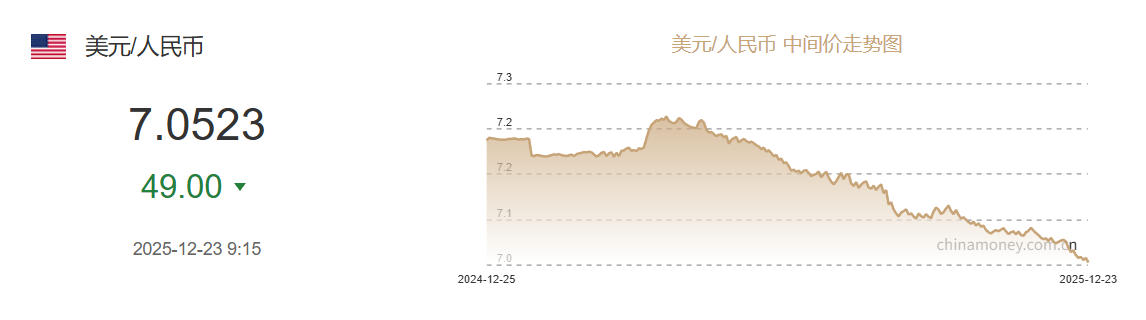
转自:新华财经 新华财经北京12月23日电(马萌伟)22日,美元指数止步三连涨、跌落一周高位;在岸人民币兑美元涨 破7.04关口,最高升至7.0367;北美交易时段盘中,离岸人民币兑美元14个月来首次盘中涨破7.03关 口,最高升至7.0293。 23日,人民币对美元中间价调升49点至7.0523,升值至2024年9月30日以来高点。截至发稿,在岸人民 币兑美元报7.0352,离岸人民币兑美元报7.0278。 消息显示,美国总统特朗普将在明年1月第一周指定美联储新主席人选。鲍威尔的四年主席任期将于明 年5月届满,特朗普此前表示,他希望选择一位支持增长友好型货币政策的继任者。 美联储理事米兰表示,如果美联储明年不继续降息,可能面临引发经济衰退的风险。他还表示,预计短 期内不会出现经济下行,但失业率上升应促使美联储官员继续降息。 上周,美元指数结束了此前的连续3周下跌,在美国就业数据和通胀双双不及预期的背景下,展现出了 一定的韧性,人民币汇率延续上行势头。统计数据显示,在岸人民币兑美元累计涨144个基点报7.041, 离岸人民币累计上涨大约195点报7.0342,人民币对美元中间价累计调升88个基点报7.055。 ...
12月23日人民币兑美元中间价上调49个基点
Sou Hu Cai Jing· 2025-12-23 02:49
中国人民银行授权中国外汇交易中心公布,2025年12月23日银行间外汇市场人民币汇率中间价为:1美 元对人民币7.0523元,1欧元对人民币8.2828元,100日元对人民币4.4846元,1港元对人民币0.90673元, 1英镑对人民币9.4771元,1澳大利亚元对人民币4.6841元,1新西兰元对人民币4.0766元,1新加坡元对 人民币5.4663元,1瑞士法郎对人民币8.8910元,1加拿大元对人民币5.1172元,人民币1元对1.1366澳门 元,人民币1元对0.57847马来西亚林吉特,人民币1元对11.2047俄罗斯卢布,人民币1元对2.3731南非兰 特,人民币1元对210.43韩元,人民币1元对0.52205阿联酋迪拉姆,人民币1元对0.53308沙特里亚尔,人 民币1元对46.9330匈牙利福林,人民币1元对0.50902波兰兹罗提,人民币1元对0.9025丹麦克朗,人民币 1元对1.3118瑞典克朗,人民币1元对1.4368挪威克朗,人民币1元对6.08512土耳其里拉,人民币1元对 2.5532墨西哥比索,人民币1元对4.4251泰铢。 12月23日,人民币兑美元中间价上调49个基点, ...
人民币对美元开盘基本持平,报7.0380
Sou Hu Cai Jing· 2025-12-23 02:49
Core Viewpoint - The report indicates that the recent "delayed" settlement wave may provide short-term support for the appreciation of the Renminbi against the US dollar, with historical trends suggesting a potential improvement in the settlement rate following two consecutive quarters of Renminbi appreciation [1] Group 1: Currency Exchange Rates - On December 23, the onshore Renminbi opened at 7.0380 against the US dollar, remaining stable compared to the previous day's closing rate of 7.0382 [1] - The offshore Renminbi was reported at 7.03067 against the US dollar as of 9:30 AM [1] - The central parity rate of the Renminbi against the US dollar was set at 7.0523, an increase of 49 basis points from the previous day [1] Group 2: Market Trends and Predictions - The US dollar index fluctuated above the 98 mark, reported at 98.1829 as of 9:30 AM [1] - Historical experience indicates that after two quarters of Renminbi appreciation, the settlement rate typically improves, suggesting a potential continuation of this trend into January due to the upcoming Chinese New Year [1] - It is anticipated that the settlement wave could support a Renminbi appreciation of approximately 0.8% against the US dollar index in January [1]
12月23日人民币对美元中间价报7.0523 上调49个基点
Zhong Guo Xin Wen Wang· 2025-12-23 01:42
广告等商务合作,请点击这里 本文为转载内容,授权事宜请联系原著作权人 图源:中国外汇交易中心网站截图 来源:中国新闻网 编辑:郭晋嘉 12月23日人民币对美元中间价报7.0523 上调49个基点 中新网12月23日电 据中国外汇交易中心网站消息,中国人民银行授权中国外汇交易中心公布,2025年12月23日银行间外汇市场人民币汇率中间价为:1美元 对人民币7.0523元,上调49个基点。 中新经纬版权所有,未经书面授权,任何单位及个人不得转载、摘编或以其它方式使用。 关注中新经纬微信公众号(微信搜索"中新经纬"或"jwview"),看更多精彩财经资讯。 ...
人民币对美元中间价报7.0523 调升49个基点
Zhong Guo Jing Ji Wang· 2025-12-23 01:36
中国人民银行授权中国外汇交易中心公布,2025年12月23日银行间外汇市场人民币汇率中间价为: 1美元对人民币7.0523元,1欧元对人民币8.2828元,100日元对人民币4.4846元,1港元对人民币0.90673 元,1英镑对人民币9.4771元,1澳大利亚元对人民币4.6841元,1新西兰元对人民币4.0766元,1新加坡 元对人民币5.4663元,1瑞士法郎对人民币8.8910元,1加拿大元对人民币5.1172元,人民币1元对1.1366 澳门元,人民币1元对0.57847马来西亚林吉特,人民币1元对11.2047俄罗斯卢布,人民币1元对2.3731南 非兰特,人民币1元对210.43韩元,人民币1元对0.52205阿联酋迪拉姆,人民币1元对0.53308沙特里亚 尔,人民币1元对46.9330匈牙利福林,人民币1元对0.50902波兰兹罗提,人民币1元对0.9025丹麦克朗, 人民币1元对1.3118瑞典克朗,人民币1元对1.4368挪威克朗,人民币1元对6.08512土耳其里拉,人民币1 元对2.5532墨西哥比索,人民币1元对4.4251泰铢。 (责任编辑:魏京婷) 中国经济网北京12月23日 ...
离岸人民币7.03逼近破7,差距仅0.03,究竟会破吗?
Sou Hu Cai Jing· 2025-12-22 17:25
只差0.03,离岸人民币7.03逼近破7,这次真的要成了?我把话先说在前头,这文章要讲的就是这一条线的来回跌宕,时间点和动因我会把数字都拆开来念清 楚,别急着下结论,接下来的细节更好玩也更刺眼。 到了2025年12月19日,离岸人民币报7.03,距离"破7"只差不到0.03,大家的表情都开始不一样了,手机里各种推送密集提醒, 可是人民币对这六个货币合成看,整体还是有些贬值态势,这图景比单看美元更完整,普通民众因为留学和旅游,自然更关心人民币兑美元的那条线, 美国联邦政府债务已经破了38万亿美元,利息一年付得近万亿美元,特朗普有降息冲动,他希望借此压低债务的融资成本,另外美国当前的物价水平也给降 息找了口实, 2025年一开始,离岸人民币对美元大约是1美元兑7.33人民币,市场上的人都记得这个起点, 到了4月初,特朗普掀起一波新的全面关税攻势,汇率一度被推低到7.48的水平,很多人当时还在咬牙观望, 之后中美之间搞了六轮谈判,氛围慢慢缓和,第三季度美联储开始连续降息,人民币从低谷里往回抬,全年累计升值接近4%,场面一下子活了起来, 第二个推手出现在年末结汇这头,2025年里人民币不断升值,很多企业持有美元资产就 ...