
智能驾驶

Search documents
八成市场,两家瓜分:智能驾驶第三方赛道马太效应显现,Momenta、华为占据头部
Di Yi Cai Jing Zi Xun· 2026-01-19 02:34
Core Insights - The report indicates that by November 2025, the cumulative sales of passenger cars equipped with urban NOA (Navigation Assisted Driving) in China reached 3.129 million units, marking a shift from high-end differentiation to mainstream adoption [1][3] Group 1: Market Dynamics - Urban NOA has transitioned from niche to mainstream, impacting vehicle delivery schedules, user experience, and brand risks [3] - The market is maturing rapidly, leading to a clear "Matthew Effect," where leading players dominate the market [6][16] - Momenta and Huawei's HI model together hold over 80% of the urban NOA third-party supplier market, with Momenta leading at approximately 61.06% market share [3][12] Group 2: Competitive Landscape - The industry is witnessing a dual-leader scenario, with Momenta and Huawei establishing a strong competitive position [13][16] - Momenta's urban NOA deployment reached 414,400 units from January to November 2025, reinforcing its leadership in the third-party supplier market [12][22] - Collaborations with major automotive brands like BMW and Mercedes-Benz highlight the importance of ongoing technological iteration and reliability in the competitive landscape [15][20] Group 3: Technological Advancements - The evolution of urban NOA is driven by three mechanisms: algorithmic advancement, data feedback loops, and accumulated trust through reliability [9][10][12] - Momenta's R6 reinforcement learning model exemplifies the shift towards advanced algorithms that enhance decision-making capabilities beyond human replication [9] - The data advantage gained through large-scale deployment leads to exponential growth in algorithm training effectiveness, making it difficult for latecomers to catch up [11] Group 4: Global Expansion - Momenta is actively expanding its global footprint, partnering with Southeast Asian platforms and international automotive brands to promote Chinese smart driving technology [18][20] - The adaptability of Chinese smart driving solutions to various global markets is attributed to the complex urban traffic conditions in China, which serve as a robust training environment [19] Group 5: Future Outlook - The Ministry of Industry and Information Technology predicts that by 2030, the integration of advanced driving assistance and connected features will create a trillion-level value increment for the automotive industry [21] - Urban NOA is expected to evolve from a high-end feature to a fundamental capability in new vehicles, influencing user experience and brand trust [21][22] - The competition in urban NOA is likened to a marathon, with Momenta's comprehensive capabilities making it difficult for competitors to replicate [22][23]

政策与技术双驱-智驾L3与L4的变局
2026-01-19 02:29
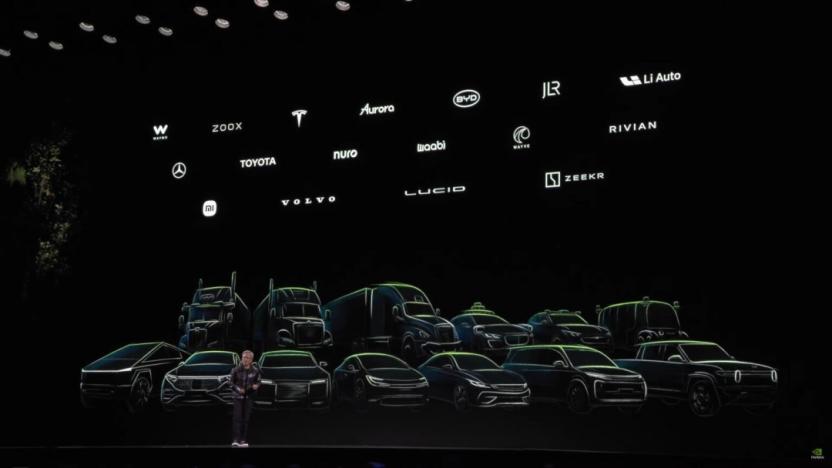
Summary of Conference Call Records Industry Overview - The conference call discusses the developments in the autonomous driving industry, particularly focusing on the advancements in L3 and L4 technologies, as well as the impact of NVIDIA's open-source Alpaca model on the Robotaxi market and L2+ technology adoption [1][2]. Key Points and Arguments NVIDIA's Open-Source Model - NVIDIA's Alpaca model, with approximately 10 billion parameters, has been released as an open-source project, which includes weights, inference scripts, simulation frameworks, and a physical AI open dataset. This initiative aims to lower the technical barriers for Robotaxi scalability and L2+ technology adoption [2]. - The open-source ecosystem provided by NVIDIA allows companies to operate and optimize their models without starting from scratch, thus reducing trial and error costs [2]. Regulatory Changes in North America - Recent regulatory changes in North America have simplified approval processes and relaxed safety requirements for autonomous vehicles, promoting innovation and commercialization. This creates a more efficient and flexible R&D environment for both domestic and global automakers [5][6]. - The new policies include exemptions for vehicles without steering wheels or pedals, allowing faster testing and deployment of non-compliant vehicles [6]. Technical Challenges and Solutions - Key challenges in autonomous driving technology include adaptation to extreme weather, construction zone recognition, and building user trust. Solutions involve enhancing modal strategies, combining visual and language understanding, and implementing redundant designs in control systems [7][8]. - The need for explainable decision-making and transparency is emphasized to build user trust, with companies encouraged to disclose decision-making processes [8]. Market Projections for 2026 - Significant advancements in China's smart driving sector are expected in 2026, including conditional commercialization of L3 technology, expansion of Robotaxi fleets, and iterative optimization of models and methodologies by autonomous driving companies [11]. - The penetration rate for L2 assisted driving is projected to reach 70%, with urban NOA penetration exceeding 15%. L3 technology is expected to account for 1%-2% of the market, primarily in mid-range vehicles [16]. Competitive Landscape - The competitive landscape is evolving, with major players like Huawei, Xiaopeng, and others continuously iterating their technology solutions. The performance of new models is under scrutiny, with some experiencing regressions in capabilities [12][14]. - The industry is anticipated to see significant changes in rankings and performance, with some manufacturers potentially being eliminated due to competitive pressures [15]. Additional Important Insights - The conference highlights the importance of simulation and physical AI applications in enhancing model performance, particularly in special scenarios that are not well-represented in real-world driving data [10]. - The establishment of a national-level autonomous driving technology assessment framework in China is suggested to facilitate the evaluation and regulation of L3 and L4 technologies [10]. This summary encapsulates the critical insights and projections regarding the autonomous driving industry, emphasizing the role of technology, regulatory changes, and competitive dynamics shaping the market landscape.
英伟达正在被中国车企抛弃
3 6 Ke· 2026-01-19 02:19
Core Viewpoint - The automotive industry is witnessing a significant shift towards self-developed chips, with companies like Xiaopeng and NIO moving away from NVIDIA's chips to their own solutions, indicating a trend where automakers prioritize self-sufficiency in technology [1][5][16]. Group 1: Market Dynamics - Xiaopeng has launched four new models equipped with its self-developed Turing chip, marking a complete transition from NVIDIA's chips [1]. - NIO is also transitioning to its self-developed Shenqi chip, which is expected to reduce costs significantly compared to purchasing NVIDIA chips [1][5]. - NVIDIA's market share in the high-end autonomous driving chip sector is projected to decline from 39% in 2024 to 25% in 2025, as more companies adopt self-developed solutions [1][5][8]. Group 2: Competitive Landscape - In 2024, NVIDIA's Orin-X chip held a 39.8% market share with 2.1 million units shipped, but its dominance is being challenged by Chinese companies like Horizon Robotics, which offers competitive chips at lower prices [3][4]. - Horizon's J5 chip has secured contracts with over nine automakers for more than 20 models, highlighting the growing competition in the mid-range chip market [4]. - By 2025, NVIDIA's partnerships with major clients like NIO and Xiaopeng have diminished, indicating a shift in the competitive landscape [5][8]. Group 3: Financial Performance - NVIDIA's automotive revenue for the first three quarters of fiscal 2025 was only $1.745 billion, accounting for just over 1% of its total revenue of $147.8 billion, with the majority coming from data center and AI-related products [12][14]. - The company has faced challenges with the delayed launch of its Thor chip, which has affected automakers' product timelines and market strategies [15][16]. Group 4: Strategic Shifts - NVIDIA is attempting to transition from a chip supplier to a comprehensive autonomous driving solution provider, as evidenced by its hiring of key personnel from Xiaopeng and the introduction of the open-source VLA model [17][18]. - The effectiveness of NVIDIA's open-source model, Alpamayo, has been questioned, with concerns about its practical application in the automotive sector [18].


2025年快递业务量同比增长13.7%,上海发布智驾利好政策
Zhong Guo Neng Yuan Wang· 2026-01-19 02:10
Group 1: Express Delivery Industry - The express delivery business volume is expected to grow by 13.7% year-on-year by 2025, with some companies benefiting from price increases amid reduced competition [2] - During the week of January 5-11, the total collection volume of postal express reached approximately 4.107 billion pieces, a week-on-week increase of 7.1% and a year-on-year increase of 4.1% [2] - The total delivery volume for the same week was about 4.16 billion pieces, with a week-on-week increase of 6.0% and a year-on-year increase of 9.0% [2] - By 2025, the express delivery industry in China is projected to achieve a revenue of 1.5 trillion yuan and a business volume of 199 billion pieces, representing year-on-year growth of 6.5% and 13.7% respectively [2] - The report recommends investing in SF Holding (002352) due to valuation, operational resilience, and improved shareholder returns, while also being optimistic about Zhongtong Express [2] Group 2: Logistics Industry - The chemical product price index (CCPI) in China is at 4024 points, showing a year-on-year decrease of 7.7% but a month-on-month increase of 1.1% [3] - The domestic sea freight price for liquid chemicals is 169 yuan/ton, reflecting a year-on-year decrease of 8.98% [3] - Shanghai has launched a plan to promote high-level autonomous driving, aiming to enhance the competitiveness of smart connected technologies and expand the application of L3 autonomous vehicles [3] - The report recommends Hai Chen Co., Ltd. (300873) due to improved demand in the logistics sector [3] Group 3: Aviation Industry - The average daily number of flights in China has decreased by 5.66% year-on-year, with domestic flights down by 6.18% and international flights down by 2.58% [4] - The Brent crude oil futures price is at $64.13 per barrel, showing a month-on-month increase of 1.25% and a year-on-year decrease of 19.76% [4] - The report recommends investing in the aviation sector, specifically China National Aviation (601111) and China Southern Airlines (600029), due to expected profit elasticity from supply-demand optimization [4] Group 4: Shipping Industry - The China Container Freight Index (CCFI) is at 1209.85 points, reflecting a month-on-month increase of 1.3% but a year-on-year decrease of 22.5% [5] - The Shanghai Container Freight Index (SCFI) is at 1574.12 points, showing a month-on-month decrease of 4.4% and a year-on-year decrease of 31.3% [5] - The report indicates that the dry bulk freight index (BDI) is at 1586.4 points, with a year-on-year increase of 51.2% [5] - The report highlights that the highway freight traffic has decreased year-on-year by 2.02%, with a total of 55.089 million trucks passing through highways during the week of January 5-11 [5]
港股异动 | 喜相逢集团(02473)再涨超9% 公司拟控股旷时科技 卡位毫米波雷达感知赛道
智通财经网· 2026-01-19 02:01
Core Viewpoint - Xixiangfeng Group (02473) has seen its stock price increase by over 9%, currently trading at 10.49 HKD, with a transaction volume of 52.07 million HKD, following the announcement of a memorandum of understanding with Kuangshi Technology to acquire a 51% stake in the millimeter-wave radar technology company [1][1][1] Group 1: Company Strategy - The acquisition represents a key strategic move for Xixiangfeng Group to deepen its layout in the intelligent driving industry chain and build an integrated capability of "scenario + technology + operation" [1][1] - This marks a significant transition for Xixiangfeng Group from a traditional automotive circulation service provider to a technology-driven intelligent mobility platform [1][1] Group 2: Kuangshi Technology Overview - Kuangshi Technology is one of the few domestic providers with a full-chain independent capability in millimeter-wave radar solutions, covering "chip - algorithm - module - complete machine - system platform" [1][1] - The core team of Kuangshi Technology has substantial expertise in RF front-end, signal processing, and AI fusion algorithms, with products that cover multiple scenarios including assisted driving, intelligent transportation, and smart IoT [1][1]
1.19犀牛财经早报:首批新能源主题基金四季报解密基金经理布局运作
Xi Niu Cai Jing· 2026-01-19 01:39
Group 1 - The first batch of new energy theme funds has reported that investment strategies are shifting from traditional lithium batteries to advanced technologies such as smart driving, artificial intelligence, and controllable nuclear fusion, indicating strong confidence in the structural market for new energy in 2026 [1] - The public fund issuance market has seen a significant increase in activity, with many new products being oversubscribed and some sold out in a single day, reflecting a recovery in market confidence and changes in product strategies and investor allocation [1] - Over 10 private equity firms have been penalized for regulatory violations, including issues related to fund pools and guaranteed returns, indicating a push for compliance and internal control improvements in the private equity industry [1] Group 2 - Three securities investment consulting firms have been penalized and ordered to stop accepting new clients due to regulatory issues, highlighting ongoing scrutiny in the investment advisory sector [2] - Several small and medium-sized banks have raised deposit rates by up to 20 basis points as part of a strategy to attract deposits amid a competitive market environment, reflecting a cautious approach to managing their funding needs [2] - The S transaction market has gained traction with increased activity in the transfer of shares from popular companies in sectors like humanoid robotics and commercial aerospace, driven by renewed confidence in the primary market for unprofitable companies [3] Group 3 - The People's Bank of China has announced a structural interest rate cut, reducing the re-lending and rediscount rates by 0.25 percentage points, which is expected to encourage lending in key sectors and support economic transformation [4] - The bond market is anticipated to experience increased volatility in 2026, with a focus on capturing short-term opportunities rather than long-term trends, as investors navigate the balance between strong expectations and weak realities [4] - The Hong Kong stock market has seen a surge in refinancing activities, with nearly 30 companies raising over HKD 26 billion, a significant increase compared to the previous year, indicating a robust environment for capital raising [4] Group 4 - Insurance companies are optimistic about the equity market in 2026, planning to enhance their asset allocation strategies to capitalize on favorable macroeconomic trends and potential profit opportunities [5] - Morgan Stanley has projected significant price increases for DDR4 and NOR Flash memory chips in the first quarter of 2026, driven by supply constraints and strong demand for advanced storage products [5] - The commercial aerospace sector has shown signs of market enthusiasm, although recent price corrections suggest a need for careful evaluation of long-term trends versus short-term adjustments [6] Group 5 - Porsche's global sales fell to approximately 279,000 units in 2025, a decline of 10% year-on-year, with a significant drop in the Chinese market, reflecting challenges in supply and a strategic shift towards prioritizing profit margins over volume [7] - The Beijing Yiren Angel Children's Hospital is facing operational challenges due to rental debts, prompting public donations that have exceeded 15 million yuan, highlighting community support for healthcare initiatives [7] - Ningbo Ronbay New Energy Technology Co., Ltd. is under investigation by the China Securities Regulatory Commission for misleading statements regarding a major contract, which could impact its market reputation and operations [8][9]


华为乾崑智驾 ADS 4.1 升级点公布,支持 eAES 防夹心、驾驶员失能靠边停等
Xin Lang Cai Jing· 2026-01-19 01:26
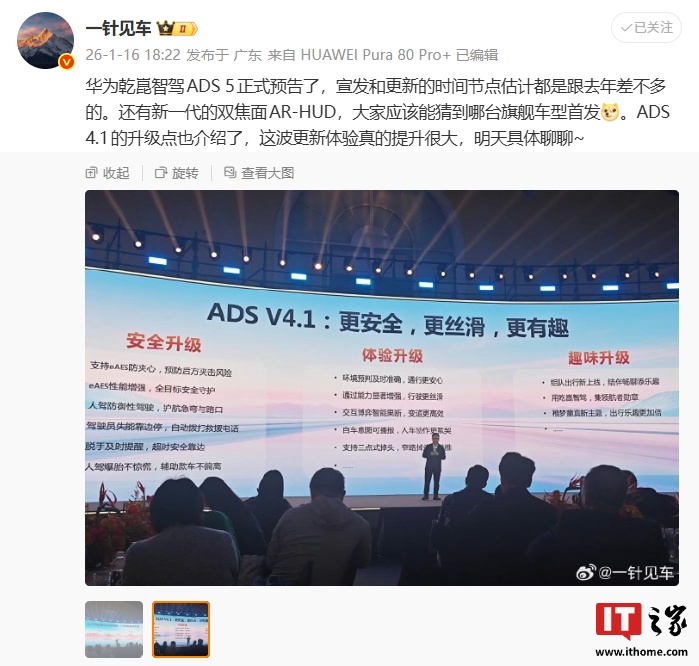
Core Viewpoint - Huawei announced the upgrades of its QianKun Intelligent Driving ADS 4.1 during the media day on January 16, focusing on safety, experience, and fun enhancements [1][6]. Safety Upgrades - Support for eAES anti-clamping to prevent rear-end collision risks - Enhanced eAES performance for all-target safety protection - Defensive driving assistance for sharp turns and intersections - Automatic emergency call when the driver is incapacitated - Timely alerts for hands-off driving, ensuring safe stopping - Assistance for drivers during tire blowouts to prevent vehicle deviation [3][11]. Experience Upgrades - Improved environmental prediction for safer passage - Enhanced driving smoothness through significant capability improvements - Intelligent interaction for efficient lane changes - Vehicle intent broadcasting for better human-vehicle collaboration - Support for three-point turns, allowing elegant maneuvers in narrow roads - New group travel feature for enjoyable companionship during trips [7][13]. Fun Upgrades - Upcoming releases include ADS 5, Harmony Cabin 6, and the next-generation digital chassis engine XMC, with details to be revealed before the April Beijing Auto Show - LCoS dual-focus AR-HUD will debut on the new Wanjie M9 - New sensor hardware will first be featured in Wanjie M9 and ZunJie S800 [6][12].
中泰期货晨会纪要-20260119
Zhong Tai Qi Huo· 2026-01-19 01:24
1. Report Industry Investment Rating There is no information about the industry investment rating in the report. 2. Core Views of the Report - **Macro - financial**: For stock index futures, short - term operations should focus on volume and price, considering profit - taking; for treasury bond futures, adopt an oscillatory approach [14][15]. - **Black commodities**: Steel products may oscillate in the short term, and iron ore is relatively weak and should be shorted on rallies; coking coal and coke prices may oscillate and rise in the short term, but the upside is limited; for ferroalloys, manganese ore is strong in the short term, and silicon iron can be long - bought on dips in the medium - to - long term; for soda ash and glass, observe soda ash, and hold long positions in glass or take profits on rallies [16][18][19][20][21]. - **Non - ferrous metals and new materials**: For zinc, observe and keep existing short positions; for lead, observe; lithium carbonate may oscillate weakly; industrial silicon may continue to oscillate, and polysilicon may oscillate weakly [22][24][26][27]. - **Agricultural products**: Cotton may enter a short - term consolidation stage; sugar may oscillate and consolidate; for eggs, adopt an oscillatory approach for 02 - 03 contracts; apples may be strong; corn may oscillate within a range; jujubes may oscillate; for live pigs, short near - month contracts on rallies [31][33][36][39][40][41][42]. - **Energy and chemicals**: Crude oil may weaken; fuel oil prices will follow oil prices; plastics may oscillate; rubber may oscillate, and short - buy on dips; synthetic rubber may weaken in the short term; methanol may have a short - term correction, and long - buy far - month contracts on dips; caustic soda should be shorted; asphalt may oscillate within a range; the polyester industry chain may be under pressure, and short - sell in the short term and conduct positive spreads in the medium term; LPG may have short - term rebound momentum but limited long - term upside; pulp may oscillate; logs may oscillate; urea futures may be strong due to expectations [45][47][48][50][51][52][53][54][56][57][59]. 3. Summary by Relevant Catalogs 3.1 Macro Information - The State Council held a meeting to promote consumption and address issues such as arrears to enterprises and migrant workers' wages [7]. - The CSRC emphasized market stability and strengthened supervision [7]. - The central bank and the financial regulatory authority adjusted the minimum down - payment ratio for commercial housing loans [7]. - China and Canada reached a consensus on economic and trade cooperation, and Canada will give China an EV quota [8]. - The CSRC solicited opinions on the derivatives trading supervision regulations [8]. - The Ministry of Housing and Urban - Rural Development proposed large - scale urban renewal investment [8]. - China developed a high - energy hydrogen ion implanter [9]. - Two rocket launches failed [9]. - Xidian University made achievements in radar antennas and chip heat dissipation [9][10]. - The US is about to withdraw from the WHO but owes dues [10]. - The US may impose high tariffs on South Korean memory chip manufacturers [10]. - The first shipment of Simandou iron ore arrived in China [10]. - Nvidia revised data on copper demand in data centers [11]. - Trump's statement affected the Fed chair speculation [12]. - The US sent a message to Iran [12]. - Barclays analysts predicted US corporate bond issuance [12]. - The SHFE adjusted trading limits for silver and nickel futures [12]. 3.2 Macro - financial 3.2.1 Stock Index Futures - On Friday, the A - share market opened high and closed low. Short - term operations should focus on volume and price, considering profit - taking. If there is no further increase in volume and an inverted hammer line, the index may enter an adjustment phase [14]. 3.2.2 Treasury Bond Futures - The money market is balanced and loose, and bond yields are steep. Adopt an oscillatory approach, with the main focus on the money market, risk appetite, and the pace of allocation funds [15]. 3.3 Black Commodities 3.3.1 Steel and Iron Ore - Macro - policies are slightly positive for the steel industry. Steel is in a de - stocking state, with acceptable orders in the short term. Real - estate and infrastructure demand is weak, while coil demand is good. Steel may oscillate, and iron ore is relatively weak [16][18]. 3.3.2 Coking Coal and Coke - Coking coal prices have rebounded due to supply disruptions. Coke has started the first price increase. In the short term, there is a chance for a price rebound, but the upside is limited due to the pressure on steel industry profits [19]. 3.3.3 Ferroalloys - Manganese ore is strong in the short term, but it is difficult to transfer profits downstream. Silicon iron has no significant fundamental changes, and it can be long - bought on dips in the medium - to - long term [20]. 3.3.4 Soda Ash and Glass - Soda ash supply is at a high level, and new capacity may be put into production. Observe soda ash. Glass may improve its supply - demand situation if production cuts are implemented. Hold long positions in glass or take profits on rallies [21]. 3.4 Non - ferrous Metals and New Materials 3.4.1 Zinc - Domestic zinc inventories increased slightly. The price of zinc futures fell at night. It is recommended to observe and keep existing short positions [22][23]. 3.4.2 Lead - Lead inventories increased to a one - and - a - half - month high. The price of lead futures fell at night. It is recommended to observe [24][25]. 3.4.3 Lithium Carbonate - After a short - term increase driven by export expectations, the price of lithium carbonate may oscillate weakly due to weak vehicle demand and macro - sentiment adjustment [26]. 3.4.4 Industrial Silicon and Polysilicon - Industrial silicon may continue to oscillate, with pressure on the upside. Polysilicon may oscillate weakly, waiting for the improvement plan on January 20 [27][29]. 3.5 Agricultural Products 3.5.1 Cotton - Cotton supply is currently loose, but there are expectations of supply reduction in the long term. Zhengzhou cotton may enter a short - term consolidation stage [31][32]. 3.5.2 Sugar - The global sugar market has a surplus. Domestic sugar is in a season of both supply and demand growth. Zhengzhou sugar may oscillate and consolidate [33][34]. 3.5.3 Eggs - As the Spring Festival approaches, the demand for eggs may peak and then weaken. Adopt an oscillatory approach for 02 - 03 contracts [36][37][38]. 3.5.4 Apples - Apple prices may be strong. The market is in a game between supply support and demand constraints. Observe the consumption during the Spring Festival stocking period [39]. 3.5.5 Corn - Corn prices may oscillate within a range. The key is the change in farmers' selling sentiment. Observe the port collection and the potential selling pressure in March [40]. 3.5.6 Jujubes - Jujube prices may oscillate. Observe the market performance during the consumption peak season [41][42]. 3.5.7 Live Pigs - The supply of live pigs is slow, and the price may be strong in the short term but with limited upside. Short near - month contracts on rallies [42][43]. 3.6 Energy and Chemicals 3.6.1 Crude Oil - Geopolitical conflicts in the Middle East support oil prices, but the supply surplus is still severe. Oil prices may weaken if the geopolitical situation eases [45]. 3.6.2 Fuel Oil - Fuel oil prices will follow oil prices, with the focus on the geopolitical situation in Iran. The supply - demand situation has slightly improved [47]. 3.6.3 Plastics - Polyolefins have high supply pressure and weak demand, but upstream losses may support a small rebound. Adopt an oscillatory approach [48][49]. 3.6.4 Rubber - Rubber may oscillate, with cost support. Look for short - buying opportunities on dips [50]. 3.6.5 Synthetic Rubber - Synthetic rubber may weaken in the short term. Take profits on short positions on dips [51]. 3.6.6 Methanol - Methanol's supply - demand situation has slightly improved, but there is a risk of inventory accumulation at the end of the month. Long - buy far - month contracts on dips [52]. 3.6.7 Caustic Soda - Caustic soda production is at a high level, and the inventory is high. Adopt a short - selling approach [53]. 3.6.8 Asphalt - Asphalt prices may oscillate within a range, and the winter - storage period has temporarily stabilized [54][55]. 3.6.9 Polyester Industry Chain - The polyester industry chain is under pressure due to weakening demand expectations. Short - sell in the short term and conduct positive spreads in the medium term [56]. 3.6.10 Liquefied Petroleum Gas (LPG) - LPG prices may have short - term rebound momentum due to cost and demand support, but the long - term upside is limited. Lightly short - sell [57]. 3.6.11 Pulp - Pulp prices may oscillate due to weakening downstream demand and new warehouse receipts. Observe the international situation and macro factors [57][58]. 3.6.12 Logs - Log prices may oscillate, with the market in a weak supply - demand balance [59]. 3.6.13 Urea - Urea futures are supported by expectations, but the spot market is weakening. Observe the improvement of spot market liquidity [59].
合资车企在华将迎来电动化“背水一战”
Zhong Guo Qi Che Bao Wang· 2026-01-19 00:35
Group 1 - The core viewpoint of the article highlights the significant challenges faced by multinational automotive companies in the Chinese electric vehicle (EV) market, with a notable decline in sales and market share [3][4]. - In 2025, Volkswagen's sales in China dropped to 2.69 million units, a decrease of 8% year-on-year, with only 116,900 units being electric vehicles [3]. - BMW's sales in China fell by 12.5% to 625,500 units, while Mercedes-Benz experienced a 19% decline, selling only 575,000 units [3]. - Chinese domestic brands have captured nearly 70% of the passenger car market share, with a retail penetration rate of 53.9% for new energy vehicles [4]. Group 2 - The year 2026 is viewed as a critical turning point for multinational car manufacturers, with intensified product strategies aimed at regaining market share in China [5][6]. - Volkswagen plans to launch over 20 new energy models in 2026, marking it as a year for accelerated delivery of new energy products [6]. - BMW aims to introduce around 20 new products across all powertrain types, leveraging a new generation platform [6]. - Audi and other manufacturers are focusing on localizing R&D and product offerings to better meet Chinese consumer demands [6]. Group 3 - Multinational companies still hold significant advantages in brand recognition, craftsmanship, and global service systems, particularly in the high-end electric vehicle market [8]. - The transition from traditional fuel vehicle users to electric vehicle buyers is a key challenge for these companies, necessitating effective strategies to convert brand loyalty into electric vehicle sales [9]. - Companies are encouraged to innovate in battery technology and smart driving features to differentiate themselves in the competitive landscape [9].
首批新能源主题基金四季报出炉 基金经理延伸布局且高仓位运作
Zheng Quan Shi Bao· 2026-01-18 18:13
Group 1 - The core investment theme of public funds is shifting from traditional lithium batteries to advanced technologies such as smart driving, artificial intelligence (AI), and controllable nuclear fusion, indicating strong confidence in the structural market for the new energy sector in 2026 [1][6] - Recent performance data shows that leading new energy theme funds have focused on high-growth sectors like energy storage, lithium batteries, solid-state batteries, and new energy vehicles, with significant returns reported [2][3] - The first batch of new energy theme funds that disclosed their Q4 2025 reports achieved impressive performance, with returns significantly surpassing mainstream market indices [2][3] Group 2 - New energy theme funds are diversifying their portfolios by extending investments into emerging areas such as AI computing power and controllable nuclear fusion while maintaining high allocations in established sectors like power batteries and solar energy [3][6] - Fund managers are optimistic about the structural opportunities arising from the new energy industry, particularly in power equipment exports and energy storage, with some funds reporting excess returns exceeding 22% [4][6] - The investment strategies of fund managers reflect a focus on long-term fundamental trends, including the growth of large-scale energy storage, leading lithium battery companies, and the increasing demand for electric vehicles [6][7]

