
端侧AI

Search documents
端侧AI需求爆发改写联想估值逻辑
Zhi Tong Cai Jing· 2025-10-21 12:10
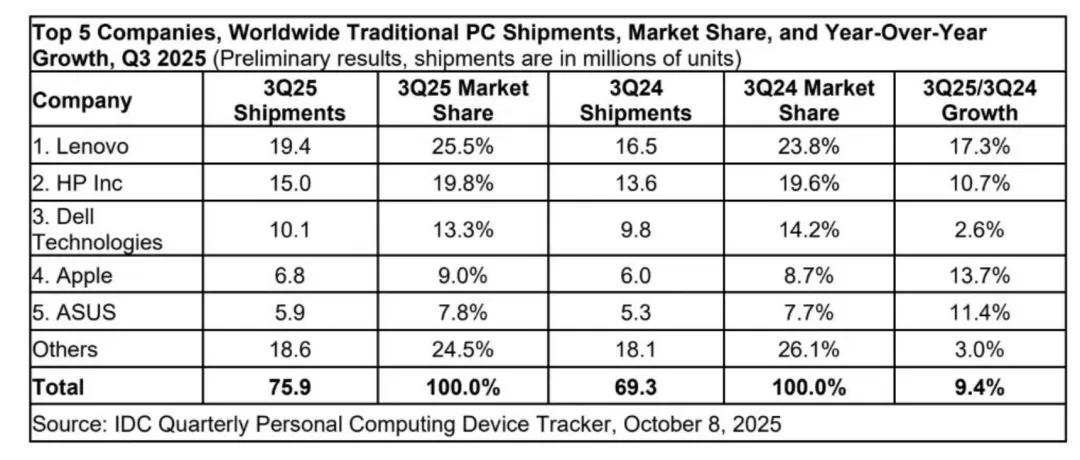
Core Insights - The global PC market is experiencing a resurgence driven by artificial intelligence (AI), with shipments expected to reach 75.9 million units in Q3 2025, marking a 9.4% year-over-year increase [1][2] - Lenovo has significantly increased its market share to 25.5%, outperforming competitors like HP and Dell, which indicates a shift towards AI-driven demand in the PC sector [1][2][7] - The competition among leading PC manufacturers is increasingly focused on capturing the AI edge, with Lenovo's strategy aligning well with the industry's shift towards edge AI [3][6] Market Performance - Lenovo's PC shipments reached 19.4 million units in Q3 2025, reflecting a 17.3% growth compared to the previous year, while HP and Dell saw lower growth rates of 10.7% and 2.6%, respectively [2][7] - The overall market share distribution shows Lenovo leading with 25.5%, followed by HP at 19.8%, and Dell at 13.3% [2] AI PC Market Dynamics - The AI PC segment is projected to grow at a compound annual growth rate (CAGR) of 44% from 2024 to 2028, with expectations that AI PCs will account for 70% of total PC shipments by 2028 [6] - Lenovo's AI PC shipments have surpassed 30%, positioning the company as a leader in the global Windows AI PC market [7] Strategic Positioning - Major tech companies like NVIDIA, OpenAI, and Microsoft are recognizing the potential of edge AI, with NVIDIA investing $5 billion in Intel to enhance AI PC capabilities [3][4] - Lenovo's "hybrid AI" strategy aligns with the industry's focus on local computing power, data privacy, and low latency, positioning it as a key player in the AI ecosystem [5][9] Financial Implications - The shift towards AI PCs is expected to enhance Lenovo's overall gross margin, as AI PCs are viewed as high-value products [9] - Lenovo's service business (SSG) is projected to maintain high growth and profitability, further supporting the company's transition from hardware sales to integrated AI service offerings [9][10]


端侧AI需求爆发改写联想(00992)估值逻辑
智通财经网· 2025-10-21 11:42
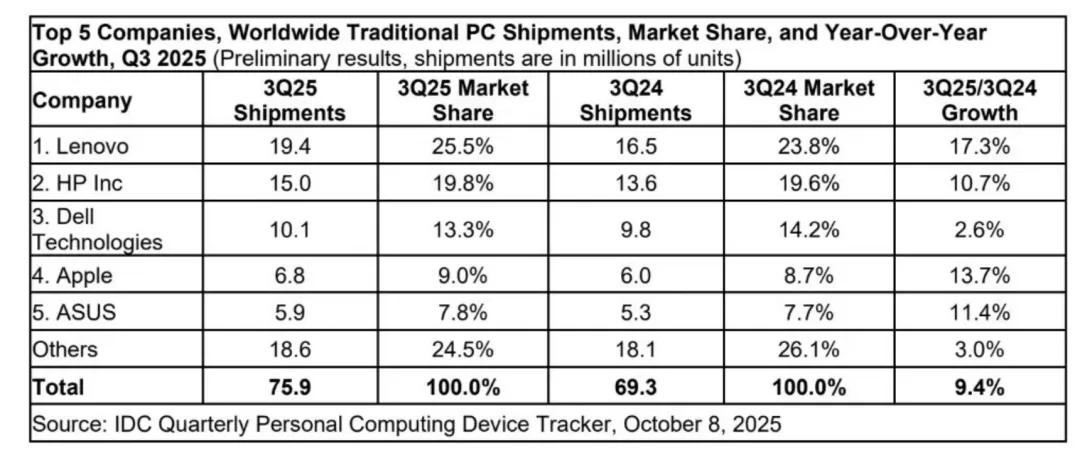
智通财经APP获悉,据国际数据公司(IDC)发布的《全球季度个人计算设备追踪报告》,2025年第三季度全球PC市场出货总量达到7590万台,同比增长 9.4%。 与过去多年不同,全球PC市场的重新繁荣并非是因厂商库存调整,而是进入了由人工智能驱动的新一轮市场爆发周期。IDC的这份报告中的数据显示,在 AI PC市场占据优势的头部厂商的市场份额加速攀升,在端侧AI的竞争格局中亦形成战略领先。 联想集团与惠普在PC市场的竞争已并非仅是基于销售规模,而更多是由抢夺端侧AI入口的战略驱动。 AI计算的初期阶段,核心能力集中在云端,但这种模式的固有缺陷已日益暴露:高昂的API调用成本、网络往返造成的高延迟,以及企业对敏感数据隐私 和主权的严格要求。 英伟达、OpenAI、微软等全球AI巨头已对端侧AI的巨大潜力形成共识:必须将算力竞争推向终端设备,将AI从"云端工厂"带至"物理世界",而在AI终端 中,PC是数量规模最为庞大的。 稍早前,英伟达宣布将以50亿美元注资英特尔,其中一项重要的合作就是关于AI PC。按照黄仁勋的说法,由这次合作带来的"AI PC"市场规模可能达到 500亿美元。英特尔对英伟达的战略价值是可在 ...
PC市场再现加速增长,背后绝非简单的周期轮回
Ge Long Hui· 2025-10-21 11:38
Core Insights - The global PC market is experiencing a resurgence driven by artificial intelligence (AI), with a projected shipment of 75.9 million units in Q3 2025, representing a year-over-year growth of 9.4% [1][2] - Lenovo leads the market with a 25.5% share, significantly ahead of HP at 19.8%, and has shown a remarkable growth rate of 17.3%, far exceeding the industry average [1][2][8] - The competition among top manufacturers is increasingly focused on capturing the edge AI market, with companies like NVIDIA and OpenAI recognizing the potential of AI PCs as critical hardware for AI applications [3][4][5] Market Dynamics - The AI PC segment is expected to grow at a compound annual growth rate (CAGR) of 44% from 2024 to 2028, potentially capturing 70% of the total PC market by 2028 [7] - Lenovo's AI PC shipments accounted for over 30% of its total PC shipments in Q3 2025, solidifying its position as a leader in the AI PC market [8][9] - The shift towards AI PCs is reshaping the valuation logic for companies, with AI PCs being viewed as high-margin products compared to traditional PCs [9] Strategic Positioning - Lenovo's "hybrid AI" strategy aligns with the broader industry trend towards localized AI models and edge computing, positioning the company as a key player in the AI ecosystem [6] - The integration of AI capabilities into Lenovo's service offerings is expected to enhance overall profitability, with the services segment showing a 22% operating margin, significantly higher than hardware [9][10] - Lenovo's robust supply chain and operational resilience are critical competitive advantages, enabling the company to meet large-scale enterprise demands effectively [10]



Windows10停服,全球PC市场出货骤增7%
Guan Cha Zhe Wang· 2025-10-21 10:08
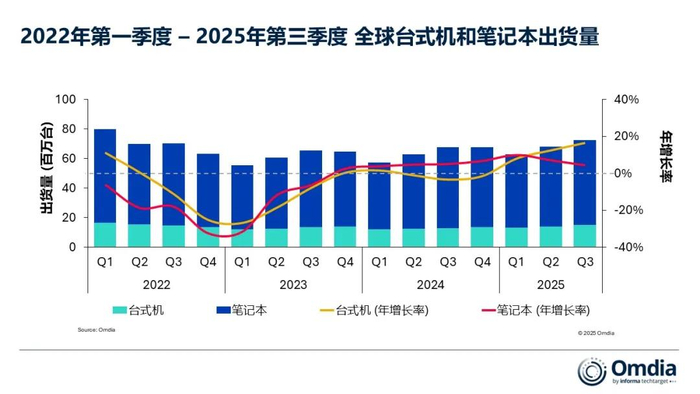
Core Insights - Omdia's latest research indicates a 6.8% year-on-year growth in total shipments of desktops, laptops, and workstations, reaching 72 million units by Q3 2025, driven primarily by device upgrade demands as Windows 10 service termination approaches [1][4] Shipment Data - In Q3 2025, laptop shipments (including mobile workstations) are expected to grow by 4% to 57.2 million units, while desktop shipments (including desktop workstations) are projected to increase by 17% to 15.2 million units [1][4] - Lenovo leads the global PC market with a shipment of 19.4 million units, a 17% increase year-on-year, followed by HP with 15 million units (11% growth), Dell with 10.1 million units (3% growth), Apple with over 6 million units, and Asus with 5.8 million units (7% growth) [5][6] Upgrade Demand - The demand for PC upgrades remains strong among enterprises and consumers, particularly as the deadline for Windows 10 service termination approaches [4][6] - A survey indicated that only 39% of respondents believe their clients have completed PC upgrades, while 18% plan to continue using Windows 10 post-support termination, indicating a significant need for ongoing support and guidance from Microsoft and its partners [4] Future Outlook - Major industry players are expected to unveil new product roadmaps to stimulate PC purchasing demand, with upcoming releases of advanced PC chipsets from Qualcomm and Intel [6] - The 2026 International Consumer Electronics Show (CES) is anticipated to showcase new and attractive PC products, with a focus on "edge AI" technology [6]
机构:受Windows 10停服影响,三季度全球PC市场出货骤增7%
Guan Cha Zhe Wang· 2025-10-21 09:51
Core Insights - Omdia's latest research indicates that the total shipment of desktops, laptops, and workstations is expected to grow by 6.8% year-on-year, reaching 72 million units by Q3 2025, driven by strong device upgrade demand as Windows 10 support ends [1][4] Shipment Growth - Laptop shipments, including mobile workstations, are projected to increase by 4% to 57.2 million units, while desktop shipments, including desktop workstations, are expected to rise by 17% to 15.2 million units [1][4] Market Dynamics - The end of Windows 10 support has led to heightened demand for PC upgrades among both enterprises and consumers, with a significant portion of users still on Windows 10 or using PCs older than five years [4] - A survey indicated that only 39% of enterprise customers have completed their PC upgrades, while 18% plan to continue using Windows 10 post-support, suggesting ongoing opportunities for Microsoft and its partners to promote transitions [4] Vendor Performance - Lenovo leads the global PC market with a shipment of 19.4 million units, a 17% increase year-on-year, followed by HP with 15 million units (11% growth), and Dell with 10.1 million units (3% growth) [5][6] - Apple and Asus follow with shipments of 6.6 million and 5.8 million units, respectively, with Apple maintaining over 6 million units for five consecutive quarters [6] Future Outlook - Major industry players are expected to unveil new product roadmaps to stimulate PC demand, with Qualcomm and Intel launching upgraded chipsets [6] - The upcoming CES 2026 is anticipated to showcase new and attractive PC products, with a focus on "edge AI" technology [6]



达瑞电子2025前三季营收净利双增 股价6个月涨113%北向资金加仓
Chang Jiang Shang Bao· 2025-10-21 00:04
Core Viewpoint - Darui Electronics (300976.SZ) has achieved significant growth in its performance for the first three quarters of 2025, driven by its dual focus on "consumer electronics" and "new energy" sectors, with a revenue of 2.278 billion yuan and a net profit of 231 million yuan, reflecting year-on-year increases of 28.59% and 26.84% respectively [1][2]. Group 1: Financial Performance - In the first three quarters of 2025, Darui Electronics reported a revenue of 2.278 billion yuan, up 28.59% year-on-year, and a net profit of 231 million yuan, up 26.84% year-on-year [1][2]. - For the third quarter of 2025, the company achieved a revenue of 873 million yuan, representing a year-on-year growth of 29.48%, and a net profit of approximately 98.94 million yuan, which is a 28.92% increase year-on-year [3]. Group 2: Market Position and Strategy - Darui Electronics has established a strong customer base in the consumer electronics sector, including major brands such as Apple, Sony, and Microsoft, and has successfully entered the supply chains of leading companies in the new energy sector like CATL, BYD, and Tesla [1][4]. - The company has strategically positioned itself in the new energy market since 2022, focusing on the development of structural and functional components, which has contributed to its revenue growth [2][4]. Group 3: Growth Drivers - The growth in Darui Electronics' performance is attributed to the recovery in the consumer electronics market driven by advancements in AI models and the increasing demand for power and energy storage batteries in the global new energy vehicle market [2]. - The company’s revenue from the consumer electronics business reached 807 million yuan in the first half of 2025, a year-on-year increase of 5.91%, while the new energy business revenue was 585 million yuan, up 81.32% year-on-year, driven by large orders from key customers and an increase in high-value products [4]. Group 4: Strategic Acquisitions - In 2025, Darui Electronics acquired Vistech to enhance its product offerings, integrating a full system solution for "glass fiber-carbon fiber" and advancing lightweight material research to meet the needs of high-end consumer electronics and AI sectors [5]. - Vistech specializes in carbon fiber products used in various consumer electronics applications, including components for foldable screens, and has established a leading position in product quality metrics [5].

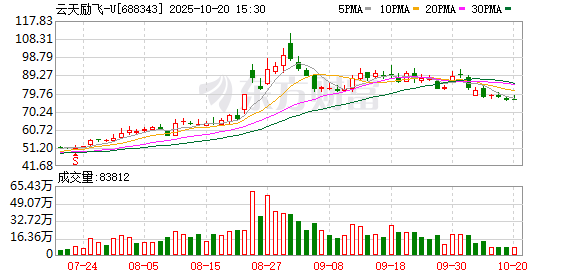
云天励飞:做AI推理算力的“加速器”
Zheng Quan Ri Bao· 2025-10-20 16:41
Core Insights - The article discusses the advancements in AI technology, particularly focusing on Shenzhen Yuntian Lifei Technology Co., Ltd. (Yuntian Lifei), which is leading in AI reasoning chips and aims to make AI accessible to everyday users [2][3][4]. Group 1: AI Development Stages - Yuntian Lifei's AI development is categorized into three stages: - Stage 1.0 (2012-2022): Machines mimicking human senses, focusing on understanding visual and auditory inputs [3]. - Stage 2.0 (2022-present): The era of large models where machines can process complex events and generate content [3]. - Stage 3.0 (future): The robot era, where machines will have both cognitive and physical capabilities, allowing for more interaction with society and the environment [3]. Group 2: Product Offerings and Market Expansion - Yuntian Lifei has launched products for enterprise, consumer, and industry applications, leveraging its "algorithm + chip + data" capabilities [3][4]. - The company has made significant strides in consumer applications, including the development of AI smart glasses and children's educational devices under the brand "Luka Doctor" [4][8]. - In Q1 of this year, enterprise-level revenue accounted for 47.3% of total revenue, while consumer-level revenue was 42.5%, indicating a growing focus on consumer applications [5]. Group 3: Research and Development Investment - In the first half of 2025, Yuntian Lifei invested 202 million yuan in R&D, representing 31.36% of its revenue [6]. - The company has received multiple awards in the field of AI, highlighting its strong technical foundation and innovation [6]. Group 4: Market Potential and Future Outlook - The AI reasoning chip market in China is projected to grow from 11.3 billion yuan in 2020 to 162.6 billion yuan by 2024, with a compound annual growth rate of 94.9% [7]. - The global AI toy market is expected to exceed $11 billion in 2024 and reach $58 billion by 2030, indicating a significant growth opportunity in this sector [10]. Group 5: Strategic Initiatives - Yuntian Lifei is focusing on the end-side AI market, with plans to launch products aimed at children's education and companionship [8][9]. - The company is exploring the integration of AI technology into toys, which can redefine traditional play experiences and enhance parent-child relationships [10].

AI消费电子行业观点报告:立讯展出AR眼镜和陪护机器人,看好端侧AI产业趋势-20251020
Shanghai Securities· 2025-10-20 12:11
Investment Rating - The report maintains an "Overweight" rating for the industry [1] Core Viewpoints - The global edge AI market is expected to continue growing, with AI glasses being one of the best hardware carriers for edge AI, indicating a promising industrial trend [1][12] - Luxshare Precision's "Cloud Sparrow 2nd Generation" AR glasses are leading a new era of AR glasses industrialization, showcasing significant technological advancements at the 26th China International Optoelectronic Expo [1][12] - The report identifies three growth logics for AI smart glasses: imminent industry explosion, accelerated layout by leading companies, and the transformative potential of AI glasses in consumer electronics [2][16] Summary by Sections Industry Overview - The report highlights that global AI glasses sales are projected to reach 1.52 million units in 2024, 3.5 million in 2025, 60 million by 2029, and potentially 1.4 billion by 2035, indicating substantial room for penetration compared to traditional glasses [2][16] Company Developments - Luxshare Precision is actively positioning itself in the smart glasses sector, providing assembly services for various brands and evolving into a more comprehensive ODM service provider [1][12] - The report notes that leading companies like Meta and Apple are accelerating their entry into the market, with Meta launching the Meta Celeste AR glasses and Apple expected to release Apple Glass in 2026 [2][16] Investment Recommendations - The report suggests focusing on companies such as Luxshare Precision, Lens Technology, Linyang Technology, GoerTek, and others as potential investment opportunities in the AI consumer electronics sector [4][16]

每日投行/机构观点梳理(2025-10-20)
Jin Shi Shu Ju· 2025-10-20 10:29
Group 1: Gold Market Insights - Deutsche Bank reports that gold's share in global "foreign exchange and gold" reserves has risen to 30%, while the dollar's share has decreased from 43% to 40%. If gold is to match the dollar's share, its price would need to rise to approximately $5,790 per ounce [1] - Western Securities suggests that the current high gold prices indicate the potential for a long-term bull market, driven by central bank purchases, despite some investor concerns about short-term overbought conditions [2] Group 2: U.S. Banking Sector Analysis - CICC states that recent bank failures in the U.S. do not pose a systemic risk to the financial system, as they are more localized credit risk events rather than widespread issues. However, rising credit risks in a high-interest environment could lead to tighter lending conditions [2] - Huatai Securities highlights that while the U.S. banking sector currently shows healthy cash flows and liquidity, long-term integration pressures remain due to the large number of small banks facing challenges in asset quality and competition [7] Group 3: Economic Indicators and Market Trends - CICC emphasizes that the expectation of an economic cycle recovery is the most significant factor influencing asset pricing this year, with indicators showing diminishing resistance to recovery [6] - CICC also notes that while maintaining optimism towards the stock market, investors should be cautious in their asset allocation, focusing on undervalued sectors and commodities expected to perform well in the fourth quarter [6] Group 4: Rare Earth and Cobalt Market Opportunities - CITIC Securities reports that China's recent export controls on rare earths are expected to strengthen its strategic position, potentially leading to price increases and challenges for overseas supply chains [4] - The report indicates that the tightening of controls on rare earths will likely benefit high-performance magnetic materials, increasing demand for iron oxide permanent magnets [4] Group 5: Environmental Regulations and Market Potential - Huatai Securities estimates that the market space for tail gas treatment under the National Seven standards could reach 100 billion yuan, benefiting companies with advanced technology and competitive products in this sector [8]
午评:创业板指涨2.49%,煤炭、半导体等板块拉升,CPO概念等活跃
Zheng Quan Shi Bao Wang· 2025-10-20 04:33
Core Viewpoint - A-shares experienced a strong upward trend, with major indices showing significant gains, indicating positive market sentiment and sector performance [1] Market Performance - As of the midday close, the Shanghai Composite Index rose by 0.69% to 3866.09 points, the Shenzhen Component Index increased by 1.38%, and the ChiNext Index surged by 2.49% [1] - The total trading volume across the Shanghai, Shenzhen, and North markets reached 11.711 trillion yuan [1] Sector Analysis - Key sectors that saw notable gains include coal, gas, semiconductors, automobiles, and insurance [1] - Emerging concepts such as CPO, brain engineering, and humanoid robots were also active in the market [1] Structural Insights - Current structural fundamental clues in A-shares are primarily related to Chinese companies going abroad, with the ongoing US-China tensions impacting market pricing for overseas ventures [1] - The experience from TACO since April, combined with increased confidence in China, has led to investor hesitation in reallocating assets, creating opportunities for high dividend sectors [1] Strategic Intent - The new strategic focus for China is on ensuring long-term and systematic resource security, supply chain safety, and leading technology security [1] - After the rotation of dividend sectors, it is essential to closely monitor new trends that may persist into the next year, particularly regarding supply chain security and edge AI [1]
