
全国统一大市场建设

Search documents
专访中国消费经济学会副理事长洪涛:未来将更加重视有效供给和满足有效需求
Mei Ri Jing Ji Xin Wen· 2025-10-29 15:37
Core Viewpoint - The Fourth Plenary Session of the 20th Central Committee of the Communist Party of China emphasizes the construction of a strong domestic market and the acceleration of a new development pattern, focusing on expanding domestic demand and promoting consumption and investment [1] Group 1: Investment and Consumption - The session highlights the importance of combining investment in physical assets and human capital, reflecting a people-centered approach and prioritizing public welfare in economic development [2] - The "three drivers" of economic growth—consumption, investment, and exports—are crucial, with a focus on how to connect and promote these elements for mutual development [2] - The shift from supply-led to demand-led growth indicates a commitment to high-quality development, emphasizing the need to identify potential consumption and effective investment while avoiding wasteful production [2][3] Group 2: Market Integration - The session calls for the resolute removal of barriers to the construction of a unified national market, indicating a stronger commitment to building a high-level socialist market economy [4] - The transition from "accelerating removal" to "resolutely removing" barriers reflects the government's determination to enhance market integration and eliminate regional segmentation [4] - Promoting a virtuous cycle between consumption and investment, as well as supply and demand, is essential for expanding effective demand and increasing effective supply [5] Group 3: Interaction and Ecosystem - Achieving the goal of mutual promotion between consumption and investment requires a proactive approach, moving away from a reactive consumption model [6] - The emphasis on extending industrial chains, connecting supply chains, and integrating value chains aims to create an ecosystem where different elements interact positively, aligning with high-quality development goals [6]
沪指再冲4000点,中证A500ETF(159338)净流入超1.6亿份,关注同类中更多人选择的中证A500ETF
Mei Ri Jing Ji Xin Wen· 2025-10-29 06:35
Group 1 - The Shanghai Composite Index has once again surpassed the 4000-point mark, with the CSI A500 ETF (159338) seeing a net inflow of 165 million shares, indicating a more balanced capital influx into broad-based indices [1] - The recent "14th Five-Year Plan" report has positively set the tone to boost confidence, emphasizing the focus on economic development and accelerating the construction of a unified national market, providing solid support for the medium to long-term performance of the A-share market [1] - As US-China trade negotiations progress and expectations for Federal Reserve interest rate cuts strengthen, overseas disruptive factors are gradually diminishing, allowing the A-share market to refocus on domestic narratives [1] Group 2 - According to the 2025 mid-year report, the total number of accounts for the Guotai CSI A500 ETF ranks first among similar products, being more than three times that of the second-ranked product, indicating a growing interest among investors [1] - Investors interested in the CSI A500 ETF (159338) may consider it as a potential investment option due to its leading position in account numbers among 38 similar products [1]
沪指再冲4000点 中证A500ETF(159338)净流入超1.6亿份 关注同类中更多人选择的中证A500ETF
Mei Ri Jing Ji Xin Wen· 2025-10-29 04:59
Group 1 - The Shanghai Composite Index has once again surpassed the 4000-point mark, with the CSI A500 ETF (159338) seeing a net inflow of 165 million units, indicating a more balanced capital influx into broad-based indices [1] - The recent "14th Five-Year Plan" report has positively set the tone to boost confidence, emphasizing the focus on economic development and accelerating the construction of a unified national market, which provides solid support for the medium to long-term outlook of the A-share market [1] - As US-China trade negotiations progress and expectations for Federal Reserve interest rate cuts strengthen, overseas disruptive factors are gradually diminishing, allowing the A-share market to refocus on domestic narratives [1] Group 2 - In terms of customer numbers, the Guotai CSI A500 ETF ranks first in its category, with total accounts being more than three times that of the second-ranked competitor, indicating a growing preference among investors for the CSI A500 ETF (159338) [1]
聚焦“十五五”规划建议|建设强大国内市场 坚持投资于物和投资于人紧密结合
Xin Hua Wang· 2025-10-29 01:08
Group 1 - The core viewpoint emphasizes the importance of a strong domestic market as a strategic support for Chinese-style modernization, highlighting the need for a combination of investment in physical and human capital to promote consumption and investment [1][2] - The proposal outlines practical measures to boost consumption and expand effective investment, including increasing government investment in people's livelihoods and enhancing human resource development [1] - The document stresses the necessity of breaking down barriers to the construction of a unified national market, proposing measures to unify market rules and regulations, and to address "involution" competition [2] Group 2 - The focus on expanding domestic demand is identified as a strategic basis for economic development, aiming to create a robust domestic economic circulation system [2] - The recommendations aim to release the benefits of China's super-large market by addressing various market obstacles [2] - The integration of policies for human capital investment and material capital investment is highlighted as essential for sustainable economic growth [1]
地方竞争模式迎来历史性重构关口
Di Yi Cai Jing· 2025-10-28 13:15
Core Viewpoint - The restructuring of local government competition is crucial for maintaining development enthusiasm while avoiding unnecessary losses from "involution" competition, especially in the context of building a unified national market [1] Group 1: Changes in Local Competition - Local competition has historically been a key driver of China's economic growth, but its effectiveness is diminishing as the economy undergoes structural changes [2] - The shift from a manufacturing-led economy to a service-oriented one is evident, with the tertiary sector accounting for 56.7% of GDP in 2024 and employing 48.8% of the workforce [3] - The focus on production-oriented spending by local governments has suppressed consumer spending, leading to a threefold negative effect on residents' consumption [3] Group 2: Innovation and Economic Growth - The traditional factor-driven growth model is becoming less effective, with the marginal productivity of capital declining from nearly 30% in 2000 to below 10% in 2019 [4] - Local competition has reduced the returns on innovation, creating a "prisoner's dilemma" where regions compete for subsidies, ultimately leading to fiscal losses and uncertainty in innovation outcomes [4] Group 3: Regional Economic Dynamics - Economic growth is shifting from uniform progress to steady differentiation among regions, with resource allocation increasingly favoring areas with inherent advantages [5] - The central government has emphasized the importance of promoting the efficient flow and aggregation of various factors since 2019, aiming to create regional growth poles centered around major cities [5] Group 4: Reforming Local Competition - Short-term measures to address local competition's negative effects include regulating local investment attraction practices [6] - Long-term reforms should focus on establishing a new local competition system that prioritizes spatial allocation benefits over mere GDP growth [6] - The new competition framework should shift from capital-centric to labor-centric, encouraging local governments to enhance living quality and public services to attract talent [7] Group 5: Taxation and Incentives - The reform should transition from protective competition to incentive-based competition, leveraging fiscal policies to guide local governments towards regional cooperation and industry development [8] - Adjustments in the distribution of tax revenues based on consumption rather than production are necessary to align local incentives with national economic growth [10] - Encouraging inter-regional collaboration and fair distribution of economic statistics will promote the rational flow of economic factors [10]
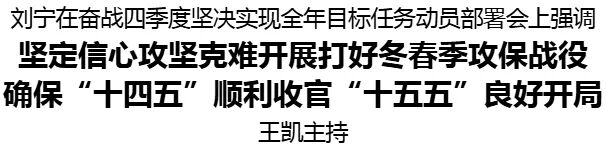
奋战四季度坚决实现全年目标任务动员部署会召开 刘宁出席并讲话 王凯主持
He Nan Ri Bao· 2025-10-28 10:48
Core Points - The meeting held in Zhengzhou emphasized the importance of achieving annual goals and ensuring a good start for the "15th Five-Year Plan" [1] - The provincial leadership highlighted the need for effective economic development, focusing on quality and reasonable growth [1][2] - There is a strong commitment to stabilize the economy, enhance policy implementation, and support enterprises and agriculture [2] Group 1 - The provincial government aims to maintain economic stability by enhancing monitoring, enterprise support, and agricultural production [2] - Efforts will be made to boost consumer confidence, increase investment, and expand foreign trade [2] - The government plans to integrate technological and industrial innovation to build a modern industrial system [2] Group 2 - The meeting underscored the importance of addressing major issues through research and preparing for the "15th Five-Year Plan" [3] - There is a focus on early planning for next year's economic work, including policy measures and major projects [3] - The meeting was conducted via video conference, allowing participation from various provincial cities and regions [3]

油气体制改革再进一步 ——专家解读《油气管网设施公平开放监管办法》
Zhong Guo Hua Gong Bao· 2025-10-28 03:07
Core Viewpoint - The introduction of the new "Regulatory Measures for Fair Access to Oil and Gas Pipeline Facilities" aims to enhance the regulatory framework in the oil and gas sector, ensuring fair access and improving operational efficiency in the industry [1][2][3]. Regulatory Framework - The new regulatory measures adapt to the evolving regulatory requirements and industry needs, building on the previous framework established in 2014 and refined in 2019 [2][3]. - The new measures specifically address past regulatory challenges, enhancing the ability to serve market demands for fair access to oil and gas pipeline facilities [2][3]. Key Changes - The new regulations elevate the status of the regulatory framework, increasing its authority and deterrent effect, and introduce specific penalties for violations to standardize enforcement actions [4][5]. - The measures outline clear penalties for various violations, reducing discretionary enforcement and potential disputes [4][5]. Market Impact - The new regulations are expected to facilitate a more competitive environment by clarifying rights and obligations among market participants and enhancing the legal framework for enforcement [3][6]. - The measures aim to break down monopolistic barriers in the pipeline sector, promoting a fair and transparent competitive landscape [7][8]. High-Quality Development - The new regulatory framework is seen as crucial for the high-quality development of the oil and gas industry, supporting the establishment of a multi-level regulatory mechanism and promoting regional market prosperity [7][8]. - The measures align with the broader goals of creating a unified national market, enhancing the efficiency of energy resource allocation [7][8].
国泰海通:电子化学品等新材料未来将增加有效供给 行业内龙头企业有望受益
Zhi Tong Cai Jing· 2025-10-28 02:49
Group 1 - The 20th Central Committee's Fourth Plenary Session emphasizes the importance of effective investment and breaking down barriers to the construction of a unified national market, which may benefit leading companies in the chemical industry [1] - The report highlights that the domestic production rate of electronic chemicals and high-end polyolefins is low, indicating potential growth areas for future development [2] - The petrochemical industry faces challenges due to homogeneous production capacity, necessitating stricter management of new refining and key petrochemical projects to avoid disorderly expansion and duplication [3] Group 2 - The refining industry is identified as a key area for governance, with a significant portion of refining capacity in Shandong province, suggesting potential for capacity reduction and benefits for private refining enterprises [4] - The polyester filament industry is proactively implementing production cuts to balance market supply and demand, which may favor leading companies in the sector [4]

面向高水平社会主义市场经济体制建设有为政府
Xin Hua Ri Bao· 2025-10-27 20:26
Group 1 - The core viewpoint emphasizes that high-quality development is the primary task for building a modern socialist country, which relies on constructing a high-level socialist market economy system [1][2] - The construction of a high-level socialist market economy system is essential for addressing social and ecological crises that have emerged during over 40 years of market reform, highlighting the need for government and market relationship reforms [2][3] - The new requirements for a proactive government under a high-level socialist market economy system include strengthening state-owned enterprises, adjusting macroeconomic regulation, enhancing top-level design for a unified market, and improving capital operation supervision [3][4] Group 2 - The basic focus of government functions under a high-level socialist market economy system should include deepening the marketization of production factors, addressing market failures, and improving foundational market economic systems [4][5] - The new expansion of government functions requires attention to domestic and international complexities, promoting common prosperity, and ensuring equitable public services and income distribution [5][6] - The government must facilitate the development of new productive forces and manage the relationship between the real economy and virtual economy to prevent financial risks and promote a balanced real estate market [6]
总书记的关切·落地的回响|物流降成本 经济运行更高效
Ren Min Ri Bao· 2025-10-26 02:51
Core Insights - The Chinese government emphasizes the need to effectively reduce logistics costs across society to enhance industrial competitiveness and improve economic efficiency [1] - The development of rural logistics is crucial for comprehensive rural revitalization, addressing long-standing challenges in remote and low-population-density areas [1] Group 1: Policy Initiatives - A series of targeted policies have been implemented to improve rural logistics, including the 2021 issuance of guidelines to accelerate the construction of rural delivery logistics systems and the 2022 proposal to enhance the layout of rural logistics and express delivery points [1][2] - The 2024 action plan aims to further reduce logistics costs nationwide, reflecting a commitment to improving rural logistics infrastructure [1] Group 2: Logistics Network Development - As of the end of 2024, Xinjiang has established 1,537 postal service outlets and 7,920 village-level comprehensive logistics service stations, achieving basic coverage of express delivery services in administrative villages [2] - The introduction of a new delivery model involving centralized shipping from major cities to Xinjiang has significantly reduced shipping costs, enabling even perishable goods to be delivered with free shipping [2] Group 3: Economic Impact - The logistics network has facilitated the distribution of unique agricultural products across the country, with rural online retail sales increasing by 18.18% and agricultural product online retail sales rising by 14.08% in 2024 [2] - The establishment of a unified national market and the enhancement of transportation networks have injected vitality into economic operations, promoting efficient resource flow between urban and rural areas [3][4] Group 4: Infrastructure Projects - Major infrastructure projects, such as the Chengdu-Chongqing logistics park and the Jianghuai Canal, are being developed to improve logistics efficiency and connectivity [3] - The construction of the Ezhou Huahu International Airport aims to create a comprehensive air freight network, enhancing logistics capabilities across Asia and beyond [4]