
国泰中证A500ETF

Search documents
大额买入与资金流向跟踪(20260323-20260327)
GUOTAI HAITONG SECURITIES· 2026-03-31 03:18
- **Tracking indicators and calculation methods** The report uses two key metrics: the proportion of large buy order transaction amounts and the proportion of net active buy transaction amounts. The large buy order transaction amount proportion reflects the buying behavior of large funds. It is calculated by restoring tick-by-tick transaction data into buy and sell order data based on bid and ask sequence numbers, filtering for large orders by transaction volume, and computing the proportion of large buy order transaction amounts relative to the total daily transaction amount. The net active buy transaction amount proportion reflects investors' active buying behavior. It is calculated by identifying whether each transaction is an active buy or sell based on tick-by-tick transaction data, subtracting active sell transaction amounts from active buy transaction amounts, and computing the proportion of net active buy transaction amounts relative to the total daily transaction amount[7] - **Individual stock tracking** The report tracks individual stocks based on the two metrics mentioned above. For the past 5 trading days (20260323-20260327), the top 10 stocks with the highest average proportion of large buy order transaction amounts include New Energy Taishan (93.2%), Snow Wave Environment (85.7%), and Zhongli Group (85.4%). Similarly, the top 10 stocks with the highest average proportion of net active buy transaction amounts include Zhen De Medical (16.7%), China General Nuclear (15.9%), and Zhejiang Energy Power (12.6%)[9][10] - **Broad-based index tracking** The report applies the same metrics to major broad-based indices. For the past 5 trading days, the average proportion of large buy order transaction amounts for indices such as the Shanghai Composite Index, SSE 50, and CSI 300 ranged from 69.5% to 73.7%. The average proportion of net active buy transaction amounts for these indices ranged from 1.0% to 3.2%[12] - **Sector tracking** The report tracks the metrics across various sectors based on the CITIC primary industry classification. For the past 5 trading days, sectors such as coal (78.4%), steel (78.7%), and real estate (78.9%) had high proportions of large buy order transaction amounts. Sectors like medicine (12.3%), steel (10.8%), and food & beverage (10.6%) had high proportions of net active buy transaction amounts[13] - **ETF tracking** The report tracks ETFs using the same metrics. For the past 5 trading days, the top 10 ETFs with the highest average proportion of large buy order transaction amounts include Guotai CSI A500 ETF (92.4%), Huatai-PineBridge CSI A500 ETF (92.1%), and Penghua CSI Oil & Gas ETF (91.3%). The top 10 ETFs with the highest average proportion of net active buy transaction amounts include Haifutong SSE Urban Investment Bond ETF (24.4%), Fuguo ChiNext Artificial Intelligence ETF (19.4%), and Guotai SSE 10-Year Treasury Bond ETF (16.9%)[15][16]


大额买入与资金流向跟踪20260316-20260320
GUOTAI HAITONG SECURITIES· 2026-03-23 14:20
- The report constructs indicators using transaction details data to track large purchases and net active purchases[1][7] - The large order transaction amount ratio depicts the buying behavior of large funds[7] - The net active purchase amount ratio depicts investors' active buying behavior[7] - The large order transaction amount ratio is calculated by restoring transaction data to buy and sell order data and filtering large orders based on transaction volume, then calculating the ratio of large order transaction amount to the total transaction amount of the day[7] - The net active purchase amount ratio is calculated by identifying each transaction as active buy or active sell based on transaction data, subtracting the transaction amounts of the two, and calculating the ratio of net active purchase amount to the total transaction amount of the day[7] Model Backtest Results - Large order transaction amount ratio for individual stocks (20260316-20260320): Shaoneng Co., Ltd. 86.7%, Angang Steel Co., Ltd. 85.7%, Zhongli Group 85.5%, Huadian Liaohe Energy 85.5%, Wentou Holdings 85.3%, Xining Special Steel 84.9%, Jiangyan Group 84.8%, China High-Speed Railway 84.7%, Guangshen Railway 84.6%, Shaanxi International Trust 84.6%[9] - Net active purchase amount ratio for individual stocks (20260316-20260320): Yunnan Baiyao 15.5%, Supor 14.9%, ZJ Bio-Tech-U 14.5%, Industrial and Commercial Bank of China 13.9%, Fulin Precision 13.6%, China World Trade Center 13.3%, Anbotong 13.0%, Zhongwang Fabric 13.0%, Shandong Expressway 12.2%, Youngor 12.2%[10] - Large order transaction amount ratio for broad-based indices (20260316-20260320): SSE Composite Index 72.3%, SSE 50 Index 71.3%, CSI 300 Index 73.4%, CSI 500 Index 71.3%, ChiNext Index 72.4%[12] - Net active purchase amount ratio for broad-based indices (20260316-20260320): SSE Composite Index -4.6%, SSE 50 Index -4.3%, CSI 300 Index -2.3%, CSI 500 Index -3.9%, ChiNext Index 0.7%[12] - Large order transaction amount ratio for CITIC first-level industries (20260316-20260320): Petroleum and Petrochemical 76.4%, Coal 77.5%, Nonferrous Metals 73.7%, Electric Power and Public Utilities 77.5%, Steel 78.3%, Basic Chemicals 74.1%, Construction 76.9%, Building Materials 75.1%, Light Manufacturing 74.4%, Machinery 72.6%, Electric Power Equipment and New Energy 74.8%, National Defense and Military Industry 69.5%, Automotive 72.5%, Commercial Retail 74.6%, Consumer Services 74.7%, Home Appliances 75.0%, Textiles and Apparel 75.8%, Medicine 71.1%, Food and Beverage 68.7%, Agriculture, Forestry, Animal Husbandry, and Fishery 75.1%, Banking 80.0%, Non-Banking Finance 74.2%, Real Estate 77.3%, Transportation 78.3%, Electronics 69.5%, Communications 73.4%, Computers 70.5%, Media 73.3%, Comprehensive 76.1%, Comprehensive Finance 73.3%[13] - Net active purchase amount ratio for CITIC first-level industries (20260316-20260320): Petroleum and Petrochemical -3.4%, Coal 0.5%, Nonferrous Metals -4.8%, Electric Power and Public Utilities -1.0%, Steel -10.2%, Basic Chemicals -5.4%, Construction -10.0%, Building Materials -5.5%, Light Manufacturing -5.4%, Machinery -4.1%, Electric Power Equipment and New Energy -0.1%, National Defense and Military Industry -9.0%, Automotive -3.6%, Commercial Retail -12.4%, Consumer Services -4.4%, Home Appliances -5.9%, Textiles and Apparel -8.2%, Medicine -6.1%, Food and Beverage -5.1%, Agriculture, Forestry, Animal Husbandry, and Fishery -6.9%, Banking -2.2%, Non-Banking Finance -11.9%, Real Estate -8.4%, Transportation -2.3%, Electronics -2.3%, Communications 1.2%, Computers -10.9%, Media -11.4%, Comprehensive -14.2%, Comprehensive Finance -20.8%[13] - Large order transaction amount ratio for ETFs (20260316-20260320): Huatai-PineBridge CSI A500 ETF 93.6%, Huatai-PineBridge MSCI China A50 Interconnection ETF 93.5%, Guotai CSI A500 ETF 93.4%, Haifutong SSE Urban Investment Bond ETF 92.0%, Huaxia CSI A500 ETF 91.5%, Tianhong CSI Computer Theme ETF 91.2%, Guotai CSI All Index Building Materials ETF 90.4%, Southern CSI All Index Dividend Quality ETF 89.6%, Penghua CSI Oil and Natural Gas ETF 89.1%, Harvest CSI Rare Earth Industry ETF 89.1%[15] - Net active purchase amount ratio for ETFs (20260316-20260320): Tianhong CSI Industrial Nonferrous Metals Theme ETF 18.3%, Harvest CSI Green Power ETF 14.0%, Huaxia CSI Subdivided Nonferrous Metals Industry ETF 13.9%, Invesco Great Wall CSI Dividend Low Volatility 100 ETF 13.2%, Huaxia CSI Semiconductor Materials and Equipment Theme ETF 12.2%, Haifutong SSE Urban Investment Bond ETF 12.0%, Huatai-PineBridge CSI Energy ETF 11.1%, E Fund Shenzhen 100 ETF 11.0%, Southern ChiNext Artificial Intelligence ETF 10.1%, Huatai-PineBridge Dividend Low Volatility ETF 9.4%[16]




大额买入与资金流向跟踪(20260309-20260313)
GUOTAI HAITONG SECURITIES· 2026-03-17 08:47
- The report focuses on tracking large buy orders and net active buy orders using transaction detail data[1][2] - Two key indicators are used: the proportion of large buy order transaction amounts and the proportion of net active buy order amounts[7] - The proportion of large buy order transaction amounts reflects the buying behavior of large funds[7] - The proportion of net active buy order amounts reflects investors' active buying behavior[7] - The report provides rankings for stocks, industries, and ETFs based on these indicators over the past 5 trading days (20260309-20260313)[4][6] Quantitative Models and Construction Methods 1. **Model Name**: Large Buy Order Transaction Amount Proportion - **Construction Idea**: To track the buying behavior of large funds[7] - **Construction Process**: - Restore transaction data to buy and sell order data using the buy and sell sequence numbers in the transaction detail data - Filter out large orders based on transaction volume - Calculate the proportion of large buy order transaction amounts to the total transaction amount of the day[7] - **Evaluation**: This indicator effectively captures the buying behavior of large funds[7] 2. **Model Name**: Net Active Buy Order Amount Proportion - **Construction Idea**: To track investors' active buying behavior[7] - **Construction Process**: - Identify each transaction as either an active buy or an active sell using the buy and sell markers in the transaction detail data - Subtract the transaction amounts of active sells from active buys to get the net active buy amount - Calculate the proportion of net active buy amounts to the total transaction amount of the day[7] - **Evaluation**: This indicator effectively captures investors' active buying behavior[7] Model Backtest Results 1. **Large Buy Order Transaction Amount Proportion** - **Top 5 Stocks**: - Jiugang Hongxing: 87.2%, 90.5%[9] - Wentou Holdings: 86.6%, 97.1%[9] - Jinbin Development: 86.3%, 86.4%[9] - Ningbo Construction: 85.6%, 98.8%[9] - Xining Special Steel: 85.3%, 97.9%[9] - **Top 5 Industries**: - Banking: 81.3%, 61.3%[13] - Real Estate: 79.8%, 51.0%[13] - Construction: 78.5%, 88.9%[13] - Comprehensive: 77.9%, 46.1%[13] - Steel: 77.7%, 35.4%[13] - **Top 5 ETFs**: - Guotai SSE 10-Year Treasury Bond ETF: 95.4%, 99.6%[15] - Huatai-PineBridge MSCI China A50 Interconnection ETF: 94.0%, 93.4%[15] - Huatai-PineBridge CSI A500 ETF: 93.2%, 90.9%[15] - Guotai CSI A500 ETF: 92.5%, 53.9%[15] - Huaxia CSI A500 ETF: 92.0%, 97.5%[15] 2. **Net Active Buy Order Amount Proportion** - **Top 5 Stocks**: - Minsheng Bank: 22.2%, 98.8%[10] - SDIC Power: 21.8%, 97.1%[10] - Everbright Bank: 19.5%, 99.6%[10] - Zhejiang Bank: 19.2%, 96.3%[10] - Shangtai Technology: 18.9%, 100.0%[10] - **Top 5 Industries**: - Banking: 10.5%, 64.2%[13] - Food & Beverage: 4.7%, 56.0%[13] - Real Estate: 2.5%, 50.2%[13] - Construction: 0.4%, 72.4%[13] - Basic Chemicals: -0.9%, 75.7%[13] - **Top 5 ETFs**: - Harvest CSI Green Power ETF: 35.4%, 98.4%[16] - E Fund CSI Dividend Low Volatility ETF: 21.6%, 97.9%[16] - Huatai-PineBridge CSI All Index Power Utilities ETF: 18.7%, 97.9%[16] - Southern S&P China A-Share Large Cap Dividend Low Volatility 50 ETF: 15.7%, 96.7%[16] - GF GEM ETF: 13.8%, 90.9%[16]



大盘反弹,中证A500ETF(159338)大涨超1.5%,连续4日净流入超5亿元
Mei Ri Jing Ji Xin Wen· 2026-02-09 06:12
Core Viewpoint - The article emphasizes the strategic direction of state-owned enterprises during the "14th Five-Year Plan" period, focusing on the integration and optimization of resources, innovation, and the development of emerging industries [1] Group 1: Strategic Initiatives - State-owned capital will drive the "three concentrations" strategy to promote restructuring and optimization [1] - There will be a strong emphasis on independent and original innovation, alongside the implementation of the "AI+" special action plan [1] - The focus will be on emerging industries such as renewable energy, aerospace, low-altitude economy, quantum technology, and 6G, with future planning for intelligent embodiment, biomanufacturing, marine energy, and green shipping [1] Group 2: Industry and Market Performance - The CSI A500 index emphasizes industry balance and leading companies, providing a more diversified and growth-oriented investment opportunity compared to the CSI 300 index [1] - As of the end of 2025, the CSI A500 index has increased by 464.28% since its base date, outperforming the CSI 300 index, which has risen by 361.15%, resulting in an excess return of 103.13% [1] - The number of clients for the Guotai CSI A500 ETF is the highest in its category, being more than three times that of the second-ranked competitor [1]
大盘今日回调,把握大宽基布局机会,中证A500ETF(159338)回调超1.2%,市场向上的大方向有望延续
Sou Hu Cai Jing· 2026-01-30 09:39
Group 1 - The core viewpoint of the article emphasizes that the market is expected to maintain an upward trend, supported by recent regulatory policies aimed at stabilizing market sentiment and encouraging long-term capital inflow [1] - The market is entering a phase of intensive disclosure of annual performance forecasts from listed companies, which is likely to increase speculative sentiment and shift the investment focus from macro liquidity to micro performance verification [1] - The CSI A500 ETF (159338) has shown superior historical performance, with a growth rate of 464.28% since its base date, compared to 361.15% for the CSI 300 index, resulting in an excess return of 103.13 percentage points [1] Group 2 - The CSI A500 ETF emphasizes industry balance and leading companies in specific sectors, offering a more diversified and growth-oriented investment profile, which is advantageous during periods of industrial structural upgrades [1] - As of the mid-2025 report, the number of accounts for the Guotai CSI A500 ETF is three times that of the second-ranked product in its category, indicating a strong preference among investors for this ETF [1]
大额买入与资金流向跟踪(20260112-20260116)
GUOTAI HAITONG SECURITIES· 2026-01-20 11:45
Quantitative Factors and Construction Methods 1. Factor Name: Large Order Transaction Amount Ratio - **Factor Construction Idea**: This factor captures the buying behavior of large funds by analyzing the proportion of large order transaction amounts relative to the total daily transaction amount[7] - **Factor Construction Process**: 1. Use tick-by-tick transaction data to identify buy and sell orders based on bid and ask sequence numbers 2. Filter transactions by order size to identify large orders 3. Calculate the proportion of large buy order transaction amounts to the total daily transaction amount Formula: $ \text{Large Order Transaction Amount Ratio} = \frac{\text{Large Buy Order Transaction Amount}}{\text{Total Daily Transaction Amount}} $ - **Factor Evaluation**: This factor effectively reflects the buying behavior of large funds[7] 2. Factor Name: Net Active Buy Amount Ratio - **Factor Construction Idea**: This factor measures the active buying behavior of investors by calculating the net active buy amount as a proportion of the total daily transaction amount[7] - **Factor Construction Process**: 1. Use tick-by-tick transaction data to classify each transaction as either active buy or active sell based on trade direction 2. Subtract the active sell transaction amount from the active buy transaction amount to obtain the net active buy amount 3. Calculate the proportion of the net active buy amount to the total daily transaction amount Formula: $ \text{Net Active Buy Amount Ratio} = \frac{\text{Active Buy Amount} - \text{Active Sell Amount}}{\text{Total Daily Transaction Amount}} $ - **Factor Evaluation**: This factor provides insights into the active buying behavior of investors[7] --- Factor Backtesting Results 1. Large Order Transaction Amount Ratio - **Top 5 Stocks by 5-Day Average**: 1. 惠博普 (92.6%, 99.6% percentile)[9] 2. 美年健康 (89.6%, 99.2% percentile)[9] 3. 志特新材 (89.2%, 99.2% percentile)[9] 4. 津滨发展 (88.4%, 99.6% percentile)[9] 5. 江南高纤 (87.7%, 98.8% percentile)[9] 2. Net Active Buy Amount Ratio - **Top 5 Stocks by 5-Day Average**: 1. 杭萧钢构 (16.7%, 99.8% percentile)[10] 2. 纬德信息 (15.4%, 100.0% percentile)[10] 3. 中科微至 (15.0%, 99.6% percentile)[10] 4. 新风光 (13.8%, 100.0% percentile)[10] 5. 联合水务 (13.3%, 97.5% percentile)[10] 3. Broad-Based Indices - **Large Order Transaction Amount Ratio (5-Day Average)**: - 上证指数: 73.8% (12.8% percentile)[12] - 上证50: 70.6% (64.2% percentile)[12] - 沪深300: 73.1% (64.2% percentile)[12] - 中证500: 73.0% (6.6% percentile)[12] - 创业板指: 71.6% (90.1% percentile)[12] - **Net Active Buy Amount Ratio (5-Day Average)**: - 上证指数: -5.8% (86.8% percentile)[12] - 上证50: -12.9% (90.5% percentile)[12] - 沪深300: -8.8% (89.3% percentile)[12] - 中证500: -3.4% (86.0% percentile)[12] - 创业板指: -4.4% (84.8% percentile)[12] 4. Industry-Level Results - **Top 5 Industries by Large Order Transaction Amount Ratio (5-Day Average)**: 1. 房地产: 79.8% (90.1% percentile)[13] 2. 煤炭: 78.5% (66.3% percentile)[13] 3. 钢铁: 78.2% (42.8% percentile)[13] 4. 建筑: 77.9% (24.3% percentile)[13] 5. 综合: 77.8% (50.6% percentile)[13] - **Top 5 Industries by Net Active Buy Amount Ratio (5-Day Average)**: 1. 房地产: -9.5% (95.1% percentile)[13] 2. 电子: 2.2% (78.6% percentile)[13] 3. 汽车: 0.9% (60.9% percentile)[13] 4. 家电: 0.1% (84.4% percentile)[13] 5. 通信: -4.7% (89.7% percentile)[13] 5. ETFs - **Top 5 ETFs by Large Order Transaction Amount Ratio (5-Day Average)**: 1. 华泰柏瑞中证A500ETF (92.9%, 96.3% percentile)[15] 2. 易方达中证A500ETF (91.6%, 100.0% percentile)[15] 3. 国泰中证A500ETF (91.5%, 15.6% percentile)[15] 4. 华泰柏瑞沪深300ETF (91.0%, 99.2% percentile)[15] 5. 易方达沪深300ETF (91.0%, 99.6% percentile)[15] - **Top 5 ETFs by Net Active Buy Amount Ratio (5-Day Average)**: 1. 东财上证科创板50成份ETF (23.4%, 100.0% percentile)[16] 2. 海富通上证城投债ETF (20.9%, 88.5% percentile)[16] 3. 国泰上证10年期国债ETF (15.6%, 61.3% percentile)[16] 4. 富国创业板人工智能ETF (14.3%, 65.9% percentile)[16] 5. 嘉实中证稀土产业ETF (14.1%, 92.6% percentile)[16]


中证A500的优势似乎越来越明显了
Xin Lang Cai Jing· 2026-01-19 06:07
Core Viewpoint - The market is increasingly favoring the CSI A500 index, which has shown significant outperformance compared to the CSI 300 index, particularly driven by high-tech sectors like communication semiconductors and AI applications [1][2][3]. Performance Summary - In 2025, the CSI 300 index rose by 17.66%, while the CSI A500 index increased by 22.43%, resulting in an excess return of nearly 5% [1]. - As of January 16, 2026, the CSI 300 index gained 17.74% over the last six months, whereas the CSI A500 index surged by 24.83%, leading to an excess return exceeding 7% [3]. - Since its inception on December 31, 2004, the CSI 300 index has appreciated by 371.31%, while the CSI A500 index has risen by 488.94%, yielding an excess return of over 110% [3][16]. Fund Flow and Investment Strategy - In the past 20 days, the CSI A500 ETF has seen a net inflow of over 11.2 billion, indicating strong investor interest and confidence in its value [3][17]. - The CSI A500 index is designed to be more balanced, reducing weight in traditional sectors like finance and food & beverage, while increasing exposure to emerging sectors such as computing, electronics, pharmaceuticals, and military [3][17]. - The index incorporates ESG evaluations and industry-neutral strategies, focusing on leading companies within each sector, thus providing a well-rounded investment approach [3][17]. Market Outlook and Strategy - The current market environment suggests that while there may be short-term adjustments, the overall bullish trend remains intact, with potential for further upward movement [20]. - A "broad-based core and satellite enhancement" strategy is recommended to navigate market fluctuations effectively, allowing for both stability and growth [22][24]. - The satellite allocation should focus on sectors that are either recovering or innovating, creating a balanced portfolio that can withstand volatility while maximizing returns [25].
首只规模超过500亿元的A500ETF诞生!
Xin Lang Cai Jing· 2026-01-13 05:18
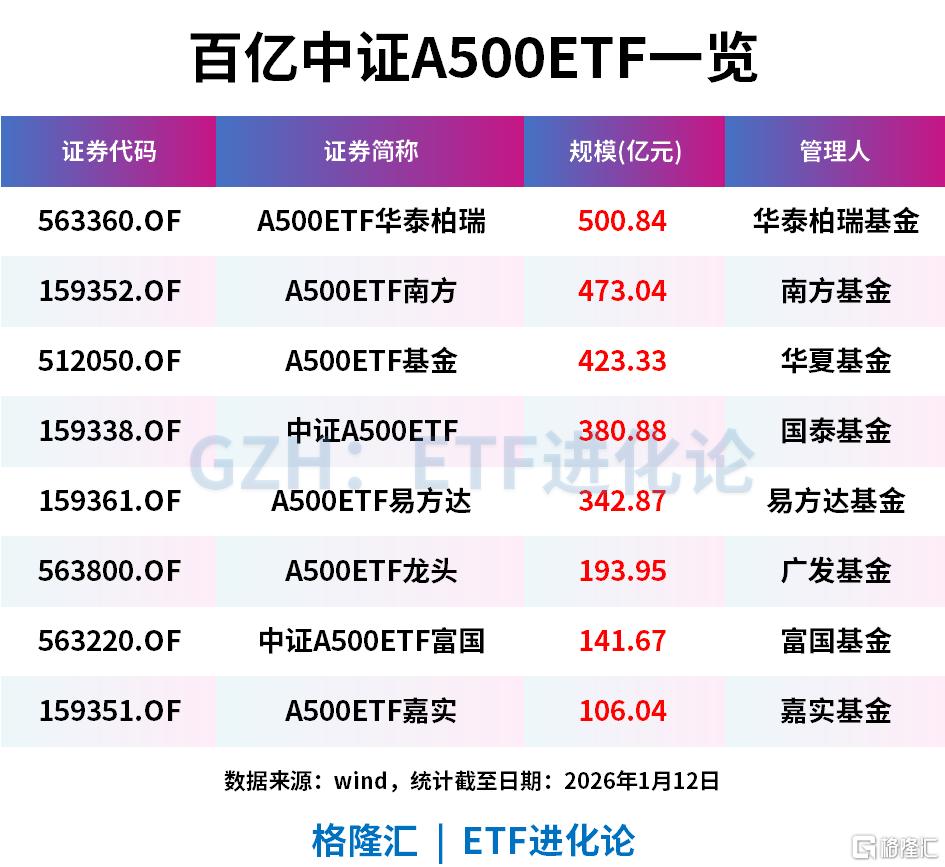
Group 1: A500 ETF Market Overview - As of January 12, the total scale of 40 A500-related ETFs reached 300.89 billion yuan, with 8 ETFs exceeding 10 billion yuan, accounting for 85.16% of the total scale [1] - The A500 ETF managed by Huatai-PB became the first A500 index ETF to exceed 50 billion yuan, with a scale of 50.84 billion yuan [1] - The second and third largest A500 ETFs are managed by Southern Fund and Huaxia Fund, with scales of 47.22 billion yuan and 42.33 billion yuan, respectively [1][3] Group 2: A500 ETF Scale Details - The top A500 ETFs by scale include: - A500 ETF Huatai-PB: 50.84 billion yuan [3] - A500 ETF Southern: 47.22 billion yuan [3] - A500 ETF Huaxia: 42.33 billion yuan [3] - A500 ETF Guotai: 38.09 billion yuan [3] - A500 ETF E Fund: 34.29 billion yuan [3] - A500 ETF GF: 19.40 billion yuan [3] - A500 ETF Fortune: 14.17 billion yuan [3] - A500 ETF Harvest: 10.60 billion yuan [3] Group 3: Market Sentiment and Trends - The current macro environment is favorable, with ample liquidity supporting market risk appetite, contributing to a positive response in global stock markets [5][7] - There is a strong inclination for new capital inflow as institutions prepare for the upcoming Spring Festival and Two Sessions, indicating a robust demand for A-shares [5] - The market is expected to continue its upward trend, with a focus on structural opportunities and sector rotation, particularly in commercial aerospace and technology sectors [7][8]




里程碑!A股成交创历史新高 华夏基金成首家万亿级ETF管理公司
Cai Jing Wang· 2026-01-12 23:27
Core Viewpoint - The A-share market has seen a significant increase in trading volume, with the total reaching 3.64 trillion yuan, surpassing the previous record of 3.49 trillion yuan set during the "924 market" [1] Group 1: ETF Market Overview - The total trading volume of ETFs reached 427.88 billion yuan, with the Shanghai Stock Exchange accounting for 246.39 billion yuan and the Shenzhen Stock Exchange for 181.56 billion yuan [1] - The trading volume of stock-type ETFs was 236.09 billion yuan, while bond-type ETFs reached 105.94 billion yuan, and currency-type ETFs totaled 27.60 billion yuan [2] - The total scale of ETFs in China reached 6.19 trillion yuan as of January 12, 2026, marking a growth of 2.29 trillion yuan from the end of 2024 [2] Group 2: Growth of ETF Products - As of the end of 2025, the total number of ETFs in China exceeded 1,381, covering various asset classes including broad-based, industry themes, cross-border, commodities, and bonds [2] - 华夏基金 has established a comprehensive ETF ecosystem with 117 products, reflecting a strong commitment to index investment since the launch of the first domestic ETF in December 2004 [3] - The number of clients holding 华夏基金 ETFs reached 3.74 million by mid-2025, indicating high trust from both individual and institutional investors [3] Group 3: Competitive Landscape - As of January 12, 2026, 16 fund managers have ETF assets exceeding 100 billion yuan, with 华夏基金 leading at over 1.1 trillion yuan [4] - 易方达基金 follows closely with ETF assets exceeding 920 billion yuan, while 华泰柏瑞基金 has surpassed 650 billion yuan [4] - 华夏基金 offers 83 ETF products with the lowest fee rates among similar products, enhancing the investment experience for holders [3]
超800亿资金 加仓!
Zhong Guo Zheng Quan Bao· 2026-01-08 12:59
Group 1 - The A-share market experienced fluctuations and corrections on January 8, with the satellite and aerospace sectors showing strong gains, leading the top ten in ETF performance [1][8] - The satellite industry chain has been consistently strong since the beginning of the year, with significant increases in sub-sectors such as Beidou navigation, space stations, and commercial aerospace [7][10] - Several ETFs related to satellites and aerospace have shown notable price increases, with the Satellite ETF rising by 6.20% and the Aerospace ETF by 5.62% [9] Group 2 - A total of 876.98 billion yuan was raised by six major A500 ETFs from December 8, 2025, to January 7, 2026, indicating a strong inflow of funds into the market [3][18] - The military industry sector also saw significant inflows, with multiple military-themed ETFs rising over 4% in value [11][12] - Bond and money market ETFs were actively traded, with several achieving transaction volumes exceeding 100 billion yuan, indicating robust investor interest in these asset classes [15][16] Group 3 - Analysts suggest that after recent market rallies, some funds are seeking to allocate to dividend-paying assets with defensive characteristics, leading to a noticeable inflow into the Low Volatility Dividend ETF [21] - The Low Volatility Dividend Index's dividend yield has been rising, currently at 5.06%, which remains attractive compared to the 10-year government bond yield, appealing to medium- to long-term investors [21][22]
