
国产替代

Search documents
南大光电2025年业绩预增,子公司股权收购深化电子特气布局
Jing Ji Guan Cha Wang· 2026-02-12 10:39
Performance Outlook - The company has released a performance forecast for 2025, expecting a net profit attributable to shareholders of between 653 million and 733 million yuan, representing a year-on-year growth of 41% to 59% [2] Financial Movements - The board of directors approved a plan to use up to 1.7 billion yuan of idle self-owned funds to purchase financial products, which will be submitted for review at the first extraordinary shareholders' meeting in 2026 [3] Subsidiary Development - The company plans to acquire an additional 16.1666% stake in its subsidiary, Ulanqab Nanda, for 77.6 million yuan, increasing its ownership to 91.05%. This move aims to deepen the layout of the electronic specialty gas business [4] Industry Policies and Environment - The photolithography adhesive industry is expected to benefit from policy support and supply chain changes in 2026. The company's ArF photolithography adhesive has passed customer validation and achieved mass production, potentially benefiting from accelerated domestic substitution [5]

安路科技股东减持后股价上涨,行业景气与资金流入成关键
Jing Ji Guan Cha Wang· 2026-02-12 10:18
Group 1: Stock Price Movement Reasons - Seven major shareholders, including the National Big Fund and Silan Microelectronics, plan to reduce their holdings by up to 4%, with the Big Fund intending to reduce 2% [1] - The reduction plan is within market expectations due to historical reduction patterns, as these shareholders had previously disclosed and completed a reduction plan in August 2025 [1] - The maximum reduction of 16.03 million shares is estimated to be worth approximately 460 million yuan based on the closing price on the announcement date, while the company's trading volume on that day reached 2.068 billion yuan, indicating limited reduction pressure [1] Group 2: Industry Sector Situation - On February 12, 2026, the semiconductor sector rose by 2.43%, with Anlu Technology benefiting from increased AI computing power demand and domestic substitution logic [2] - The company's stock price increased by 3.85% on the same day, with a turnover rate of 1.69% and a volume ratio of 1.14, indicating active buying interest [2] - The semiconductor index (H30184) rose by 2.34%, supported by capital inflow into the sector [2] Group 3: Financial and Technical Aspects - On February 11, 2026, the main capital net inflow was 2.5933 million yuan, with net financing purchases of 6.9711 million yuan, indicating leveraged funds entering the market to offset reduction pressure [3] - Despite an expected loss of 230 million to 280 million yuan in 2025, the company anticipates sequential revenue growth starting from the second quarter of 2025 due to the introduction of new products [3] Group 4: Future Development - Analysts believe that the reduction by major shareholders is a normal exit behavior under the fund's lifecycle, rather than a negative judgment on the company's fundamentals [4] - The National Big Fund's first phase has entered a recovery period, and the funds from the reduction may rotate into more advanced fields, continuing to support industry development [4] - The company has only been profitable in one of the last four years (2022), with a projected revenue decline of 15.62% to 21.76% in 2025, which may pressure the stock price if future product commercialization does not meet expectations [4]

复旦微电发布限制性股票激励计划,股价应声上涨近5%
Jing Ji Guan Cha Wang· 2026-02-12 09:48
Core Viewpoint - The stock price of Fudan Microelectronics (688385) increased by 4.92% on February 12, closing at 87.30 yuan, with a trading volume of 1.824 billion yuan, closely related to the company's announcement of a restricted stock incentive plan for 2026 [1] Group 1: Stock Performance - The company plans to grant 11.16 million shares of restricted stock to 308 incentive targets, accounting for 1.35% of the total share capital, with a grant price of 41.59 yuan per share, approximately 50% of the average trading price before the announcement [2] - The stock price increase is significantly higher than the semiconductor sector's average rise of 2.43%, indicating strong market sentiment [3] Group 2: Financial Implications - The incentive plan is expected to generate share-based payment expenses of approximately 487 million yuan, which will be amortized from 2026 to 2029, potentially suppressing net profit in the short term [4] - The company's net profit for the third quarter of 2025 has already decreased by 22.69% year-on-year, and the current price-to-earnings ratio (TTM) stands at 151.18 times, significantly above the semiconductor industry average, raising concerns about the ability to meet performance expectations [4] Group 3: Industry Context - The semiconductor sector is currently driven by AI computing power demand, and the company's FPGA chip domestic substitution logic further strengthens market expectations for core business growth [5] - The incentive plan is seen as a positive signal for binding core talent and enhancing long-term competitiveness, although the sector's volatility and macro policy changes should be monitored [5]

新材料自主可控加速,新材料ETF国泰(159761)涨超1%
Mei Ri Jing Ji Xin Wen· 2026-02-12 09:18
Group 1 - The core viewpoint is that the domestic self-sufficiency process in the new materials sector is accelerating, with a continuous increase in domestic alternative material enterprises [1] - The domestic semiconductor industry is steadily advancing in localization, with ongoing capital investments in downstream sectors [1] - Various sub-sectors such as new energy materials, biomedical materials, medical materials, lubricants and plastic additives, food and feed additives, and modified plastics are expected to see growth or positive changes by 2025 [1] Group 2 - It is anticipated that the chemical industry's profitability will recover from its bottom in 2025, despite external disturbances affecting terminal demand, as cost levels decrease and industry capital expenditures approach their end [1] - Sub-industries expected to see significant year-on-year net profit growth in 2025 include certain semiconductor materials, display materials, and modified plastics [1] - Key materials for growth focus on self-sufficiency, including semiconductor materials, panel materials, packaging materials, synthetic biological materials, adsorption and separation materials, lithium battery and fluorine materials, modified plastics, robotic materials, and catalytic materials [1] Group 3 - The Guotai New Materials ETF (159761) tracks the New Materials Index (H30597), which focuses on the new materials industry by selecting representative listed company securities in advanced basic materials, key strategic materials, and cutting-edge new materials [1] - The index aims to reflect the overall performance of listed company securities related to new materials, with a sector allocation that emphasizes chemical and non-ferrous metal fields closely related to new materials technology [1]
中国银河证券:供给紧俏推升价格 电子布行业迎上行周期
智通财经网· 2026-02-12 09:12
Core Viewpoint - The global supply of specialty fiberglass cloth is currently limited due to high production technology barriers, leading to a supply-demand imbalance and rising prices. This situation is expected to persist, especially with the continued high demand for AI computing power, which will further support the tight supply of high-end specialty fiberglass cloth and impact traditional electronic cloth production capacity [1][2][3]. Group 1: Market Dynamics - The demand for specialty fiberglass cloth is rapidly increasing due to the explosive growth in AI computing power, which drives the need for high-performance materials in electronic products such as AI servers and 5G base stations [2]. - The production capacity for fiberglass is expected to increase by 2025; however, the release of this capacity will face delays, maintaining the supply shortage of specialty fiberglass cloth [2][3]. - Traditional electronic cloth supply is also tightening as manufacturers shift production towards specialty fiberglass cloth, leading to price increases for traditional electronic cloth [3]. Group 2: Financial Performance - Several fiberglass companies, including China National Materials and Honghe Technology, are projected to see significant profit growth in 2025, with expected net profit increases of 173.76%-251.97% and 745%-889%, respectively, driven by rising demand and prices for electronic cloth [4]. - The overall profitability of the fiberglass industry is anticipated to continue recovering, with expectations of further price increases for electronic cloth due to sustained high demand for AI computing [4]. Group 3: Investment Opportunities - Two investment directions are suggested: 1) Focus on companies with specialty fiberglass production capabilities, such as China National Materials and Honghe Technology, which are likely to benefit from the ongoing high demand and price growth [5]. 2) Consider companies like China Jushi that have advantages in traditional electronic cloth production capacity and cost, as they are expected to benefit from the tightening supply and rising prices [5].

斯迪克高端膜材扩产,技术突破助力国产替代
Jing Ji Guan Cha Wang· 2026-02-12 08:31
Core Viewpoint - The company is expanding its production capacity for high-end functional film materials with an investment of 510 million yuan, expected to gradually release capacity starting in 2026, which may support future revenue growth [2]. Group 1: Capacity Expansion - The company plans to invest 510 million yuan from its own funds to build a new production line for high-end functional film materials, with capacity expected to be released gradually from 2026 [2]. Group 2: Business and Technical Development - The company has achieved technological breakthroughs in high-end materials such as OCA optical adhesive and polarizer protective films, becoming a supplier for major panel manufacturers like BOE and TCL Huaxing, and has entered Apple's supply chain, benefiting from the trend of domestic substitution [3]. Group 3: Performance and Operating Conditions - The company's Q3 2025 report shows a year-on-year revenue growth of 11.57%, but a year-on-year net profit decline of 15.81%, indicating the need to monitor the upcoming annual financial report [4].
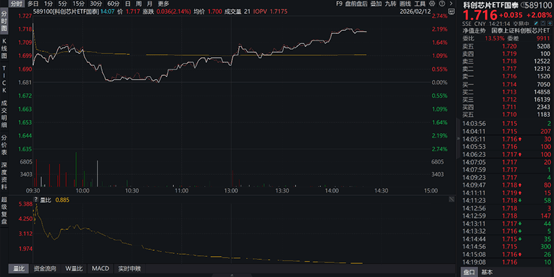
全球AI算力与存储定价机制重塑,科创芯片ETF(589100)再度活跃,盘中涨超2.2%
Mei Ri Jing Ji Xin Wen· 2026-02-12 07:41
Core Viewpoint - The global AI computing power and storage pricing mechanisms are being reshaped, leading to renewed activity in the Sci-Tech Chip ETF (589100), which saw an intraday increase of over 2.2% [1][3]. Group 1: Global AI Infrastructure and Semiconductor Sector - The AI infrastructure remains robust, with significant developments such as the merger between SpaceX and xAI, resulting in a combined valuation of $1.25 trillion, indicating strong long-term investment in AI models and data infrastructure [4]. - Major storage companies like Samsung, SK Hynix, and Micron are shifting from long-term fixed pricing agreements to short-term or monthly pricing mechanisms, enhancing pricing flexibility and improving profitability for leading firms [4]. - Intel and AMD have reported tightening supplies of server CPUs to Chinese customers, with delivery times extending to several months and prices increasing by over 10%, indicating a recovery in the server chip supply chain [4]. Group 2: Domestic Developments in AI Computing Power - Local companies such as Pony.ai and Moore Threads are applying domestic AI computing power in key training and simulation areas, marking a significant step in the commercialization of local GPU ecosystems [5]. Group 3: Semiconductor Industry Dynamics - The semiconductor industry is experiencing structural differentiation, with rising demand for AI servers, HBM, high-performance GPUs, and advanced logic chips driving the current industry recovery [6]. - Tesla is focusing on AI, autonomous driving, and robotics over the next 3-5 years, having established an AI training center in China, which opens up further demand for edge computing and automotive-grade chips [6]. - The reform of storage pricing mechanisms is expected to enhance industry profitability stability, with a new monthly pricing model that will allow quicker reflection of demand recovery in financial performance [6]. Group 4: Investment Opportunities in Sci-Tech Chip ETF - The investment focus in the semiconductor sector is shifting towards "AI computing power, high-end storage, and domestic substitution," with global tech giants increasing their investments in AI infrastructure [8]. - The Sci-Tech Chip ETF (589100) targets core assets in the Sci-Tech sector, covering critical areas such as design, equipment, materials, and packaging testing, showcasing strong growth potential in advanced processes and GPU design [8]. - The current environment of rising capital towards AI computing, improved industry dynamics, and optimized pricing mechanisms highlights the investment value in the chip sector, making the Sci-Tech Chip ETF a strategic tool for investors looking to capitalize on AI infrastructure and domestic semiconductor assets [8].

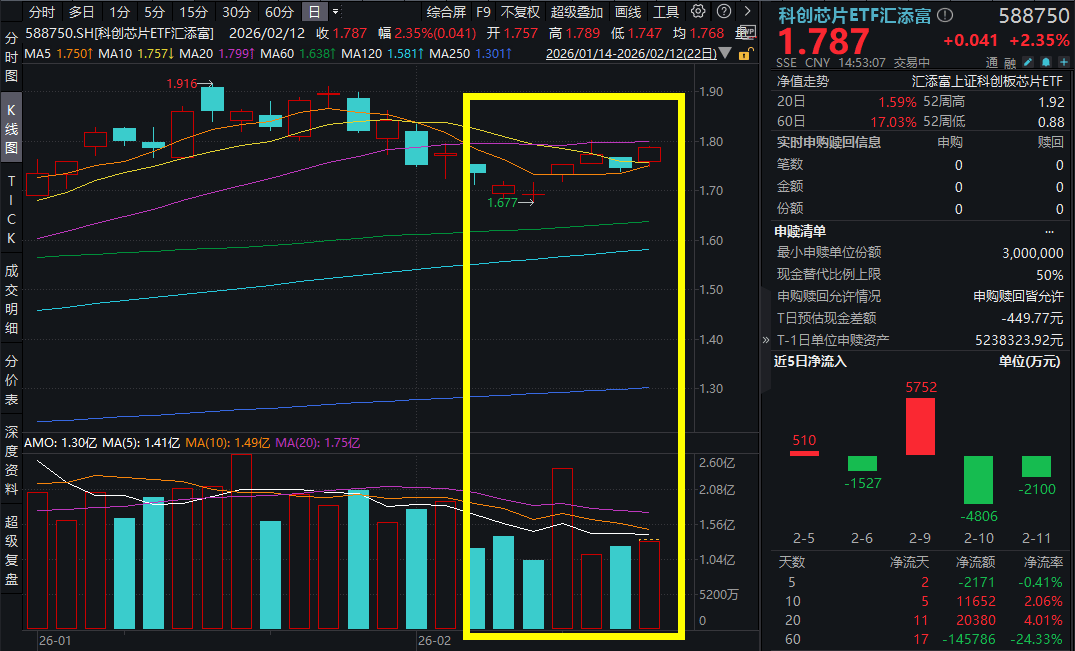
大模型接连上新!AI竞赛加速,存储芯片延续暴涨!芯原股份涨近13%,科创芯片ETF汇添富(588750)涨超2%,大厂抢占春节AI流量,算力需求爆发
Sou Hu Cai Jing· 2026-02-12 07:22
Core Viewpoint - The A-share market is experiencing an upward trend, particularly in the sci-tech chip sector, with significant gains in the ETF Huatai-PineBridge (588750) and its constituent stocks [1][3]. Group 1: Market Performance - As of 14:53, the sci-tech chip ETF Huatai-PineBridge (588750) rose over 2%, with a slight increase in trading volume [1]. - Key constituent stocks such as Chip Origin (涨近13%), Baiwei Storage (涨超7%), and Cambricon (涨超3%) showed notable gains [3]. Group 2: Stock Performance Details - The following stocks were highlighted for their performance: - Haiguang Information: 2.89% increase [4] - Chip Origin: 12.92% increase [4] - Baiwei Storage: 7.21% increase [4] - The performance of these stocks indicates a strong interest in the electronic sector, particularly in chip-related companies [4]. Group 3: Policy and Investment Trends - Recent policy initiatives emphasize the need for state-owned enterprises to enhance investment in computing power and promote the synergy between computing and electricity [5]. - Major tech companies are significantly increasing their capital expenditures, with Alibaba planning to raise its investment in AI infrastructure from 380 billion to 480 billion RMB over the next three years [6]. Group 4: AI and Cloud Services - The demand for AI applications is surging, with major companies like Tencent, Alibaba, ByteDance, and Baidu investing over 4.5 billion RMB to capture the AI market [5]. - International cloud service providers are also ramping up their capital expenditures, with Meta, Alphabet, Amazon, and Microsoft projecting substantial increases in their investments for AI infrastructure [7]. Group 5: Index and Investment Strategy - The sci-tech chip 50 ETF (588750) focuses on high-tech segments of the chip industry, with a high concentration of core segments at 95%, indicating strong growth potential [8][11]. - The index has shown a remarkable profit growth rate of 94% in the first three quarters of 2025, significantly outperforming peers [11]. - The ETF is characterized by high elasticity and rapid rebound potential, making it an attractive option for investors looking to capitalize on the chip sector's growth [12].



【IPO一线】楠菲微电子启动上市辅导 聚焦AI互联芯片领域
Ju Chao Zi Xun· 2026-02-12 07:07
Core Viewpoint - Shenzhen Nanfei Microelectronics Co., Ltd. has officially submitted its initial public offering (IPO) and listing guidance report to the Shenzhen Regulatory Bureau of the China Securities Regulatory Commission, marking the start of its listing guidance phase [1] Company Overview - Nanfei Microelectronics was established on November 13, 2015, with a registered capital of approximately 414 million yuan, located in Nanshan District, Shenzhen [1] - The company has achieved mass production of various products, including gigabit/10-gigabit industrial Ethernet SOC switch chips, 4-port gigabit PHY chips, and advanced process Ethernet switch chips [1] - In 2023, the annual shipment of mid-range switch chips exceeded 1 million units, with plans to complete mass production of domestically advanced process chipsets by 2024 and expand into AI intelligent interconnection business by 2025 [1] Industry Context - The global semiconductor industry is entering a new technological cycle, with the domestic integrated circuit localization process accelerating, driven by clear policy guidance and strong application demand [2] - Emerging technologies such as 5G, artificial intelligence, and the Internet of Things are continuously expanding the application boundaries of semiconductor products, providing structural opportunities for domestic companies [2] - Over the next 3 to 5 years, the domestic semiconductor industry is expected to enter a high-speed growth phase, with Nanfei Microelectronics likely to benefit from this trend [2] Financing and Shareholding Structure - Nanfei Microelectronics has undergone 8 rounds of financing, with the most recent C round completed in September 2025, raising over 1 billion yuan [2] - The major shareholder, Zeng Yu, directly holds 17.82% of the company's shares and indirectly controls an additional 12.25% through various partnerships, giving him a total voting power of 48.92% [3] Strategic Goals - The company aims to leverage the resources of the capital market to enhance R&D investment, strengthen core technology capabilities, expand production capacity, and optimize product structure [3] - Following the IPO, Nanfei Microelectronics plans to further invest in technology R&D, capacity expansion, and market development, striving to enter a higher quality development stage [3] - The initiation of the IPO process is a significant milestone in the company's development and injects new market expectations into the domestic semiconductor industry [3]
林泰新材:2026年定增草案点评:拟定增不超过3.8亿元,加码摩擦材料新品与新场景布局-20260212
Soochow Securities· 2026-02-12 06:24
Investment Rating - The investment rating for the company is "Buy" [8] Core Insights - The company plans to raise no more than 380 million yuan through a private placement to enhance its product lineup in friction materials and expand into new market scenarios [8] - The strategic focus is on high-growth markets for intelligent driving and new energy vehicles, targeting high-value domestic alternatives in the automotive sector [8] - The company is positioned as the sole domestic supplier of wet paper-based friction plates for passenger vehicles, with significant growth potential in commercial vehicles and engineering machinery [8] Financial Projections - Total revenue is projected to grow from 206.56 million yuan in 2023 to 760.40 million yuan in 2027, reflecting a compound annual growth rate (CAGR) of approximately 34.70% [8] - Net profit attributable to the parent company is expected to increase from 49.18 million yuan in 2023 to 241.84 million yuan in 2027, with a notable growth rate of 38.49% in 2027 [8] - The earnings per share (EPS) is forecasted to rise from 0.87 yuan in 2023 to 4.27 yuan in 2027, indicating a strong upward trend in profitability [8]