
硬科技

Search documents
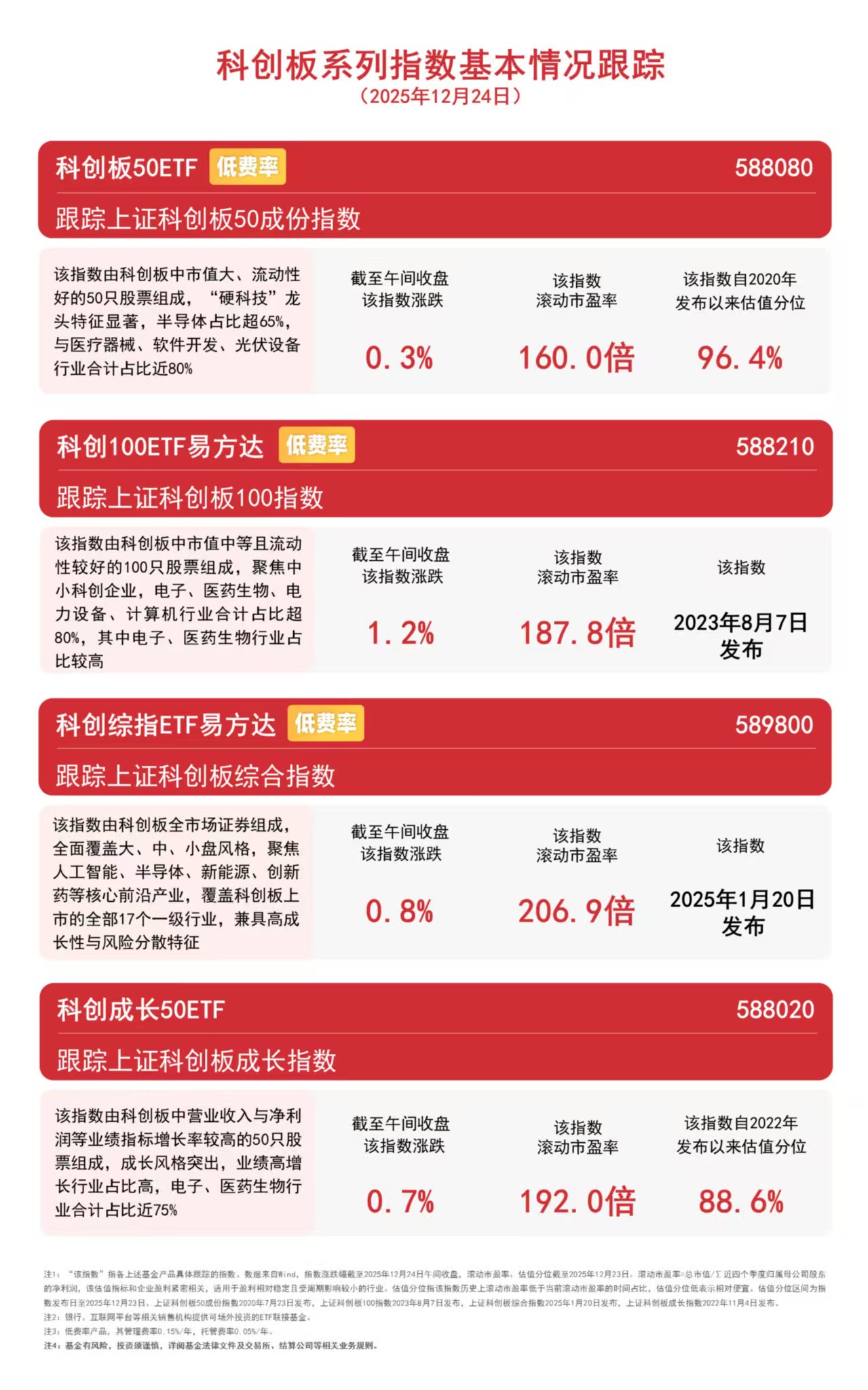
科创板系列指数午前反弹,关注科创板50ETF(588080)等产品长期投资价值
Mei Ri Jing Ji Xin Wen· 2025-12-24 07:52
Group 1 - The article discusses various ETFs tracking the Sci-Tech Innovation Board indices, highlighting their focus on high-growth sectors such as semiconductors, medical devices, and software development [2][3] - The Sci-Tech 50 ETF tracks the top 50 stocks by market capitalization and liquidity on the Sci-Tech Innovation Board, with over 65% of its composition in semiconductors and nearly 80% in related sectors [2] - The rolling price-to-earnings (P/E) ratio for the Sci-Tech 50 ETF is reported at 160.0 times, indicating a high valuation level since its inception [2] Group 2 - The Sci-Tech 100 ETF focuses on 100 medium-sized stocks with good liquidity, primarily in the electronics, biomedicine, and electrical equipment sectors, which together account for over 80% of the index [2] - The rolling P/E ratio for the Sci-Tech 100 ETF is noted at 187.8 times, reflecting its valuation dynamics [2] - The Sci-Tech Comprehensive Index ETF covers all market securities on the Sci-Tech Innovation Board, focusing on core industries like artificial intelligence and new energy, with a rolling P/E ratio of 206.9 times [2] Group 3 - The Sci-Tech Growth 50 ETF tracks 50 stocks with high growth rates in revenue and net profit, with nearly 75% of its composition in the electronics and biomedicine sectors [3] - The rolling P/E ratio for the Sci-Tech Growth 50 ETF is reported at 192.0 times, indicating its growth-oriented investment strategy [3] - The article mentions that the management fee for these low-fee products is 0.15% per year, and the custody fee is 0.05% per year [3]

北交所市场点评:北证50逆势调整,结构性分化与政策预期并存
Western Securities· 2025-12-24 07:51
Investment Rating - The report does not explicitly state an investment rating for the industry or specific companies [27]. Core Insights - The North Exchange A-shares trading volume reached 21.69 billion yuan on December 23, 2025, an increase of 1.215 billion yuan from the previous trading day, with the North Exchange 50 index closing at 1439.94, down 0.64% [2][9]. - The North Exchange specialized and innovative index closed at 2413.60, down 1.05% [2][9]. - Among 286 companies listed on the North Exchange, 33 saw an increase in stock price, while 253 experienced a decline [2][17]. - The report highlights that the hard technology sector, including semiconductors and AI computing, was the main focus of A-share trading, but this did not effectively transmit to the North Exchange [4]. Summary by Sections Market Review - On December 23, the North Exchange A-shares trading volume was 21.69 billion yuan, with a PE_TTM of 60.37 times [9][15]. - The North Exchange 50 index decreased by 0.64%, while the specialized and innovative index fell by 1.05% [2][9]. Stock Performance - The top five gainers included: - Rongyi Precision (up 8.9%) - Hongxi Technology (up 7.9%) - Shuguang Digital Innovation (up 6.8%) - Tonghui Electronics (up 6.5%) - Tianhong Lithium Battery (up 6.4%) [2][17]. - The top five losers were: - Hanxin Technology (down 14.9%) - Xingchen Technology (down 13.3%) - *ST Guandao (down 12.1%) - Tianye Co. (down 11.7%) - Ruixing Co. (down 9.1%) [2][17]. Important News - Beijing issued the first batch of L3 level special license plates for autonomous driving vehicles on highways, allowing dynamic driving tasks under certain conditions [3][20]. - The National Development and Reform Commission and the National Energy Administration aim for a total installed capacity of 15 million kilowatts for solar thermal power by 2030, with costs comparable to coal power [3][20]. Company Announcements - Changjiang Energy Technology plans to use up to 100 million yuan of temporarily idle raised funds to purchase safe and liquid investment products [21]. - Meideng Technology announced the use of 10 million yuan of idle self-owned funds for cash management [21][24].
私募基金经理刘明达:在中国资本市场寻找“必然性”|我们的四分之一世纪
Jing Ji Guan Cha Wang· 2025-12-24 07:02
站在位于深圳福田区深科技城的新办公室窗前,刘明达望向窗外。那里有一条狭长的景观河,穿过繁华的都市腹 地,最终汇入茫茫大海。对于刘明达而言,这个景观不仅是风水上的"聚气",更像是一种隐喻:资本如水,流向 编者按: 2025 年,经济观察报以 " 我们的四分之一世纪 " 为年终特刊主题,旨在通过数十位时代亲历者的故事,共 绘一幅属于这段岁月的集体记忆图谱。 何处往往不由人的意志转移,唯有顺势而为,方能入海。 如果我们以二十五年为一个刻度,将时钟拨回至2000年,那是千禧年的曙光,也是中国资本市场草莽与希望并存 的混沌初开。那一年,互联网泡沫在大洋彼岸破裂,而中国正站在WTO的门口,蓄势待发。 刘明达,受访者供图 在这四分之一世纪的洪流中,有人在浪潮之巅高歌,旋即被"拍死"在沙滩上;有人在谷底绝望,却不知黎明将 至。作为中国阳光私募的第一批从业人员,刘明达是这漫长周期的亲历者。他穿越了A股市场的数轮牛熊,从最 初的"傻瓜组合"到如今重仓硬科技,他始终试图在巨大的不确定性中寻找那难以捕捉的"必然性"。 他不是聚光灯下最喧嚣的演说家,却是这个市场最长情的陪伴者之一。当我们试图通过一个人来管窥中国资产管 理行业的二十五年 ...


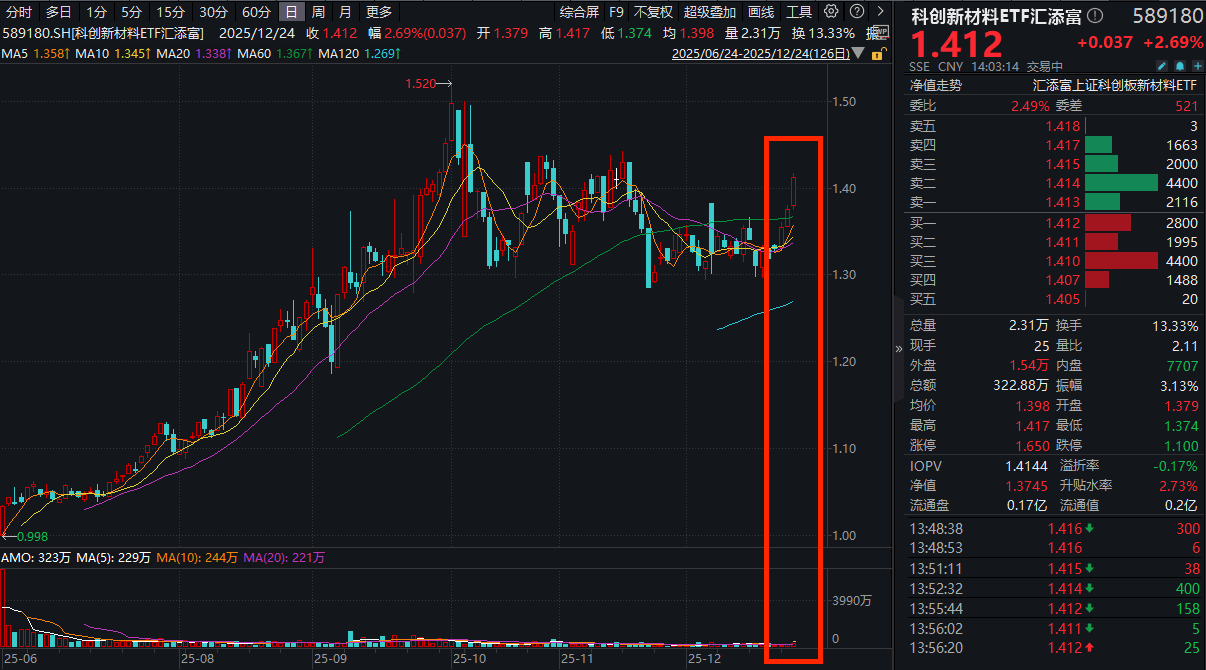
斯瑞新材涨超8%,沪硅产业21亿元配套融资获踊跃认购!科创新材料ETF汇添富(589180)大涨近3%强势冲击三连阳!如何布局硬科技底层?
Sou Hu Cai Jing· 2025-12-24 06:23
Group 1 - The core viewpoint of the news highlights the surge in hard technology concepts, particularly the strong performance of the Science and Innovation Materials ETF, which rose nearly 3% and achieved a three-day winning streak [1][3] - Shenzhen has recently issued measures to attract and utilize foreign investment, focusing on the international development of advanced manufacturing and encouraging foreign investment in key sectors such as high-end equipment manufacturing and new materials [3] - The recent completion of a significant asset restructuring project by Hu Silicon Industry, raising 7.04 billion yuan, marks a pivotal moment for the company as it aims to enhance its focus on 300mm silicon wafer technology and accelerate its R&D projects [3][4] Group 2 - The component stocks of the Science and Innovation Materials ETF showed strong performance, with notable gains including over 9% for Jia Yuan Technology and over 8% for Si Rui New Materials [3][4] - The commercialization of CPO technology is accelerating, reshaping the optical network material structure, with major companies like Nvidia and Broadcom advancing their initiatives in this area [5] - The global non-ferrous metal market is experiencing a collective surge, with copper prices breaking historical records, indicating a strong performance in the commodities market [5][6]

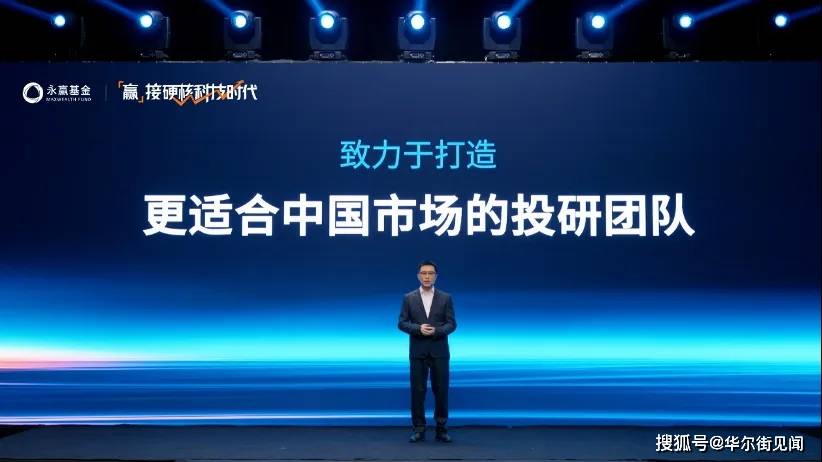
解密永赢“科技4.0”图谱!更适合中国市场的投资新范式
Sou Hu Cai Jing· 2025-12-24 03:15
Core Viewpoint - Yongying Fund has established itself as a prominent player in the domestic fund market, focusing on hard technology investment strategies and showcasing its investment system and product strategies during its mid-year strategy meeting [1]. Group 1: Investment Framework - Yongying Fund's equity investment framework is not merely a commercial activity but is based on forward-looking judgments regarding potential market opportunities, focusing on structural opportunities [2][3]. - The investment research system is built on a team of professionals with complementary core competencies, creating a comprehensive and practical investment system referred to as the "1+N" model [6]. - The "1+N" investment ecosystem has been a key factor in the fund's performance improvement, with its equity funds ranking 7th in absolute returns over the past year [6][10]. Group 2: Investment Strategy - The fund's strategy for the second half of 2025 emphasizes hard technology (AI/military) and new productive forces, advocating for a focus on leading technologies [10][13]. - The fund's analysis indicates that the Chinese capital market is poised for a significant uptrend starting from September 2024, driven by a re-evaluation of Chinese assets by foreign investors [13]. - The fund highlights the importance of aligning investment strategies with leading technologies to enhance focus and efficiency in investment outcomes [14]. Group 3: Hard Technology Opportunities - Yongying Fund's investment products cover various sectors, including humanoid robots, innovative pharmaceuticals, low-altitude economy, new consumption, AI industry chain, photolithography machines, and advanced manufacturing [15]. - The fund's managers believe that the humanoid robot market is on the verge of rapid growth, potentially surpassing the number of smartphones and cars in the coming years [23]. - The innovative pharmaceutical sector is seen as having significant potential, with the fund's managers optimistic about the industry's future performance due to favorable conditions and a strong research base [20].
中证协:组织编制好证券行业“十五五”规划;吸金超600亿元!多只中证A500ETF规模创新高 | 券商基金早参
Mei Ri Jing Ji Xin Wen· 2025-12-24 01:47
Group 1 - The China Securities Association (CSA) is organizing the preparation of the "14th Five-Year" plan for the securities industry, aiming to guide the long-term development of the capital market and enhance the strategic layout of leading brokerage firms [1] - The CSA emphasizes the importance of self-discipline, service, and transmission functions, aiming to gather industry wisdom and promote high-quality development in the securities sector [1] Group 2 - The total scale of the A500 ETF has exceeded 263 billion yuan, with net inflows of 616.77 billion yuan in December, accounting for over 90% of the total net inflows into stock ETFs during the same period [2] - Leading companies like Huatai-PB and Southern have seen significant increases in their A500 ETF scales, reflecting strong market demand for broad-based asset allocation [3] Group 3 - The median annualized yield of money market funds has dropped to 1.23%, a nearly 20% decrease from the beginning of the year, with over 130 products falling below the 1% threshold [4] - The trend of declining yields in money market funds is prompting capital to seek new investment opportunities, particularly in the hard technology sector, which has seen over 350 billion yuan in public fund participation in private placements since the beginning of 2025 [4]


胡晓:培育敢投愿投会投生态
Jing Ji Ri Bao· 2025-12-24 00:10
Group 1 - The development of "hard technology" in fields such as optoelectronic chips, aerospace, and precision manufacturing is increasingly rich, and the strategy of "investing early, investing small, and investing in hard technology" aligns with the technological revolution and industrial transformation [1] - Early-stage and small "hard technology" companies often face challenges such as financing difficulties and long cycles, necessitating precise capital empowerment to overcome growth bottlenecks [1] - A good ecosystem that encourages "willing to invest, able to invest" is essential, focusing on policy guidance and mechanism innovation to direct capital towards early-stage and small "hard technology" enterprises, addressing financing pain points and injecting lasting momentum into innovative development [1] Group 2 - Mechanism innovation is crucial, balancing risk-sharing and value realization, with differentiated risk compensation and tax incentives for high-risk investments in major strategic areas to enhance capital risk appetite [2] - Promoting the pricing and trading of new asset types such as intellectual property and data can enhance the financing capabilities of small and medium-sized technology enterprises [2] - Establishing efficient and smooth exit channels is vital, requiring the development of a streamlined flow mechanism, optimizing information disclosure to reduce information asymmetry in the primary market, and fostering the growth of private equity secondary market funds to alleviate fundraising difficulties [2]
健信超导许建益:硬科技创业需守初心育恒心
Shang Hai Zheng Quan Bao· 2025-12-24 00:08
Core Viewpoint - The company emphasizes that hard technology entrepreneurship is both a technological and a long-term battle, requiring a steadfast commitment to innovation and market needs to achieve high-quality development in the industry [1][2] Group 1: Company Strategy and Vision - The company aims to focus on technological innovation as the core driving force and market demand as the guiding principle for its development in the medical health sector [2] - The chairman highlights the importance of maintaining a long-term perspective and staying true to the company's original mission in navigating industry cycles [1] Group 2: Technological Advancements - The company has achieved significant breakthroughs in core components of MRI equipment, including superconducting magnets and permanent magnets, becoming a leading manufacturer in China and the largest global supplier of MRI permanent magnets [1] - The company has developed a diverse product matrix, including 1.5T and 3.0T superconducting magnets, and has secured 13 core technologies with independent intellectual property rights [1] Group 3: Market Position and Growth - The company has established deep collaborations with leading manufacturers in the domestic market, ensuring stable supply of 1.5T products and gradually increasing the supply of 3.0T products to rural hospitals [1] - Over 50% of the company's MRI equipment products are sold to overseas markets, with ongoing efforts to build localized service networks in international markets [1] Group 4: Future Outlook - The company plans to continue its dual focus on domestic and international markets, leveraging its global layout to empower downstream MRI equipment manufacturers in expanding overseas [1] - The company is committed to exploring the feasibility of applying superconducting technology in industrial fields such as wind power generation and power transmission [1]
培育敢投愿投会投生态
Jing Ji Ri Bao· 2025-12-23 22:53
Group 1 - The development of "hard technology" in fields such as optoelectronic chips, aerospace, and precision manufacturing is increasingly enriching its connotation, with a strategic focus on "early investment, small investment, and hard technology" to align with technological revolutions and industrial transformations [1] - Early-stage and small "hard technology" companies often face challenges such as financing difficulties and long cycles, necessitating precise capital empowerment to overcome growth bottlenecks [1] - Cultivating a favorable ecosystem that encourages investment requires policy guidance and mechanism innovation to direct capital towards early-stage and small "hard technology" enterprises, addressing financing pain points and injecting sustained momentum into innovative development [1] Group 2 - Mechanism innovation is crucial, balancing risk-sharing and value realization, with differentiated risk compensation and tax incentives for high-risk investments in major strategic areas to enhance capital risk appetite [2] - Promoting the pricing and trading of new asset types such as intellectual property and data can enhance the financing capabilities of small and medium-sized technology enterprises [2] - Establishing efficient and smooth exit channels is essential, requiring the development of a streamlined circulation mechanism and optimizing information disclosure to reduce information asymmetry in the primary market [2]
硬科技突围: 产业攻坚、资本加持,共建科创生态圈
Sou Hu Cai Jing· 2025-12-23 17:07
Core Viewpoint - Hard technology is positioned as a core engine for cultivating new productive forces, benefiting from policy empowerment and capital market innovations while facing challenges in technology, ecosystem construction, and compliance competition [1] Group 1: Capital Market Support - The "14th Five-Year Plan" emphasizes enhancing the inclusiveness and adaptability of the capital market, improving the coordination of investment and financing functions [2] - Companies like Sray New Materials have not engaged in mergers and acquisitions since their listing but are exploring policies that support such activities, indicating a growing tolerance and support from the capital market for tech companies [2] - Investment institutions are increasingly recognizing the multi-tiered capital market's role in supporting companies at various stages and sizes, with a focus on suitable listing segments [2] Group 2: Long-term Capital and Industry Development - Patient and long-term capital significantly impacts industry development, allowing for mid to long-term planning without short-term pressure [3] - Hard technology development is categorized into two tracks: areas where China has natural advantages and those where it is catching up, both benefiting from domestic talent and improved routes [3] Group 3: Ecosystem Construction - A collaborative ecosystem among tech companies, investment institutions, and research organizations is essential, focusing on risk-sharing and benefit-sharing mechanisms [1] - Investment institutions are increasingly looking for high-quality projects in large-scale sectors rather than saturated markets, emphasizing the importance of team quality and product iteration speed [5][6] Group 4: Challenges and Strategies - Companies face multiple challenges in their growth, necessitating the establishment of robust systems for commercial culture, collaborative R&D, and operational adaptability [8] - Compliance is a primary concern for companies expanding internationally, requiring thorough legal arrangements before engaging with overseas clients [9] Group 5: Investment Strategies - Investment institutions like Dongfang Fuhai balance their portfolios by combining early-stage and later-stage projects to ensure quick returns while investing in high-potential early-stage projects [10] - Analysts are focusing on fundamental scientific principles and the impact of international relations on industry dynamics, indicating a comprehensive approach to risk assessment [10]

