积极财政政策

Search documents
财政部部长蓝佛安最新发声!
天天基金网· 2025-07-30 05:12
Core Viewpoint - The article emphasizes the importance of utilizing proactive fiscal policies to enhance economic performance and stability, focusing on measures such as issuing long-term special bonds and local government bonds to stimulate growth and improve microeconomic circulation [1][2]. Group 1: Fiscal Policy Measures - The Ministry of Finance plans to accelerate the issuance and utilization of ultra-long-term special bonds and local government special bonds to create tangible work volume as soon as possible [1]. - A total of 14.1 trillion yuan was spent from the national general public budget in the first half of the year, ensuring strong support for key areas [1]. - By the end of June, the central government had allocated 9.29 trillion yuan in transfer payments to local governments, with over 90% of central budget investments disbursed [1]. Group 2: Debt Management and Economic Support - The Ministry of Finance has implemented a one-time increase of 6 trillion yuan in the debt limit for 2024, with 3.8 trillion yuan in new replacement bonds issued by the end of June [2]. - The average interest cost of replaced debt has decreased by over 2.5 percentage points, significantly alleviating repayment pressure and freeing up more funds for development and public needs [2]. - The focus is on promoting consumption to expand domestic demand, with policies aimed at enhancing service consumption in areas such as elderly care, childcare, culture, and tourism [2]. Group 3: Social Spending and Employment Support - In 2025, the budget for education, social security, and employment is set to be nearly 4.5 trillion yuan, with year-on-year growth of 6.1% and 5.9% respectively [3]. - The central government has allocated 1.1 trillion yuan for basic pension insurance subsidies, ensuring timely and full payment of pensions [3]. - Policies to support employment, such as job retention subsidies and tax reductions, are being strengthened to protect key groups in the labor market [3]. Group 4: Fiscal and Tax System Reform - The article discusses the need for a modern budget system and improved budget management practices to enhance local fiscal autonomy [4]. - There are plans to optimize the consumption tax system and improve the value-added tax refund policy to align with new business models [4]. - The Ministry of Finance is promoting zero-based budgeting reforms at the central level to support local governments in similar reforms [4].


财政部部长蓝佛安:抓紧实施育儿补贴制度 逐步推行免费学前教育
Di Yi Cai Jing· 2025-07-29 23:52
Group 1 - The article emphasizes the need for the Ministry of Finance to align its actions with the central government's analysis of the economic situation, promoting high-quality economic and social development through effective fiscal policies [1][22] - The Ministry plans to implement a childcare subsidy system, gradually promote free preschool education, and provide subsidies for elderly care services for disabled seniors to better meet the service needs of the population [1][23] Group 2 - The Ministry of Finance aims to enhance employment stability through policies such as job retention subsidies, tax reductions, and employment support for key groups [1][23] - There is a focus on increasing educational support and improving the quality of educational resources, alongside the implementation of social security, healthcare, and welfare policies to ensure basic living standards for vulnerable groups [1][23] Group 3 - The Ministry is committed to accelerating the issuance and utilization of long-term special bonds and local government bonds to create tangible work output as part of its fiscal policy [1][22] - The article highlights the importance of using fiscal funds to guide and stimulate economic activity, ensuring that various policy effects are continuously released [1][22]
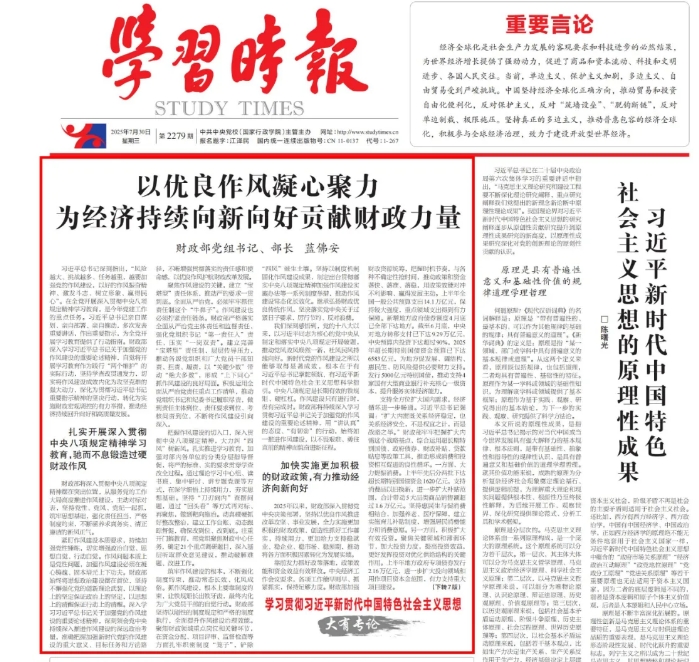
财政部长:用好用足更加积极财政政策 加大财政逆周期调节力度
Zheng Quan Shi Bao· 2025-07-29 23:39
Group 1 - The article emphasizes the need for a more proactive fiscal policy to enhance economic stability and growth through increased fiscal counter-cyclical adjustments [1] - It highlights the importance of issuing and utilizing ultra-long special bonds and local government special bonds to generate tangible work output promptly [1] - The article discusses the role of fiscal funds in guiding and stimulating policy effectiveness, particularly in supporting traditional industry upgrades and the development of emerging industries [1] Group 2 - The article stresses the importance of strengthening social welfare measures to address urgent public concerns, including employment stability and educational support [2] - It advocates for the implementation of a childcare subsidy system and the gradual introduction of free preschool education to better meet the needs of families [2] - The article calls for enhanced social security, healthcare, and assistance policies to ensure basic living standards for vulnerable populations [2] Group 3 - The article outlines the need for continuous reform of the fiscal and tax system to improve governance efficiency and budget management [3] - It suggests optimizing the VAT refund policy and developing tax systems that align with new business models [3] - The article emphasizes the importance of enhancing local fiscal autonomy through improved transfer payment systems [3] Group 4 - The article focuses on promoting consumption to expand domestic demand and unlock market potential [4] - It discusses the need to improve policies supporting service consumption in areas such as elderly care, childcare, culture, and tourism [4] - The article highlights the importance of coordinating fiscal and financial policies to better meet consumer demand and support the real estate market's sustainable development [4]
上半年我国财政运行总体平稳 有力支撑经济社会发展
Zhong Guo Chan Ye Jing Ji Xin Xi Wang· 2025-07-29 22:34
上半年,我国实施更加积极的财政政策,中央对地方转移支付已下达9.29万亿元,占年初预算的 89.8%;发行新增地方政府一般和专项债券2.6万亿元,支持地方重点领域重大项目建设;下达超长期特 别国债资金预算超6500亿元,有力支持"两重"项目建设和"两新"工作。其中,"以旧换新"带动汽车、家 电、家装、手机等商品上半年销售额1.6万亿元。 财政部最新数据显示,上半年,全国财政收入11.56万亿元。其中,税收收入逐步回升,从4月份起,连 续3个月实现同比增长。全国财政支出14.13万亿元,同比增长3.4%。社会保障和就业、教育、科学技术 等支出同比增长均超过5%。 上半年,中央财政已下达就业、养老、医疗、困难群众救助等补助资金超过2万亿元,为民生保障和经 济社会发展提供有力支撑。 ...
下半年:还将出台哪些新政策?︱重阳荐文
重阳投资· 2025-07-29 07:31
Core Viewpoint - The article discusses the economic outlook for the second half of the year, emphasizing the need for policy support to achieve the annual GDP growth target of 5% after a 5.3% growth in the first half of the year [1][5]. Economic Performance - The actual GDP growth in the first half of the year was 5.3%, with Q1 at 5.4% and Q2 at 5.2%, exceeding the 5% annual target [5][7]. - The GDP deflator index in Q2 fell by 1.2%, marking the ninth consecutive quarter of negative growth, leading to a nominal GDP growth of only 3.9% [5][8]. - The growth was primarily driven by proactive policies and early consumer demand stimulation, particularly through the "trade-in" policy [7][8]. Consumer and Investment Trends - Retail sales of consumer goods increased by 5% in the first half, with significant growth in categories related to the "trade-in" policy, such as home appliances and furniture [8][11]. - Fixed asset investment grew by only 2.8%, with infrastructure investment up by 4.6% and manufacturing investment by 7.5%, while real estate investment declined by 11.2% [11][19]. - Equipment investment surged by 17.3%, contributing 86% to overall investment growth [11][19]. Export Dynamics - Exports showed resilience, with a 5.9% increase in dollar terms, despite a 10.9% decline in exports to the U.S. [15][19]. - The diversification of exports helped mitigate the impact of reduced U.S. demand, with significant growth in exports to Africa, ASEAN, and the EU [15][19]. Economic Concerns - Despite positive data, there are concerns about potential weaknesses in the economy, particularly in consumer spending and manufacturing investment in the second half [19][20]. - The "trade-in" policy's impact on retail sales is expected to diminish in the latter half of the year due to lower funding and higher base effects from last year [19][20]. - Real estate sales and prices are showing signs of weakness, with new housing sales down by 3.5% and sales revenue down by 5.5% in the first half [23][24]. Policy Outlook - The article anticipates that the government will focus on targeted policies rather than large-scale stimulus, given the strong economic foundation laid in the first half [27][28]. - Potential policy directions include optimizing existing programs like the "trade-in" initiative and addressing restrictions on consumer spending [29][30]. - Infrastructure investment is expected to be a key area of focus, with ongoing projects and new financing tools being introduced to support technology and consumption [30][31]. Monetary Policy - The monetary policy is expected to remain supportive, with potential for minor adjustments in reserve requirements and interest rates [34][35]. - The article suggests that the central bank may take a cautious approach to monetary easing, focusing on maintaining stability in the currency exchange rate [35][36]. Structural Issues - The article highlights that the main challenges facing the Chinese economy are structural rather than total output-related, emphasizing the need for a focus on domestic and international circulation [26][38].

1267亿欧元!报道:德国政府将批准包含创纪录投资的2026年预算
Hua Er Jie Jian Wen· 2025-07-28 13:47
创纪录投资提振经济,德国政府"财政火箭筒"正在陆续射出。 在核心预算层面,借贷规模将出现显著增长。报道援引财政部消息人士称,核心预算借贷将从2024年的 333亿欧元跃升至2026年的899亿欧元。 据媒体周一报道,德国财政部消息人士透露称,政府将于周三批准一项包含创纪录投资规模的2026年预 算草案,投资金额高达1267亿欧元(约1476亿美元),作为基础设施和国防"财政火箭筒"计划的重要组 成部分。 这一大规模支出计划是德国政府振兴疲软经济的关键举措。德国是G7国家中唯一连续两年未实现增长 的经济体,政府预测今年经济仍将陷入停滞。 特别基金助力投资激增,核心预算借贷大幅增长 德国政府此次投资激增主要依靠两大特别基金的支持。 其中,5000亿欧元的基础设施特别基金将在2026年增加589亿欧元的借贷,该基金同样不受德国"债务刹 车"规则约束。 "债务刹车"规则将借贷限制在GDP的0.35%以内,但基础设施投资获得了豁免。这为德国政府大规模基 础设施投资扫清了法律障碍。 在国防支出方面,德国前总理朔尔茨在俄乌战争爆发后设立的1000亿欧元国防特别基金将在2026年增加 255亿欧元的借贷,该基金预计将在202 ...
上半年财政运行总体平稳 有力保民生促增长
Jin Rong Shi Bao· 2025-07-28 02:33
Group 1: Fiscal Revenue and Expenditure - In the first half of the year, the national general public budget revenue was 11.5566 trillion yuan, a year-on-year decrease of 0.3%, with tax revenue at 9.2915 trillion yuan, down 1.2%, and non-tax revenue at 226.51 billion yuan, up 3.7% [1] - The national general public budget expenditure reached 14.1271 trillion yuan, a year-on-year increase of 3.4%, with significant growth in social security and employment spending by 9.2%, education spending by 5.9%, and health spending by 4.3% [1][3] - Monthly tax revenue has shown a recovery trend since April, with a continuous increase for three months, indicating a gradual improvement in economic conditions [1] Group 2: Fiscal Policy and Support Measures - The Ministry of Finance has implemented a more proactive fiscal policy to boost consumption and stabilize employment, ensuring timely budget approvals and fund disbursements [2] - In the first half of the year, the central government allocated 929 billion yuan in transfer payments to local governments, accounting for 89.8% of the annual budget, which is an increase of 1.7 percentage points compared to the previous year [2] - Special bonds worth 2.6 trillion yuan were issued to support major projects at the local level, with an additional 658.3 billion yuan allocated for long-term special bonds to support key projects [2] Group 3: Special Bonds Management - The issuance and use of special bonds have accelerated, with 2.16 trillion yuan of new local government special bonds issued in the first half of the year, a year-on-year increase of 45% [4] - The management of special bonds has shifted to a "negative list" approach, allowing more projects to qualify for funding, including land reserves and affordable housing [5] - The Ministry of Finance has enhanced supervision of special bond funds to prevent misappropriation and ensure proper management of assets and repayment [6] Group 4: Debt Replacement Policy - As of the end of June, 1.8 trillion yuan of the 2 trillion yuan debt replacement bonds for 2025 had been issued, with 1.44 trillion yuan already utilized [7] - The debt replacement policy has alleviated liquidity pressure by replacing high-interest, short-term hidden debts with low-interest bonds, thus reducing overall debt servicing costs [8] - The implementation of the replacement policy has released significant financial resources for local governments, allowing them to focus on economic development and structural adjustments [8]

李迅雷:下半年增量政策可期
Sou Hu Cai Jing· 2025-07-27 09:09
Economic Growth and Policy Support - The GDP growth rate reached 5.3% in the first half of 2025, with a target of 5% for the entire year, indicating sustained policy support for the economy [1] Fiscal Policy - The fiscal policy will remain stable with an emphasis on optimizing existing resources without increasing deficits or issuing new bonds, focusing on precise measures to enhance employment and foreign trade [2] - The government plans to adjust budget allocations and expedite the issuance of special bonds for next year to support major economic provinces [2] Monetary Policy - A moderately loose monetary policy is anticipated, with potential for slight reductions in reserve requirements and interest rates, while maintaining stability in the RMB exchange rate against the USD [3] - Structural policy tools will be accelerated to support technological innovation and boost consumption [3] Consumer Promotion - Policies aimed at promoting consumption will focus on optimizing trade-in programs and removing unreasonable restrictions on consumer spending, particularly in major cities [4] - Initiatives may include childcare subsidies and local consumption voucher policies to stimulate spending [4] Investment Stability - Infrastructure investment is expected to rebound, supported by the completion of an 800 billion yuan construction project list and the initiation of significant projects [5] - New policy financial tools will be implemented to support key sectors such as digital economy and green transformation [5] Real Estate Market - The focus will shift from large-scale expansion to optimizing existing urban infrastructure, with an emphasis on safety and disaster prevention [6] - Attention will be given to policies that support the construction of quality housing and the revitalization of idle real estate [6] Employment and Market Governance - Policies to promote employment and consumption are expected to be rolled out, particularly in the service sector, as part of a broader effort to enhance market governance and competition [7]
上半年积极财政持续发力,更多资源用于保民生、促发展
Hua Xia Shi Bao· 2025-07-26 20:15
Core Viewpoint - The overall fiscal performance in China for the first half of the year shows a stable trend, with a slight decline in revenue but an increase in expenditure, indicating a proactive fiscal policy aimed at supporting economic growth and social welfare [2][3][4]. Revenue Summary - National general public budget revenue reached 11.56 trillion yuan, a year-on-year decrease of 0.3%, with tax revenue at 9.29 trillion yuan, down 1.2%, while non-tax revenue increased by 3.7% to 2.27 trillion yuan [3][5]. - Government fund budget revenue was 1.94 trillion yuan, down 2.4%, with land use rights revenue declining by 6.5% to 1.43 trillion yuan [3]. Expenditure Summary - National general public budget expenditure was 14.13 trillion yuan, up 3.4% year-on-year, with central government expenditure increasing by 9% to 1.99 trillion yuan and local government expenditure rising by 2.6% to 12.14 trillion yuan [4]. - Government fund budget expenditure surged by 30% to 46.27 trillion yuan, with central government fund expenditure increasing by 6.2 times [4]. Debt Issuance and Fiscal Policy - The issuance of national bonds reached a record high of 7.88 trillion yuan, a 35.28% increase, while local government special bonds issued amounted to 2.16 trillion yuan, up 45% [6][7]. - The fiscal policy remains aggressive, with a focus on enhancing local financial support and implementing measures to boost consumption [6][8]. Social Welfare Focus - The fiscal strategy emphasizes social welfare, including the establishment of a childcare subsidy system and support for employment among vulnerable groups [8]. - The government has allocated 66.74 billion yuan for employment assistance and is working to reduce the costs of child-rearing to promote a family-friendly society [8].

667.4亿元、5522亿元、1566.8亿元……力度加大!“数”看经济半年报感知民生温度
Yang Shi Wang· 2025-07-26 02:35
Group 1 - The overall fiscal operation in China for the first half of 2025 shows a stable trend, with total public budget revenue at 115,566 billion yuan, a year-on-year decrease of 0.3%, but the decline rate has narrowed by 0.8 percentage points compared to the first quarter [1][19] - Major tax categories have shown steady growth, with domestic value-added tax, domestic consumption tax, and individual income tax increasing by 2.8%, 1.7%, and 8% respectively [3] - Total public budget expenditure reached 141,271 billion yuan, reflecting a year-on-year growth of 3.4%, with significant increases in spending on social security, education, science and technology, and environmental protection, all exceeding 5% [22] Group 2 - Central government has allocated 667.4 billion yuan for employment support, continuing to implement policies to reduce unemployment and enhance social insurance subsidies [6] - Basic pension benefits for retirees have been increased by 2%, and the minimum standard for urban and rural residents' basic pension has been raised by 20 yuan [8] - A total of 5,522 billion yuan has been allocated for medical security services, with per capita financial subsidies for basic public health services increasing to 99 yuan per year [11] Group 3 - The issuance of national bonds in the first half of 2025 reached 78,800 billion yuan, marking a year-on-year increase of 35.28%, the highest issuance scale for the same period in history [23][25] - The government has initiated a program to support the replacement of consumer goods, with 3,000 billion yuan allocated for this purpose, aimed at stimulating consumption and promoting industry transformation [28]