AI大模型

Search documents
酷特智能:将两个募投项目延期至2026年12月31日
Mei Ri Jing Ji Xin Wen· 2025-12-31 11:51
Core Viewpoint - The company has announced a delay in the completion date of two fundraising investment projects, extending the timeline from December 31, 2025, to December 31, 2026, without affecting the project's objectives, total investment, or operational impact [1] Group 1 - The board of directors approved the proposal to postpone the "C2M Industrial Internet Clothing Pilot Factory Construction Project" and the "Pilot Factory Digitalization, C2M Industrial Internet Platform Upgrade, and Kute AI Model Construction Project" [1] - The delay in the fundraising projects does not change the total investment amount or the implementing entity [1] - The company asserts that this postponement will not have a significant adverse impact on its normal operations [1]

何小鹏:2026年,自动驾驶将从L2跳跃至L4
Guan Cha Zhe Wang· 2025-12-31 10:33
Core Viewpoint - The CEO of XPeng Motors, He Xiaopeng, believes that fully autonomous vehicles will become as ubiquitous as the iPhone within the next three years, rendering previous smart devices obsolete [1][3]. Group 1: Autonomous Driving Levels - He Xiaopeng stated that by 2026, next-generation fully autonomous driving will emerge in China and the U.S., skipping the L3 stage and moving directly from L2 to L4 [2][5]. - The current advancements in Tesla's Full Self-Driving (FSD) version 14.2 indicate that L4 autonomous driving is "within reach" [3]. - The distinction between L2 and fully autonomous driving is based on four key differences: capability, scenarios, safety, and efficiency [3]. Group 2: XPeng's Technological Progress - XPeng's VLA (Vehicle Learning Architecture) is undergoing rapid self-evolution, with advancements perceived to be occurring at an accelerated pace [4]. - The upcoming release of XPeng's VLA 2.0 is anticipated to enhance its autonomous driving capabilities [4]. - XPeng aims to compete with Tesla's full version of the system in the European market by the end of 2026 [5]. Group 3: Industry Perspectives - Companies like Tesla, XPeng, and Horizon believe that AI large model technology can directly facilitate the transition from L2 to L4 autonomous driving [5]. - Other companies prefer a gradual approach, using L3 as a transitional stage before reaching L4 [6].


大厂入场斗法,“AI六小龙”变“四小强”
Xin Jing Bao· 2025-12-31 08:54
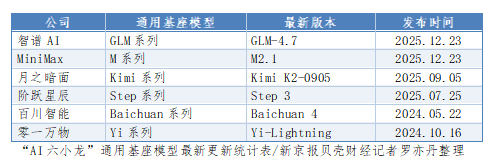
Core Insights - 2025 is a pivotal year for the global economy and China's industries, marked by deep differentiation and value reconstruction, moving beyond mere trends to focus on substantial changes in sectors like AI, storage chips, and new energy vehicles [1] - The narrative of AI in China has shifted, with the emergence of DeepSeek capturing significant attention and altering the competitive landscape for the previously prominent "AI Six Dragons" [2][3] AI Industry Dynamics - The "AI Six Dragons" have seen their prominence wane as new players like DeepSeek gain traction, leading to a shift in focus from foundational models to application-oriented strategies [2][3] - Investment sentiment has changed, with investors now prioritizing application companies over foundational model developers, reflecting a more pragmatic approach to survival in the AI sector [3][4] - The cost of developing foundational models is high, with significant investments required for GPU resources and training, making it a challenging landscape for startups [4][5] Competitive Landscape - The rise of DeepSeek has prompted many AI startups to abandon foundational model development in favor of application-focused strategies, leading to a significant industry convergence [8][10] - The competition among foundational models is intensifying, with parameters reaching trillion-level scales and increasing training costs, raising the barriers to entry [11] - Companies like Zhiyuan and MiniMax are expected to go public soon, marking a new phase for the "AI Dragons" as they seek to establish themselves in the market [12][13] Market Positioning - The "AI Four Strong" have emerged as the new designation for companies that continue to focus on foundational model development while emphasizing practical applications [13][14] - The competitive landscape is dominated by major players like ByteDance, Alibaba, and Tencent, which have established significant user bases and market penetration, creating formidable barriers for smaller companies [16][17] - The shift towards application-oriented services is evident, with only a few leading players remaining committed to foundational models, indicating a strategic pivot in the industry [18]

回望2025|大厂入场斗法,“AI六小龙”变“四小强”
Bei Ke Cai Jing· 2025-12-31 08:48
Core Narrative - 2025 is a pivotal year for the global economy and China's industries, marked by deep differentiation and value reconstruction after years of technological accumulation and market turbulence [2][3] - The focus has shifted from chasing trends to a more rational examination of changes occurring beneath the surface, with significant developments in sectors like storage chips, new energy vehicles, gold prices, AI models, and content consumption [2] AI Industry Dynamics - The narrative of 2025 has been characterized by differentiation and sedimentation, with true opportunities belonging to those who build intrinsic strength amidst cyclical noise [3] - The "AI Six Dragons" (智谱, MiniMax, 月之暗面, 阶跃星辰, 百川智能, 零一万物) have seen their prominence diminish as they witness the rise of DeepSeek, which has captured public attention and industry expectations [6][9] - The emergence of DeepSeek has led to a shift in focus from foundational models to application-oriented companies, as the market recognizes that foundational models are primarily the domain of tech giants [9][10] Market Trends and Strategic Shifts - The AI industry is experiencing a significant shift, with many companies moving away from the foundational model approach to focus on application and vertical integration [19][20] - Companies like 智谱 and MiniMax are expected to go public soon, with their valuations reflecting steady revenue growth despite increasing losses [21][22] - The competitive landscape is intensifying, with the need for models to solve real business problems becoming paramount, leading to a natural consolidation in the industry [19][29] Competitive Landscape - The "AI Six Dragons" are now referred to as the "AI Four Strong," indicating a shift in market perception and focus towards those who remain committed to foundational model development [22][23] - The competition is increasingly dominated by major players like ByteDance, Alibaba, and Tencent, making it challenging for smaller companies to find effective entry points in this resource-intensive race [28][29] - The rise of DeepSeek has prompted a reevaluation of strategies among the "AI Six Dragons," with many companies now prioritizing core technological innovation over rapid product releases [18][19] User Engagement and Market Position - In November, the monthly active user (MAU) data showed that ByteDance's AI applications significantly outperformed others, with its app reaching 309 million users, while 月之暗面 lagged behind with 3.06 million [24][27] - The competitive pressure from major players has led to a strategic pivot among smaller companies, focusing on enhancing model capabilities and application value [19][21]

A股2025年热门板块一览,七大板块涨幅超100%
Ge Long Hui· 2025-12-31 08:14
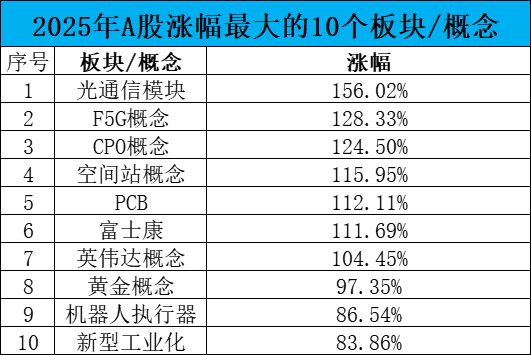
Core Viewpoint - The A-share market in 2025 saw significant growth across various sectors, with the top ten sectors experiencing substantial annual increases driven by factors such as AI demand, technological advancements, and geopolitical tensions [1][2] Group 1: Sector Performance - The top-performing sectors in 2025 included: - Optical Communication Modules with a growth of 156.02% - F5G Concept with a growth of 128.33% - CPO Concept with a growth of 124.50% - Space Station Concept with a growth of 115.95% - PCB with a growth of 112.11% - Foxconn with a growth of 111.69% - Nvidia Concept with a growth of 104.45% - Gold Concept with a growth of 97.35% - Robotics with a growth of 86.54% - New Industrialization with a growth of 83.86% [1][2] Group 2: Drivers of Growth - The surge in Optical Communication Modules and CPO Concept was primarily driven by: - Explosive demand for AI computing power - Accelerated technological iterations - Domestic substitution and policy funding support [1] - The growth in PCB, Foxconn, and Nvidia Concept was attributed to: - Explosive growth in AI computing demand - Increased production and sales of high-end products due to AI servers - Resonance with demand from new energy vehicles and consumer electronics, leading to record-high industry performance [1] - The significant rise in the Gold Concept was driven by: - The onset of the Federal Reserve's interest rate cuts, which lowered real interest rates and weakened the dollar - Escalating global geopolitical conflicts and ongoing central bank gold purchases, alongside a trend towards de-dollarization, creating a demand for safe-haven assets [1]
基流科技完成数亿元B+轮融资 自研Venus智算平台破解算力效率难题
Zheng Quan Ri Bao Wang· 2025-12-31 07:45
Venus智算平台可以显著提升智算集群交付运营效率:平台内置的高性能集合通信库可以将千卡集群端 到端算力利用率进一步提升2%—6%,提升大规模MoE推理的扩展性和鲁棒性,降低延迟49%;智能调 度器在秒级故障自愈与弹性扩缩容能力之上,进一步实现跨任务并行计算交叠,使强化学习任务算力利 用率提升37%:智能故障定位系统通过函数级在线时序图记录与分析,可以实现大规模计算任务卡死问 题100%的故障定位,对在线训推任务的性能影响不超过千分之一。 依托Venus智算平台,基流科技已打造多个标杆案例,覆盖大模型公司、AI云厂商、城市算力网、政务 云、金融科技、园区与算力实验室等核心场景。在某大型金融机构算力中心项目中,仅用两个月完成全 栈信创落地,纳管5种以上GPU;在海淀区弹性算力实验室项目中,纳管超200P算力,破解AI企业算力 资源紧张、调度难等痛点,支持50多家科创企业的机器人及具身智能、AI推理、多模态等多行业场景 算力需求,助力企业千亿级模型训练周期缩短近5倍;在上海临港(600848)2000P算力集群项目中, 实现年化硬件故障率低于1%,训推任务平均无故障时间超过72小时,服务等级协议(SLA)超过99 ...
国投证券:2026年家电以旧换新政策出台 有望提振家电消费景气
智通财经网· 2025-12-31 06:58
智通财经APP获悉,国投证券发布研报称,2026年家电以旧换新政策落地,相较于2025年,明年补贴政 策支持范围有所缩小、补贴比例有所下调、更聚焦高能效产品,整体内容基本符合市场预期,有望刺激 家电内销边际改善,推动行业产品结构优化。预计国内家电消费将保持稳健表现,具有研发、渠道和品 牌优势的白电、黑电企业将更受益于新政策;外销方面,中美贸易冲突趋于缓和,关税压力有望降低, 且家电企业全球产能逐步释放,新兴市场持续贡献增量。 3)实施机制方面,2026年政策明确在全国范围内执行统一的补贴标准;建立补贴资金预拨制度,缓解企 业垫资压力;充分发挥不同销售渠道优势,支持线下实体零售;增加农村地区线下经营主体、引导线上 渠道向农村地区倾斜等方式,提高农村地区消费便利度。 2025年以旧换新政策有效刺激家电消费 据国家统计局数据显示,2025年1-11月份,全国限额以上单位家用电器和音像器材类商品零售额 YoY+14.8%。据央视新闻援引商务部消息,1-11月,全国家电以旧换新超12844万台,测算累计补贴金 额约827亿元,带动家电消费约4395亿元。家电以旧换新补贴政策带动更新需求释放,有效提振家电消 费景气。 2 ...
半导体设备板块逆势上涨,半导体设备ETF易方达(159558)盘中净申购达3400万份
Mei Ri Jing Ji Xin Wen· 2025-12-31 05:43
Group 1 - The market showed mixed performance on December 31, with technology sectors under pressure while semiconductor equipment and software sectors rose, as evidenced by the China Securities Semiconductor Materials and Equipment Theme Index increasing by 0.7% and the Shanghai Stock Exchange Sci-Tech Innovation Board Artificial Intelligence Index rising by 0.3% [1] - Changxin Technology submitted its prospectus on December 30, aiming to list on the Sci-Tech Innovation Board and raise 29.5 billion yuan to enhance its core competitiveness in the DRAM industry. It is noted as the largest DRAM storage enterprise in China, with revenue reaching 32.084 billion yuan in the first three quarters of 2025, surpassing the total revenue for 2024 [1] - According to Guojin Securities, semiconductor equipment is the cornerstone of the semiconductor industry chain, with opportunities for growth in domestic chip development driven by storage expansion and self-sufficiency. The semiconductor equipment sector, positioned upstream in the industry chain, is crucial for chip manufacturing and testing [1] Group 2 - The China Securities Semiconductor Materials and Equipment Theme Index consists of 40 stocks involved in semiconductor materials and equipment, with semiconductor equipment and materials accounting for 62% and 22% respectively. The Shanghai Stock Exchange Sci-Tech Innovation Board Artificial Intelligence Index focuses on AI industry chain enterprises, with the digital chip design sector making up over 50% [2] - The semiconductor equipment ETF, E Fund (159558), and the Sci-Tech Artificial Intelligence ETF (588730) track the aforementioned indices, providing investors with opportunities to capitalize on investments in the chip industry chain [2]
中金公司首席经济学家彭文生:加强财政政策和货币政策协调
Zhong Guo Jin Rong Xin Xi Wang· 2025-12-31 03:25
Core Viewpoint - The speech emphasizes the need for coordination between fiscal and monetary policies to address medium-term economic fluctuations and ensure sustainable growth [3][4][7]. Group 1: Economic Theories and Adjustments - The traditional New Keynesian theory suggests that the economy can achieve macro balance in the medium to long term, but short-term frictions can lead to welfare losses, necessitating counter-cyclical monetary policy [3]. - There is a call for reflection and adjustment of this framework, particularly emphasizing the importance of medium-term fluctuations and the need for cross-cycle adjustments, which may require greater intensity than counter-cyclical adjustments [4]. Group 2: Medium-term Influencing Factors - Financial cycles are identified as a medium-term force, with the current phase being a downward trend, leading to a relative demand shortage compared to supply [5]. - Economies of scale are highlighted as another medium-term influencing factor, with the green industry and AI being significant contributors. The green industry benefits from economies of scale, while fossil energy typically does not [5][6]. - AI's impact on economic growth is debated, with estimates suggesting it could contribute an additional 0.8-1.3 percentage points to annual growth over the next decade, while other analyses predict a more modest increase of 0.07 percentage points [6]. Group 3: Geoeconomic Issues - The shift in China's trade partners towards the "Belt and Road" initiative and the increasing share of direct investment in these countries are noted as significant geoeconomic trends [7]. - Both economies of scale and geoeconomic factors contribute to the relative demand shortage, necessitating coordinated fiscal and monetary policies to boost domestic demand and ensure sustainable medium-term growth [7].

投GPU“铲子”股,赚了100倍
投中网· 2025-12-31 03:04
Core Viewpoint - The article highlights the significant investment opportunities in the domestic GPU sector, particularly focusing on the success of companies like Strong One Co., Ltd. (强一股份) and its role in the semiconductor testing market, especially with its probe cards [5][10][15]. Group 1: Company Performance and Market Position - Strong One Co., Ltd. has seen a remarkable increase in its market value, reaching 34.6 billion RMB after its IPO, with a price surge of 213% on its first trading day [5][10]. - The company reported revenues of 254 million RMB, 354 million RMB, and 641 million RMB for the years 2022, 2023, and 2024 respectively, with a compound annual growth rate of nearly 60% [10]. - Strong One's net profit grew from 15.62 million RMB in 2022 to 233 million RMB in 2024, marking a 14-fold increase over three years [10]. Group 2: Competitive Advantage and Technology - Strong One Co., Ltd. specializes in MEMS probe cards, crucial for testing semiconductor wafers, and has achieved the ability to mass-produce cards with a pitch of 45μm or less, catering to advanced GPU and high-performance processor manufacturing [6][7]. - The company has become the ninth largest semiconductor probe card manufacturer globally in 2023 and is projected to rise to sixth place in 2024, highlighting its rapid ascent in the industry [7][11]. - The probe card market in China is still in its early stages, with Strong One capturing less than 5% of the global market share despite the domestic market exceeding 10% of the global total [10]. Group 3: Strategic Partnerships and Future Growth - Strong One's primary client is a globally recognized chip design company, which significantly contributes to its revenue, accounting for over 80% of its income in recent years [7][10]. - The company is also focusing on the domestic replacement of high-bandwidth memory (HBM) chips, which are critical for AI applications, and is developing MEMS sample cards for DRAM and NAND Flash [8][11]. - The surge in demand for AI models and the corresponding need for advanced GPUs and testing solutions position Strong One as a key player in the evolving semiconductor landscape [11][15].